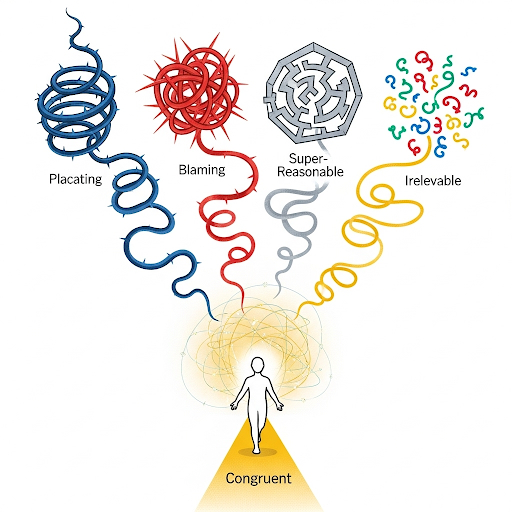
Virginia Satir revealed why smart people choose destructive communication patterns like placating, blaming, and super reasonable responses. Learn to recognize and consciously change your defensive communication stances.
Published on consciouschoicemastery.com | Approx. 10-12 min read
“The problem is not that people don’t know how to communicate. The problem is that they know how to communicate, and they consciously choose patterns that don’t serve them or their relationships.”
Virginia Satir, the pioneering family therapist known as the “Mother of Family Therapy,” spent decades observing a puzzling phenomenon: highly intelligent, emotionally aware people consistently choosing communication patterns they knew were destructive.
Her research revealed that poor communication isn’t usually the result of lacking skills or awareness. Instead, people consciously select defensive communication stances because these patterns serve immediate survival needs, even when they recognize the long-term damage they create.
This makes Satir’s work essential for understanding conscious choice intelligence in relationships: How do you recognize when you’re consciously choosing communication patterns that protect you in the moment but harm your connections over time?
The Five Communication Stances: Conscious Choices in Disguise
Satir identified five primary communication patterns people use under stress. What most people miss is that these aren’t unconscious reactions, they’re conscious survival strategies that people choose because they work in the short term.
The Placating Stance: “I Don’t Matter”
The Pattern: Always agreeing, apologizing, taking responsibility for others’ emotions, avoiding any appearance of conflict.
Body Language: Slouched posture, submissive positioning, downward gaze, apologetic gestures.
The Conscious Choice: “If I make everyone else happy and never cause problems, I’ll be safe and loved.”
Why Smart People Choose This:
- Avoids immediate conflict and rejection
- Maintains relationships through crisis periods
- Provides sense of control through self sacrifice
- Creates identity as “the helpful one” that feels valuable
Real-Time Recognition: You’re choosing to placate when you hear yourself saying “It’s fine” when it’s not, “Whatever you want” when you have preferences, or “I’m sorry” for things that aren’t your responsibility.
The Hidden Cost: Others learn they can’t trust your authentic opinions, you become resentful about unmet needs, and relationships lack genuine intimacy because no one knows the real you.
The Blaming Stance: “You Don’t Matter”
The Pattern: Attacking, criticizing, making others responsible for your emotional state, dominating through aggression.
Body Language: Pointing finger, rigid posture, increased size and volume, intimidating positioning.
The Conscious Choice: “If I stay on offense, I won’t have to feel vulnerable or examine my own contribution to problems.”
Why Smart People Choose This:
- Provides immediate sense of power and control
- Avoids the discomfort of self reflection and personal responsibility
- Creates distance when intimacy feels threatening
- Gets short-term compliance from others
Real-Time Recognition: You’re choosing to blame when you’re focused on what others did wrong rather than your response options, when you feel righteously angry instead of curious, or when you’re trying to win rather than understand.
The Hidden Cost: People avoid sharing authentic thoughts with you, relationships become adversarial rather than collaborative, and you miss information that could improve situations because people stop being honest with you.
The Super-Reasonable Stance: “Feelings Don’t Matter”
The Pattern: Overly logical responses, emotional detachment, treating personal situations like intellectual problems to be solved.
Body Language: Stiff, controlled posture, minimal emotional expression, intellectual gestures, physical distance.
The Conscious Choice: “If I stay rational and objective, I can control the situation and avoid emotional vulnerability.”
Why Smart People Choose This:
- Feels safer than emotional exposure and potential rejection
- Provides sense of intellectual superiority and control
- Avoids dealing with uncomfortable feelings (yours and others’)
- Creates identity as “the logical one” that feels valuable
Real-Time Recognition: You’re choosing super-reasonable when you respond to emotional situations with analysis, when you feel irritated by others’ “irrational” emotions, or when you’re solving instead of listening.
The Hidden Cost: Others feel unheard and emotionally abandoned, important information gets lost because emotions contain data, and relationships lack warmth and genuine connection.
The Irrelevant Stance: “Nothing Matters”
The Pattern: Distracting, changing subjects, making jokes during serious moments, creating chaos to avoid dealing with issues.
Body Language: Erratic movement, dramatic gestures, scattered attention, physically moving away from intensity.
The Conscious Choice: “If I make everything light and keep things moving, we won’t have to deal with painful or difficult realities.”
Why Smart People Choose This:
- Provides temporary relief from overwhelming emotional intensity
- Avoids having to take positions on difficult issues
- Creates identity as “the entertaining one” that feels valuable
- Prevents having to disappoint people with authentic responses
Real Time Recognition: You’re choosing irrelevance when you make jokes during serious conversations, change subjects when emotions arise, or create distractions when focus is needed.
The Hidden Cost: Important issues never get resolved, others feel frustrated and unheard, and you miss opportunities for genuine intimacy and problem solving.
The Congruent Stance: “We All Matter”
The Pattern: Authentic expression where words, feelings, and body language align, balanced attention to self and others, direct and honest communication.
Body Language: Open, relaxed posture, natural movement, appropriate eye contact, authentic emotional expression.
The Conscious Choice: “I can be authentic while respecting others, and together we can handle whatever emerges.”
Why Smart People Often Avoid This:
- Requires tolerating uncertainty about others’ responses
- Means taking responsibility for your authentic impact on others
- Involves staying present with difficult emotions instead of managing them
- Requires giving up control over how others perceive you
The Courage Required: Congruent communication demands the conscious choice to prioritize authentic relationship over immediate comfort, control, or safety.
The Choice Architecture Behind Communication Patterns
Satir’s insight was that people don’t stumble into defensive communication, they choose it because it serves immediate survival needs. Understanding the choice architecture behind each stance reveals opportunities for conscious communication intelligence.
The Survival Logic
Each defensive stance represents a sophisticated solution to perceived threats:
Placating Logic: “If I’m not a problem, I’m safe” Blaming Logic: “If I’m strong, I’m safe” Super Reasonable Logic: “If I’m right, I’m safe” Irrelevant Logic: “If I’m entertaining, I’m safe”
The Choice Point Recognition
The moment you feel stress in a communication situation, you’re at a choice point:
- Will you choose a defensive stance for immediate safety?
- Will you choose congruent communication despite the uncertainty?
The Pattern: Most people make this choice unconsciously and automatically. Conscious choice intelligence involves recognizing the choice point in real-time and making an intentional decision about which pattern serves the situation and relationship best.
The Three-Layer Analysis
Layer 1: Surface Communication (What Others Hear) The actual words, tone, and body language you use in the conversation.
Layer 2: Pattern Recognition (The Survival Strategy) Which of Satir’s stances you’re choosing and what threat you’re trying to manage through this communication choice.
Layer 3: Consciousness Message (The Authentic Response) What you would communicate if you felt completely safe and wanted to serve the highest good of the relationship and situation.
Real-Time Application: Conscious Communication Choice
The Enhanced Communication Protocol
When you notice stress arising in a communication situation:
Step 1: Choice Point Recognition (30 seconds)
- Pause before responding automatically
- Notice the physical sensation of stress or defensiveness
- Recognize: “I’m about to choose a communication pattern”
Step 2: Pattern Awareness (30 seconds)
- Which defensive stance feels most appealing right now?
- What threat are you trying to manage through this communication choice?
- What survival need would this pattern serve?
Step 3: Authentic Assessment (1 minute)
- What do you actually think and feel about this situation?
- What would serve the highest good of this relationship?
- What would you communicate if you felt completely safe?
Step 4: Conscious Communication Choice (Ongoing)
- Choose your communication pattern based on what serves authentic relationship rather than just immediate safety
- Align your words, feelings, and body language as much as possible
- Stay present with whatever response emerges from authentic communication
Domain Specific Communication Intelligence
Professional Communication:
- Recognizing when you choose super reasonable to avoid workplace vulnerability
- Using authentic communication to build genuine collaboration rather than just managing impressions
- Balancing professional boundaries with congruent expression
Intimate Relationships:
- Identifying which defensive stance you default to under relationship stress
- Practicing authentic communication during conflict without attacking or withdrawing
- Creating safety for mutual vulnerability rather than managing each other’s emotions
Family Communication:
- Recognizing inherited communication patterns from your family of origin
- Choosing congruent communication even when family systems pressure you toward defensive stances
- Modeling authentic communication for children rather than teaching defensive patterns
Social Communication:
- Noticing when you choose placating to maintain social harmony at the cost of authenticity
- Using honest communication in social settings without becoming blaming or superior
- Balancing social connection with authentic self expression
The Hidden Costs of Smart Defensive Communication
Because defensive communication stances work in the short term, intelligent people often become sophisticated at using them strategically. This creates several hidden costs:
Relationship Erosion
- People stop trusting your authentic opinions (from chronic placating)
- Others avoid honest communication with you (from chronic blaming)
- Relationships lack emotional warmth and intimacy (from chronic super-reasonable behavior)
- Important issues never get resolved (from chronic irrelevant responses)
Internal Disconnection
- You lose touch with your authentic thoughts and feelings
- Identity becomes based on your defensive pattern rather than genuine self-expression
- Emotional intelligence decreases because you avoid practicing with real emotions
- Decision-making suffers because you’re not accessing complete information about situations
Systemic Problems
- Defensive communication creates more defensive communication in others
- Problems persist because authentic information doesn’t get shared
- Creativity and innovation suffer because people can’t safely share authentic ideas
- Trust erodes throughout your personal and professional systems
Beyond Defense: Developing Communication Choice Intelligence
Satir’s congruent communication isn’t just about being nice or honest, it’s about developing the capacity to make conscious choices about communication patterns based on what serves authentic relationship rather than just immediate safety.
The Development Process
Phase 1: Pattern Recognition
- Identifying your default defensive stance under different types of stress
- Recognizing the survival logic that makes your defensive patterns feel necessary
- Understanding how your defensive communication affects others and relationships
Phase 2: Choice Point Awareness
- Developing real-time recognition of communication choice moments
- Creating space between stress and automatic defensive response
- Practicing conscious selection of communication patterns
Phase 3: Authentic Communication Skill Building
- Learning to express authentic thoughts and feelings without attacking others
- Developing capacity to stay present with others’ authentic expressions
- Building tolerance for the uncertainty that comes with genuine communication
Phase 4: Relationship System Change
- Creating communication environments that support authentic expression
- Helping others develop their own communication choice intelligence
- Building relationships based on genuine connection rather than defensive management
The Ultimate Communication Intelligence
Satir’s vision of congruent communication represents advanced choice intelligence: the ability to choose authenticity over safety, connection over control, and truth over comfort, while maintaining respect for both yourself and others.
This doesn’t mean expressing every thought and feeling without consideration. It means developing the sophisticated capacity to choose communication patterns that serve genuine relationship and mutual growth rather than just immediate survival needs.
Virginia Satir demonstrated that communication patterns are conscious choices, not automatic
@ Lee Greene