Discover how Murasaki Shikibu, author of the world’s first novel, used integrative decision-making to create groundbreaking literature—and what her approach teaches modern decision-makers.
Published on consciouschoicemastery.com | Approx. 10-12 min read
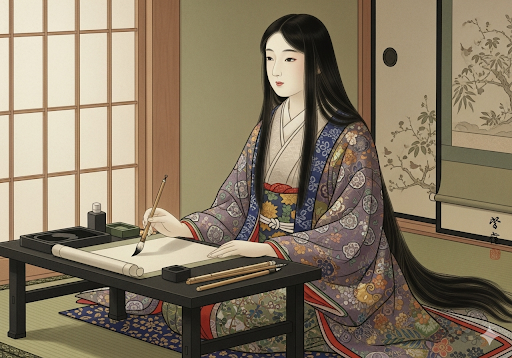
Around the year 1000 CE, a Japanese court lady sat down to solve a problem that had never been solved before.
Murasaki Shikibu wanted to tell a story—not just any story, but one that captured the full complexity of human experience. The epic poems and historical chronicles of her time were too rigid. The folk tales too simple. She needed something entirely new.
What she created, The Tale of Genji, became the world’s first psychological novel. But here’s what no one talks about: the decision-making process that made it possible.
To write Genji, Murasaki had to navigate competing demands that would paralyze most people. She needed to balance historical accuracy with emotional truth. Court protocol with personal authenticity. Literary tradition with radical innovation. Political safety with artistic integrity.
Most people, when facing decisions with this level of complexity, default to either pure logic or pure intuition. They analyze until they’re paralyzed, or they “go with their gut” and ignore crucial practical considerations.
Murasaki did neither. She did both.
The Integration That Changed Literature Forever
Look closely at The Tale of Genji and you’ll see evidence of a remarkably sophisticated decision-making process—one that integrates analytical thinking with intuitive wisdom at every level.
Her Analytical Intelligence:
- Meticulously researched court ceremonies, seasonal customs, and political hierarchies
- Structured the narrative across decades with intricate character development
- Carefully balanced multiple plotlines and managed a cast of hundreds
- Strategically positioned her work to avoid political controversy while pushing literary boundaries
Her Intuitive Intelligence:
- Captured the subtle emotional landscapes that make the characters feel real across a millennium
- Chose to center women’s inner lives when most literature focused on men’s external actions
- Trusted her instinct that readers would connect with psychological complexity
- Sensed when to break from established forms to serve the deeper truth of her story
The genius wasn’t in choosing one approach over the other. The genius was in the integration.
Why This Matters for Your Decisions Today
If you’re reading this and thinking, “This sounds like how I approach complex decisions,” you might be what I call an Analytic Intuitive.
Analytic Intuitives are people who naturally integrate both logical analysis and intuitive wisdom in their decision-making. Like Murasaki, they don’t choose between head and heart—they use both. They want data AND they trust their gut. They seek evidence that supports what feels right.
This integration is sophisticated, but it often feels like a burden rather than a gift. Our either/or culture pressures us to choose: be logical OR be intuitive. Think OR feel. Analyze OR trust your instincts.
But the most innovative decisions—the ones that create something entirely new—require both systems working together.
The Pattern Hidden in History
Murasaki Shikibu isn’t an isolated case. Throughout history, the people who created truly groundbreaking innovations shared this same integrative approach:
- They gathered extensive information AND trusted their instincts about what mattered
- They honored practical constraints AND followed their vision of what was possible
- They studied existing models AND intuited what was missing
- They planned strategically AND remained open to unexpected insights
What made them different wasn’t superior intelligence in one area—it was their ability to orchestrate multiple types of intelligence simultaneously.
The Challenge of Integration Without Framework
Here’s where it gets interesting. Murasaki succeeded because her court culture, despite its rigid social rules, actually supported integrative thinking. Poetry, calligraphy, music, and conversation were all expected to blend technical mastery with emotional resonance.
We don’t have that cultural support. In our specialized, efficiency-driven world, integration often feels like confusion. When your analysis points one way and your intuition points another, you might think you’re being indecisive. When you need both data and gut-check validation, others might pressure you to “just pick one” and move faster.
The result? Many sophisticated thinkers start doubting their natural process instead of developing it.
What Murasaki Would Do with Modern Decisions
Imagine if Murasaki Shikibu were navigating today’s complex choices—career pivots, relationship decisions, creative projects, business strategies.
She wouldn’t abandon her integrative approach. She’d develop frameworks that honored both her analytical intelligence (research, planning, risk assessment) and her intuitive intelligence (values alignment, timing sensitivity, pattern recognition).
She’d create protocols for when head and heart disagree, rather than getting stuck in endless loops of “but the analysis says this while my gut says that.”
She’d recognize that the most sophisticated decisions require both systems—not because she couldn’t choose between them, but because reality itself is both logical and felt, both structured and fluid.
The Framework You’ve Been Missing
After years of studying integrative decision-making—first in myself, then in my clients, and now in historical innovators like Murasaki—I’ve identified specific patterns that make integration efficient rather than overwhelming.
There are protocols for when analysis and intuition disagree. There are methods for processing both types of intelligence without interference. There are frameworks that honor your natural complexity while preventing decision paralysis.
Most importantly, there’s a way to transform your integrative gifts from a source of confusion into your greatest decision-making advantage.
The Question That Started Everything
The question that drove Murasaki to create the world’s first novel was this: “How do I tell the whole truth?”
Not just the facts. Not just the feelings. The whole truth—which requires both analytical precision and intuitive wisdom.
That same question drives the best decisions in any era: How do I choose the path that honors both what makes sense and what feels right? Both what’s practical and what’s authentic? Both what’s possible and what’s meaningful?
If that question resonates with you, you might be an Analytic Intuitive—someone whose greatest decision-making gift is integration, not separation.
And like Murasaki, you don’t need to choose between your different ways of knowing. You need to orchestrate them skillfully.
The frameworks exist. The integration is possible. The question is whether you’re ready to transform your natural complexity into confident discernment.
What would you create if you could make decisions with both the precision of analysis and the wisdom of intuition—without the exhaustion of internal conflict?
Murasaki showed us it’s possible to change the world by honoring the full complexity of human experience.
What will you create when you honor the full complexity of your own decision-making gifts?
Ready to discover if you’re an Analytic Intuitive? Take the Decision-Making Style Assessment and learn the frameworks that transform integration from confusion into confident discernment.