The systematic approach to creating massive change through strategic leverage points that require minimal force
Published on consciouschoicemastery.com | Approx. 10-12 min read
“Call me Trimtab,” Buckminster Fuller would say when introducing himself later in life. The phrase puzzled many listeners until Fuller explained the metaphor that had become central to his approach for creating change in complex systems.
On large ships, the rudder that steers the vessel is itself too heavy to turn by hand. So ship designers attach a small auxiliary rudder called a “trimtab” to the main rudder. When the helmsman turns the trimtab, it creates pressure that easily turns the larger rudder, which then steers the entire ship.
“The trimtab is the small servo-rudder which applies the low effort which easily turns the big rudder around,” Fuller explained. “It takes almost no effort at all. So I said that the little individual can be a trimtab.”
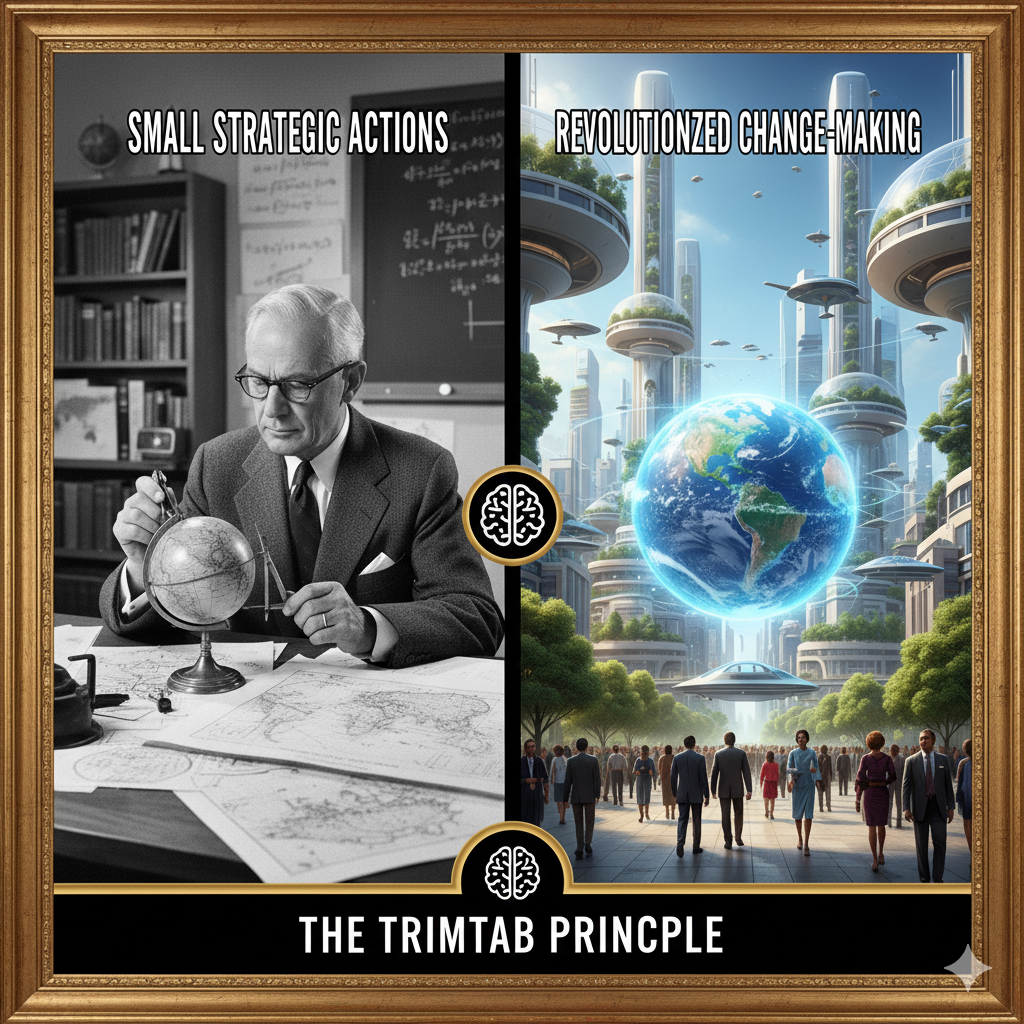
Fuller’s Trimtab Principle became his systematic methodology for creating disproportionately large positive changes through strategic small actions. Rather than trying to force change through direct confrontation with large systems, Fuller developed frameworks for identifying leverage points where minimal effort could catalyze massive beneficial transformation.
His 56-year application of trimtab thinking produced revolutionary innovations, influenced educational systems worldwide, and created change movements that continue expanding today. The Trimtab Principle reveals why some people create extraordinary impact while others exhaust themselves pushing against immovable obstacles.
The Physics of Strategic Leverage: Understanding System Dynamics
Fuller’s Trimtab Principle emerged from his systematic analysis of how complex systems actually change versus how people typically try to change them. His engineering background helped him recognize that natural systems use leverage and strategic positioning rather than brute force to accomplish extraordinary results.
In mechanical systems, leverage allows small forces to move large masses by applying pressure at strategic points rather than pushing directly against the entire weight. Fuller observed that social, economic, and technological systems operated according to similar principles—they could be influenced dramatically through strategic interventions rather than massive direct efforts.
The leverage principle operates through systematic understanding of:
Resistance and Flow Patterns
- Natural resistance points: Where systems defend against change through institutional inertia, established interests, or embedded assumptions
- Natural flow directions: Where systems are already moving and can be guided rather than redirected
- Energy distribution: How effort applied at different points produces vastly different results
- Momentum utilization: Ways to work with existing forces rather than against them
Strategic Positioning
- Influence multiplication points: Locations in systems where small changes create cascade effects
- Decision nexus identification: Places where choices get made that affect entire systems
- Information leverage: Points where new data or perspectives can shift decision-making
- Timing optimization: When systems are most receptive to beneficial change
Indirect Action Methods
- Demonstration over confrontation: Showing better approaches rather than arguing against existing ones
- Attraction over compulsion: Making beneficial changes irresistible rather than mandatory
- Inspiration over regulation: Creating desire for improvement rather than compliance with rules
- Evidence over ideology: Using proven results rather than theoretical arguments
Fuller applied these principles systematically rather than relying on intuition or luck. His trimtab methodology included specific techniques for analyzing system dynamics and identifying optimal intervention points.
Modern application: Before trying to create change through direct force, systematically analyze the system you want to influence. Where does it naturally resist versus flow? What leverage points exist? How could strategic positioning multiply your impact?
The Demonstration Strategy: Proof of Concept as Change Catalyst
Fuller’s primary trimtab method involved creating demonstrations that proved better approaches were possible rather than arguing against existing systems. His systematic approach to proof-of-concept development provides frameworks for making beneficial changes irresistible.
Instead of criticizing inefficient architecture, Fuller built geodesic domes that demonstrated dramatically superior performance. Rather than attacking educational methods, he created learning experiences that proved comprehensive thinking produced better results. Instead of arguing for resource efficiency, he designed innovations that made efficiency more profitable than waste.
The demonstration methodology included:
Strategic Example Selection
- High visibility applications: Choosing demonstration contexts where success would be widely noticed
- Significant performance gaps: Focusing on areas where improvement would be undeniably superior
- Replication potential: Developing examples that others could adapt and implement
- Stakeholder relevance: Creating demonstrations that mattered to people with decision-making authority
Comprehensive Advantage Development
- Multiple benefit integration: Ensuring demonstrations were superior across several dimensions simultaneously
- Cost-effectiveness optimization: Making better approaches more economical than existing methods
- User experience enhancement: Providing solutions that were easier and more pleasant to use
- Long-term sustainability: Demonstrating benefits that would compound over time rather than diminish
Strategic Implementation
- Pilot project design: Creating controlled experiments that minimized risk while maximizing learning
- Success measurement: Establishing clear metrics that proved superior performance objectively
- Documentation systems: Recording methods and results so others could replicate success
- Scaling pathways: Developing systematic approaches for expanding successful demonstrations
Fuller’s geodesic dome projects exemplify this demonstration strategy. Rather than trying to convince the construction industry to change through arguments, Fuller created domes for specific applications where their advantages were undeniable. The U.S. Marine Corps used Fuller’s domes because they were lighter, stronger, and faster to deploy than conventional structures. Success in military applications attracted attention from civilian architects and engineers who saw the performance advantages firsthand.
Each successful dome application created evidence that attracted more sophisticated projects. Ford Motor Company commissioned Fuller to design pavilions for the 1964 World’s Fair because his approach delivered superior results at lower cost. The Montreal Expo dome became an international landmark that influenced architects worldwide.
The demonstration principle: Instead of fighting existing systems directly, create proof-of-concept examples that make better approaches irresistible through superior performance.
Modern application: What could you demonstrate rather than argue for? Where could you create small-scale proof that your approach works better? How could you make beneficial changes attractive rather than mandatory?
The Educational Trimtab: Teaching as Systematic Change Strategy
Fuller discovered that education could function as a powerful trimtab when approached systematically. Rather than trying to change educational institutions directly, he developed teaching methods that proved comprehensive thinking produced superior results, then shared these approaches with people who could implement them in their own contexts.
Fuller’s educational trimtab strategy operated through systematic influence multiplication. Each person who learned his methods could apply them in their own work, creating beneficial changes that influenced their colleagues, students, and organizations. These second-order effects generated third-order influences that continued expanding over time.
The educational trimtab methodology involved:
Comprehensive Learning Experience Design
- Integration demonstration: Showing how knowledge from different fields could be combined for superior problem-solving
- Practical application: Using real challenges rather than theoretical exercises to teach principles
- Systems thinking development: Helping people understand interconnected relationships rather than isolated facts
- Creative capability enhancement: Developing natural innovative capacity rather than teaching specific techniques
Strategic Teaching Contexts
- University speaking tours: Reaching future leaders, innovators, and decision-makers during their formative development
- Professional conferences: Influencing practitioners who could implement methods in their work immediately
- Workshop facilitation: Creating intensive experiences where participants could practice comprehensive approaches
- Publication and documentation: Making methods available to people who couldn’t attend presentations directly
Multiplicative Impact Design
- Method transmission: Teaching approaches rather than just conclusions so others could adapt principles to their situations
- Application encouragement: Providing frameworks people could implement in their existing roles and responsibilities
- Network development: Connecting students and participants so they could support each other’s implementation efforts
- Documentation and sharing: Creating resources that enabled ongoing learning and method refinement
Fuller’s educational influence multiplied systematically because he taught thinking methods rather than specific solutions. Students could apply comprehensive thinking approaches to engineering, architecture, business, social work, environmental challenges, and personal development. His educational trimtab created beneficial changes across multiple domains simultaneously.
The Buckminster Fuller Institute continues this educational trimtab strategy today, supporting people who apply Fuller’s systematic thinking approaches to contemporary challenges. The influence keeps expanding because the methods remain relevant for new generations facing different but analogous problems.
The educational trimtab principle: Teaching systematic thinking methods creates influence multiplication because each person who learns can apply the approaches in their own context and teach others.
Modern application: How could you share effective methods you’ve developed? What could you teach that would help others create beneficial changes in their own domains? How could educational influence multiply your positive impact?
The Innovation Trimtab: Strategic Technology Development
Fuller’s approach to innovation demonstrates how systematic technology development can function as a trimtab for transforming entire industries. His method involved creating technologies that made beneficial behaviors more efficient and profitable than harmful ones, thereby changing system incentives rather than trying to regulate behavior.
Rather than arguing that people should use resources more efficiently, Fuller invented technologies that made efficiency more profitable than waste. Instead of requiring people to think comprehensively, he developed tools that made comprehensive thinking easier and more effective than fragmented approaches.
The innovation trimtab strategy included:
Strategic Technology Selection
- High-impact leverage identification: Focusing development efforts on technologies that could influence multiple systems simultaneously
- Adoption barrier analysis: Understanding what prevented beneficial technologies from spreading and designing solutions that overcome those obstacles
- Economic advantage integration: Ensuring innovations provided superior financial returns in addition to social and environmental benefits
- Scalability optimization: Developing technologies that became more effective and economical as they expanded
Systematic Development Process
- Comprehensive requirement analysis: Understanding all factors that would affect technology adoption and success
- Iterative prototype refinement: Testing and improving designs through systematic experimentation
- Real-world validation: Proving effectiveness under actual use conditions rather than laboratory environments
- Documentation and knowledge sharing: Making development methods available to accelerate similar innovations
Strategic Deployment Methods
- Strategic partnership development: Working with organizations that could implement and distribute innovations effectively
- Market demonstration: Creating applications that proved economic and performance advantages convincingly
- Open-source knowledge sharing: Making innovations available to maximize beneficial impact rather than private profit
- Education and training: Teaching people how to use and adapt technologies for their specific contexts
Fuller’s Dymaxion car project illustrates this innovation trimtab approach. Designed in the 1930s, the three-wheeled vehicle achieved 35 miles per gallon while carrying 11 passengers, demonstrating that transportation could be dramatically more efficient without sacrificing performance.
While the Dymaxion car never achieved mass production due to financing and marketing challenges, Fuller’s systematic approach to transportation efficiency influenced automotive design for decades. His principles for aerodynamics, weight reduction, and energy optimization became standard practices that continue improving vehicle efficiency today.
Fuller’s geodesic dome innovations provide another example of innovation trimtab strategy. The domes made efficient architecture more profitable than conventional approaches because they required fewer materials while providing superior performance. This economic advantage drove adoption across military, industrial, and civilian applications.
The innovation trimtab principle: Strategic technology development can change system incentives by making beneficial behaviors more profitable and efficient than harmful ones.
Modern application: What technologies could you develop that would make good choices easier and more profitable? How could innovation remove barriers to beneficial behaviors? What systematic improvements could influence entire industries?
The Communication Trimtab: Strategic Information Distribution
Fuller recognized that information could function as a powerful trimtab when distributed strategically. Rather than trying to convince people to change their opinions, he developed methods for making accurate information about system realities so accessible that beneficial decisions became obvious.
His World Game project exemplified this communication trimtab approach. Instead of arguing that global cooperation would be better than competition, Fuller provided comprehensive data showing that Earth possessed sufficient resources to provide abundance for everyone if systems were organized efficiently. The information itself became the argument.
The communication trimtab methodology involved:
Strategic Information Selection
- Reality-based documentation: Focusing on accurate data about actual conditions rather than opinions or theories
- Leverage point revelation: Highlighting information that would most influence decision-making
- Assumption challenge: Providing data that questioned widely-held beliefs preventing beneficial changes
- Opportunity identification: Making people aware of possibilities they hadn’t recognized
Systematic Distribution Methods
- Multiple channel utilization: Using books, lectures, articles, films, and direct conversation to reach diverse audiences
- Context adaptation: Presenting information in formats appropriate for different professional and cultural contexts
- Credibility establishment: Ensuring information sources were respected and verification was possible
- Timing optimization: Sharing information when people were most receptive to new perspectives
Impact Multiplication Design
- Memorable presentation: Making information easy to remember and share with others
- Practical application: Connecting information to specific decisions people needed to make
- Network distribution: Encouraging informed people to share accurate information within their own circles
- Tool development: Creating resources that helped people access and use information effectively
Fuller’s comprehensive documentation of resource efficiency principles functioned as a communication trimtab that influenced designers, engineers, and entrepreneurs worldwide. His calculations showing that Earth could support everyone comfortably changed how people thought about scarcity and abundance.
His operating manual for “Spaceship Earth” concept became a communication trimtab that shifted how people understood environmental responsibility. By presenting Earth as a finite spaceship requiring careful resource management, Fuller made environmental thinking practical rather than idealistic.
The communication trimtab principle: Strategic information distribution can change decision-making by making accurate data about system realities easily accessible to relevant decision-makers.
Modern application: What crucial information could you make more accessible? How could you present data that would make beneficial choices obvious? What communication trimtabs could shift perspectives in your field?
The Personal Trimtab: Individual Action as System Influence
Fuller’s Trimtab Principle applies powerfully to personal effectiveness and individual change-making. His methodology provides frameworks for maximizing individual impact through strategic choice-making rather than exhausting effort on ineffective activities.
The personal trimtab approach involves systematically identifying where individual actions can create influence multiplication rather than trying to change everything through direct effort. Fuller demonstrated that single individuals could catalyze beneficial changes across entire industries and social systems when they operated as strategic trimtabs.
The personal trimtab methodology includes:
Strategic Positioning Analysis
- Influence sphere identification: Understanding where your actions and choices affect other people’s decisions
- Leverage point recognition: Finding places where small changes in your behavior could produce large beneficial effects
- Network effect mapping: Analyzing how your choices influence people who influence others
- Timing and context optimization: Positioning your actions when and where they will have maximum positive impact
Capability Development Strategy
- Skill leverage identification: Developing capabilities that multiply your effectiveness across multiple domains
- Knowledge advantage building: Becoming systematically informed about areas where accurate information could influence beneficial decisions
- Relationship cultivation: Building connections with people who could amplify beneficial changes you initiate
- Platform development: Creating ways to share effective methods with people who could implement them
Strategic Action Selection
- High-leverage activity focus: Concentrating effort on actions that produce disproportionately large beneficial results
- Demonstration prioritization: Choosing to model effective approaches rather than arguing for them
- Systematic implementation: Approaching personal changes methodically rather than relying on motivation or willpower
- Impact measurement: Tracking how personal trimtab actions create beneficial effects beyond immediate results
Influence Multiplication Methods
- Teaching and mentoring: Sharing effective methods with people who can apply them in their own contexts
- Example and inspiration: Living in ways that demonstrate beneficial possibilities to others
- Resource and opportunity sharing: Connecting people with capabilities and opportunities that serve mutual benefit
- System participation: Engaging with existing systems in ways that improve their functioning rather than avoiding them
Fuller’s own life exemplified personal trimtab effectiveness. His systematic approach to life optimization created innovations that benefited millions of people. His educational influence continues multiplying through people who apply his methods to contemporary challenges.
The personal trimtab principle: Individual actions can create systematic influence multiplication when positioned strategically rather than applied through direct force.
Modern application: Where does your behavior influence other people’s choices? How could small changes in your actions create beneficial cascade effects? What could you demonstrate that would inspire others to beneficial changes?
The Organizational Trimtab: Strategic Change Within Institutions
Fuller’s Trimtab Principle provides systematic approaches for creating beneficial changes within organizations and institutions. His methodology reveals how individuals can influence large systems from any position through strategic trimtab actions rather than requiring formal authority.
Organizations often resist change because existing systems protect established interests and embedded assumptions. Direct confrontation with institutional inertia typically produces defensive reactions that strengthen resistance. The trimtab approach works with organizational dynamics rather than against them.
The organizational trimtab strategy involves:
System Dynamics Analysis
- Power flow mapping: Understanding how decisions actually get made rather than official organizational charts
- Influence network identification: Recognizing informal leadership and communication patterns that affect change adoption
- Resistance pattern recognition: Analyzing what organizational systems defend against and why
- Change readiness assessment: Identifying when and where organizations are most receptive to beneficial modifications
Strategic Positioning Methods
- Value alignment demonstration: Showing how beneficial changes serve the organization’s existing goals and interests
- Risk mitigation: Designing changes that minimize threats to organizational stability while maximizing improvement potential
- Success metric integration: Connecting proposed changes to measurements the organization already values
- Stakeholder benefit distribution: Ensuring beneficial changes serve multiple constituencies rather than threatening some to benefit others
Implementation Pathway Design
- Pilot project development: Creating small-scale demonstrations that prove beneficial changes work without threatening existing systems
- Coalition building: Identifying and connecting people within the organization who would benefit from and support changes
- Communication strategy: Presenting changes in language and frameworks the organization already understands and values
- Learning and adaptation: Building feedback mechanisms that allow organizational trimtab efforts to improve based on experience
Influence Multiplication Planning
- Success documentation: Recording and sharing evidence of beneficial changes to encourage broader adoption
- Method transmission: Teaching trimtab approaches to other people within the organization who could apply them in their own areas
- External connection: Linking organizational innovations to broader networks that could amplify beneficial effects
- Legacy development: Creating systems that continue improving organizational effectiveness beyond initial trimtab interventions
Fuller’s work with corporations, universities, and government agencies demonstrated organizational trimtab effectiveness. His architectural innovations succeeded because they provided superior performance that served organizational interests while advancing his comprehensive design objectives.
The organizational trimtab principle: Strategic positioning within institutions can create beneficial changes that spread throughout the organization and influence broader systems.
Modern application: How could you create beneficial changes within organizations you’re part of? What could you demonstrate that would serve institutional interests while advancing beneficial objectives? Where are strategic leverage points for positive influence?
The Timing Trimtab: Strategic Moment Recognition and Utilization
Fuller’s systematic analysis of change dynamics revealed that timing often determines whether trimtab actions succeed or fail. His methodology includes frameworks for recognizing and utilizing strategic moments when systems are most receptive to beneficial transformation.
Complex systems go through cycles of stability and change. During stable periods, systems resist modification and maintain existing patterns. During transition periods, systems become more flexible and responsive to strategic influences. The trimtab approach involves recognizing these timing patterns and positioning actions accordingly.
The timing trimtab methodology includes:
Change Readiness Indicators
- System stress signals: Recognizing when existing approaches are producing unsatisfactory results that create openness to alternatives
- Leadership transitions: Identifying periods when new decision-makers are establishing their approaches and considering innovations
- Crisis and opportunity moments: Understanding when challenges create receptivity to beneficial changes that wouldn’t be considered during normal operations
- Resource availability cycles: Timing trimtab actions when organizations and individuals have capability to implement changes
Strategic Preparation Methods
- Opportunity readiness: Developing capabilities and resources needed to act effectively when strategic moments arise
- Network positioning: Building relationships that enable rapid implementation when timing becomes favorable
- Information preparation: Gathering data and developing presentations that can be shared quickly when decision-makers become receptive
- Pilot project development: Creating proof-of-concept demonstrations that can be scaled rapidly during favorable timing windows
Optimal Timing Implementation
- Recognition and response: Monitoring system conditions and responding quickly when strategic moments develop
- Momentum utilization: Acting decisively when change dynamics favor beneficial modifications rather than waiting for perfect conditions
- Acceleration methods: Intensifying trimtab efforts during periods when systems are most responsive to positive influence
- Transition navigation: Helping systems move smoothly from old patterns to beneficial new approaches
Impact Maximization Strategy
- Window duration analysis: Understanding how long favorable timing conditions typically last and organizing actions accordingly
- Multiple front coordination: Using favorable timing to implement beneficial changes across several areas simultaneously
- Foundation building: Creating infrastructure during receptive periods that will support continued beneficial development
- Learning capture: Documenting what works during favorable timing to improve future strategic moment utilization
Fuller’s timing sensitivity contributed significantly to his influence. His geodesic dome innovations succeeded partly because he introduced them when the military needed lightweight portable structures and architects were exploring new approaches. His environmental thinking gained traction when public awareness of ecological challenges was increasing.
The timing trimtab principle: Strategic moment recognition and utilization can dramatically multiply the effectiveness of beneficial change efforts.
Modern application: What timing indicators suggest receptivity to beneficial changes in your domains? How could you prepare to act effectively when strategic moments arise? What favorable timing windows might be developing?
Trimtab Thinking for Modern Change-Makers
Fuller’s Trimtab Principle provides systematic frameworks for creating beneficial change in contemporary contexts. His methodology remains relevant because it works with system dynamics rather than requiring massive resources or formal authority.
Technology and Innovation Trimtabs
- Platform development: Creating technologies that make beneficial behaviors easier and more profitable than harmful ones
- Network effect design: Building innovations that become more valuable as more people use them
- Open-source strategy: Sharing innovations to accelerate beneficial adoption rather than maximizing private profit
- Integration solutions: Developing technologies that work better when combined with existing systems rather than requiring replacement
Social and Environmental Trimtabs
- Demonstration communities: Creating local examples of sustainable living that prove beneficial approaches work practically
- Economic model innovation: Developing business approaches that make environmental and social responsibility more profitable
- Education and awareness: Making accurate information about system realities easily accessible to decision-makers
- Policy and regulation influence: Providing data and solutions that make beneficial policy changes obvious and practical
Professional and Career Trimtabs
- Skill development strategy: Building capabilities that create opportunities to influence beneficial changes in your field
- Network cultivation: Developing relationships with people who can amplify beneficial innovations you contribute
- Method sharing: Teaching effective approaches you’ve developed to people who can implement them in their contexts
- Example and inspiration: Living and working in ways that demonstrate beneficial possibilities to colleagues and peers
Personal Effectiveness Trimtabs
- Leverage point identification: Focusing effort on activities that produce disproportionately large beneficial results
- System participation: Engaging with existing systems in ways that improve their functioning rather than avoiding them
- Capability multiplication: Developing skills and knowledge that enhance your effectiveness across multiple life domains
- Influence positioning: Placing yourself where your actions and choices affect other people’s beneficial decisions
Your Trimtab Challenge: Strategic Action for Maximum Beneficial Impact
Fuller’s Trimtab Principle provides a framework for maximizing your positive influence through strategic positioning and action rather than exhausting effort against immovable obstacles. His methodology can transform how you approach change-making in any domain.
Week 1: System Analysis and Leverage Point Identification
- Choose your change domain: Select an area where you want to create beneficial influence—your organization, community, field, or broader social issue
- Map system dynamics: Analyze how the system actually works versus how it’s supposed to work. Where does it resist change? Where does it flow naturally?
- Identify leverage points: Look for strategic positions where small actions could create beneficial cascade effects
- Assess your positioning: Understand where you have influence and how it could be strategically deployed
Week 2: Strategic Positioning and Preparation
- Develop strategic capabilities: Build skills, knowledge, or relationships that would enhance your trimtab effectiveness
- Create demonstration opportunities: Design small-scale proof-of-concept projects that could show better approaches work
- Gather supporting information: Collect data and evidence that would make beneficial changes obvious to decision-makers
- Build coalitions: Connect with other people who share beneficial objectives and could amplify your efforts
Week 3: Trimtab Implementation and Testing
- Execute strategic actions: Implement small-scale trimtab interventions and measure their effects
- Monitor system responses: Track how your actions influence broader patterns rather than just immediate results
- Adapt and refine: Adjust your approaches based on system feedback and learning from initial experiments
- Document methods and results: Record what works so you can replicate and share effective approaches
Week 4: Impact Multiplication and Learning Integration
- Scale successful approaches: Expand trimtab actions that produced beneficial effects
- Share methods with others: Teach effective approaches to people who could implement them in their own contexts
- Connect with broader networks: Link your beneficial changes to larger movements and systems that could amplify them
- Plan next iteration: Design expanded trimtab strategies based on what you’ve learned about strategic influence
The trimtab principle: Small strategic actions positioned at leverage points can create beneficial changes far beyond what seems possible through direct effort alone.
What change could you catalyze through trimtab thinking rather than direct confrontation? Where could strategic positioning multiply your beneficial influence? How could you become a trimtab for positive change in systems you care about?
Buckminster Fuller’s Trimtab Principle demonstrates that individual strategic action can create systematic beneficial change when positioned at leverage points rather than applied through brute force. His methodology remains among the most practical frameworks for effective change-making ever developed.
@ 2025 Lee Greene