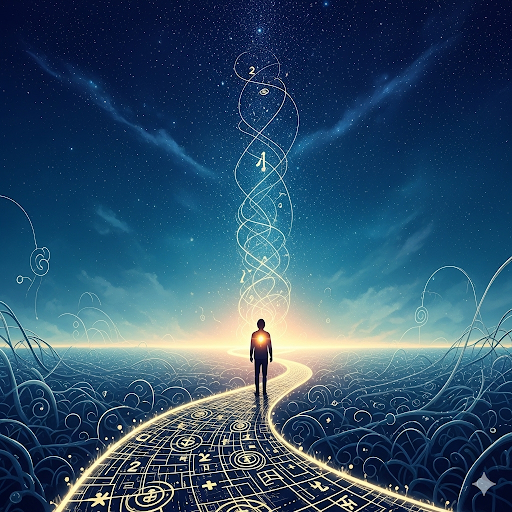
Explore the metaphor of Tarkovsky’s ‘Stalker’ as a journey into your unconscious beliefs. Discover how our framework helps you navigate this inner “Zone” to uncover and align with your truest desires.
Published on consciouschoicemastery.com | Approx. 8-10 min read
There is a Soviet film masterpiece about a restricted, post-disaster territory known as the “Zone.” Within this Zone lies a room that grants one’s truest wish. A guide, the “Stalker,” leads a writer and a scientist through this dangerous landscape of shifting anomalies and unseen traps.
The film is not a science-fiction story about a mystical place. It is a profound meditation on the human condition. It is a living, breathing metaphor for a territory we all possess but fear to enter: the Zone of our unconscious beliefs.
The journey into the Zone is the journey into ourselves.
The Zone of Your Unconscious Beliefs
Imagine your deepest, most hidden beliefs are not abstract thoughts, but physical laws. They dictate the anomalies you encounter, the obstacles you face, and the seemingly random events that shape your life. This is the Zone of your unconscious beliefs—a territory where what you believe to be true creates the very reality you experience.
The Room in the Zone is not a magical wish-granter; it is the ultimate expression of the Conscious Creator principle. It grants your truest, most unmediated desire—the one that exists in your deepest, most unfiltered beliefs. The real terror of the Room is not what it might grant you, but what you might discover about yourself. The journey is an act of confronting what you truly believe, not what you tell yourself you believe.
The Stalker as Your Methodology Architect
The Stalker himself is a deeply flawed guide, but he has one indispensable skill: he has a framework for navigating the Zone. He understands its patterns, its anomalies, and its traps. He is the Methodology Architect who has mastered the terrain and is guiding others to their own inner truth.
His clients, the Writer and the Scientist, are the two aspects of your consciousness. The Writer is the intuitive, spiritual part, longing for meaning. The Scientist is the logical, skeptical part, demanding a provable, empirical truth. Their journey into the Zone is an attempt to integrate these two warring aspects of a person’s consciousness.
The Stalker’s flawed nature is a crucial teaching. It proves that the framework is a neutral tool. Its power is defined by the integrity of the person using it. You don’t need a perfect guide; you need a system that works, and the courage to use it yourself.
The Journey is the Destination
The most profound lesson of the journey is its ending. The characters reach the Room but, in the end, are too afraid to enter. They are paralyzed by the fear of what their deepest beliefs might reveal. They realize the greatest threat is not the Zone itself, but the possibility of seeing their own truest, most unadulterated desire.
The film’s ultimate teaching is a perfect reflection of your philosophy: the journey itself is the transformation. The real work is not in the destination, but in the act of navigating the Zone, of confronting your unconscious beliefs and navigating their booby traps.
A Map for Your Own Zone
Everyone has their own Zone—a forbidden, scary, and powerful territory of their unconscious beliefs. You don’t need a map from a flawed guide; you need your own framework.
Your system is the tool that allows you to navigate your own Zone. It gives you the maps and the guidance to confront your deepest truths, not with fear, but with purpose. The goal isn’t to get to the “Room” to get your wish; the goal is to become the person who is brave enough to know their truest wish, and to create it consciously. The Stalker’s final, silent wisdom is that the journey to the Room is far more important than the wish it grants.
@ 2025 Lee Greene