How Ancient Rulers Silenced Critics: From Socrates’ Execution to Cicero’s Assassination – The Brutal History of Censorship in Greece and Rome
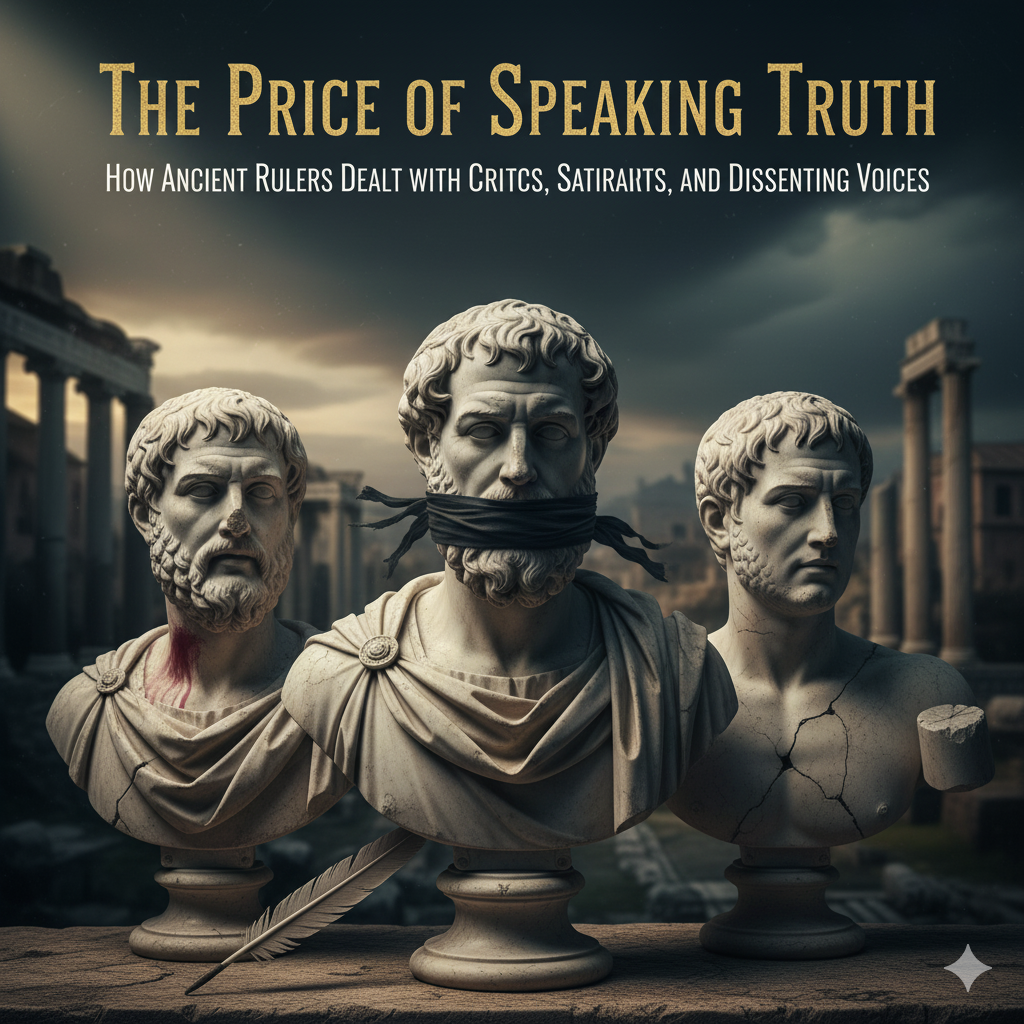
Published on consciouschoicemastery.com | Approx. 10-12 min read
Introduction
The ancient world was far from silent when it came to criticism of power. From the bustling democracy of Classical Athens to the imperial courts of Rome, voices emerged to challenge, mock, and question those in authority. Yet the price of such boldness was often severe, and the fates of these ancient critics reveal much about the tensions between free expression and political power in antiquity.
This exploration examines how Greek city-states and Roman emperors responded to their critics—philosophers, poets, orators, and playwrights who dared to speak uncomfortable truths. Their stories illuminate patterns of censorship, persecution, and the ultimate cost of challenging authority that echoed through centuries of Western civilization.
The Athens Experiment: Democracy and Its Discontents
Socrates: The Gadfly of Athens (469-399 BC)
Perhaps no ancient critic paid a higher price for his dissenting voice than Socrates, the philosopher whose questions proved more dangerous than any sword. In 399 BC, Socrates was tried on charges of “asebeia (impiety) against the pantheon of Athens, and corruption of the youth of the city-state,” with the prosecution citing two specific impious acts: “failing to acknowledge the gods that the city acknowledges” and “introducing new deities.”
The deeper issue lay in Socrates’ fundamental challenge to Athenian democracy itself. “Growing to adulthood in this bastion of liberalism and democracy, Socrates somehow developed a set of values and beliefs that would put him at odds with most of his fellow Athenians. Socrates was not a democrat or an egalitarian. To him, the people should not be self-governing; they were like a herd of sheep that needed the direction of a wise shepherd.”
His criticism was comprehensive and uncompromising: “He criticizes the Assembly for its illegal actions and the Athenian courts for the ease with which matters of justice are distorted by emotional pleading,” and “insists that only a few people can acquire the knowledge necessary for improving the young of any species, and that the many will inevitably do a poor job.”
According to recent scholarship, Socrates was indeed “guilty as charged” within the context of his time. Ancient Greeks were “instinctively religious people, who believed that their cities were protected by gods who needed to be appeased,” and many Athenians genuinely believed that “undesirables in their midst had offended Zeus and his fellow deities” after years of military disasters.
The trial’s outcome demonstrated the seriousness of the charges. After conviction, “consistent with common legal practice, they voted to determine his punishment and agreed to a sentence of death to be executed by Socrates’s drinking a poisonous beverage of hemlock.” Even when offered the chance to escape with a lesser penalty, Socrates remained defiant: “Men of Athens, I honor and love you; but I shall obey the god rather than you, and while I have life and strength I shall never cease from the practice and teaching of philosophy.”
Aristophanes: Comedy as Political Weapon (446-386 BC)
The relationship between satirical comedy and political power in Athens reveals another facet of ancient censorship. Aristophanes, known as “The Father of Comedy,” wrote plays that “often dealt with real-life figures, including Euripides and Alcibiades, and contemporary events, such as the Peloponnesian War.”
His second play, “The Babylonians” (now lost), created a major political incident: “Aristophanes’s second play, The Babylonians (now lost), was denounced by Cleon as a slander against the Athenian polis.” The play “not only virulently attacked Cleon, the demagogue then in power in Athens, but also showed the ‘allies’ as the slaves of the Athenian Demos,” leading Cleon to impeach Aristophanes.
The prosecution was based on a charge of “unpatriotic behavior” because Aristophanes had “viciously satirized current politicians, particularly the reigning demagogue Cleon” in front of “Athenians and foreigners alike—recall that important foreigners attended the Dionysia.”
The harassment was systematic and personal. In his later play “Acharnians,” Aristophanes described his ordeal: Cleon “dragged me into the council chamber and slandered me and lied about me and ranted and raved, so that I almost perished under the mud-slinging.” Though “details of the trial are not recorded,” Aristophanes “caricatured Cleon mercilessly in his subsequent plays.”
Remarkably, the conflict between satirist and politician had lasting consequences beyond their lifetimes. Socrates himself acknowledged that Aristophanes’ comedy “The Clouds,” which mocked him as a representative of the Sophists, contributed to his negative reputation among Athenians, showing how satirical attacks could have serious long-term effects on their targets.
Rome’s Literary Bloodbath: The Imperial Response to Criticism
Ovid: Exile for Poetry (43 BC – 17/18 AD)
The Roman Empire’s approach to dissent was far more systematic and brutal than Athens’ democratic persecution. The case of Ovid demonstrates how literary content alone could trigger imperial wrath. “At the age of 50, Ovid, the most famous poet of his time, was banished from Rome to the remote town of Tomis on the Black Sea” in 8 AD “by the exclusive intervention of the Emperor Augustus.”
Ovid attributed his exile to “carmen et error” (“a poem and a mistake”), with the poem likely being his “Ars amatoria.” The work was problematic because it “taught Romans how to conduct affairs and seduce lovers,” directly contradicting “Augustus’s moral legislation” and his attempts to restore traditional Roman values.
The punishment was precisely calculated: Ovid “suffered relegatio, a milder form of exile that allowed him to keep property and (in principle) maintain his marriage,” but was “removed from Rome’s conversation.” This was not imprisonment but strategic isolation from “his salons, his readings, his ability to shape taste.”
What made Ovid’s case particularly significant was the systematic nature of imperial moral control. “Popular individuals such as Julia the Elder and, years later, Julia the Younger, who were both members of Augustus’ own family, faced exile under accusations of adultery,” showing that Augustus intended moral discipline even at the highest levels of society.
The poet spent his remaining years in Tomis pleading for clemency: “His petitions to the emperor were all in vain. After Augustus’ death in A.D. 14, Ovid tried to get his successor Tiberius to commute his sentence, but the new emperor was impervious to the continued pleas of both the poet and his wife.”
Lucan: Death for Seditious Poetry (39-65 AD)
The fate of the young poet Lucan reveals the deadly escalation of literary censorship under Nero. Lucan wrote the “Pharsalia,” “a critique of civil war that Nero interpreted as seditious. Banned from public life, Lucan continued his work underground, ultimately joining a conspiracy against the Emperor, and dying at 26 after being ordered to commit suicide.”
This case demonstrates how literary censorship could create a vicious cycle: artistic suppression led to deeper political opposition, which in turn justified more severe persecution.
Seneca: The Philosopher’s Dilemma (4 BC – 65 AD)
Seneca’s case illustrates the particular dangers faced by intellectuals in positions of power. Initially Nero’s tutor and advisor, Seneca “tried to pass on his philosophy of a virtuous life, and with the help of the prefect of the Pretorian Guard, Burrus, he tried to keep Nero’s indulgences under control.”
As Nero’s behavior became increasingly erratic, Seneca found himself in an impossible position. In 65 AD, “Seneca’s enemies denounced him as having been a party to a conspiracy to murder Nero, and he was ordered to commit suicide.” The charges appear to have been false, as modern scholars note he was “falsely accused of being part of a plot to assassinate the emperor.”
The execution was deliberately drawn out and humiliating. According to Tacitus, Seneca’s “age and diet were blamed for slow loss of blood and extended pain rather than a quick death. He also took poison, which was not fatal. After dictating his last words to a scribe, and with a circle of friends attending him in his home, he immersed himself in a warm bath, which he expected would speed blood flow and ease his pain.”
Cicero: The Ultimate Political Execution (106-43 BC)
The assassination of Cicero represents perhaps the most brutal example of how political speech could prove fatal in the Roman world. “After Caesar’s assassination in 44 BC, he led the Senate against Mark Antony, attacking him in a series of speeches” known as the Philippics.
When the Second Triumvirate was formed between Octavian, Antony, and Lepidus, they “set about proscribing their respective enemies.” Despite Octavian’s initial resistance, “Antony was implacable, insisting that he be the first to be put to death” along with “his son, his brother, and his brother’s son and all his household, his faction, and his friends.”
The execution on December 7, 43 BC was deliberately humiliating: “Cicero was killed… his head and hands (having penned the Philippics) hacked off” and displayed on the rostra “where Cicero had inveighed against Antony.” Antony’s wife Fulvia “took the head in her hands and spat on it. Then, setting it on her knees, opened the mouth and, with pins from her hair, pierced the tongue that had argued so eloquently against her husband.”
The Mechanics of Ancient Censorship
Informal Networks of Suppression
Unlike modern censorship systems, ancient Rome relied heavily on informal networks of persecution: “anyone influential at the imperial court could assume the role of censor, scrutinizing writings for any hint of criticism and bringing potentially ‘dangerous’ works to the emperor’s attention.” This created “a volatile environment” where individuals with “animus nocendi (the intent to harm)” could interpret works maliciously.
Retroactive Punishment
The Roman system practiced “retroactive censorship” rather than prior restraint: “rulers punished writers after the fact, leading to cases like Nero’s banning of Lucan’s Pharsalia.” This approach was “common, with no standardized process to prevent the spread of dissenting ideas before publication. Instead, rulers punished writers after the fact.”
The Power of Comedy and Satire
Ancient rulers understood that mockery could be more dangerous than direct political opposition. As one modern analysis notes about Ovid’s case: “A regime that ties civic virtue to masculine self-control and paternal authority cannot enjoy being laughed at.” Satirical works like Ovid’s taught Romans to “wink at the law,” making “rule-breaking fashionable among exactly the class Augustus wanted to control.”
Religious Persecution as Political Tool
In Athens, religious charges often masked political motivations. The timing of Socrates’ trial was significant: “The year in which Socrates was prosecuted, 399, was one in which several other prominent figures were brought to trial in Athens on the charge of impiety,” suggesting “a sense of anxiety about the dangers of religious unorthodoxy and about the political consequences that religious deviation could bring.”
The Evolution of Censorship
From Democratic Persecution to Imperial Control
The transition from Greek to Roman approaches reveals an evolution in how authority dealt with critics. In Athens, “the vibrant democratic environment fostered open debate, encouraging comedians to address current events, leaders, and societal issues with satire” while “political freedom enabled playwrights like Aristophanes to craft bold, satirical works that challenged authority.”
However, even in Athens, censorship evolved over time. After Athens’ defeat in the Peloponnesian War, “one thing that was not allowed was political satire, the very meat of Aristophanic comedy. Old Comedy… was dead,” replaced by “Middle Comedy, which put its emphasis on comedy of manners… rather than from the foibles of particular living persons.”
The Roman Systematization
Roman censorship became far more systematic and deadly than its Athenian predecessor. The empire developed sophisticated methods of suppression including “book burning,” “legal punishments for dissenting views,” and the establishment of “a precedent” for literary persecution that escalated under successive emperors.
The Psychology of Persecution
The Threat of Laughter
Ancient sources reveal that rulers were particularly threatened by satirical criticism because “laughter destabilizes moral scripts more efficiently than invective.” When critics like Ovid created works that made “rule-breaking fashionable,” they undermined authority in ways that direct political opposition could not.
The Paradox of Martyrdom
Interestingly, some critics may have actively sought martyrdom. In Socrates’ case, “most scholars see the conviction and execution of Socrates as a deliberate choice made by the famous philosopher himself,” noting that “the trial of Socrates thus became the most interesting suicide the world has ever seen.”
The Corruption of Power
The case of Seneca illustrates how proximity to power could corrupt even the most principled critics. Described alternately as someone who “cherished sobriety, reason, and moral virtue” and as “a clever manipulator” who “exploited his vast influence to enrich himself,” Seneca’s story shows how the line between principled dissent and opportunistic collaboration could become blurred.
Lasting Consequences: The Silence That Followed
The Chilling Effect
Ancient censorship created widespread “self-censorship as a natural defense mechanism, as writers anticipated potential backlash.” This “forced writers to navigate carefully, sometimes using coded language to express dissent, relying on readers to ‘decode’ their true meaning.”
The Historical Record
The persecution of ancient critics had lasting effects on how we understand antiquity itself. The bias against certain emperors was systematically reinforced: “There is a noticeable bias against emperors who have just passed away, whereas those who are living are rarely criticized (at least explicitly).” The policy of “damnatio memoriae” meant that “some emperors would be severely maligned in subsequent histories.”
Cultural Transformation
The suppression of critical voices fundamentally changed artistic culture. After the persecution of critics like Aristophanes, “the great period of classic Athenian dramatic art in both its tragic and comic forms was clearly finished.” Similarly, the Roman persecution of poets and philosophers contributed to a general intellectual decline in later imperial periods.
Patterns Across Civilizations
The Consistency of Response
Despite different political systems, both Greek democracies and Roman autocracies showed remarkably similar patterns in dealing with critics:
- Religious charges were often used to mask political motivations
- Informal networks of persecution were more effective than formal censorship
- Satirical criticism was treated as more dangerous than direct political opposition
- Retroactive punishment was preferred to prior restraint
- Symbolic humiliation accompanied physical punishment
The Price of Speaking Truth
The ancient world’s treatment of critics revealed a fundamental tension: as one historian noted about Cicero’s death, it marked when “the Roman Republic truly died.” The systematic elimination of dissenting voices ultimately weakened the very institutions that rulers claimed to protect.
Conclusion: The Ancient Legacy
The fates of ancient critics—from Socrates’ hemlock to Cicero’s severed head displayed on the rostra—reveal the consistent patterns by which authority has always responded to uncomfortable truths. These cases demonstrate that the tension between free expression and political power is neither new nor unique to any particular form of government.
What emerges from these historical examples is the recognition that satirical and philosophical criticism posed genuine threats to established order. As one scholar noted about Aristophanes, the “mythmaking literary mind created an atmosphere of persecution and censorship” that surrounded these figures, but the persecution itself was often quite real.
The ultimate lesson from antiquity may be that the most effective critics were often those who made resistance “look cool, normal, or amusing” rather than those who engaged in direct political confrontation. Yet this same effectiveness made them targets for the most severe punishment.
The ancient world’s approach to dissent—whether through Athens’ democratic persecution of Socrates or Rome’s systematic elimination of critical voices—established precedents that would echo through centuries of Western civilization. The price paid by these ancient critics reminds us that the freedom to speak uncomfortable truths has never been guaranteed, and those who exercised it did so at their own peril.
Their sacrifices, whether voluntary or forced, preserved for posterity not just their words but the very idea that truth-telling, however dangerous, remains essential to human civilization. In their deaths, they became more powerful than they had been in life, their silenced voices speaking across millennia about the eternal tension between authority and the human conscience.
The stories of these ancient critics serve as historical testimony to both the fragility and the necessity of free expression. Their fates remind us that the question of how societies deal with dissenting voices is as old as civilization itself, and their courage in the face of persecution continues to inspire those who would speak truth to power.
Sources and Bibliography
Primary Sources
- Plato. Apology. Trans. Benjamin Jowett. The Center for Hellenic Studies, Harvard University.
- Plutarch. Life of Cicero.
- Tacitus. Annals. Trans. Church & Brodribb.
- Cassius Dio. Roman History.
- Ovid. Tristia and Epistulae ex Ponto.
Modern Academic Sources
- Brickhouse, Thomas C. and Nicholas D. Smith. Socrates on Trial. Oxford University Press and Princeton University Press, 1989.
- Cartledge, Paul. Ancient Greek Political Thought In Practice. University of Cambridge, 2009.
- Colaiaco, James A. Socrates against Athens: Philosophy on Trial. Routledge, 2001.
Web Sources
- “Guarding the Word: Speech, Censorship, and Power in Ancient Rome.” Roman Empire Times, December 6, 2024.
- “Trial of Socrates.” Wikipedia, accessed September 2025.
- “Socrates was guilty as charged.” University of Cambridge, June 8, 2009.
- “The Death of Cicero.” Encyclopedia Romana, University of Chicago.
- “Exile of Ovid.” Wikipedia, May 27, 2025.
- “Poetry, Treason, and Payback: Roman Censorship and Ovid’s Exile.” Sarah Holz Blog, September 30, 2021.
- “The Poem Rome Couldn’t Tolerate: Why Ovid Was Exiled to Tomis in 8 CE.” Spoken Past.
- “Emperor Augustus exiled this poet from Rome.” National Geographic, January 25, 2022.
- “Aristophanes: Satirist versus Politician.” The Center for Hellenic Studies, Harvard University, March 30, 2021.
- “Aristophanes and Ancient Greek Comedies.” Facts and Details.
- “The Development of Greek Comedy and Its Influence on Ancient Theatre.” Ancient Worlds Archive, June 8, 2025.
- “Seneca the Younger.” Wikipedia, accessed September 2025.
- “The Two Sides of Seneca.” Farnam Street, October 4, 2017.
- “Resigned to his fate – The death of Cicero.” Ancient World Magazine.
- “How Cicero’s murder ushered in the Roman Empire.” National Geographic, May 3, 2021.
Historical Analysis
- Stone, I.F. The Trial of Socrates, 1988.
- Waterfield, Robin. Why Socrates Died: Dispelling the Myths, 2009.
- Parenti, Michael. The Assassination of Julius Caesar: A People’s History of Ancient Rome.
Journal Articles and Academic Papers
- “In 399 B.C.E., Socrates was executed by the Athenian court on.” McGill University Classical Studies, 2006-7.
- Henry, Denis and B. Walker. “Tacitus and Seneca.” Greece & Rome, Vol. 10, No. 2 (Oct., 1963), pp. 98-110.
@ 2025 Lee Greene