How Islamic civilization preserved and transformed global astronomical knowledge, creating systematic institutions and mathematical innovations that synthesized Greek, Persian, Indian, and Arab traditions into comprehensive frameworks for cosmic understanding
Stars as Scripture: The Development of Astrological Thought Across World Cultures Series
This article concludes a comprehensive analysis of how different civilizations developed astrological systems integrated with their mythological and cosmological frameworks:
- The First Stargazers: Sumerian Origins
- The Eternal Return: Egyptian Stellar Mythology and Calendar Systems
- The Mathematical Sky: Babylonian Systematization of Celestial Science
- The Harmonious Cosmos: Greek Synthesis and Philosophical Integration
- The Science of Light: Hindu Jyotisha and Vedic Cosmology
- The Mandate of Heaven: Chinese Bureaucratic Astrology and Imperial Order
- The Sacred Calendar: Maya Precision and Cosmic Cycles
- The Preserved Wisdom: Islamic Translation and Mathematical Refinement
- Universal Patterns: Comparative Analysis of Celestial Meaning-Making
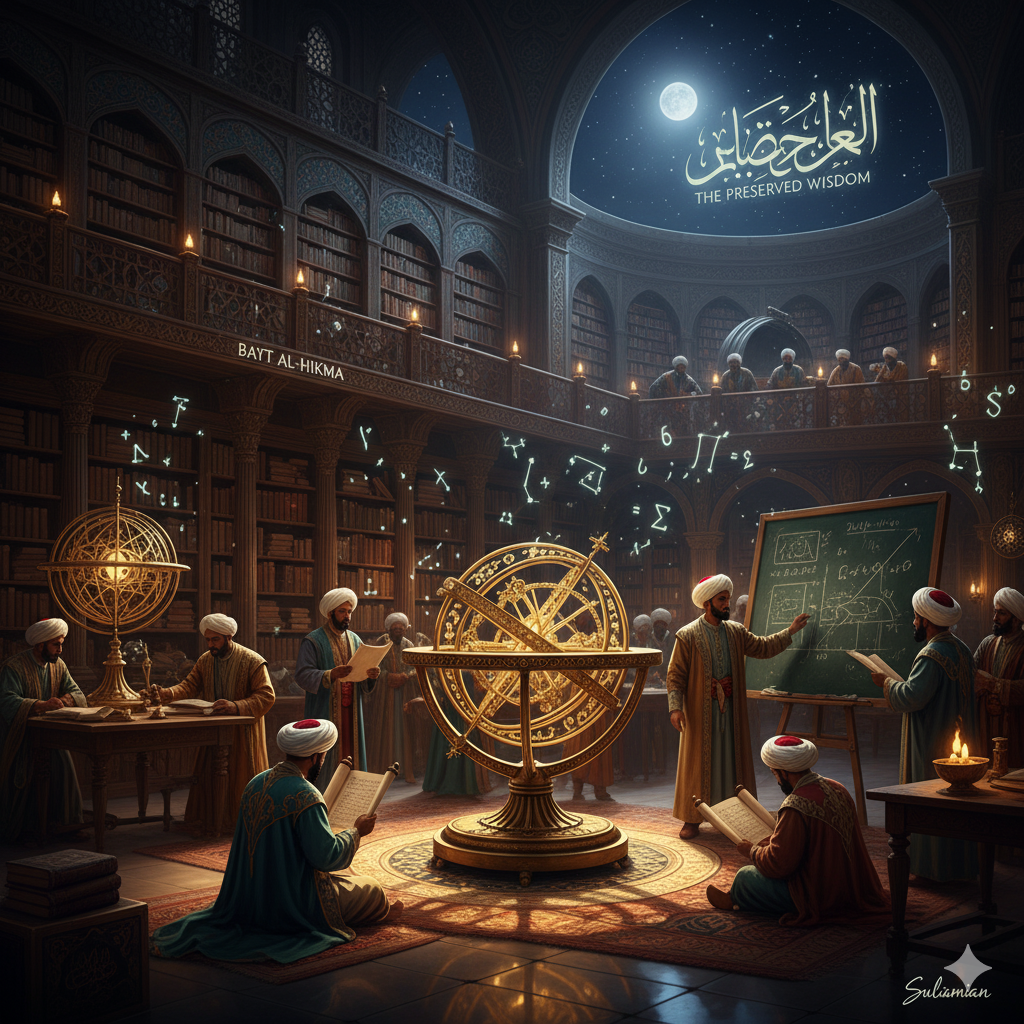
Bayt al-Hikma: The House of Wisdom and the Great Translation Movement
In the courts and cities of the expanding Islamic world, from the Abbasid capital of Baghdad through the scholarly centers of Córdoba, Cairo, and Samarkand, Islamic civilization accomplished what no previous culture had achieved: the systematic preservation, translation, and mathematical refinement of astronomical knowledge from Greek, Persian, Indian, and Mesopotamian traditions, creating comprehensive syntheses that advanced both theoretical understanding and practical applications while establishing institutional frameworks for sustained astronomical research and education.
Unlike previous civilizations that primarily built upon their immediate cultural predecessors, Islamic astronomers deliberately sought out and integrated astronomical knowledge from all available traditions, creating what they called ‘ilm al-nujum (علم النجوم)—the science of the stars—a comprehensive approach to cosmic knowledge that served simultaneously as mathematical science, religious practice, and practical guidance for navigation, timekeeping, and agricultural coordination. This integration of diverse astronomical traditions with Islamic mathematical innovations created systematic approaches to celestial investigation that preserved ancient wisdom while developing new theoretical frameworks and computational methods.
The Islamic achievement emerged from unique cultural circumstances that emphasized the unity of all knowledge (wahdat al-‘ulum), created institutional support for translation and research through libraries and observatories, developed mathematical techniques that enabled more precise calculation and theoretical modeling, and established educational frameworks that trained astronomers in both technical competence and religious scholarship while encouraging original investigation and cross-cultural synthesis.
Understanding Islamic astronomical contributions requires examining how their distinctive integration of preservation, translation, and innovation created systems of cosmic knowledge that influenced not only Islamic civilization but also the recovery of astronomical science in medieval Europe, the development of modern mathematical methods, and the establishment of institutional frameworks for systematic scientific research that continue to influence contemporary astronomical education and investigation.
The Translation Movement: Preserving and Transforming Ancient Wisdom
The Abbasid Caliphs and Institutional Support
The Abbasid caliphs, particularly Al-Ma’mun (r. 813-833 CE), established unprecedented governmental support for astronomical research and translation, creating institutions like the Bayt al-Hikma (House of Wisdom) in Baghdad that systematically collected, translated, and preserved astronomical knowledge from across the known world.
Al-Mas’udi’s Muruj adh-dhahab (Meadows of Gold) describes Abbasid scholarly patronage:
“Al-Ma’mun gathered scholars from all nations—Greeks, Persians, Indians, and Arabs—providing them with resources to translate the astronomical works of Ptolemy, Brahmasiddhanta, and the Sindhind, while encouraging original research and observational verification of ancient calculations.”¹
Abbasid institutional support established:
- Systematic governmental patronage enabling large-scale translation projects and astronomical research
- International scholarly collaboration bringing together expertise from multiple cultural traditions
- Quality control systems ensuring accurate translation and verification of ancient astronomical texts
- Educational frameworks combining linguistic training with mathematical competence and observational technique
The Translation of Ptolemy’s Almagest and Greek Astronomical Literature
Islamic translators, led by scholars like Hunayn ibn Ishaq (809-873 CE) and Thabit ibn Qurra (836-901 CE), created comprehensive Arabic translations of Greek astronomical literature, particularly Ptolemy’s Almagest, while adding commentary and verification based on fresh observations and mathematical analysis.
Hunayn ibn Ishaq’s translation methodology demonstrates scholarly precision:
“We have compared multiple Greek manuscripts of Ptolemy’s Majesti (Almagest), corrected copyist errors through cross-referencing, and added explanatory commentary where the mathematical procedures require clarification. Our translation preserves the original geometric methods while enabling Arabic mathematical terminology and computational verification.”²
Greek text preservation achieved:
- Accurate translation preserving geometric methods and observational data from Greek astronomical literature
- Critical scholarship identifying and correcting manuscript errors through comparative textual analysis
- Integration of translation with commentary enabling Islamic mathematical and observational refinement
- Cultural preservation ensuring continuity of Greek astronomical knowledge through Islamic institutional frameworks
The Integration of Indian Mathematical Astronomy
Islamic astronomers systematically studied and translated Indian astronomical texts, particularly the Brahmasiddhanta and Sindhind, integrating Indian numerical methods and trigonometric techniques with Greek geometric astronomy to create more powerful computational approaches.
Al-Biruni’s India describes Islamic engagement with Indian astronomy:
“The Hindus have achieved remarkable sophistication in numerical calculation and trigonometric methods enabling precise planetary position computation. Their mathematical techniques, when combined with Greek geometric theory and Persian observational traditions, create comprehensive approaches to astronomical calculation previously unavailable to any single culture.”³
Indian astronomical integration provided:
- Numerical computational methods enhancing precision in astronomical calculation beyond Greek geometric limitations
- Trigonometric techniques enabling more efficient solution of spherical astronomical problems
- Alternative theoretical frameworks providing checks on Greek astronomical assumptions and calculations
- Mathematical synthesis creating computational tools superior to any single cultural tradition
Persian and Mesopotamian Observational Traditions
Islamic astronomers incorporated Persian astronomical knowledge, including the Zij-i Shahriyari (Royal Tables) and Sassanid observational data, while drawing upon Mesopotamian computational methods preserved in Persian and Syriac texts.
The Zij-al-Sindhind by Al-Khwarizmi demonstrates Persian integration:
“The Persian royal tables preserve systematic observations spanning centuries, enabling verification of Greek theoretical predictions and correction of computational errors. Combined with Indian mathematical methods, Persian observational data provides superior accuracy in eclipse prediction and planetary position calculation.”⁴
Persian tradition integration enabled:
- Long-term observational verification of theoretical astronomical predictions through systematic data comparison
- Cultural preservation of pre-Islamic astronomical knowledge while integrating it with Islamic scholarly frameworks
- Computational accuracy improvement through combination of multiple cultural mathematical and observational traditions
- Historical perspective enabling evaluation of theoretical claims through multi-century empirical verification
Mathematical Innovations: Algebra, Trigonometry, and Computational Refinement
Al-Khwarizmi and Algebraic Methods in Astronomy
Muhammad ibn Musa Al-Khwarizmi (c. 780-850 CE) developed algebraic methods that revolutionized astronomical calculation, enabling more efficient solution of complex problems in spherical astronomy while creating mathematical frameworks applicable to both theoretical and practical astronomical applications.
Al-Khwarizmi’s Zij al-Sindhind demonstrates algebraic astronomical application:
“Algebraic methods enable systematic solution of astronomical problems that require extensive geometric construction in Greek methods. By reducing geometric relationships to numerical equations, we achieve both computational efficiency and theoretical clarity in celestial calculation.”⁵
Algebraic astronomical methods provided:
- Computational efficiency enabling more complex astronomical calculation within practical time constraints
- Mathematical generalization allowing systematic treatment of astronomical problem types rather than case-by-case geometric solutions
- Theoretical clarity through algebraic reduction of geometric relationships to numerical procedures
- Educational advantages enabling training of astronomical calculators without extensive geometric construction skills
Ibn al-Haytham and Observational Mathematical Physics
Al-Hasan Ibn al-Haytham (Alhazen, 965-1040 CE) created systematic approaches to astronomical observation and mathematical modeling that integrated empirical verification with theoretical development, establishing methodological frameworks that anticipated modern scientific practice.
Ibn al-Haytham’s Doubts on Ptolemy demonstrates critical mathematical methodology:
“Astronomical theories must achieve agreement between mathematical prediction and observational verification. Where Ptolemy’s geometric models fail to predict observed phenomena accurately, we must develop alternative mathematical frameworks based on systematic observation and rigorous geometric analysis.”⁶
Ibn al-Haytham’s methodological innovations included:
- Systematic integration of observational verification with mathematical theoretical development
- Critical evaluation of inherited astronomical theories through empirical testing and mathematical analysis
- Development of alternative theoretical frameworks when existing models failed observational verification
- Methodological precedents for experimental and mathematical approaches to natural investigation
Al-Battani and Precision Observational Astronomy
Ahmad ibn Muhammad Al-Battani (Albategnius, 858-929 CE) achieved unprecedented precision in astronomical observation and calculation, correcting Greek and Indian astronomical constants while developing systematic approaches to long-term observational verification.
Al-Battani’s Zij al-Sabi’ demonstrates observational precision:
“Through systematic observation over decades, we have determined the solar year length as 365 days, 5 hours, 46 minutes, 24 seconds—more accurate than Ptolemy’s calculation. Our observations of planetary positions enable correction of ancient astronomical tables and refinement of theoretical parameters.”⁷
Al-Battani’s observational achievements provided:
- Precision observational data exceeding accuracy of previous astronomical traditions
- Systematic error correction in inherited astronomical constants through long-term observational programs
- Methodological frameworks for astronomical parameter determination through systematic measurement
- Quality control systems ensuring observational accuracy and theoretical consistency
Institutional Development: Observatories, Libraries, and Educational Centers
The Baghdad Observatory and Systematic Research Programs
The Abbasid establishment of astronomical observatories, particularly the Baghdad Observatory under Al-Ma’mun, created institutional frameworks for sustained astronomical research combining observational programs with theoretical development and mathematical innovation.
Al-Tabari’s History describes the Baghdad Observatory research program:
“Al-Ma’mun established the observatory with bronze instruments enabling precise coordinate measurement. The research program includes systematic planetary observations, eclipse timing, star catalog revision, and verification of inherited astronomical constants through long-term observational campaigns.”⁸
Observatory institutional innovation provided:
- Systematic observational programs enabling long-term astronomical research projects spanning multiple decades
- Precision instrumentation facilitating observational accuracy exceeding previous astronomical traditions
- Collaborative research frameworks combining observational astronomy with theoretical development and mathematical innovation
- Educational programs training astronomical observers and calculators in both practical technique and theoretical understanding
The House of Wisdom Library and Manuscript Preservation
The Bayt al-Hikma in Baghdad became the largest astronomical library in the medieval world, systematically collecting, copying, and preserving astronomical texts from all available cultural traditions while supporting translation and commentary projects.
Ibn al-Nadim’s Fihrist catalogs astronomical library holdings:
“The House of Wisdom astronomical collection includes Greek works by Ptolemy, Hipparchus, and Apollonius; Indian texts including the Siddhanta and Sindhind; Persian royal tables and Sassanid observations; and original Arabic astronomical treatises with observational verifications and mathematical refinements.”⁹
Library preservation systems achieved:
- Comprehensive collection and preservation of astronomical knowledge from multiple cultural traditions
- Quality manuscript production ensuring accurate textual transmission across generations
- Scholar access enabling comparative study and synthetic theoretical development
- Cultural preservation maintaining continuity of astronomical knowledge through political changes and institutional transitions
Madrasas and Astronomical Education
Islamic educational institutions (madrasas) integrated astronomical instruction with religious education, creating curricula that developed both technical competence in mathematical astronomy and religious scholarship in Islamic law and theology.
The Nizamiyya Curriculum describes astronomical education:
“Students master arithmetic, geometry, and algebra as preparation for astronomical calculation. The astronomical curriculum includes Ptolemy’s Almagest, Indian computational methods, astrolabe construction and use, and practical applications including prayer time calculation and qibla determination.”¹⁰
Educational system integration provided:
- Systematic training combining mathematical competence with religious scholarship and practical astronomical applications
- Institutional continuity ensuring transmission of astronomical knowledge across generations through established educational frameworks
- Quality control maintaining standards in both technical astronomical competence and religious scholarly authority
- Cultural integration enabling astronomical knowledge to serve both scientific understanding and religious practice
Technological Innovations: Instruments, Computation, and Practical Applications
The Astrolabe: Perfection of the Analog Computer
Islamic craftsmen and astronomers perfected the astrolabe design, creating precision instruments that served as portable analog computers for solving complex astronomical problems while enabling practical applications in navigation, timekeeping, and religious observance.
Al-Zarqali’s Saphea represents astrolabe design advancement:
“The universal astrolabe enables astronomical calculation for any geographical latitude through stereographic projection principles. Precision construction with graduated scales allows accurate solution of problems in spherical astronomy, calendar calculation, and religious timing requirements.”¹¹
Astrolabe technological advancement provided:
- Portable computational capability enabling astronomical calculation without extensive mathematical libraries or computational support
- Precision manufacturing techniques creating accurate mechanical analog computers serving both theoretical and practical applications
- Educational instruments enabling hands-on learning of astronomical concepts through mechanical demonstration
- Cultural integration serving both scientific calculation and religious observance through unified instrumental design
Zij Compilation and Astronomical Tables
Islamic astronomers created comprehensive astronomical table collections (zij, زيج), synthesizing observational data and computational methods from multiple traditions while adding original observations and mathematical refinements.
The Toledan Tables (Zij al-Taqwim) by Al-Zarqali demonstrate comprehensive tabulation:
“These tables combine Greek geometric theory, Indian computational methods, Persian observational data, and original Arabic observations to provide accurate planetary positions, eclipse predictions, and calendar calculations for practical astronomical and astrological applications.”¹²
Zij compilation achievements included:
- Comprehensive tabulation enabling practical astronomical calculation without specialized mathematical training
- Accuracy improvement through synthesis of multiple cultural traditions and original observational verification
- Standardization creating widely usable astronomical references serving both scholarly research and practical application
- Cultural transmission enabling diffusion of Islamic astronomical refinements throughout medieval world
Navigation and Geographic Applications
Islamic astronomers developed systematic applications of astronomical knowledge to navigation and geography, creating mathematical methods for determining position, direction, and time that served both commercial and religious travel requirements.
Al-Biruni’s geographic astronomy demonstrates practical application:
“Astronomical observation enables determination of geographical coordinates through meridian observation, star altitude measurement, and eclipse timing correlation between distant locations. These methods serve both commercial navigation and religious requirements for accurate qibla determination.”¹³
Navigation applications provided:
- Practical utilization of astronomical knowledge serving commercial expansion and religious pilgrimage requirements
- Mathematical frameworks enabling systematic position determination and directional orientation through celestial observation
- Cultural integration combining scientific astronomical knowledge with practical travel and religious observance needs
- International communication enabling coordination and standardization across the expanding Islamic world
Religious Integration: Islamic Astronomy and Spiritual Practice
Prayer Times and Qibla Determination
Islamic religious practice required precise astronomical calculation for determining prayer times (salat) and the direction of Mecca (qibla), creating practical applications that integrated mathematical astronomy with religious observance while encouraging astronomical education and precision instrument development.
Ibn al-Shatir’s treatise on religious astronomy explains integration:
“Determining proper prayer times requires accurate calculation of solar positions throughout the year and geographical variations in sunrise, sunset, and shadow lengths. Qibla calculation requires spherical trigonometry and geographical coordinate determination combining mathematical astronomy with religious precision requirements.”¹⁴
Religious astronomical applications provided:
- Practical necessity encouraging widespread astronomical education and computational competence among religious scholars
- Precision requirements demanding accuracy in both theoretical calculation and observational verification
- Cultural integration ensuring astronomical knowledge served spiritual development and community religious coordination
- Educational motivation encouraging development of astronomical competence as religious obligation and spiritual development
Islamic Calendar and Lunar Observation
The Islamic lunar calendar required systematic moon observation and calculation, creating astronomical applications that combined empirical observation with mathematical prediction while integrating individual religious obligation with community coordination.
Al-Biruni’s Chronology of Ancient Nations explains Islamic calendar astronomy:
“The lunar calendar requires both systematic observation of lunar phases and mathematical calculation of lunar month lengths enabling long-term calendar planning. Combining observational verification with computational prediction ensures both religious accuracy and practical community coordination.”¹⁵
Calendar astronomical applications enabled:
- Systematic integration of observational astronomy with religious calendar requirements and community coordination
- Mathematical development enabling both short-term observational accuracy and long-term calendar planning
- Cultural frameworks combining individual religious observance with community astronomical coordination
- Educational systems developing both observational competence and mathematical calculation skills serving religious practice
Astrology and Islamic Philosophical Integration
Islamic scholars developed sophisticated approaches to astrological interpretation that integrated inherited Greek, Persian, and Indian traditions with Islamic philosophical frameworks emphasizing divine unity (tawhid) and natural causation.
Al-Kindi’s On the Stellar Rays demonstrates Islamic astrological philosophy:
“Celestial influences operate through natural causation established by divine wisdom. Astrological interpretation serves human guidance while acknowledging divine sovereignty over all natural processes. Astronomical calculation enables understanding of natural influences without compromising Islamic theological principles.”¹⁶
Islamic astrological integration achieved:
- Philosophical frameworks enabling astrological practice within Islamic theological constraints
- Natural causation theories explaining celestial influence without compromising divine unity and sovereignty
- Cultural synthesis integrating inherited astrological traditions with Islamic philosophical and religious frameworks
- Educational approaches combining astronomical competence with theological sophistication and philosophical understanding
Regional Centers and Cultural Variations
Al-Andalus: The Córdoba School and Western Islamic Astronomy
Islamic Spain developed distinctive astronomical traditions that synthesized Eastern Islamic innovations with local conditions while creating educational and institutional frameworks that influenced both Islamic and Christian European astronomical development.
Al-Zarqali’s work in Toledo demonstrates Andalusian astronomical achievement:
“The Toledan school combines Eastern Islamic mathematical methods with systematic local observations, creating astronomical tables and instruments adapted to Western geographical conditions while maintaining connection with broader Islamic astronomical traditions.”¹⁷
Andalusian contributions included:
- Regional adaptation of Islamic astronomical methods to Western geographical and cultural conditions
- Educational institutions creating astronomical expertise serving both Islamic scholarly networks and cross-cultural exchange
- Technical innovations in instrumental design and computational methods adapted to local requirements
- Cultural transmission enabling Islamic astronomical knowledge to influence European medieval scholarly development
The Maragheh Observatory and Theoretical Innovation
The Maragheh Observatory in Ilkhanate Persia (13th century CE) represented the culmination of Islamic institutional astronomical development, creating systematic research programs that produced theoretical innovations anticipating later European astronomical developments.
Nasir al-Din al-Tusi’s theoretical innovations at Maragheh:
“The Tusi couple enables linear motion generation through circular motion combination, resolving theoretical difficulties in Ptolemaic planetary models while maintaining commitment to circular celestial motion. These geometric innovations enable more accurate planetary prediction through systematic mathematical refinement.”¹⁸
Maragheh innovations provided:
- Theoretical developments anticipating Copernican and Keplerian mathematical techniques
- Systematic institutional research creating sustained programs of observational verification and theoretical development
- International scholarly collaboration bringing together astronomers from Islamic, Chinese, and other cultural traditions
- Mathematical innovations demonstrating Islamic astronomical creativity and theoretical sophistication
The Samarkand Observatory and Ulugh Beg’s Stellar Catalog
The Samarkand Observatory under Ulugh Beg (1394-1449 CE) achieved unprecedented precision in stellar observation, creating star catalogs that surpassed ancient Greek accuracy while demonstrating continued Islamic innovation in observational astronomy.
Ulugh Beg’s Zij-i Sultani demonstrates observational precision:
“Our systematic stellar observations using the Fakhri sextant achieve coordinate accuracy exceeding Ptolemy and Hipparchus. The new star catalog corrects ancient errors while providing precision stellar positions enabling superior navigational and astrological calculation.”¹⁹
Samarkand achievements included:
- Observational precision surpassing all previous astronomical traditions
- Systematic star catalog creation providing improved data for both theoretical astronomy and practical applications
- Instrumental innovation creating observational capability exceeding previous technological achievements
- Cultural demonstration of continued Islamic astronomical vitality and precision capability
Transmission to Europe and the Medieval Renaissance
The Translation Schools of Spain and Sicily
The translation movement from Arabic to Latin in medieval Spain and Sicily enabled transmission of Islamic astronomical knowledge to European scholars, creating the foundation for European medieval and Renaissance astronomical development.
Gerard of Cremona’s translation work demonstrates European engagement:
“We have translated Al-Battani’s astronomical tables, Ptolemy’s Almagest from the Arabic version with Islamic commentary, and the Toledan Tables enabling European access to Islamic astronomical refinements and observational improvements.”²⁰
European translation efforts provided:
- Cultural transmission enabling European recovery of Greek astronomical knowledge preserved and refined in Islamic civilization
- Introduction of Islamic mathematical innovations including algebraic methods and trigonometric techniques
- Practical astronomical resources enabling European calendar reform, navigation improvement, and educational development
- Institutional frameworks enabling systematic European engagement with Islamic astronomical scholarship
The Influence on Medieval European Universities
Islamic astronomical knowledge became central to medieval European university curricula, with Islamic texts and methods forming the foundation for European astronomical education and research development.
The University of Paris astronomical curriculum demonstrates Islamic influence:
“Students study the Almagest from Arabic translations with Islamic commentary, learn algebraic methods from Al-Khwarizmi, and master astrolabe construction according to Islamic design principles. Islamic astronomical scholarship provides the foundation for European mathematical astronomy.”²¹
European educational integration achieved:
- Systematic incorporation of Islamic astronomical methods and theoretical frameworks into European scholarly education
- Institutional development creating European astronomical competence based on Islamic knowledge preservation and refinement
- Cultural synthesis enabling European scholars to build upon Islamic astronomical achievements while developing distinctive theoretical approaches
- Quality standards ensuring European astronomical education achieved competence comparable to Islamic scholarly traditions
Copernicus and Islamic Theoretical Foundations
Renaissance astronomers like Nicolaus Copernicus built directly upon Islamic theoretical innovations, particularly the mathematical techniques developed at Maragheh, while creating revolutionary theoretical frameworks that transformed understanding of cosmic structure.
Contemporary analysis of Copernican Islamic sources:
“Copernicus utilized mathematical techniques identical to those developed by Al-Tusi and Ibn al-Shatir at Maragheh, demonstrating direct transmission of Islamic theoretical innovations to European Renaissance astronomy despite revolutionary changes in cosmological interpretation.”²²
Islamic foundations in European astronomy included:
- Mathematical techniques enabling European theoretical innovations through Islamic geometric and computational methods
- Observational data providing empirical foundations for European astronomical theoretical development
- Institutional precedents demonstrating systematic approaches to astronomical research and theoretical development
- Cultural frameworks proving continuity between Islamic astronomical scholarship and European scientific revolution
Contemporary Recognition and Historical Assessment
Modern Appreciation of Islamic Astronomical Achievement
Contemporary scholarship increasingly recognizes Islamic astronomical contributions as crucial for both preserving ancient knowledge and creating theoretical and mathematical innovations that enabled later European scientific development.
Modern historical assessment of Islamic astronomy:
“Islamic astronomers preserved, refined, and transmitted astronomical knowledge from multiple cultural traditions while creating original theoretical innovations and mathematical methods. Without Islamic scholarly preservation and development, European Renaissance astronomy would have been impossible.”²³
Contemporary recognition includes:
- Historical appreciation for Islamic preservation of classical astronomical knowledge during European cultural disruption
- Acknowledgment of Islamic mathematical and theoretical innovations contributing to global astronomical development
- Understanding of Islamic institutional frameworks as models for systematic scientific research and educational development
- Cultural appreciation for Islamic synthesis demonstrating possibilities for cross-cultural scholarly collaboration and knowledge integration
Islamic Science and Modern Scientific Methodology
Islamic approaches to astronomical investigation, particularly the integration of theoretical development with observational verification pioneered by Ibn al-Haytham, established methodological precedents fundamental to modern scientific practice.
Analysis of Islamic scientific methodology:
“Islamic astronomers developed systematic approaches integrating mathematical theory, observational verification, and experimental testing that established methodological frameworks fundamental to modern scientific investigation. Their institutional support for sustained research programs provided organizational models for contemporary scientific institutions.”²⁴
Islamic methodological contributions provided:
- Systematic integration of theoretical development with empirical verification establishing precedents for modern scientific methodology
- Institutional frameworks enabling sustained scientific research programs providing organizational models for contemporary scientific institutions
- Cultural integration of scientific investigation with practical application and educational development
- International collaboration demonstrating possibilities for cross-cultural scientific cooperation and knowledge synthesis
Contemporary Islamic Astronomy and Cultural Revival
Contemporary Islamic communities maintain interest in traditional astronomical knowledge while integrating classical wisdom with modern scientific understanding, creating cultural frameworks honoring both religious heritage and scientific advancement.
Modern Islamic astronomical practice demonstrates:
- Cultural continuity maintaining traditional astronomical knowledge within contemporary Islamic educational and religious frameworks
- Integration of classical Islamic astronomical scholarship with modern scientific understanding and technological capabilities
- Educational development creating programs combining traditional Islamic astronomical knowledge with contemporary scientific training
- Cultural identity preservation through continued engagement with Islamic astronomical heritage while participating in global scientific communities
Conclusion: The Bridge Between Worlds
Islamic astronomical achievement represents a unique synthesis in human intellectual history: the systematic preservation, translation, and mathematical refinement of global astronomical knowledge, creating comprehensive frameworks that served simultaneously as cultural preservation, scientific advancement, and practical guidance for religious, commercial, and educational applications. This synthesis established Islamic civilization as the crucial bridge between ancient astronomical traditions and modern scientific development while demonstrating the possibilities for cross-cultural scholarly collaboration and knowledge integration.
The Islamic approach to astronomy demonstrates the power of systematic preservation and intellectual openness to transform inherited knowledge into advanced understanding that serves both cultural continuity and innovative development. Their integration of Greek geometric sophistication, Indian mathematical methods, Persian observational traditions, and original Arabic innovations created astronomical frameworks that achieved both theoretical advancement and practical utility while establishing institutional precedents for sustained scientific research and international scholarly collaboration.
Islamic astronomical achievements challenge contemporary assumptions about cultural boundaries in scientific development, demonstrating historical precedents for approaches to knowledge that transcend cultural limitations through systematic study, translation, and synthesis. Their contributions established precedents for scientific institutions, mathematical methods, and theoretical frameworks that continue to influence contemporary astronomical research and education while providing models for international scientific cooperation and cultural preservation.
Understanding Islamic astronomical wisdom provides essential context for appreciating both the continuity of human intellectual development and the crucial role of cultural preservation and translation in scientific advancement. The astronomers and scholars of Islamic civilization created more than improved calculations and refined instruments—they demonstrated that systematic preservation and cross-cultural synthesis could advance human understanding while maintaining cultural identity and religious commitment, creating knowledge that served both scientific truth and spiritual wisdom.
Their legacy persists in every mathematical technique, every systematic research program, every recognition that scientific knowledge transcends cultural boundaries while requiring cultural frameworks for preservation and development. The preserved wisdom of Islamic astronomy continues to illuminate pathways toward knowledge that honors both intellectual precision and cultural continuity, demonstrating that systematic investigation and cross-cultural synthesis can advance human understanding while preserving the diverse cultural traditions that enrich and sustain scientific development across generations.
Sources:
- Al-Mas’udi, Muruj adh-dhahab (Meadows of Gold), trans. Aloys Sprenger, in El-Mas’ūdī’s Historical Encyclopaedia (London: Oriental Translation Fund, 1841), Abbasid scholarly patronage sections.
- Hunayn ibn Ishaq, translation methodology, preserved in Ibn Abi Usaybi’a, ‘Uyun al-anba fi tabaqat al-atibba (Sources of Information on the Classes of Physicians), trans. Lothar Kopf (Beirut: Dar Maktabat al-Hayat, 1965), translation technique descriptions.
- Al-Biruni, Kitab fi Tahqiq ma li’l-Hind (India), trans. Edward C. Sachau (London: Kegan Paul, Trench, Trübner & Co., 1910), Volume 2, Indian astronomy analysis sections.
- Al-Khwarizmi, Zij al-Sindhind, analysis in E. S. Kennedy, “A Survey of Islamic Astronomical Tables,” Transactions of the American Philosophical Society 46, no. 2 (1956): 123-177.
- Al-Khwarizmi, algebraic methods in astronomy, analysis in Roshdi Rashed, The Development of Arabic Mathematics: Between Arithmetic and Algebra (Dordrecht: Kluwer Academic, 1994), 156-189.
- Ibn al-Haytham (Alhazen), Kitab fi al-Shakuk ala Batlamyus (Doubts on Ptolemy), analysis in A. I. Sabra, “Ibn al-Haytham’s Criticisms of Ptolemy’s Optics,” Journal of the History of Arabic Science 4 (1980): 145-149.
- Al-Battani, Kitab al-Zij al-Sabi’, trans. C. A. Nallino, in Al-Battānī sive Albatenii Opus Astronomicum (Milan: Ulrico Hoepli, 1899-1907), observational precision sections.
- Al-Tabari, Tarikh al-rusul wa’l-muluk (History of Prophets and Kings), trans. Clifford Edmund Bosworth, The History of al-Ṭabarī (Albany: SUNY Press, 1985-2007), Volume 32, Baghdad Observatory descriptions.
- Ibn al-Nadim, Kitab al-Fihrist, trans. Bayard Dodge, The Fihrist of al-Nadīm (New York: Columbia University Press, 1970), astronomical library catalog sections.
- The Nizamiyya Curriculum, analysis in George Makdisi, The Rise of Colleges: Institutions of Learning in Islam and the West (Edinburgh: Edinburgh University Press, 1981), astronomical education sections.
- Al-Zarqali, Saphea (Universal Astrolabe), analysis in Emmanuel Poulle, Les Instruments de la Théorie des Planètes selon Ptolémée (Geneva: Librairie Droz, 1980), 234-267.
- Al-Zarqali, Zij al-Taqwim (Toledan Tables), analysis in José Chabás and Bernard R. Goldstein, The Alfonsine Tables of Toledo (Dordrecht: Kluwer Academic, 2003), Islamic astronomical table traditions.
- Al-Biruni, geographic astronomical applications, analysis in David A. King, Islamic Mathematical Astronomy (London: Variorum Reprints, 1986), navigation and geography sections.
- Ibn al-Shatir, religious astronomical applications, analysis in E. S. Kennedy, “Late Medieval Planetary Theory,” Isis 57 (1966): 365-378.
- Al-Biruni, Kitab al-Athar al-Baqiya (Chronology of Ancient Nations), trans. C. Edward Sachau (London: William H. Allen, 1879), Islamic calendar astronomy sections.
- Al-Kindi, De Radiis Stellarum (On the Stellar Rays), analysis in Gerrit Bos and Charles Burnett, Scientific Weather Forecasting in the Middle Ages (London: Kegan Paul International, 2000), Islamic astrological philosophy.
- Al-Zarqali and the Toledo school, analysis in Julio Samsó, Islamic Astronomy and Medieval Spain (Aldershot: Ashgate Variorum, 1994), Andalusian astronomical traditions.
- Nasir al-Din al-Tusi, Tadhkira fi ‘ilm al-hay’a (Memoir on Astronomy), analysis in F. Jamil Ragep, Naṣīr al-Dīn al-Ṭūsī’s Memoir on Astronomy (New York: Springer-Verlag, 1993), Tusi couple innovations.
- Ulugh Beg, Zij-i Sultani, analysis in E. B. Knobel, Ulugh Beg’s Catalogue of Stars (Washington: Carnegie Institution, 1917), Samarkand observational precision.
- Gerard of Cremona, translation work, analysis in Charles Burnett, “The Translation of Arabic Science into Latin: A Case of Alienation of Intellectual Property?” Bulletin of the Royal Institute for Inter-Faith Studies 4, no. 2 (2002): 145-157.
- Medieval European university curricula, analysis in Edward Grant, The Foundations of Modern Science in the Middle Ages (Cambridge: Cambridge University Press, 1996), Islamic influence sections.
- Copernican Islamic sources, analysis in George Saliba, Islamic Science and the Making of the European Renaissance (Cambridge: MIT Press, 2007), mathematical technique transmission.
- Modern historical assessment, David A. King, “Islamic Astronomy,” in The Cambridge History of Arabic Literature: Religion, Learning and Science in the ‘Abbasid Period (Cambridge: Cambridge University Press, 1990), 274-289.
- Islamic scientific methodology analysis, Ahmad Dallal, Islam, Science, and the Challenge of History (New Haven: Yale University Press, 2010), methodological contributions assessment.
@ 2025 Lee Greene