Mozart’s Genius & Eccentricity: The Same Creative Energy in Different Applications
Published on consciouschoicemastery.com | Approx. 10-12 min read
The Same Fire, Different Containers
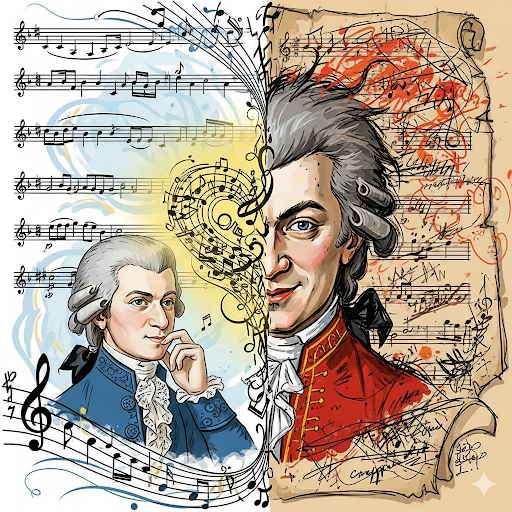
Wolfgang Amadeus Mozart could compose a perfect sonata in his head while playing billiards, then immediately turn around and make crude jokes that scandalized Viennese society. He wrote music of transcendent spiritual beauty, then penned scatological letters to his cousin. He created architectural masterpieces of harmonic sophistication, then behaved like an impulsive child in social situations.
For centuries, biographers have treated this as a contradiction: How could such divine musical intelligence coexist with such earthly, often embarrassing behavior?
But what if it’s not a contradiction at all? What if Mozart’s genius and his eccentricities were the exact same energy, just finding different expressions depending on whether he was channeling it consciously or letting it run unconsciously?
This recognition changes everything about how we understand creative intensity, both in historical figures and in ourselves.
The Recognition: Intensity Needs Direction
The Raw Energy Source
Mozart possessed what we might call extraordinary creative intensity, a fundamental aliveness, curiosity, and energetic engagement with experience that operated at levels most people never access. This wasn’t just “talent” or “skill”, it was raw creative force.
When this intensity encountered his musical training and innate compositional intelligence, it produced works like the Jupiter Symphony and the Requiem. When the same intensity lacked conscious direction, it produced behavior that ranged from charmingly childlike to socially mortifying.
The Key Recognition: Mozart’s so called “eccentricities” weren’t separate from his genius. They were the same creative fire seeking expression through less conscious channels.
The Three Level Guidance System in Mozart’s Music
When Mozart composed, he was unconsciously using what we recognize as a sophisticated Three: Level Guidance System:
Level 1: Inner Wisdom: His direct musical intuition, the ability to hear complete compositions internally before writing them down. This was his access to pure creative knowing.
Level 2: Life Experience: His accumulated mastery of musical structures, forms, and techniques developed through years of practice and study. He could feel what worked based on his vast compositional experience.
Level 3: Universal Principles: His understanding of fundamental musical laws—harmony, counterpoint, formal architecture, that govern effective composition across cultures and centuries.
When all three levels operated in Conscious Self Partnership, Mozart’s creative intensity found perfect expression. The energy that might otherwise scatter into impulsiveness became focused creative force.
The Conscious Expression: Genius as Channeled Intensity
The Compositional Container
Mozart’s musical work demonstrates Continuous Choice at its most sophisticated level. Every note, every harmonic progression, every structural decision was the result of his creative intensity making conscious choices guided by his three level wisdom.
Listen to the opening of his Piano Concerto No. 23 in A major. What sounds like effortless beauty is actually thousands of micro choices: which intervals to use, how to balance the piano against the orchestra, when to introduce tension and when to resolve it, how to create forward momentum while maintaining harmonic logic.
This is Inherent Capability operating through conscious direction. Mozart’s intensity didn’t need to be tamed or controlled, it needed to be partnered with and given sophisticated containers for expression.
The Available Support System
Mozart’s musical genius emerged through his Available Support network:
- Inner Support: His natural musical intelligence and compositional intuition
- Technical Support: Years of formal training that gave him tools for sophisticated expression
- Cultural Support: The musical traditions and forms that provided frameworks for his innovations
- Practical Support: Patrons, venues, and audiences that created contexts for his work
When Mozart accessed all these support systems consciously, his creative intensity became transcendent art. The same energy that could seem chaotic in social situations found perfect order and expression through musical channels.
The Unconscious Expression: Eccentricity as Misdirected Genius
When Intensity Lacks Direction
Mozart’s challenging social behaviors, his impulsiveness, crude humor, inability to manage money, tendency toward inappropriate comments, weren’t character flaws. They were the same creative intensity seeking expression without adequate containers or conscious guidance.
Consider his famous scatological letters. The same linguistic playfulness and inventive energy that created sophisticated musical wordplay in his operas was expressing itself through crude humor when it lacked the structure and purpose that musical composition provided.
His financial irresponsibility followed the same pattern. The abundance mentality that allowed him to create music with generous, overflowing inspiration became problematic when applied to money management without the practical frameworks that musical composition required.
The Missing Conscious Self Partnership
In social situations, Mozart often operated without Conscious Self Partnership. Instead of asking his conscious self “How can I channel this energy effectively here?” he let his intensity express itself reactively.
This wasn’t moral failure, it was the absence of Adaptive Flexibility. Mozart had learned to adapt his creative energy brilliantly for musical expression, but he hadn’t developed equivalent skill for social or practical situations.
The same Available Support that served him musically, inner wisdom, accumulated experience, universal principles, was available for social situations, but he hadn’t learned to access it consciously outside of compositional work.
The Modern Parallel: Your Creative Intensity
Recognizing Your Own Mozart Pattern
Many people with high creative intensity experience their own version of the Mozart paradox. They have moments of genuine brilliance, insight, and creative flow, alternating with periods where the same energy creates chaos, overwhelm, or social awkwardness.
If this resonates, here’s the recognition: You don’t have too much energy. You have unconscious energy that needs better conscious direction.
Signs of Unconscious Creative Intensity:
- Brilliant ideas followed by inability to implement them practically
- Deep insights that you struggle to communicate clearly to others
- Creative flow states alternating with scattered, overwhelmed periods
- Impatience with “mundane” tasks that feel beneath your creative capacity
- Tendency to start many projects but struggle to complete them systematically
The Mozart Recognition: This isn’t dysfunction, it’s creative intensity seeking conscious partnership.
Your Three Level Guidance for Creative Energy
You can apply the same conscious direction to your creative intensity that Mozart used in his musical work:
Level 1: Inner Wisdom Access:
- “What does my creative energy want to express through this situation?”
- “How can I honor my intensity while remaining practical and effective?”
- Regular check ins with your authentic creative impulses
Level 2: Life Experience Integration:
- “What has my experience taught me about channeling creative energy effectively?”
- “When has my intensity served me well, and what conditions supported that?”
- Learning from your own patterns of successful and unsuccessful energy expression
Level 3: Universal Principles Application:
- “What generally works well for people with high creative intensity?”
- “How can I adapt proven frameworks to serve my unique creative energy?”
- Using established principles for creative work, time management, and energy direction
The Five Essential Life Principles for Creative Intensity
Transforming Eccentricity into Conscious Expression
Adaptive Flexibility for Creative Energy:
- Recognize that your intensity is an asset that needs different containers for different situations
- Develop multiple channels for creative expression rather than expecting one outlet to handle all your energy
- Adapt your energy management approach to your unique personality and circumstances
Continuous Choice in Energy Direction:
- Every moment, choose whether to channel your intensity consciously or let it scatter unconsciously
- Recognize that what others call “eccentricity” is often just unconscious energy expression
- Practice conscious decision making about where and how to direct your creative force
Available Support for Intensity Management:
- Access inner wisdom about how your energy naturally wants to express itself
- Draw on your experience of when creative intensity has served you well
- Use universal principles and practical frameworks that support high energy creative people
Inherent Capability Recognition:
- Trust that your creative intensity is fundamentally an asset, not a problem to solve
- Recognize that you already have sophisticated intelligence for creative work
- Understand that learning conscious direction is different from suppressing or controlling your energy
Conscious Self Partnership with Creative Force:
- Develop collaborative relationship with your intensity rather than fighting or judging it
- Learn to ask your conscious self: “How can we channel this energy effectively here?”
- Practice internal dialogue that supports rather than criticizes your creative nature
The Integration Practice: From Scattered to Focused Brillianc
Daily Energy Direction Protocol
Morning Creative Intention (5 minutes):
- Connect with your conscious self and acknowledge your creative intensity as an asset
- Ask your Three Level Guidance System: “How does my creative energy want to express itself today?”
- Choose 2 or 3 specific containers or projects where you’ll consciously channel your intensity
Midday Energy Check In (3 minutes):
- Notice whether your creative energy is flowing through conscious channels or scattering unconsciously
- If scattered, ask: “What does this energy need right now? What conscious direction would serve it?”
- Make one small adjustment to redirect intensity toward chosen focuses
Evening Integration Review (5 minutes):
- Celebrate moments when you channeled creative intensity consciously
- Notice patterns: when did energy serve you well vs. when did it become overwhelming?
- Ask your conscious self: “What did we learn about effective energy direction today?”
The Container Development System
Like Mozart’s musical training provided containers for his intensity, you can develop containers for yours:
Creative Containers:
- Regular creative practices (writing, art, music, movement) that give your intensity structured expression
- Projects with clear parameters that channel energy toward specific outcomes
- Collaboration with others who can help focus and direct your creative force
Practical Containers:
- Time management systems adapted for high energy creative personalities
- Organization methods that honor your natural creative flow rather than fighting it
- Financial and business frameworks that support rather than constrain creative work
Social Containers:
- Communication skills that help you express insights clearly and effectively
- Boundary setting practices that protect your creative energy while maintaining relationships
- Leadership approaches that channel your intensity into inspiring and supporting others
The Recognition: You Are the Conscious Director
The Mozart Understanding
Here’s what Mozart’s life teaches us: Creative intensity is not something to be tamed—it’s something to be consciously partnered with and skillfully directed.
Mozart’s musical genius wasn’t separate from his personal eccentricities. They were the same creative fire. When that fire had conscious direction and adequate containers (musical composition), it produced transcendent beauty. When it lacked conscious partnership (social and practical situations), it created challenges.
You face the same fundamental choice Mozart faced every day: Will you channel your creative intensity consciously or let it express itself unconsciously?
The Creative Mastery Recognition
You don’t need less creative energy, you need more conscious direction of the energy you have.
Your intensity isn’t a bug, it’s a feature that needs skilled operation.
What others call “eccentricity” might be genius energy seeking better containers for expression.
When you develop Conscious Self Partnership with your creative intensity, supported by your Three Level Guidance System and anchored in the Five Essential Life Principles, the same energy that sometimes creates overwhelm becomes the source of your most valuable contributions.
The Daily Choice
Every moment offers the same choice that Mozart faced: conscious channeling or unconscious scattering.
When you choose conscious direction:
- Your creative insights find practical expression
- Your intensity becomes magnetic and inspiring rather than overwhelming
- Your natural creative intelligence serves both your authentic expression and your effectiveness in the world
This isn’t about becoming “normal” or suppressing your creative nature. This is about becoming the conscious director of extraordinary creative force.
Mozart’s tragedy wasn’t his eccentricity, it was the limited containers his era provided for creative intensity. You live in a time with more opportunities than ever for conscious creative expression.
The question isn’t whether you have the intensity for creative mastery. The question is: Will you partner with it consciously?
The Living Legacy: Creative Intensity as Conscious Gift
Beyond the Tortured Artist Myth
The Mozart paradox dissolves the myth that creative genius requires suffering, chaos, or social dysfunction. Mozart’s challenges weren’t the price he paid for his gifts—they were simply what happened when extraordinary creative energy lacked conscious direction.
Your creative intensity, consciously partnered with and skillfully directed, becomes your greatest contribution to the world. Like Mozart’s music, which continues creating beauty and inspiring others 250 years after his death, your consciously channeled creative energy creates lasting value.
The Recognition: Every moment of conscious creative expression is a gift not just to yourself, but to everyone your life touches.
The same energy that sometimes feels overwhelming, scattered, or too intense is the same energy that, consciously directed, creates your most meaningful work and most authentic expression.
The Choice: Will you treat your creative intensity as a problem to manage, or as genius energy seeking conscious partnership?
Mozart’s music gives us the answer. When creative intensity meets conscious direction, the result isn’t just personal satisfaction, it’s contribution to the ongoing evolution of human possibility.
Your creative intensity, consciously partnered with, is waiting to create its own timeless contributions.
Where in your life is creative intensity currently expressing itself unconsciously? What containers could you develop to give your creative energy more conscious direction? How might your Three Level Guidance System help you channel intensity toward your most meaningful creative expression?
@ Lee Greene