Why Plato and Aristotle Were Both Completely Right (And How Their Integration Reveals The Pattern
Introduction: The Argument That Shaped Western Philosophy
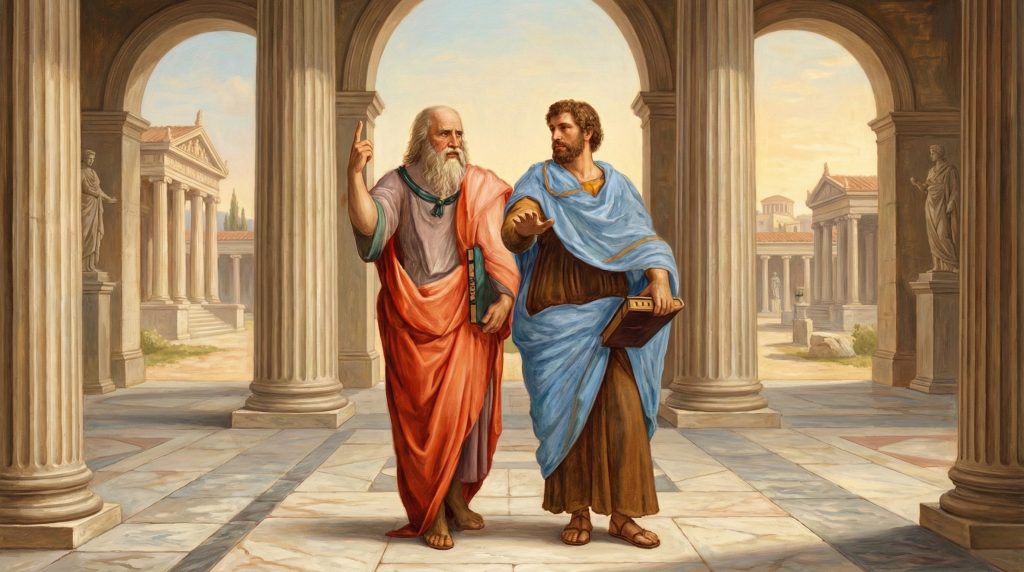
Western philosophy has a central tension.It appeared 2,400 years ago when Aristotle, Plato’s star student, rejected his teacher’s core claim. It never went away. The tension? Is reality fundamentally BEING (eternal, unchanging, transcendent) or BECOMING (changing, temporal, immanent)? Are truth and meaning found by looking UP (to eternal Forms, to transcendent patterns) or by looking IN (to nature, to observable processes)? Is the physical world real, or a shadow of something higher? Plato said one thing. Aristotle said the opposite.
And Western philosophy has been taking sides ever since:
Team Plato:
- Idealists
- Mystics
- Rationalists
- Anyone who believes truth transcends the physical world
Team Aristotle:
- Empiricists
- Scientists
- Materialists
- Anyone who believes truth is found through observation of nature
2,400 years of debate. Idealism vs. Materialism. Spirit vs. Matter. Transcendence vs. Immanence. Being vs. Becoming. But here’s what I’m going to show you: The debate was unnecessary. Plato and Aristotle weren’t opposed. They were seeing the SAME pattern from different angles. Both were completely right. And when you integrate them, when you see how they fit together, something emerges that neither could provide alone. This integration has a name. I call it the Holographic Gestalt.
By the end of this essay, you’ll understand:
- What “holographic” means (and why it resolves the Plato/Aristotle debate)
- What “gestalt” means (and why you need BOTH, not one or the other)
- How this maps to the seven-gate pattern of Inanna’s descent into the underworld (form to formless, Plato) and ascent, (formless to form, Aristotle) how Sumerian Mythology and the myth of Inanna, resolve (Plato = ascent, Aristotle = descent, together = complete cycle)
- Why Western philosophy wasted 2,400 years arguing over a false dichotomy
- How this applies to YOUR transformation (not just abstract philosophy)
I. The Debate: What Plato and Aristotle Actually Said
Plato’s Position: Look UP (Transcendence, Being, Forms)
Plato’s core claim? The physical world is not the ultimate reality. It’s a shadow of something higher, eternal, perfect, unchanging Forms.
Example:
You see a beautiful horse.Plato asks, why do you recognize it as beautiful? Because you’ve seen the Form of Beauty (not in this life, but before birth, your soul knew the Forms directly). The physical horse is beautiful only insofar as it participates in the eternal Form of Beauty. The Form is real. The physical horse is an imperfect copy.
Same with everything:
- Justice (the Form) vs. just actions (imperfect copies)
- Triangle (the Form, perfect) vs. drawn triangles (imperfect approximations)
- Good (the Form) vs. good things (shadows of the Form)
The Forms are:
- Eternal (never change)
- Perfect (no flaws)
- Transcendent (exist beyond/above the physical world)
- Knowable through REASON (not through senses, senses show you shadows, reason shows you Forms)
The implication? Truth is found by ascending. Turning away from the physical world (shadows) and toward the eternal Forms (reality). The allegory of the cave. Prisoners in a cave see shadows on the wall (physical world). One prisoner escapes, climbs out, sees the SUN (the Form of the Good, ultimate reality). He returns to tell others, “What you think is real is shadows. Reality is outside the cave.” Plato’s direction: Upward. Ascent. Return to eternal.
Aristotle’s Position: Look IN (Immanence, Becoming, Actualization)
Aristotle spent 20 years studying under Plato. Then he rejected Plato’s Theory of Forms.
Aristotle’s core claim? The Forms aren’t separate from physical things. The Forms are IN the things. Not transcendent. Immanent.
Example:
Plato: The acorn is an imperfect copy of the eternal Form of Oak. Aristotle: Bullshit. The acorn IS a potential oak. The Form of Oak isn’t in some transcendent realm. It’s in the acorn. As potential. And through natural processes (water, soil, sun, time), the potential actualizes. Acorn → Oak. Not by “looking up” to some external Form. But by becoming what it already is (potentially). Aristotle’s framework: Potentiality → Actuality
Every natural thing has:
- Potentiality (what it can become)
- Actuality (what it currently is)
Change is the process of potentiality becoming actual. Not illusion (contra Plato). But the most real thing.
Examples:
- Embryo (potential human) → Adult (actual human)
- Marble block (potential statue) → Statue (actual form)
- Student (potential master) → Master (actualized skill)
The pattern (Form) isn’t outside the thing. It’s IN the thing, guiding its development. This is hylomorphism (hyle = matter, morphe = form): Every physical thing is matter + form, integrated. Truth is found by looking IN (to nature, to observable processes). Not by escaping the physical world, but by observing it carefully. Aristotle’s direction is Inward/Downward. Descent. Pattern manifesting in nature.
The 2,400-Year Argument
Plato: Reality is transcendent. Look UP. Ascend to eternal Forms. Aristotle: Reality is immanent. Look IN. Observe nature actualizing. Western philosophy chose sides:
Idealists followed Plato:
- Christians (God as transcendent, eternal, perfect Form of the Good)
- Neoplatonists (Plotinus, the One as source, emanation downward)
- Rationalists (Descartes, Kant, truth through reason, not senses)
Materialists followed Aristotle:
- Medieval scholastics (Thomas Aquinas synthesized Aristotle + Christianity)
- Empiricists (Locke, Hume, knowledge through observation)
- Scientists (Darwin, physics, biology, study nature to understand reality)
The debate shaped EVERYTHING:
- Religion vs. Science (transcendence vs. observation)
- Idealism vs. Materialism (mind primary vs. matter primary)
- Rationalism vs. Empiricism (reason vs. experience)
And it continues today:
- Spiritual seekers (looking UP, meditation, transcendence, higher consciousness)
- Scientists (looking IN, empirical observation, material processes)
Still arguing. Still choosing sides. For 2,400 years. But what if the debate was based on a misunderstanding?
II. The Holographic Principle: Both Saw The Whole Pattern
What “Holographic” Means
A hologram is a three-dimensional image created by light interference patterns.
The key property of a hologram? If you cut a hologram in half, both halves don’t show “half the image.” Both halves show the complete image. (Just at a lower resolution.) Cut it in quarters? All four pieces still show the whole image. Every part contains the whole. Not fractionally, completely.
Applying Holographic Principle to Plato and Aristotle
What if Plato and Aristotle weren’t seeing different things? What if they were seeing the same thing, the complete pattern, but from different angles? Holographically. Plato’s view is a complete pattern from ascent angle
Plato saw:
- Form returning to formless (physical dissolving back to eternal)
- The soul ascending from body to Forms
- The path from shadow (cave) to light (sun/Good)
- BEING as primary (eternal, unchanging)
This is Gates 7 → 1:
- Gate 7: Manifest form (physical world, shadows in cave)
- Gate 6-5-4: Progressive release of form
- Gate 3-2: Return to foundation, orientation
- Gate 1: Formless, eternal Forms, the Good, Source
Plato mapped the ascent. The return journey. Form → Formless. And he saw it completely. Aristotle’s view is a Complete pattern from descent angle
Aristotle saw:
- Formless becoming form (potential actualizing)
- The acorn’s development from seed to oak
- The embryo’s transformation from single cell to organism
- Becoming as primary (change, actualization)
This is Gates 1 → 7:
- Gate 1: Formless potential (the acorn, the embryo, pure potentiality)
- Gate 2-3: Orientation, foundation establishing
- Gate 4: Pattern visible (the organizing principle, the Form Within)
- Gate 5-6: Animation, embodiment
- Gate 7: Completed manifest form (the oak, the adult organism)
Aristotle mapped the descent. The outward journey. Formless → Form. And he saw it completely.
Both Were Right
Plato wasn’t seeing “half the pattern” (ascent only). Aristotle wasn’t seeing “the other half” (descent only). Each saw the COMPLETE PATTERN, holographically, from their angle. Plato’s hologram: The full cycle, viewed from the return journey (ascent). Aristotle’s hologram: The full cycle, viewed from the outward journey (descent) Same pattern. Complete in both. Just different perspectives.
Why did they seem opposed? Because if you only look at ascent, you conclude: “The physical world is shadow, the eternal is real, truth is transcendent.” And if you only look at descent, you conclude: “The physical world is real, change is fundamental, truth is immanent.” Both conclusions are TRUE, from their angle.But incomplete without the other.
The pattern is BOTH:
- Descent (formless → form, Aristotle)
- AND Ascent (form → formless, Plato)
Holographic.
III. The Gestalt: Why You Need Both
What “Gestalt” Means
Gestalt psychology (early 20th century) discovered: “The whole is greater than the sum of its parts.” You can’t understand the whole by analyzing parts separately. The relationship between parts creates emergent properties.
Example: A melody Individual notes (C, E, G) = parts. Melody = gestalt (something MORE than just “C + E + G”). The melody has qualities (beauty, meaning, emotional impact) that don’t exist in individual notes. The whole is qualitatively different from parts.
Applying Gestalt to Plato and Aristotle
Plato alone = Incomplete
What you get:
- Transcendence (good!)
- Eternal patterns (good!)
- Direction (ascent, good!)
What you’re missing:
- How the eternal manifests (descent)
- Why does the physical world exist (if it’s just shadow, why is it here?)
- Where to ascend FROM (need manifest form to begin ascent)
Ascent without grounding. Mysticism that floats. Truth that has no connection to lived reality. Idealism that can’t touch the earth. Aristotle alone is incomplete
What you get:
- Empirical grounding (good!)
- Observation of nature (good!)
- Change is real (good!)
What you’re MISSING:
- Where potential comes from (if form is IN the acorn, what PUT it there?)
- What direction actualization serves (acorn becomes oak, but WHY? toward what ultimate purpose?)
- What happens after completion (oak grows, matures, dies, then what? just ends?)
Descent without purpose. The process that goes nowhere. Change without telos (or telos limited to “fulfill your nature” with no transcendent meaning). Materialism that can’t explain why. Plato + Aristotle = Gestalt
What emerges:
The complete cycle:
- Formless (Gate 1, Source, Plato’s Forms, Aristotle’s pure potentiality)
- Eternal patterns exist (Plato right)
- AS potential ready to actualize (Aristotle right)
- Descent (Gates 1→7, Aristotle’s journey)
- Potential actualizes (acorn → oak)
- Form manifests (embryo → adult)
- Pattern embodies (consciousness → matter)
- Manifest form (Gate 7, physical world)
- The oak tree exists (Aristotle: this is REAL, not shadow)
- But participating in eternal pattern (Plato: connected to transcendent Form)
- Ascent (Gates 7→1, Plato’s journey)
- Form releases (death, dissolution)
- Return to formless (soul ascending, form dissolving back to Source)
- Pattern recognized (consciousness seeing eternal truth)
- Return to Formless (Gate 1)
- Completion
- Ready to descend again (cycle continues)
The gestalt is the whole cycle. Both, integrated, spiraling. This creates understanding neither Plato nor Aristotle alone could provide:
Why does formless descend into form? (Aristotle explains: to actualize potential) Why does form ascend back to formless? (Plato explains: to return to eternal source) What is the purpose of the whole cycle? (Value fulfillment, consciousness knowing itself through manifestation and return) How does it work? (Seven gates, RCIR, the pattern cycling). The gestalt reveals the complete picture.
IV. Mapping Holographic Gestalt to Seven Gates
The Integration
Here’s how Plato and Aristotle map to the seven-gate pattern:
Aristotle’s Descent (Gates 1→7):
Gate 1: Formless Potential
- Aristotle: Pure potentiality (the acorn before germination, the embryo at conception)
- The form exists potentially, not actually yet
Gate 2: Orientation
- First movement toward actualization (germination begins, cell division starts)
Gate 3: Foundation
- Basic structure establishing (roots forming, three germ layers in embryo)
Gate 4: Pattern Visible
- The organizing principle reveals itself (you can see it’s becoming an oak, not a pine; it’s human embryo, not cat)
- Aristotle’s “Form” is now VISIBLE in the thing (immanent, not transcendent)
Gate 5: Animation
- Life, movement, energy flowing (growth accelerates, organs function)
Gate 6: Embodiment
- Form fully taking shape (sapling becoming tree, fetus becoming infant)
Gate 7: Completion
- Actualized form (mature oak tree, adult human)
- Potential has become ACTUAL
- Aristotle’s endpoint: The form is now REAL, manifest, observable
PLATO’S ASCENT (Gates 7→1):
Gate 7: Manifest Form (Start of ascent)
- The physical world, the shadows in the cave
- Plato’s starting point: You’re IN form, need to ascend OUT
Gate 6: Releasing Embodiment
- Beginning to let go of identification with physical
- (Philosopher recognizing body isn’t ultimate self)
Gate 5: Energy withdrawing
- Animation declining (aging, dying, or spiritually, detachment from material concerns)
Gate 4: Pattern Recognition
- The HINGE: Seeing the eternal Form THROUGH the physical
- Recognizing the pattern underlying manifestation
- (Prisoner in cave starting to see shadows ARE shadows, not reality itself)
Gate 3: Foundation dissolving
- Physical structures releasing (death, or spiritual death of ego)
Gate 2: Orientation shifting
- Turning from physical toward eternal (prisoner climbing out of cave)
Gate 1: Return to Formless
- Soul reunited with eternal Forms
- Consciousness returned to Source
- The Good, the One, ultimate reality
- Plato’s endpoint: Transcendent union with eternal
THE COMPLETE CYCLE:
Gates 1→7 (Aristotle): Formless descending into form, potential actualizing
Gates 7→1 (Plato): Form ascending back to formless, return to eternal
Together: The spiral, the breath, RCIR. Not linear (one direction only). But cyclic (continuous, spiraling).
V. Why Western Philosophy Missed This
The Mistake
Western philosophy treated Plato and Aristotle as opposed. Thesis vs. Antithesis. Idealism vs. Realism. Transcendence vs. Immanence. And then spent 2,400 years choosing sides or trying to synthesize them externally. But they were never opposed. They were complementary angles on the same pattern. The mistake was thinking: “If Plato is right (transcendence), Aristotle must be wrong (immanence).” Or “If Aristotle is right (immanence), Plato must be wrong (transcendence).” Both are right. Transcendence and immanence are both true. Because the pattern descends (immanence) AND ascends (transcendence). It’s not either/or. It’s both, holographically, creating gestalt.
Why The Mistake Happened
1. Linear thinking
Western philosophy (post-Aristotle) became increasingly linear.
- Cause → Effect
- Problem → Solution
- Question → Answer
So when Plato said “ascend” and Aristotle said “descend,” linear thinking assumed: “They can’t both be right, you can’t go up AND down.” But in a cycle, you do both.
2. Either/or logic
Aristotle himself formalized this (Law of Excluded Middle): A thing is either X or not-X. Can’t be both. Either Forms are transcendent (Plato) OR immanent (Aristotle). Can’t be both. But in holographic gestalt, they are both. Transcendent (viewed from ascent) and immanent (viewed from descent). The pattern is eternal (Plato) and embedded in nature (Aristotle). Both.
3. Loss of mystery traditions
Ancient mystery traditions (Eleusinian, Orphic, Egyptian) understood cycles.
- Death and rebirth
- Descent and ascent
- Persephone’s journey (down to underworld, back to surface, annually)
These traditions knew: You go down AND up. Both are part of the journey. But as philosophy became more academic, divorced from mystery traditions. The cyclic understanding was lost. Replaced by linear, either/or thinking.
4. Institutional capture
Once Christianity adopted Platonism (Forms became God, transcendence became heaven). Plato’s ascent was emphasized (escape sinful world, ascend to God). Aristotle’s descent was suppressed (the physical world isn’t just shadow, it’s real, God’s creation). Eventually Aristotle was integrated (Aquinas synthesized Aristotle + Christianity). But the cyclic understanding (both ascent AND descent as one pattern) was never recovered. Christianity kept it linear. Fall (descent into sin) → Redemption (ascent to heaven). One trip down, one trip up, done.
VI. Applications: What Holographic Gestalt Means For You
Beyond Abstract Philosophy
This isn’t just historical philosophy. This is how transformation works. In your life. Right now.
Application 1: Personal Transformation
You’re navigating both directions constantly:
Descent (Aristotle):
- Recognizing potential (I could be healthier, more skilled, more loving)
- Actualizing it (working out, practicing, opening your heart)
- Embodying change (new habits, new patterns, new identity forming)
Ascent (Plato):
- Releasing old forms (letting go of who you were)
- Recognizing eternal patterns (seeing the truth underneath changing circumstances)
- Returning to Source (meditation, stillness, formless awareness)
Both are necessary. Descent without ascent is endless doing, no integration, burnout. Ascent without descent is spiritual bypassing, no grounding, floating.
With both:
Work → Rest.
Doing → Being.
Manifestation → Meditation.
Aristotle → Plato.
Holographic Gestalt.
Application 2: Creative Work
DESCENT:
- Idea (formless potential) → Execution (actualizing the vision) → Finished work (manifest form)
ASCENT:
- Completing the work → Releasing attachment → Returning to creative formless (ready for next idea)
Artists who only descends? Create, create, create, never stop, never integrate, burn out. Artists who only ascend? Endless “I’m working on myself, preparing, aligning” but never create anything. With both? Create (descend) → Complete → Release (ascend) → Rest → Create again. Holographic Gestalt.
Application 3: Relationships
Descent:
- Meeting someone (formless potential connection) → Building relationship (actualizing) → Deep intimacy (embodied bond)
Ascent:
- Recognizing the eternal in the person (beyond their physical form, their ego)
- Loving the BEING (formless) not just the personality (form)
- If relationship ends: Releasing the form while honoring the eternal pattern
Relationships that only descend? Build, build, build (intensity, enmeshment) but no space, no recognition of eternal, no breathing room. Relationships that only ascend? “Spiritual connection” with no actual embodied intimacy, no grounding, all transcendence, no descent into messy human reality. With both? Embody the relationship (descent) AND recognize the eternal (ascent). Holographic Gestalt.
Application 4: Healing
DESCENT into the wound:
- Feeling the pain (not avoiding)
- Processing the trauma (descending into it, not bypassing)
- Integrating the lesson (embodying wisdom from experience)
ASCENT from the wound:
- Recognizing the pattern (eternal truth underlying this specific pain)
- Releasing the story (it happened, but you’re not DEFINED by it)
- Returning to wholeness (formless self that was never broken)
Healing requires both, Descent (feel it, process it, integrate it, Aristotle). Ascent (recognize it, release it, transcend it, Plato). Skipping descent is bypassing (spiritual clichés covering unprocessed pain). Skipping ascent is rumination (endless processing, never releasing, stuck in story). Holographic Gestalt.
VII. The Revolutionary Implication
If Plato and Aristotle were both right. If the 2,400-year debate was based on misunderstanding. If the pattern is BOTH descent AND ascent, holographically, creating gestalt: Then most of Western philosophy’s “big debates” dissolve. Idealism vs. Materialism?
Both. Consciousness is primary (idealism) AND manifests as matter (materialism). Descent and ascent of same pattern.
Mind vs. Body?
Both. Not separate. Form (body) and formless (mind/consciousness) integrated, cycling.
Transcendence vs. Immanence?
Both. Truth is eternal (transcendent) AND embedded in nature (immanent). Same pattern, different angles.
Being vs. Becoming?
Both. Eternal Being (Plato, formless, Gate 1) AND temporal Becoming (Aristotle, actualization, Gates 1→7). Cycle includes both.
Reason vs. Experience?
Both. Reason reveals eternal patterns (Plato, ascent). Experience grounds in observable nature (Aristotle, descent). Need both.
Science vs. Spirituality?
Both. Science maps descent (how formless becomes form, observable processes). Spirituality maps ascent (how form returns to formless, transcendent truth). Same pattern.
The debates weren’t wrong. Each side was seeing the true aspect of reality. But incomplete without the other. Holographic Gestalt integrates them. Not by choosing. But by showing: both are true, from their angle.
VIII. Conclusion: The Pattern Complete
Plato looked up. Saw the eternal. Mapped ascent (Gates 7→1). He taught return to Source. Aristotle looked in. Saw nature actualizing. Mapped descent (Gates 1→7). Taught that potential becomes actual. Western philosophy argued for 2,400 years. Who was right? Both. Completely. Holographically. Each saw the whole pattern from their angle. And when you integrate both. The Gestalt emerges. Something greater than either alone.
The complete cycle:
Formless → Form → Formless.
Descent → Ascent.
Becoming → Being → Becoming.
RCIR. The spiral. The pattern. This is the Holographic Gestalt. Plato and Aristotle built it. 2,400 years ago. We just forgot to see it. Holographic Gestalt. Plato + Aristotle. Ascent + Descent. Both. Always both. That’s the pattern. Complete.