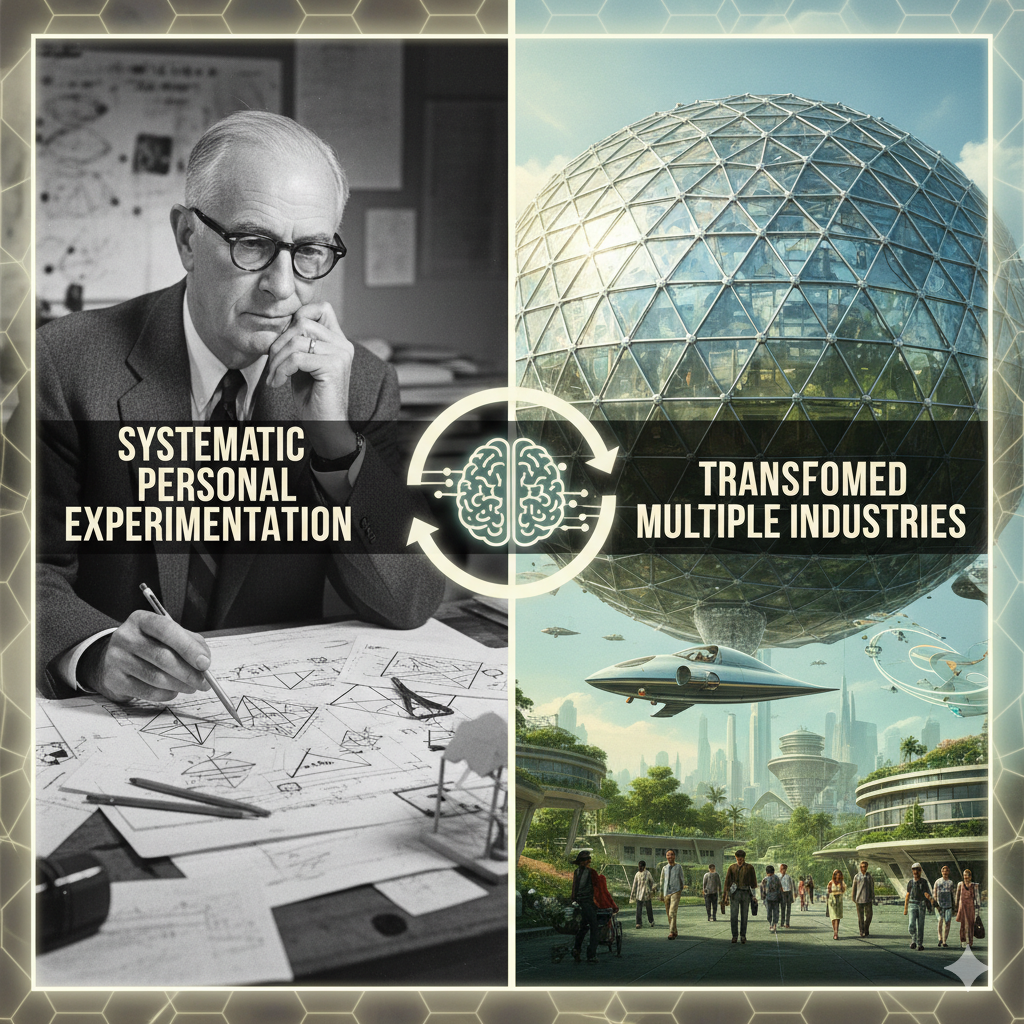
How Buckminster Fuller systematic approach to personal experimentation produced breakthrough innovations that transformed multiple industries
Published on consciouschoicemastery.com | Approx. 10-12 min read
In 1927, a 32-year-old man stood on the shore of Lake Michigan contemplating suicide. His business had collapsed, his infant daughter had died, and he felt like a complete failure. Instead of ending his life, Buckminster Fuller made a decision that would revolutionize how we think about systematic innovation, resource optimization, and human potential.
He decided to treat himself as a scientific experiment.
“What would happen,” Fuller asked himself, “if I committed my life to discovering what one individual could achieve for humanity’s benefit when operating with complete systematic efficiency?”
That question launched a 56-year experiment that produced the geodesic dome, revolutionary architectural designs, comprehensive systems thinking methodologies, and innovations that continue transforming industries today. But Fuller’s most important contribution wasn’t any single invention—it was his systematic approach to life optimization that anyone can adapt and apply.
The Experimental Framework: Designing a Life for Discovery
Fuller didn’t approach his personal transformation casually. He designed what he called “the guinea pig experiment”—a rigorous investigation with clear hypotheses, measurable outcomes, and systematic documentation spanning over five decades.
His core hypothesis was radical: if one individual operated purely for humanity’s benefit rather than personal gain, what could they accomplish? How efficient could human effort become when systematically optimized? What innovations would emerge from comprehensive thinking rather than specialized expertise?
Fuller established specific parameters that turned his life into a controlled experiment:
Work exclusively on challenges benefiting all humanity rather than specific groups, nations, or personal interests. This constraint forced him to think at planetary scale and develop solutions with universal application.
Measure success by resource efficiency rather than financial returns. Fuller tracked how much beneficial impact he could generate per unit of time, energy, and material resources invested.
Document everything systematically to provide data for others who might want to replicate or improve his methods. His detailed records became a database of systematic optimization techniques.
Refuse to accept conventional limitations about what was possible for individual achievement. Fuller treated apparent constraints as design challenges rather than permanent boundaries.
This experimental structure transformed what could have been random self-improvement into systematic investigation of human potential and conscious choice-making.
The “Doing More with Less” Discovery: Resource Optimization as Strategic Advantage
Fuller’s first major systematic insight was what he termed “ephemeralization”—the principle that technological advancement allows progressively greater performance with progressively fewer physical resources. This pattern recognition became central to his strategic thinking across all domains.
He documented this principle operating everywhere: cars becoming more fuel-efficient while providing better performance, communication devices handling more information while getting smaller, architectural structures supporting greater loads while using less material.
Rather than simply observing this trend, Fuller actively applied ephemeralization to transform his own effectiveness. His innovations consistently delivered superior performance with dramatic resource reduction compared to conventional approaches.
The Dymaxion House Project demonstrates Fuller’s systematic application of efficiency principles. Designed in the 1940s for mass production like automobiles, the house weighed only 6,000 pounds—equivalent to a large car—while providing living space comparable to conventional homes weighing 150 tons.
Fuller’s design included integrated utilities, climate control, and maintenance systems that would reduce operating costs by up to 90%. The entire structure could be manufactured in a factory, shipped efficiently, and assembled rapidly with minimal skilled labor.
While the Dymaxion House never achieved mass production due to financing and marketing challenges, Fuller’s systematic approach to resource optimization influenced generations of architects, engineers, and designers. His methods for analyzing efficiency and eliminating waste became standard practices across multiple industries.
The strategic insight: Fuller didn’t just try to build better houses. He systematically analyzed what housing was supposed to accomplish, then engineered solutions that achieved those goals with radical efficiency. This optimization methodology works for any challenge.
The Comprehensive Thinking Method: Systems Innovation Through Pattern Recognition
Fuller’s approach to invention reveals systematic methods for breakthrough innovation that extend far beyond his specific technical achievements. His geodesic dome development provides a detailed case study of how comprehensive thinking produces revolutionary solutions.
The dome project began with Fuller’s systematic analysis of structural efficiency in nature. He studied how living systems achieved maximum strength with minimum materials, focusing particularly on radiolaria—microscopic sea creatures whose skeletal structures demonstrated extraordinary engineering principles.
Fuller’s notebooks document years of mathematical analysis exploring how these natural patterns could be applied to human architecture. He systematically tested different geometric configurations, calculating strength-to-weight ratios and material requirements for each variation.
The breakthrough came through what Fuller called “comprehensive anticipatory design science”—a systematic approach to innovation that considered all relevant factors simultaneously rather than optimizing single variables in isolation.
For geodesic domes, this meant analyzing structural requirements, material properties, manufacturing processes, assembly methods, cost factors, environmental impact, and aesthetic considerations as an integrated system. Most architects focused on one or two elements; Fuller optimized all simultaneously.
His systematic process involved:
- Pattern analysis: Studying how nature solved similar structural challenges
- Mathematical modeling: Testing geometric principles across multiple configurations
- Prototype experimentation: Building and testing over 2,000 structural variations
- Comprehensive optimization: Integrating all performance requirements simultaneously
- Systematic documentation: Recording every experiment for future reference and improvement
The result was revolutionary: structures stronger than conventional buildings while using 30% less material and requiring no internal supports. The domes could enclose enormous spaces at dramatically reduced cost while providing superior environmental performance.
Fuller’s systematic approach demonstrates how breakthrough innovations emerge from comprehensive analysis rather than random creativity or specialized expertise alone.
The Scale-Appropriate Problem Solving Framework
Fuller’s guinea pig experiment led him to develop systematic approaches for identifying and solving problems at the most effective scale and timeframe. His methods reveal why most problem-solving efforts fail and how strategic thinking about scope dramatically improves solution effectiveness.
He observed that most human challenges resulted from thinking too locally or too short-term. Environmental problems required global solutions. Economic issues needed consideration of planetary resource flows. Social challenges demanded understanding of technological and educational systems operating over decades.
Fuller’s “World Game” project demonstrated this scale-appropriate thinking in action. Beginning in the 1960s, he developed comprehensive models of global resource flows, population dynamics, and technological capabilities to identify optimal strategies for achieving worldwide prosperity.
The World Game methodology involved:
- Comprehensive data collection about global resources, production capabilities, and human needs
- Systems modeling of resource flows, technological capabilities, and social dynamics
- Strategic analysis identifying high-leverage intervention points
- Scenario planning testing different approaches through systematic simulation
- Implementation strategy focusing on changes that would catalyze broader transformation
Fuller’s analysis revealed that Earth already possessed sufficient resources and technology to provide high-quality life for all inhabitants. The challenge wasn’t scarcity—it was inefficient distribution and utilization of existing capabilities.
His systematic approach identified specific leverage points where relatively small interventions could produce massive positive changes. Fuller calculated that redirecting less than 1% of global military spending toward comprehensive education and sustainable technology development could eliminate most global problems within a generation.
The core principle: Rather than solving symptoms, systematically identify the scale and timeframe where root causes can be addressed most efficiently. Fuller’s experimental approach proved that systematic thinking about problem scope dramatically improves solution effectiveness.
The Trimtab Strategy: Strategic Leverage for Maximum Impact
One of Fuller’s most practical discoveries was the “trimtab principle”—small actions applied at strategic leverage points can produce enormous changes in large systems. This principle became central to his approach for creating change without massive resources or institutional power.
Fuller drew the metaphor from ship navigation. Large ships can’t turn quickly because of their momentum and size. However, each ship has a small rudder controlling direction, and each rudder has an even smaller “trimtab” that makes turning the rudder easier.
“The trimtab is the small servo-rudder which applies the low effort which easily turns the big rudder around,” Fuller explained. “It takes almost no effort at all. So I said that the little individual can be a trimtab.”
Fuller’s life became a systematic demonstration of trimtab thinking:
Instead of trying to change the construction industry through arguments or regulations, he created demonstrations proving better approaches were possible. His geodesic domes showed dramatically superior performance, inspiring adoption by organizations seeking competitive advantages.
Rather than criticizing educational institutions, Fuller demonstrated comprehensive thinking approaches through university speaking tours. Students experienced these methods directly and applied them after graduation, spreading Fuller’s ideas organically throughout multiple fields.
Instead of fighting economic systems directly, Fuller developed innovations that made resource efficiency more profitable than waste. His designs succeeded commercially because they delivered superior performance at lower cost.
The trimtab methodology:
- Identify strategic leverage points where small innovations can demonstrate better approaches
- Create proof-of-concept demonstrations that make superior solutions visible and attractive
- Focus on making better options irresistible rather than fighting existing systems
- Document and share methods so others can replicate and improve the approach
- Build systematic momentum through incremental demonstrations rather than massive confrontations
The trimtab principle offers practical guidance for anyone seeking to create positive change without enormous resources or institutional authority.
The Documentation System: Systematic Learning Through Strategic Recording
Fuller’s experimental success required systematic documentation to identify what was working and what needed adjustment. His record-keeping methods provide frameworks for optimizing effectiveness through conscious choice-making and strategic learning.
From 1927 until his death in 1983, Fuller maintained detailed logs of his activities, observations, insights, and outcomes. He tracked time allocation, resource usage, project results, and personal energy levels with scientific precision.
This wasn’t casual journaling. Fuller used documentation to identify patterns and optimize his approaches systematically. He analyzed which activities produced the greatest beneficial impact relative to effort invested. He tracked energy cycles to schedule different types of work at optimal times. He recorded which environments and collaborations enhanced his effectiveness.
Fuller’s documentation revealed systematic principles:
- Parallel project benefits: Working on multiple projects simultaneously increased total productivity because ideas from one domain sparked insights in others
- Environmental creativity factors: His most innovative insights emerged during travel or unfamiliar environments that stimulated new perspectives
- Teaching-learning synergy: Explaining ideas to different audiences forced refinement of his thinking and revealed new applications
- Collaboration multiplication: Strategic partnerships increased his capability exponentially when structured properly
- Systematic optimization: Continuous measurement and adjustment improved performance over time
Key documentation practices:
- Daily activity tracking with focus on impact per effort invested
- Project outcome analysis identifying successful patterns for replication
- Energy optimization scheduling different work types during peak effectiveness periods
- Insight capture recording ideas immediately when they emerged
- Pattern recognition reviewing records periodically to identify systematic principles
Fuller’s systematic approach to documentation demonstrates how conscious record-keeping becomes technology for continuous improvement and strategic learning.
The Collaboration Multiplication Method: Strategic Alliance Building
Fuller’s achievements required extensive collaboration with engineers, manufacturers, educators, and organizations worldwide. His systematic approach to building and managing these alliances reveals methods for leveraging collective intelligence and shared resources.
Unlike inventors who worked in isolation, Fuller actively sought collaboration from the beginning of his experimental period. He recognized that systematic thinking approaches would be most powerful when combined with other people’s specialized expertise and resources.
Fuller’s collaboration strategy involved “coordinate synthesis”—bringing together diverse specialists to work on comprehensive solutions no individual could develop alone. His geodesic dome projects required mathematicians, structural engineers, materials scientists, manufacturers, and builders working in coordination.
His method for initiating collaborations was particularly systematic. Fuller identified organizations or individuals whose existing goals aligned with his comprehensive objectives, then proposed projects serving both parties’ interests while advancing his experimental purposes.
The U.S. Marine Corps dome projects demonstrate this approach: The military needed lightweight, portable structures for rapid deployment. Fuller needed opportunities to test geodesic designs under demanding conditions with adequate funding.
The collaboration served both parties while generating data that enhanced Fuller’s understanding of structural principles and manufacturing methods. The Marines received superior field structures; Fuller obtained real-world testing that improved his designs and demonstrated practical value.
Systematic collaboration principles:
- Alignment identification: Find partners whose existing goals overlap with your objectives
- Mutual benefit design: Structure projects serving all participants’ legitimate interests
- Expertise integration: Combine diverse specialized knowledge for comprehensive solutions
- Clear communication: Establish shared understanding of objectives and methods
- Systematic documentation: Record collaboration methods and outcomes for improvement
Fuller’s alliance-building methods demonstrate how systematic partnerships multiply individual effectiveness exponentially while advancing collective capability.
The Teaching-Learning Integration: Knowledge Development Through Strategic Sharing
Fuller treated his extensive speaking and teaching activities as integral components of his systematic investigation rather than separate from his experimental work. His approach reveals methods for accelerating learning and innovation through strategic knowledge sharing.
Beginning in the 1930s, Fuller spoke at universities, corporations, and conferences worldwide. Rather than simply sharing existing knowledge, he used presentations as opportunities to test ideas, gather feedback, and refine thinking through interaction with diverse audiences.
Fuller’s speaking style was deliberately experimental. He presented preliminary ideas and observed audience responses to gauge which concepts required further development and which were ready for practical application. His lectures functioned as real-time research laboratories.
His systematic approach involved “thinking out loud”—presenting actual problem-solving processes rather than just final conclusions. This transparency allowed audiences to understand his methods and adapt them to their own challenges.
Fuller documented how teaching enhanced his own learning systematically:
- Clarity development: Explaining complex ideas to different audiences forced discovery of clearer formulations
- Connection recognition: Questions from students and professionals consistently sparked new insights
- Application expansion: Teaching revealed practical applications he hadn’t considered before
- Method refinement: Audience feedback helped improve his systematic approaches
His “World Game” seminars demonstrated comprehensive educational methodology. Participants worked together solving real global problems using actual data about resources, technology, and human capabilities. The educational process became a laboratory for discovering practical solutions.
Strategic teaching principles:
- Experimental presentation: Test ideas through audience interaction rather than one-way communication
- Process transparency: Share problem-solving methods rather than just conclusions
- Comprehensive challenges: Use real problems requiring integration of multiple knowledge domains
- Systematic feedback: Document audience responses to improve approaches continuously
- Mutual learning: Treat teaching as collaborative investigation rather than information transfer
Fuller’s methods prove that strategic knowledge sharing accelerates innovation while serving educational objectives.
Modern Applications: Adapting Fuller’s Systematic Optimization
Fuller’s guinea pig experiment provides specific frameworks contemporary professionals and entrepreneurs can adapt for systematic optimization and conscious choice-making. His documented methods translate directly to modern contexts.
Personal Effectiveness Optimization
Resource efficiency analysis: Before trying to work harder or acquire more resources, systematically analyze how existing capabilities could be used more effectively. Track which activities produce the greatest beneficial impact relative to effort invested.
Comprehensive goal setting: Instead of optimizing separate life domains independently, analyze how work, relationships, health, and personal development affect each other as an integrated system.
Systematic experimentation: Treat personal development as ongoing investigation rather than fixed improvement goals. Document approaches, measure outcomes, and refine methods based on evidence.
Innovation and Problem-Solving
Scale-appropriate analysis: Before accepting conventional problem definitions, systematically analyze whether you’re addressing symptoms or root causes. What would solving this challenge at a larger scale or longer timeframe reveal?
Comprehensive design thinking: Instead of optimizing single variables, consider all relevant factors simultaneously. How do technical requirements, resource constraints, user needs, and implementation realities work together?
Pattern recognition methodology: Study how nature, history, or other domains have solved similar challenges. What proven principles could be adapted to your specific situation?
Strategic Decision-Making
Trimtab identification: Rather than trying to change large systems through direct confrontation, identify strategic leverage points where small innovations can demonstrate better approaches.
Documentation for optimization: Maintain systematic records of decisions, outcomes, and learning. Use this data to identify successful patterns and improve future choices.
Collaboration multiplication: Actively seek partnerships with people whose expertise and resources complement your capabilities. Structure alliances for mutual benefit while advancing shared objectives.
Professional Development
Teaching-learning integration: Share your developing expertise through writing, speaking, or mentoring. Use these activities as opportunities to refine your thinking and discover new applications.
Systematic skill development: Instead of random learning, identify capabilities that would enhance your effectiveness across multiple domains. Focus on principles and methods rather than just information.
Legacy-oriented choices: Evaluate decisions based on potential contribution to long-term positive impact rather than just immediate personal benefit.
The Compound Returns of Systematic Thinking
Fuller’s guinea pig experiment demonstrates how systematic optimization creates compound returns that dramatically exceed what seems possible through individual effort alone. His methods reveal principles for generating similar multiplication effects in any field.
When choices are made strategically based on comprehensive analysis and systematic optimization, they create platforms for increasingly effective subsequent choices. Fuller’s efficiency innovations attracted organizations seeking competitive advantages. Successful projects generated resources and credibility enabling larger experiments. Each application demonstrated capabilities that attracted more sophisticated collaborations.
This multiplication effect extended beyond technical achievements. Fuller’s systematic approach to knowledge sharing created networks of people applying his methods to their own challenges. These applications generated additional innovations and resources supporting Fuller’s ongoing experimental work.
Fuller’s comprehensive documentation and legacy orientation ensured his systematic methods would continue generating benefits long after his individual contributions ended. His approaches became technological tools others could adapt and improve for their own optimization challenges.
The core insight: Systematic conscious choice-making can achieve results that seem impossible when evaluated from conventional perspectives about individual limitations and resource constraints.
Your Guinea Pig Experiment: A Framework for Systematic Life Optimization
Fuller proved that treating life as systematic investigation can reveal extraordinary human potential when approached with comprehensive thinking and rigorous documentation. His methods provide a framework you can adapt for your own optimization experiment.
Week 1: Experimental Design
- Choose your optimization domain: Select one area where you want to enhance effectiveness—work productivity, creative output, relationship quality, or contribution to causes you care about
- Establish measurement systems: Define clear metrics for tracking current performance and experimental results
- Apply comprehensive thinking: Analyze your chosen domain as part of larger systems rather than optimizing single variables
Week 2: Pattern Recognition
- Document current approaches: Record your existing methods, resource allocation, and outcome patterns
- Study successful models: Research how others have solved similar challenges effectively
- Identify leverage points: Look for small changes that could produce disproportionately large improvements
Week 3: Systematic Experimentation
- Test the trimtab principle: Implement minimal changes at strategic points and measure results
- Practice comprehensive optimization: Consider all relevant factors simultaneously rather than sequential improvements
- Build collaboration momentum: Identify potential partnerships that could multiply your effectiveness
Week 4: Integration and Scaling
- Analyze experimental data: Review what worked, what didn’t, and what you learned about systematic optimization
- Refine your methods: Adjust approaches based on evidence rather than assumptions
- Design next iteration: Plan expanded experiments building on successful patterns
The goal isn’t to transform everything immediately. Fuller’s experiment succeeded because he treated optimization as ongoing investigation rather than one-time improvement. Start with systematic attention to one domain, document results rigorously, and let evidence guide next steps.
As Fuller discovered, conscious systematic optimization creates compound returns that multiply over time. When you treat your choices as experiments in human potential rather than random decisions, extraordinary results become systematically achievable.
What will your guinea pig experiment reveal about the possibilities hidden in systematic thinking and conscious choice-making?
Buckminster Fuller’s 56-year experiment proved that individual systematic optimization can produce innovations benefiting all humanity. His methods remain among the most practical frameworks for conscious choice-making and strategic life design ever documented.
@ Lee Greene