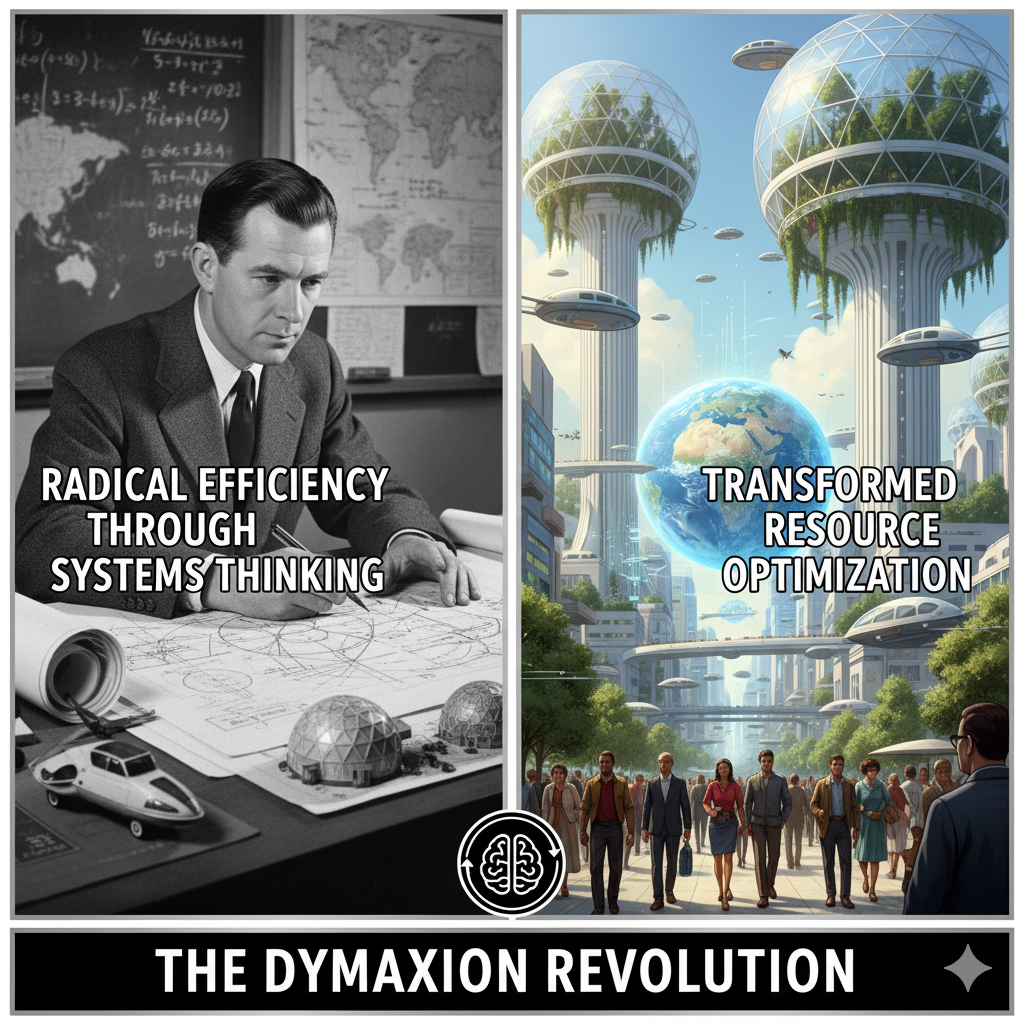
The systematic methodology that achieved maximum performance with minimum resources through comprehensive efficiency analysis
Published on consciouschoicemastery.com | Approx. 10-12 min read
In 1929, Buckminster Fuller stood before a group of potential investors holding the blueprints for what he claimed would revolutionize human shelter. The Dymaxion House, he explained, would weigh 6,000 pounds, about as much as a large automobile while providing living space equal to conventional homes weighing 150 tons. It would cost less to manufacture than a car, require no foundation, use 90% less energy, and be completely maintenance-free.
The investors were skeptical. How could a house be lighter than a car yet stronger than conventional construction? How could it cost less while performing better? Fuller’s answer revealed the systematic thinking that would transform how humans approached resource efficiency: “We’re not making houses lighter. We’re making them right.”
Fuller had coined the term “Dymaxion” by combining “dynamic,” “maximum,” and “tension” representing his systematic approach to achieving maximum performance through optimal resource utilization. The Dymaxion Revolution wasn’t just about specific inventions; it was a comprehensive methodology for radical efficiency that challenged fundamental assumptions about the relationship between performance and resource consumption.
This systematic approach to “doing more with less” became Fuller’s most practical contribution to human problem solving, providing frameworks that remain revolutionary today across technology, business, and personal effectiveness domains.
The Efficiency Paradigm Shift: From More Resources to Better Systems
Fuller’s Dymaxion methodology emerged from his systematic analysis of a fundamental question: Why did humans assume that better performance required more resources when nature consistently demonstrated the opposite principle?
Traditional approaches to performance improvement typically involved adding more materials, energy, labor, or time. Want a stronger building? Use more steel and concrete. Need faster transportation? Build bigger engines. Require better performance? Invest more resources. Fuller’s systematic analysis revealed this “more is better” assumption as a design failure rather than a natural law.
The efficiency paradigm shift involves recognizing:
Resource Multiplication vs. Resource Addition
- Conventional thinking: Better performance requires proportionally more resources
- Systems thinking: Better design can multiply performance while reducing resource requirements
- Natural models: Biological systems consistently achieve superior performance through optimal organization rather than massive resource consumption
- Design opportunity: Most human systems operate far below optimal efficiency levels, creating enormous improvement potential
Performance Optimization vs. Component Optimization
- Traditional approaches: Improve individual components separately and hope overall performance improves
- Systems approaches: Optimize how components work together to achieve performance multiplication
- Integration benefits: Properly designed systems often perform better than the sum of optimized individual parts
- Synergy discovery: Strategic component combinations can create performance characteristics that exceed what any component could achieve alone
Strategic Elimination vs. Incremental Addition
- Additive thinking: Solve problems by adding new features, materials, or processes
- Subtractive thinking: Solve problems by eliminating unnecessary elements and optimizing essential functions
- Simplification benefits: Removing complexity often improves rather than compromises performance
- Efficiency revelation: Many apparent necessities are actually inefficiencies that reduce rather than enhance performance
Comprehensive Analysis vs. Single Factor Optimization
- Specialized optimization: Maximize single performance criteria while accepting compromises in other areas
- Systems optimization: Improve multiple performance factors simultaneously through integrated design
- Trade off elimination: Comprehensive thinking often reveals approaches that eliminate rather than manage trade offs
- Breakthrough potential: Multi-dimensional optimization produces revolutionary rather than incremental improvements
Fuller’s systematic application of these principles produced innovations that seemed impossible when evaluated from conventional resource performance assumptions. His methods demonstrate how systems thinking can achieve radical efficiency through better organization rather than more consumption.
Modern application: Before adding more resources to improve performance, systematically analyze whether better organization, design, or strategic elimination could achieve superior results with fewer inputs.
The Dymaxion House: Systematic Housing Revolution
Fuller’s Dymaxion House project provides a detailed case study of how systematic efficiency thinking can revolutionize entire industries. His comprehensive analysis of housing requirements revealed enormous inefficiencies in conventional approaches and systematic opportunities for radical improvement.
Traditional housing construction assumed that shelter required massive materials, extensive labor, permanent foundations, and ongoing maintenance. Fuller’s systematic analysis questioned each assumption and developed integrated solutions that achieved superior performance across all housing requirements.
The comprehensive housing analysis included:
Functional Requirement Analysis
- Primary shelter functions: Protection from weather, comfortable interior climate, adequate space for activities, safety and security
- Secondary functions: Aesthetic appeal, community integration, storage capacity, utility access
- Performance optimization: Achieving all functions more effectively rather than accepting compromises between different requirements
- Efficiency opportunities: Identifying where conventional approaches used excessive resources without improving function
Structural Innovation Strategy
- Weight optimization: Using geometric principles and advanced materials to achieve strength with minimal mass
- Foundation elimination: Designing structures that distributed loads without requiring permanent ground connection
- Component integration: Creating building elements that served multiple functions simultaneously
- Assembly efficiency: Developing construction methods that required minimal skilled labor and time
Environmental Systems Integration
- Climate control optimization: Using design principles rather than energy consumption to maintain comfortable interior conditions
- Natural ventilation: Orienting and shaping structures to work with rather than against air flow patterns
- Solar optimization: Positioning windows and surfaces to maximize beneficial solar energy while minimizing unwanted heat
- Water management: Integrating water collection, treatment, and recycling into structural design
Economic Viability Strategy
- Manufacturing optimization: Designing components for mass production rather than custom construction
- Material efficiency: Using advanced materials strategically rather than conventional materials excessively
- Labor reduction: Developing assembly methods that required minimal specialized skills
- Lifecycle cost analysis: Optimizing total cost of ownership rather than just initial construction expense
The Dymaxion House design achieved remarkable performance characteristics:
- 6,000-pound total weight compared to 150-ton conventional houses
- 90% energy reduction through passive climate control design
- Factory production capability enabling cost reduction and quality improvement
- Rapid assembly requiring minimal foundation work and skilled labor
- Maintenance-free operation through integrated systems and durable materials
While the Dymaxion House never achieved mass production due to financing and marketing challenges, Fuller’s systematic efficiency principles influenced generations of architects and continue driving innovation in sustainable housing today.
The housing efficiency principle: Systematic analysis of functional requirements often reveals radical efficiency opportunities that conventional approaches overlook through assumption rather than analysis.
Modern application: What industry assumptions about resource requirements might systematic efficiency analysis reveal as unnecessary? How could comprehensive functional analysis reveal radical improvement opportunities?
The Dymaxion Car: Transportation Efficiency Revolution
Fuller’s Dymaxion Car demonstrated how systematic efficiency thinking could transform transportation by achieving superior performance with dramatically reduced resource consumption. His comprehensive analysis of transportation requirements revealed fundamental inefficiencies in conventional automotive design.
Traditional automotive thinking assumed trade offs between efficiency and performance, size and maneuverability, safety and weight. Fuller’s systematic approach eliminated these trade-offs through integrated design that optimized transportation function rather than following conventional automotive assumptions.
The transportation efficiency analysis included:
Performance Requirement Definition
- Primary transportation functions: Moving people safely from one location to another efficiently
- Secondary functions: Comfort, storage capacity, weather protection, social signaling
- Efficiency optimization: Achieving maximum transportation capability with minimum resource consumption
- Performance integration: Eliminating trade offs between different transportation requirements
Aerodynamic Optimization Strategy
- Natural form analysis: Studying how birds, fish, and other natural systems achieved efficient movement
- Resistance minimization: Designing shapes that moved through air with minimal energy resistance
- Stability enhancement: Using aerodynamic principles to improve rather than compromise vehicle stability
- Integration opportunity: Making aerodynamic efficiency enhance rather than conflict with other performance factors
Weight and Materials Innovation
- Structural efficiency: Using geometric principles to achieve strength with minimal mass
- Material optimization: Selecting materials for optimal strength-to-weight ratios rather than conventional availability
- Component integration: Designing elements that served multiple functions simultaneously
- Weight distribution: Optimizing mass placement for superior handling and stability
Unconventional Configuration Exploration
- Three-wheel design: Eliminating unnecessary weight and complexity while improving maneuverability
- Rear engine placement: Optimizing weight distribution and enabling superior aerodynamics
- Steering innovation: Developing control systems that enhanced rather than compromised efficiency
- Passenger optimization: Arranging seating for maximum capacity with minimal vehicle footprint
The Dymaxion Car achieved breakthrough performance characteristics:
- 35 miles per gallon efficiency while carrying 11 passengers
- 120 mph top speed with remarkable stability and safety
- Superior maneuverability enabling parking in spaces too small for conventional cars
- Innovative aesthetics that demonstrated efficiency could enhance rather than compromise design appeal
Although the Dymaxion Car never reached mass production, Fuller’s systematic efficiency principles influenced automotive design for decades. Modern electric vehicles, hybrid technologies, and efficiency innovations trace back to systematic thinking Fuller pioneered.
The transportation efficiency principle: Systematic analysis of transportation functions can reveal radical efficiency opportunities that conventional automotive assumptions prevent from being considered.
Modern application: What conventional assumptions in your field might systematic efficiency analysis reveal as unnecessary limitations? How could functional optimization eliminate rather than manage traditional trade-offs?
The Dymaxion Map: Information Efficiency Innovation
Fuller’s Dymaxion World Map demonstrates how systematic efficiency thinking applies to information design and communication challenges. His analysis of geographic representation revealed fundamental inefficiencies in conventional mapping approaches and developed solutions that improved accuracy while enhancing usability.
Traditional world maps distorted geographic relationships to fit rectangular formats that were convenient for printing and display but inaccurate for understanding global relationships. Fuller’s systematic analysis of mapping requirements produced innovative solutions that optimized information accuracy and practical utility simultaneously.
The geographic information analysis included:
Representation Accuracy Requirements
- Proportional accuracy: Showing continents and countries at their actual relative sizes
- Relationship preservation: Maintaining accurate geographic relationships between different regions
- Distortion minimization: Reducing the visual distortions inherent in representing spherical surfaces on flat displays
- Navigation utility: Creating maps useful for understanding travel distances and routes
Communication Optimization Strategy
- User understanding: Making global relationships obvious rather than requiring specialized interpretation
- Educational effectiveness: Enabling people to understand planetary geography more accurately
- Planning utility: Supporting decision-making that required accurate geographic understanding
- Cultural neutrality: Avoiding presentation biases that privileged some regions over others
Format Innovation Development
- Geometric solutions: Using mathematical principles to minimize distortion while maintaining usability
- Modular design: Creating map formats that could be arranged in different configurations for different purposes
- Assembly flexibility: Enabling users to understand global relationships from multiple perspectives
- Production efficiency: Designing maps that could be manufactured and distributed economically
Integration and Application Strategy
- Educational system integration: Making accurate geographic understanding accessible for learning
- Planning and analysis: Supporting decision-making that required accurate global perspective
- Communication enhancement: Enabling more effective discussion of global challenges and opportunities
- Perspective transformation: Helping people understand Earth as an integrated system rather than disconnected regions
The Dymaxion World Map achieved superior information efficiency:
- Accurate continental proportions without the distortions common in conventional world maps
- Flexible assembly options enabling different perspectives on global relationships
- Educational enhancement making geographic reality more accessible to learners
- Planning utility supporting better decision-making about global challenges and opportunities
Fuller’s systematic approach to information efficiency influenced cartography, data visualization, and communication design. His principles for accurate, useful information presentation remain relevant for contemporary information design challenges.
The information efficiency principle: Systematic analysis of communication requirements can reveal radical improvement opportunities in how information is organized and presented.
Modern application: What information design challenges could benefit from systematic efficiency analysis? How could functional optimization improve both accuracy and usability of complex information?
The Tensegrity Discovery: Structural Efficiency Breakthrough
Fuller’s development of tensegrity principles represents one of his most significant contributions to structural efficiency. His systematic analysis of how forces work in structural systems led to breakthrough innovations that achieved maximum strength with minimum materials through optimal force distribution.
Tensegrity, a term Fuller coined from “tension” and “integrity”, describes structural systems where components are held in stable relationships through continuous tension rather than continuous compression. This principle enabled revolutionary efficiency improvements across multiple engineering domains.
The tensegrity innovation process included:
Force Analysis and Understanding
- Compression vs. tension: Systematically analyzing how different materials and configurations handle different types of forces
- Efficiency optimization: Identifying how to achieve maximum structural integrity with minimum material usage
- Natural system study: Learning from how biological structures achieve remarkable strength to weight ratios
- Integration opportunities: Understanding how tension and compression forces could work together optimally
Systematic Experimentation Strategy
- Progressive model development: Building increasingly sophisticated prototypes to test tensegrity principles
- Performance measurement: Gathering quantitative data about strength, weight, and material efficiency
- Configuration optimization: Testing different arrangements to identify optimal tensegrity geometries
- Scaling analysis: Understanding how tensegrity principles worked at different scales from small models to large structures
Application Development Methods
- Architectural integration: Applying tensegrity principles to building design and construction
- Engineering optimization: Using tensegrity insights to improve performance of mechanical systems
- Manufacturing potential: Developing production methods that could create tensegrity structures efficiently
- Educational demonstration: Creating examples that helped others understand and apply tensegrity principles
Knowledge Transfer Strategy
- Principle documentation: Recording the systematic methods for analyzing and applying tensegrity concepts
- Practical guidance: Providing frameworks others could use to develop tensegrity solutions for their challenges
- Collaborative development: Working with engineers and architects to refine and expand tensegrity applications
- Ongoing innovation: Establishing foundations for continued development of tensegrity technologies
Tensegrity innovations achieved breakthrough structural efficiency:
- Superior strength-to-weight ratios compared to conventional structural approaches
- Material optimization enabling structures that used fewer resources while performing better
- Scalability potential from small mechanical components to large architectural applications
- Aesthetic integration where structural efficiency enhanced rather than compromised visual appeal
Tensegrity principles continue influencing architecture, engineering, and materials science. Modern applications include everything from spacecraft components to architectural landmarks, demonstrating the ongoing relevance of Fuller’s systematic efficiency discoveries.
The tensegrity principle: Systematic analysis of force relationships can reveal structural efficiency opportunities that conventional approaches overlook.
Modern application: What force relationships in your domain might systematic analysis reveal optimization opportunities? How could better understanding of tension and compression dynamics improve performance while reducing resource requirements?
The Ephemeralization Principle: Technology Efficiency Evolution
Fuller’s systematic analysis of technological development led to his discovery of “ephemeralization”, the principle that advancing technology enables progressively greater performance with progressively fewer physical resources. This insight became central to his understanding of how human capability could continue expanding while reducing environmental impact.
Ephemeralization represents the technological expression of Fuller’s broader efficiency philosophy: doing more with less through better organization and design rather than increased consumption. His systematic documentation of this principle provides frameworks for understanding and accelerating beneficial technological development.
The ephemeralization analysis included:
Historical Trend Documentation
- Performance improvement tracking: Systematic measurement of how technological capabilities improved over time
- Resource consumption analysis: Understanding how materials and energy requirements changed as technologies advanced
- Efficiency multiplication: Documenting cases where newer technologies achieved dramatically better performance with fewer resources
- Pattern recognition: Identifying the systematic factors that enabled ephemeralization across different technological domains
Acceleration Factor Identification
- Design optimization: How better engineering enabled superior performance with reduced material requirements
- Manufacturing advancement: How improved production methods reduced resource consumption while enhancing quality
- Integration synergies: How combining technologies created efficiency gains that exceeded individual component improvements
- Information leverage: How better understanding of natural principles enabled more efficient technological approaches
Application Opportunity Analysis
- Strategic technology development: Focusing innovation efforts on areas with high ephemeralization potential
- Resource optimization: Using efficiency improvements to reduce environmental impact while improving human capability
- Economic advantages: Understanding how ephemeralization created competitive benefits for efficient approaches
- Scaling potential: Identifying how efficiency gains could be multiplied through widespread adoption
Future Projection Methods
- Trend continuation: Projecting how current ephemeralization patterns might continue developing
- Breakthrough anticipation: Identifying areas where systematic efficiency improvements might produce revolutionary advances
- Constraint elimination: Understanding how advancing technology might overcome current limitations
- Opportunity preparation: Positioning for beneficial changes that ephemeralization trends suggest will develop
Examples of ephemeralization in action:
Communication Technology: From telegraph systems requiring extensive physical infrastructure to smartphones providing global communication capability in devices weighing a few ounces.
Transportation Efficiency: From early automobiles achieving 5 miles per gallon to modern vehicles providing superior performance while using dramatically less fuel per mile.
Computing Capability: From room-sized computers requiring enormous power consumption to portable devices providing vastly superior capability with minimal energy requirements.
Information Storage: From libraries requiring massive physical space to digital systems storing entire libraries in devices smaller than a book.
Fuller’s ephemeralization principle helps explain why systematic efficiency improvements can continue expanding human capability while reducing resource consumption and environmental impact.
The ephemeralization principle: Technological advancement enables progressively greater performance with progressively fewer physical resources through better design and organization.
Modern application: What ephemeralization opportunities exist in your field? How could systematic efficiency improvements enable better performance while reducing resource requirements? What technological trends suggest future ephemeralization possibilities?
The Resource Optimization Strategy: Systematic Efficiency Implementation
Fuller’s Dymaxion methodology includes systematic approaches for implementing radical efficiency improvements in any domain. His resource optimization strategy provides frameworks for achieving maximum performance with minimum consumption through comprehensive analysis and strategic implementation.
Rather than accepting conventional assumptions about resource requirements, Fuller’s methodology involves systematic questioning of what resources are actually necessary versus what resources are used through habit or incomplete analysis.
The resource optimization strategy includes:
Comprehensive Resource Audit
- Function analysis: Understanding what results are actually required versus what processes are currently used
- Waste identification: Systematic analysis of where resources are consumed without contributing to desired outcomes
- Efficiency benchmarking: Comparing current resource usage to theoretical minimums and optimal examples
- Opportunity mapping: Identifying areas where resource optimization could produce the greatest beneficial impact
Strategic Elimination Methods
- Unnecessary element removal: Identifying and eliminating resource consumption that doesn’t contribute to performance
- Process simplification: Streamlining approaches to achieve results with fewer steps and lower consumption
- Redundancy elimination: Removing duplicated efforts and overlapping resource usage
- Constraint optimization: Focusing resources on actual bottlenecks rather than spreading effort across non-limiting factors
Integration and Synergy Development
- Multi-function design: Creating solutions where single resources serve multiple purposes simultaneously
- System coordination: Organizing components so their interactions multiply rather than diminish overall efficiency
- Timing optimization: Coordinating resource usage to avoid conflicts and maximize utilization rates
- Feedback integration: Using system outputs as inputs for other processes to minimize waste
Performance Multiplication Strategy
- Leverage identification: Finding points where small resource investments produce disproportionately large performance gains
- Compound effect development: Creating improvements that build on each other to produce exponential rather than linear benefits
- Scalability optimization: Designing efficiency improvements that become more effective as they expand
- Network effect creation: Developing approaches that provide increasing returns as more people or systems adopt them
Implementation and Measurement Methods
- Pilot project development: Testing efficiency improvements on small scales before broader implementation
- Performance tracking: Systematically measuring both resource consumption and outcome achievement
- Adaptation mechanisms: Building flexibility into efficiency systems so they can improve based on experience
- Knowledge transfer: Sharing successful optimization methods so others can implement similar improvements
Fuller’s systematic resource optimization produced remarkable efficiency gains across his projects while maintaining or improving performance. His methods demonstrate how comprehensive analysis can reveal optimization opportunities that conventional approaches overlook.
The resource optimization principle: Systematic analysis of resource usage typically reveals significant efficiency improvement opportunities that can enhance performance while reducing consumption.
Modern application: What resource optimization opportunities might systematic analysis reveal in your domains? How could comprehensive efficiency thinking eliminate waste while improving results? What systematic approaches could multiply your performance-to-resource ratios?
Modern Dymaxion Applications: Efficiency Revolution Across Domains
Fuller’s Dymaxion methodology provides frameworks that apply to contemporary efficiency challenges across business, technology, personal effectiveness, and social systems. His systematic approaches to “doing more with less” remain revolutionary because they address fundamental principles of resource optimization rather than specific technologies.
Business and Organizational Efficiency
Process optimization analysis: Systematically examine business processes to identify where resources are consumed without contributing to desired outcomes. What activities could be eliminated, simplified, or integrated to achieve better results with fewer inputs?
Value stream mapping: Trace how resources flow through organizations to identify bottlenecks, redundancies, and waste points. Where could strategic improvements produce multiplication effects throughout the entire system?
Multi-function integration: Design business approaches where single resources serve multiple purposes simultaneously. How could marketing efforts also support employee development? How could customer service activities generate valuable product development insights?
Technology and Innovation Efficiency
Feature optimization: Instead of adding more features, systematically analyze which capabilities actually improve user outcomes. What could be eliminated to make remaining features more effective?
Performance per resource metrics: Measure technological success by beneficial impact achieved relative to resources consumed rather than just absolute performance or resource efficiency separately.
Integration advantages: Develop technologies that work better when combined with other systems rather than requiring replacement of existing infrastructure.
Personal and Professional Effectiveness
Time and energy optimization: Systematically analyze which activities produce the greatest beneficial results relative to time and energy invested. What could be eliminated, simplified, or combined to achieve better outcomes with less effort?
Skill leverage identification: Focus development on capabilities that enhance effectiveness across multiple life domains rather than optimizing single areas separately.
System design thinking: Organize life systems so different areas support rather than compete with each other. How could work contribute to health goals? How could relationships enhance professional effectiveness?
Social and Environmental Systems
Resource flow optimization: Analyze how materials, energy, and information move through social systems to identify efficiency improvement opportunities that could benefit everyone while reducing environmental impact.
Function-focused solutions: Address social challenges by optimizing how systems achieve their purposes rather than just adding more resources to existing approaches.
Integration opportunities: Develop solutions that address multiple social or environmental challenges simultaneously rather than treating each issue separately.
The Efficiency Multiplication Effect: How Dymaxion Thinking Creates Compound Benefits
Fuller’s Dymaxion methodology demonstrates how systematic efficiency improvements create compound benefits that multiply over time. His systematic approach to “doing more with less” produces exponential rather than linear improvements through strategic optimization and integration.
Efficiency multiplication occurs through:
Resource Liberation
- Efficiency improvements free up resources that can be applied to additional beneficial activities
- Time saved through better organization becomes available for value-creating rather than maintenance activities
- Energy conserved through optimal design can be directed toward innovation and improvement rather than maintaining inefficient systems
- Money saved through strategic optimization can fund further efficiency improvements and beneficial expansion
Performance Enhancement
- Simplified systems often perform better than complex ones because there are fewer points of failure and interference
- Integrated approaches frequently achieve better results than specialized optimization because they eliminate conflicts and create synergies
- Strategic elimination of unnecessary elements often improves rather than compromises remaining system performance
- Systematic optimization typically reveals improvement opportunities that weren’t visible from component-focused perspectives
Innovation Acceleration
- Efficiency constraints stimulate creative problem solving that produces breakthrough solutions
- Resource limitations force comprehensive thinking that reveals innovative approaches conventional methods miss
- Optimization requirements drive integration of different knowledge domains, leading to cross-pollination insights
- Systematic efficiency analysis often uncovers fundamental improvements that benefit entire industries or fields
Network Effects
- Efficient approaches become more attractive to others, leading to widespread adoption that multiplies beneficial impact
- Efficiency improvements in one system often enable efficiency improvements in connected systems
- Systematic optimization methods can be adapted and applied across different domains, creating benefits far beyond original applications
- Documentation and sharing of efficiency methods enable others to build on rather than duplicate optimization efforts
Fuller’s Dymaxion Revolution demonstrates that systematic efficiency thinking can produce transformational rather than incremental improvements across any domain where resources are applied to achieve desired outcomes.
Your Dymaxion Challenge: Implementing Radical Efficiency Through Systems Thinking
Fuller’s Dymaxion methodology provides a framework for achieving radical efficiency improvements in any area where you want to enhance performance while reducing resource consumption. His systematic approach to “doing more with less” can transform how you think about optimization and improvement.
Week 1: Efficiency Analysis and Opportunity Identification
- Select your optimization domain: Choose an area where you want to improve efficiency, work processes, personal routines, creative projects, or organizational systems
- Conduct comprehensive resource audit: Systematically track how time, energy, attention, and materials are currently consumed
- Identify waste and redundancy: Look for resources consumed without contributing to desired outcomes
- Map function vs. process: Distinguish between what you actually need to achieve and how you’re currently trying to achieve it
Week 2: Strategic Elimination and Simplification
- Question every assumption: Challenge whether each element of your current approach is actually necessary for achieving desired results
- Practice strategic elimination: Remove or reduce activities that consume resources without producing proportional benefits
- Simplify complex processes: Look for ways to achieve the same results with fewer steps, tools, or inputs
- Eliminate false necessities: Identify things you do because “that’s how it’s always done” rather than because they’re actually required
Week 3: Integration and Synergy Development
- Seek multi-function opportunities: Look for ways single resources or activities could serve multiple purposes simultaneously
- Create system synergies: Organize different elements so they support rather than compete with each other
- Optimize timing and coordination: Arrange activities to avoid conflicts and maximize resource utilization
- Build feedback loops: Use outputs from one process as inputs for others to minimize waste and create value
Week 4: Performance Multiplication and Scaling
- Measure performance per resource ratios: Track how much beneficial outcome you achieve relative to resources invested
- Identify multiplication points: Look for leverage opportunities where small resource investments produce large performance gains
- Design scalability: Create efficiency improvements that become more effective as they expand
- Document and share methods: Record successful approaches so you can replicate them and potentially help others implement similar improvements
The Dymaxion principle: Systematic efficiency analysis typically reveals radical improvement opportunities that can achieve better performance with significantly fewer resources through comprehensive optimization and strategic elimination.
What area of your life or work could benefit from Dymaxion efficiency thinking? How could systematic resource optimization free up capability for more beneficial activities? What might become possible when you achieve maximum performance with minimum resource consumption?
Buckminster Fuller’s Dymaxion Revolution demonstrates that systematic efficiency thinking can achieve radical performance improvements while reducing resource consumption through comprehensive analysis and strategic optimization. His methodology remains among the most practical frameworks for beneficial efficiency innovation ever developed.
@ Lee Greene