Why Socrates, Plato, and Aristotle aren’t three separate philosophers but one complete epistemology, and how the same pattern appears in three ancient goddesses
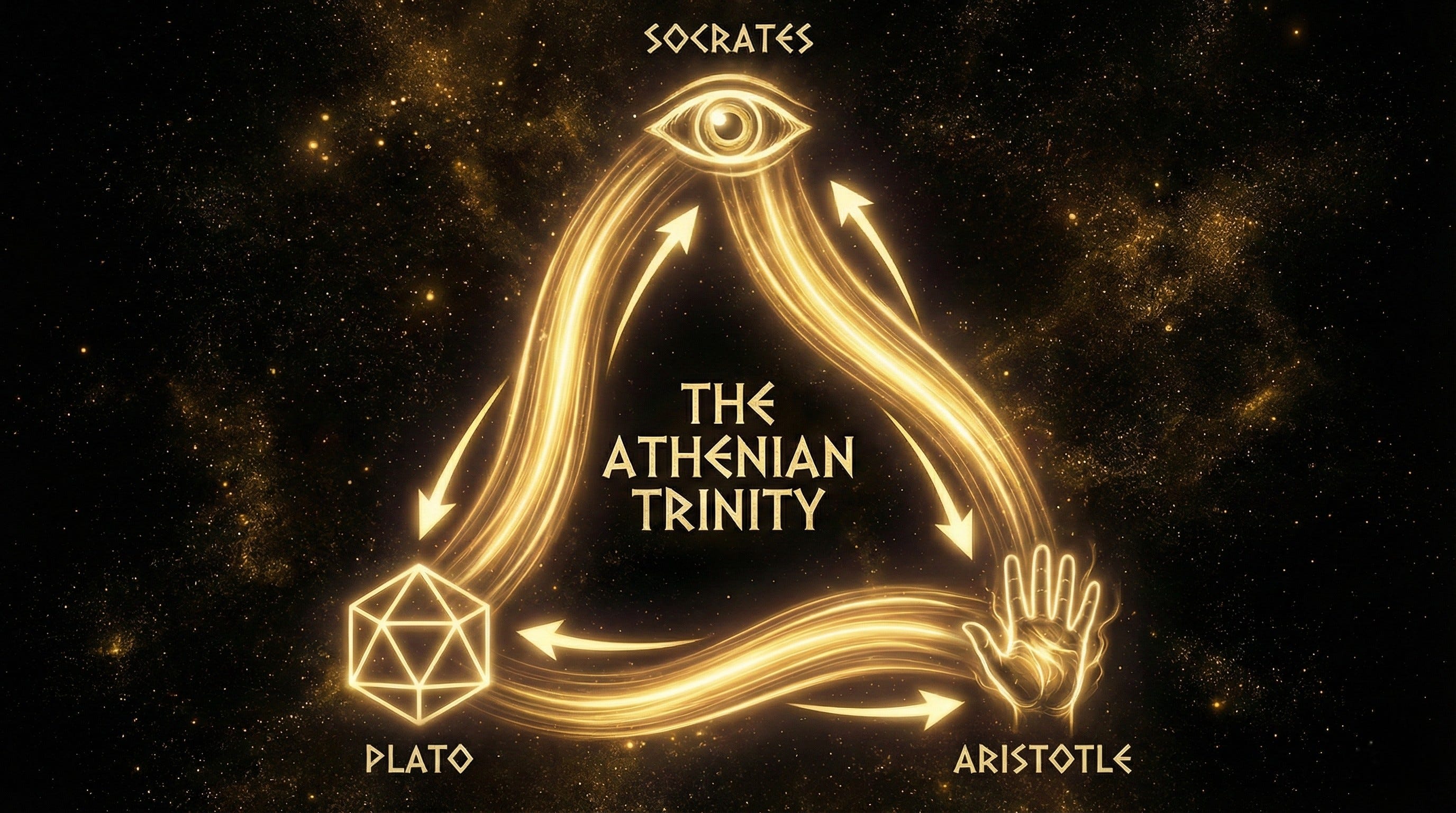
Introduction: The Misunderstanding
You learned Socrates, Plato, and Aristotle as a chronological sequence. Teacher, student, student’s student. Three great minds building on each other across generations. That’s not wrong. But it’s incomplete. What if they’re not three separate philosophers competing for your allegiance, Platonist or Aristotelian, idealist or realist, rationalist or empiricist? What if they’re three necessary movements within one complete system of knowing?
Philosophy departments teach the “progression”: Socrates laid groundwork, Plato built the system, Aristotle corrected Plato’s excesses. Linear development. Historical accident that happened to produce brilliance. But look closer. The structure isn’t accidental.
Three philosophers. Three modes of inquiry. Three branches of philosophy.
- Socrates = Epistemology (How do we know?)
- Plato = Ontology (What is real?)
- Aristotle = Teleology (What is the purpose?)
A trinity. One integrated method. I call it the Athenian Trinity.
The promise: This essay will show you:
- Why these three philosophers form a complete epistemological system
- How the same pattern appears in three ancient goddesses (ISM: Inanna-Sophia-Metis)
- Why this pattern repeats across domains (Holographic Gestalt)
- How to use the Athenian Trinity as practical method for complete knowing
Once you see this structure, you can’t unsee it. And once you recognize it, you can navigate knowledge itself more consciously. Let me show you the pattern hidden in plain sight for 2,400 years.
Part I: The Athenian Trinity As Structure
Socrates: The Question (Epistemology)
Socrates wrote nothing. He asked everything. “What is justice?” “What is virtue?” “What is knowledge?” “How do you know what you claim to know?” Genuine inquiry that exposed assumptions, dissolved certainty, revealed ignorance.
This is epistemology. The theory of knowledge. How do we know what we know? What are the grounds of our claims? What can we be certain of? Socrates doesn’t provide answers. He provides the method of questioning that makes knowledge possible. Without this movement, questioning assumptions, defining terms, examining grounds, you can’t know anything reliably. You just believe what you were told. Socrates is the foundation. Question first.
Plato: The Forms (Ontology)
Plato’s answer to Socrates’ questions. The Forms. This beautiful sunset isn’t Beauty itself. It participates in the Form of Beauty, eternal, unchanging, perfect. This just act isn’t Justice itself. It participates in the Form of Justice. Everything in this world of appearances points to a deeper reality: The world of Forms. Eternal. Unchanging. Real. This is ontology. The theory of being. What is actually real? What exists beyond appearances?
Plato’s movement. From particular to universal. From this instance to the eternal pattern. Ascent to truth. Without this movement, seeing the eternal structure beneath changing phenomena, you’re trapped in surface-level perception. You see trees but miss the forest. You see events but miss the pattern. Plato is the vision. Understand what’s real.
Aristotle: Actualization (Teleology)
Aristotle rejected Plato’s separate world of Forms. But he kept the insight: Everything has a nature, a purpose, a telos. The acorn’s telos is to become an oak. Not a pine. Not a maple. Oak. That’s its purpose, encoded in its very nature. Humans have a telos too: Eudaimonia. Flourishing. Becoming what we’re capable of becoming. Actualizing our potential. This is teleology. The theory of purpose. What is the end toward which something moves? What is it supposed to become?
Aristotle’s movement. From potential to actual. From what could be to what is. Descent into manifestation. Without this movement, actualizing understanding in purposeful action, you’re all theory, no practice. You know but don’t do. You see the pattern but don’t manifest it. Aristotle is the method. Act with purpose.
The Trinity Integrated:
These aren’t three competing philosophies. They’re three necessary movements for complete knowing:
- Question (Socrates): What am I actually dealing with? What are my assumptions?
- Understand (Plato): What’s the deeper pattern? What’s eternally true here?
- Act (Aristotle): What’s the purpose? How do I actualize this understanding?
Epistemology → Ontology → Teleology.
Question → Understand → Act.
This is the Athenian Trinity: One complete method of knowing.
Part II: ISM (Inanna, Sophia, Metis) And The Athenian Trinity
The Goddess Trinity
Before Socrates walked Athens, before Plato imagined the Forms, before Aristotle catalogued the cosmos, three goddesses taught the same pattern.
Inanna (Sumerian, ~4000 BCE): Queen of Heaven and Earth who descended to the underworld, died, and resurrected. The structure of transformation itself. Seven gates down, three days dead, seven gates up. Form → Formless → Form.
Sophia (Gnostic tradition): Divine Wisdom. Feminine principle of knowing. Not intellectual knowledge but gnosis, direct, experiential understanding of truth.
Metis (Greek): Goddess of cunning intelligence, strategic wisdom, practical knowing. Zeus’s first wife, whom he swallowed to prevent her from manifesting her wisdom.
Three goddesses. Three functions.
I call it ISM:
- Inanna = Structure (the pattern of transformation)
- Sophia = Understanding (wisdom that sees what’s real)
- Metis = Method (cunning intelligence that navigates purposefully)
The Mapping:
ISM and the Athenian Trinity aren’t separate frameworks. They’re the same structure appearing in different traditions.
Inanna ↔ Plato + Aristotle (the complete movement). Inanna contains both Platonic and Aristotelian movements within one figure.
Her descent (seven gates, stripping form, reaching the void) = Plato’s movement. Particular → Universal. Form → Formless.
Return to source.
Her ascent (resurrection, reclaiming power, returning transformed) = Aristotle’s movement. Potential → Actual. Formless → Form. Manifestation.
She IS the complete cycle Plato and Aristotle describe from opposite directions.
Sophia ↔ Plato (eternal wisdom)
Sophia = Divine Wisdom, direct knowing of eternal truth. Plato = The Forms, eternal unchanging reality.
Both point to what’s real beyond appearances. Both teach: Look beyond surface phenomena to see what’s eternally true.
Metis ↔ Aristotle (strategic action)
Metis = Cunning intelligence, strategic wisdom, knowing how to navigate. Aristotle = Practical wisdom (phronesis), knowing the right action for this situation.
Both teach: Apply wisdom purposefully. Navigate strategically. Actualize understanding in right action.
Socrates ↔ The Question Between ISM
Socrates doesn’t map to one goddess. He’s in the process of engaging ISM.
When Socrates asks “What is justice?” he’s activating:
- Inanna: What’s the structure of justice? The pattern?
- Sophia: What’s the eternal truth of justice?
- Metis: How do we practice justice strategically?
The question determines which aspect of ISM you need. Do you need to see the structure (Inanna)? Understand the eternal truth (Sophia)? Navigate purposefully (Metis)? Socrates asks the question that reveals what the moment requires. Why the same pattern in goddesses and philosophers?
Because it’s not about gender. Not about culture. Not about historical accidents. It’s about structure.
Complete knowing requires three movements:
- See/Question the structure
- Understand what’s real
- Apply/Navigate with purpose
This pattern appears:
- In goddesses (ISM – pre-rational, mythological)
- In philosophers (Athenian Trinity – rational, systematic)
- In philosophy itself (Epistemology-Ontology-Teleology)
Different content. Same structure. This is what I call Holographic Gestalt. The same pattern appearing at all scales, across all domains, because it’s fundamental. The pattern of complete knowing doesn’t change. Only its expression changes.
Part III: Socrates As Navigator
The Question Between Worlds Here’s what most philosophy courses miss. Socrates isn’t one of three equals in the trinity. He’s the driver of the other two.
Plato and Aristotle represent opposite movements:
- Plato: Particular → Universal (ascent to Forms, formless)
- Aristotle: Potential → Actual (descent to manifestation, form)
Both necessary. But which do you use when? Socrates is the question that determines direction.
Some moments require Plato:
- Return to first principles
- Strip away assumptions
- See the eternal pattern
- Ascent to truth
Some moments require Aristotle:
- Actualize understanding
- Take purposeful action
- Manifest in reality
- Descent to practice
How do you know which? Ask the Socratic question. What am I actually dealing with here? If the answer is, “I’m lost in particulars, can’t see the pattern” → Plato. Ascend to the universal. If the answer is, “I understand the pattern but haven’t acted” → Aristotle. Descend to actualization. The question reveals what the situation requires. This is why the trinity is three, not two.
Without Socrates, you’re forced to choose. Am I a Platonist or Aristotelian? Idealist or realist? But that’s fragmentation. Socrates integrates them by making the choice contextual. Which movement does this moment need?
The question navigates between eternal truth and purposeful action. That’s the role of Socrates in the Athenian Trinity. Not one of three philosophers. But the question that drives between the other two. The navigator. The integrator. The one who asks. Which way now?
Part IV: Practical Application
How to Use the Athenian Trinity This isn’t just historical insight. It’s operational technology.
Here’s how to apply it. When facing any question, problem, or decision:
Step 1: Socrates (Question/Define)
What am I actually dealing with?
- What are my assumptions?
- What terms need defining?
- What question am I actually asking?
Don’t skip this. Most people solve the wrong problem because they never questioned what the problem actually is. Socrates first. Always.
Step 2: Plato or Aristotle? (Determine direction)
After questioning, ask:
Do I need to ascend (Plato)?
- Return to first principles
- See the eternal pattern
- Understand the deeper structure
- Strip away particulars to see universal
Or do I need to descend (Aristotle)?
- Actualize understanding
- Take purposeful action
- Manifest in concrete reality
- Apply universal to this particular situation
Sometimes you need both (Plato first to understand, then Aristotle to act). But the Socratic question reveals the priority.
Step 3: Integrate (Use the complete trinity)
Once you’ve questioned (Socrates), understood the pattern (Plato), and identified the purpose (Aristotle), you have complete knowing.
Integrated wisdom:
- You know what you’re dealing with (questioned)
- You understand the eternal truth beneath it (pattern recognized)
- You can act purposefully (telos identified)
That’s the Athenian Trinity in practice.
Example: Career Decision
You’re unhappy at work. Should you quit?
Socrates: What am I actually asking? Is this about the job, or about something deeper? What do I mean by “unhappy”? What are my assumptions about work, meaning, success?
Plato: What’s the eternal pattern here? What’s my telos as a human being? What does flourishing actually look like? Is this job aligned with my nature, or am I trying to actualize someone else’s vision?
Aristotle: Given this understanding, what’s the right action? What’s the next purposeful step? How do I actualize my understanding in concrete reality?
The Athenian Trinity gives you:
- Clarity (Socrates’ questioning)
- Wisdom (Plato’s pattern recognition)
- Right action (Aristotle’s purposeful response)
Complete knowing. Integrated decision.
Example: Understanding a Text
You’re reading philosophy, mythology, or any complex text.
Socrates: What is this actually saying? What are the key terms? What assumptions does the author make?
Plato: What’s the deeper pattern? How does this relate to eternal questions? What universal truth is being expressed through this particular text?
Aristotle: How do I apply this? What’s the purpose of this teaching? How does it help me live better, act more wisely, flourish more fully?
Part V: Why This Matters
The Integration of Opposites
For 2,400 years, Western philosophy has framed Plato and Aristotle as opponents. Idealism vs. Realism. Rationalism vs. Empiricism. Theory vs. Practice. Pick a side. Defend your position. Argue against the other. That is fragmentation.
The Athenian Trinity shows they’re not opponents. They’re complementary movements within one complete system.
- Plato without Aristotle = All vision, no manifestation. Pure theory, no practice.
- Aristotle without Plato = All action, no wisdom. Purposeful movement toward the wrong ends.
- Both without Socrates = No way to know when to use which. Forced binary choice instead of contextual navigation.
Together, they’re complete.
And this pattern, integration of apparent opposites through a third element, appears everywhere:
- ISM: Inanna (structure), Sophia (understanding), Metis (method)
- RCIR: Recognize, Choose, Integrate, Repeat
Same pattern. Different domains. Learning to see this pattern, the Athenian Trinity, teaches you to see structure itself. Not just content (what Socrates said, what Plato believed, what Aristotle taught). In structure (the three-fold movement of complete knowing).And once you see structure, you see it everywhere. That’s Holographic Gestalt. That’s pattern recognition. That’s wisdom. The Gift of Athens
Socrates questioned what everyone assumed. Plato showed eternal truth beneath changing appearances. Aristotle taught purposeful action toward human flourishing. Together, they gave us a complete method of knowing. As a structure to embody. As a philosophy to study. But as epistemology to practice. The Athenian Trinity isn’t just history. It’s how to think completely. How to know truly. How to act wisely. Question. Understand. Act. Socrates. Plato. Aristotle. The trinity hidden in plain sight for twenty-four centuries.
Conclusion: The Pattern That Connects (300-400 Words)
The Athenian Trinity. Three philosophers who walked the streets of Athens 2,400 years ago. But they weren’t just building separate philosophies. They were enacting a pattern.
The same pattern that appears in:
- Three ancient goddesses (ISM)
- The structure of philosophy itself (Epistemology-Ontology-Teleology)
Question → Understand → Act.
Socrates → Plato → Aristotle.
Inanna → Sophia → Metis.
Different content. Same structure. This is Holographic Gestalt. The pattern repeating because it’s fundamental. The structure of how knowing actually works.
To know anything completely:
- Question it (examine assumptions, define terms)
- Understand it (see the pattern, recognize what’s real)
- Act on it (apply purposefully, manifest wisely)
The Athenian Trinity teaches this. As lived practice. Socrates questioned until he was executed for it. Plato built an Academy that lasted 900 years teaching eternal truth. Aristotle tutored Alexander the Great and catalogued the known world. Three lives. Three movements. One complete wisdom. And now it’s yours. To use. To embody actively. The Athenian Trinity awaits. Question everything. Understand what’s real. Act with purpose. That’s how you know. That’s how you live. That’s the gift of Athens.
@ 2026 Lee Greene