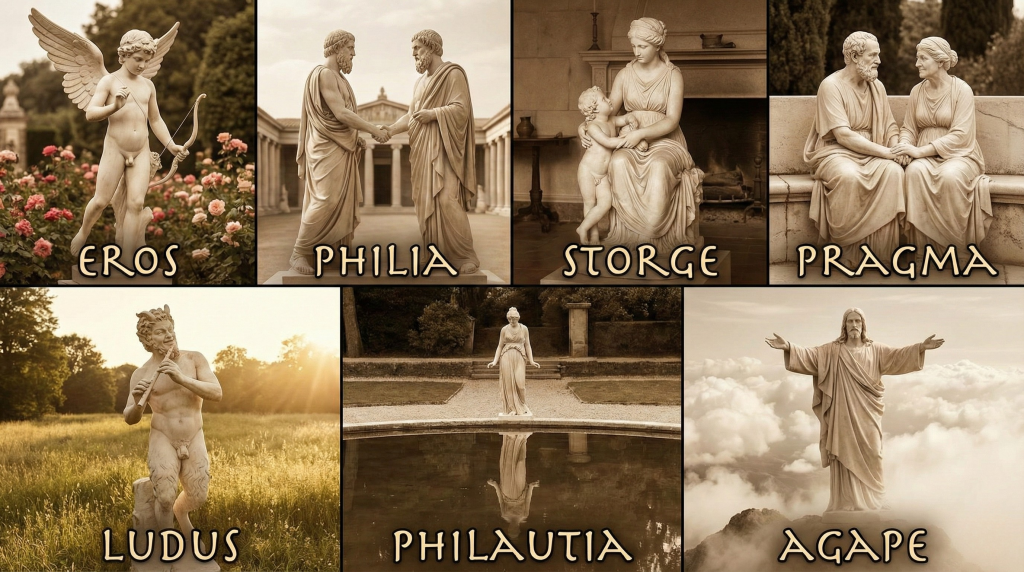
Introduction: Why Modern Love Fails
We’ve reduced love to one thing. Romance. Passion. Eros. The butterflies. The intensity. The feeling of “falling.” And we expect that one type of love to sustain us for fifty years. To be everything we need from human connection. No wonder modern relationships collapse under impossible expectations. The Greeks knew better.
They didn’t have one word for love. They had seven.
- Eros. Passionate romantic desire.
- Philia. Deep friendship between equals.
- Storge. Unconditional familial love.
- Pragma. Mature commitment over time.
- Ludus. Playful flirtatious connection.
- Philautia. Love of self.
- Agape. Unconditional divine love.
Seven types. Each with its own function. Each essential. The Greeks understood: complete love requires ALL seven. Not all from one person. But all present in your life. Modern culture forgot this. We expect romantic partners to provide all seven types. To be a lover, best friend, family, therapist, playmate, life coach, and unconditional validator. One person. Seven impossible jobs.
When they inevitably can’t be all of that, we think:
- The relationship failed
- We chose the wrong person
- Love doesn’t last
- We’re broken
None of that is true. What failed is our understanding of love. We’re operating with one-seventh of the framework the Greeks had. This essay restores the complete framework. All seven types. What each does. Why you need all of them. And which one makes all the others possible.
Part 1: The Seven Types Explained
Let me break down each type.
1. Eros: Passionate Romantic Love
Eros is a passionate desire. Physical attraction. Emotional intensity. The pull toward union with another person. This is what most people mean when they say “I’m in love.” The butterflies. The obsession. The feeling that this person completes you. Eros is about merger. Becoming one. Dissolving boundaries between self and other.
Eros operates through:
- Chemical attraction (dopamine, oxytocin, biological bonding)
- Projection (seeing in the other what you long for)
- Intensity (heightened emotional state that feels transcendent)
It creates a pull so strong you can’t resist it. This is evolutionary design. Eros drives pair bonding, reproduction, species continuation. But Eros is initiatory, not sustaining. It creates the spark. But it doesn’t maintain the fire long-term. Passion naturally fluctuates. Intensity can’t be sustained indefinitely. Eros means: “I am incomplete. You make me whole.” It’s the recognition of separation and the desperate desire to END that separation through union with another. Eros is beautiful. Powerful. Essential. But Eros Alone is insufficient.
Because the wholeness you’re seeking through merger? The other person can’t actually provide it. They can symbolize it. But they can’t be it. This is why Eros-based relationships often fail once the initial intensity fades. The person couldn’t complete you. Because no person can. A common misunderstanding is that people think Eros is love itself. Actually, eros is one type of love. The initiatory pull. Not the whole.
2. Philia: Deep Friendship
Philia is the love between equals. Mutual respect. Shared values. Loyalty. Deep friendship. Aristotle considered this the highest form of love between humans because it’s based on seeing each other clearly and choosing connection anyway. Not projection (like Eros). But recognition.
Philia operates through:
- Reciprocity (mutual give-and-take)
- Shared interests/values (common ground)
- Respect for boundaries (you remain distinct individuals)
Unlike Eros (which seeks merger), Philia maintains distinction while creating connection. “I see you AS you are. Not as I want you to be. And I choose you.” This is sustainable because it doesn’t depend on intensity or fantasy. Philia means: “You’re my equal. I respect you. I choose you.” It’s love based on who the person actually is, not who you need them to be.
This is what sustains romantic relationships after Eros fades. You might not feel butterflies anymore. But you genuinely LIKE this person. Respect them. Enjoy their company. A common misunderstanding is that people think Philia is the “friendship zone” (less than romantic love). Actually, philia is essential to lasting romantic partnerships. Eros initiates. Philia sustains.
3. Storge: Familial Love
Storge is unconditional family love. Parent to child. Siblings. The love that exists simply because you belong to each other. You don’t earn it. You don’t deserve it. It’s just given.
Storge operates through:
- Proximity (shared life, shared space)
- Natural bonding (biological/social ties)
- Acceptance without performance (you belong regardless of achievement)
This is the love that provides the foundation. You’re safe. You’re accepted. You don’t have to prove yourself. Storge means: “You belong here. Always. No matter what.” This is the baseline security humans need to thrive. In romantic relationships, Storge is the “I’ve got you” safety. When everything else fails, passion fades, disagreements happen, life gets hard, Storge says: “We’re still family. You still belong here.” A common misunderstanding is that People think Storge is an “obligation love” (you HAVE to love family). Healthy Storge is chosen for unconditional acceptance and love. Not an obligation. A gift.
4. Pragma: Enduring Love
Pragma is mature, enduring love. The love that sustains over decades. Long-term commitment. Partnership built through daily choice. Not based on feeling (which fluctuates) but on decision.
Pragma operates through:
- Conscious commitment (choosing daily, regardless of emotion)
- Shared goals and life-building
- Acceptance of imperfection (you’re both flawed, you choose each other anyway)
Pragma is what keeps couples together for fifty years. Not because they feel butterflies every day. But because they choose each other every day. Pragma means that “I choose you. Today. Tomorrow. Through all of it.” This is love as practice, not just feeling. When Eros fades (and it will), when life gets difficult (and it will), Pragma is what remains. The deliberate, sustained choice to love. A common misunderstanding is that people think Pragma is “settling” (staying because you’re too old/tired to leave). Actually, pragma is mature LOVE. Choosing partnership consciously, not just riding the high of Eros.
5. Ludus: Playful Love
Ludus is playful, flirtatious love. Teasing. Lightness. Joy in connection without heaviness or seriousness. The Greeks considered this essential, not frivolous.
Ludus operates through:
- Humor and playfulness
- Lack of heavy expectations
- Delight in the other person without needing them to be anything specific
Ludus keeps relationships alive. Without it, love becomes duty, obligation, work. With it, there’s lightness even in commitment. Ludus means that “I delight in you. This is fun.” In long-term relationships, Ludus is what prevents stagnation. You can be committed (Pragma) and playful (Ludus). You can be deeply bonded (Storge) and flirtatious (Ludus). Ludus adds joy.A common misunderstanding is that people think Ludus is like a “casual fling” (not serious love). Ludus is necessary even in serious commitments. Play prevents relationship death.
6. Philautia: Self-Love
Philautia is love of self. Two types, healthy and unhealthy. Healthy Philautia is self-respect, self-compassion, recognizing your own worth. Unhealthy Philautia is narcissism, self-obsession at others’ expense. The Greeks valued healthy Philautia as essential.
Healthy Philautia operates through:
- Treating yourself as worthy of care
- Setting boundaries (protecting your own wellbeing)
- Not seeking validation from others to feel whole
Unhealthy Philautia operates through:
- Using others to prop up a fragile ego
- Inability to see others as equally valuable
- Constant need for external validation masked as “self-love”
Healthy Philautia means: “I am worthy of love. Starting with my own.” This is the prerequisite for all other loves. You can’t genuinely love another if you don’t love yourself. Because you’ll use them to fill the void. You’ll make them responsible for your worth. And they can’t carry that. Common Misunderstanding: People think Philautia is “selfish” or “narcissistic.” Healthy Philautia is necessary. Self-love enables you to love others without grasping.
7. Agape: Unconditional Divine Love
Agape is unconditional love. Given freely. Expects nothing. Demands nothing. The Greeks considered this the highest form of love. Not human effort but divine nature.
Agape operates through:
- Wholeness (loving FROM completeness, not TOWARD it)
- No expectation of return (given as overflow, not transaction)
- Universal extension (not limited to specific people)
Agape doesn’t seek. All the other types seek something (merger, recognition, belonging, commitment, play, self-worth). Agape seeks nothing. Because it flows from already being whole.
Agape means: “I love you because love is what I AM. Not because of what you give me.” This is the only love that never fails. Not because it tries harder. Because it doesn’t need anything from the other person to remain intact. A common misunderstanding is that people think Agape is “trying to love everyone unconditionally” (like a spiritual effort). Actually, agape flows naturally when you recognize you’re already whole. It’s not supposed to be an effort. It’s supposed to be an overflow of love.
Part 2: Why You Need All Seven
Modern relationships fail because we expect one type (usually Eros) to provide all seven functions.Let’s see why that’s impossible.
Expecting Eros Alone:
You meet someone. Butterflies. Passion. Intensity.
You think: “This is IT. This is LOVE.”
And you expect that feeling to:
- Sustain passion (Eros)
- Provide deep friendship (Philia)
- Offer unconditional safety (Storge)
- Create lifelong commitment (Pragma)
- Keep things playful (Ludus)
- Validate your worth (Philautia)
- Give unconditional acceptance (Agape)
One type. Seven jobs. Eros can’t do that. Eros is DESIGNED to initiate. To create the pull. To spark connection. But Eros naturally fluctuates. Passion comes and goes. When it goes (and it will), if that’s ALL you had, the relationship feels empty. “The spark is gone. We fell out of love.” No. Eros faded. Which is normal. But if you never developed Philia, Storge, Pragma, Ludus? There’s nothing left when Eros dims.
Complete Love Requires All Seven
Eros initiates the connection. Philia sustains it through genuine friendship. Storge provides unconditional safety. Pragma commits through the hard times. Ludus keeps it alive and joyful. Philautia ensures you’re not using the other to fill your own void. Agape flows from wholeness, making all the others sustainable. All seven. Not all from one person. But all present in your life.
Your romantic partner might provide Eros, Philia, Pragma, and Ludus. Your family provides Storge. You cultivate Philautia within yourself. Agape is the foundation you rest in. This is complete love. Not expecting one relationship to be everything. But having all seven types active across your life.
Part 3: Agape as Foundation
Here’s the crucial insight the Greeks understood: Six types Seek. One type doesn’t. And that makes all the difference.
The Seeking Types:
- Eros seeks merger (“I need to be one with you”)
- Philia seeks recognition (“I need you to see me”)
- Storge seeks belonging (“I need to know I’m accepted”)
- Pragma seeks commitment (“I need you to choose me”)
- Ludus seeks play (“I need joy with you”)
- Philautia seeks self-worth (“I need to know I’m valuable”)
All six SEEK something outside themselves. And when they don’t find it, they fail.
- Eros fails when a merger isn’t achieved.
- Philia fails when recognition is withdrawn.
- Storge fails when belonging is threatened.
- Pragma fails when commitment ends.
- Ludus fails when life gets too serious.
- Philautia fails when you can’t prove your worth to yourself.
Seeking creates vulnerability.
Agape: The Non-Seeking Love
Agape is different. It doesn’t seek merger, recognition, belonging, commitment, play, or worth. Because Agape flows from wholeness. It’s not trying to get anything. It’s giving from overflow.
When you love from Agape:
- You don’t need the other person to complete you (you’re already complete)
- You don’t need them to validate you (you already know your worth)
- You don’t need them to stay forever (you’re whole with or without them)
- You don’t need anything FROM them (you’re loving AS overflow, not seeking)
This is the only sustainable foundation. Because it doesn’t depend on the other person providing something you lack.
What Happens When Agape Is the Foundation
When you rest in Agape (wholeness), all six other types transform:
- Eros can express passion without needing merger to feel whole.
- Philia can connect without needing validation to feel seen.
- Storge can offer safety without needing to receive it back.
- Pragma can commit without needing guarantees.
- Ludus can play without needing constant delight.
- Philautia can love self without needing to prove worth.
All six become expressions instead of seeking. They flow from wholeness instead of toward it. That’s sustainable. That’s the only love that never fails.
Part 4: Practical Application
So how do you actually use this framework?
Step 1: Assess Which Types You’re Strong In
Look at your current relationships (romantic, friendships, family):
- Eros: Do you experience passion, attraction, desire for connection?
- Philia: Do you have deep friendships based on mutual respect?
- Storge: Do you feel unconditionally accepted somewhere?
- Pragma: Can you commit long-term even when feelings fluctuate?
- Ludus: Do you play, tease, enjoy lightness in relationships?
- Philautia: Do you genuinely love and respect yourself?
- Agape: Can you love without needing anything in return?
Most people are strong in 2-3 types and weak/absent in the others.
Step 2: Identify What’s Missing
Where are the gaps?
- Missing Eros? You might have stable relationships but no passion. Life feels flat.
- Missing Philia? You might have intensity but no real friendship. Relationships feel shallow.
- Missing Storge? You might feel like you don’t belong anywhere. Always proving yourself.
- Missing Pragma? You might struggle with commitment. Relationships don’t last.
- Missing Ludus? Life feels heavy. Relationships feel like work, not joy.
- Missing Philautia? You seek worth from others. Relationships feel desperate.
- Missing Agape? All other loves feel like seeking. Exhausting. Never enough.
Step 3: Develop the Missing Types
You can’t force all seven from one person. But you can cultivate all seven across your life:
- To develop Eros: Allow yourself to desire. Don’t numb passion. Engage attraction consciously.
- To develop Philia: Build friendships based on mutual respect and shared values. Choose friends who SEE you.
- To develop Storge: Create or find chosen family. People who accept you unconditionally.
- To develop Pragma: Practice commitment. Choose someone/something daily, regardless of feeling.
- To develop Ludus: Play. Tease. Don’t take everything so seriously. Find delight.
- To develop Philautia: Treat yourself as worthy. Set boundaries. Stop seeking validation externally.
- To develop Agape: Recognize you’re already whole. Love flows from there, not toward completion.
Step 4: Stop Expecting One Person to Provide All Seven
This is the biggest shift.
Your romantic partner doesn’t need to be:
- Your passionate lover (Eros)
- Your best friend (Philia)
- Your unconditional family (Storge)
- Your lifelong commitment (Pragma)
- Your playmate (Ludus)
- Your source of worth (Philautia)
- Your spiritual completion (Agape)
They can provide some of these.
The rest come from:
- Friends (Philia)
- Family (Storge)
- Yourself (Philautia)
- Source/Wholeness (Agape)
Complete love is all seven types present in your life. But they don’t all have to be from one person.
Step 5: Build Agape as Foundation
This is the practice: Recognize you’re already whole. Already whole.
When you rest there:
- Eros becomes expression, not desperate seeking
- Philia becomes genuine connection, not need for validation
- Storge becomes gift, not demand
- Pragma becomes choice, not clinging
- Ludus becomes natural, not forced
- Philautia becomes obvious, not effort
All six flow from Agape. That’s the foundation. That’s the only love that never fails.
Conclusion: The Complete Framework
The Greeks gave us seven types of love.
- Eros initiates through passion.
- Philia sustains through friendship.
- Storge grounds through unconditional belonging.
- Pragma commits through daily choice.
- Ludus enlivens through play.
- Philautia empowers through self-love.
- Agape flows from wholeness.
Modern love fails because we’re using one-seventh of the framework. We expect Eros to do the work of seven. It can’t. But when you understand all seven? When you stop expecting one person to provide everything? When you cultivate all seven types across your life? When you rest in Agape as foundation? Love becomes sustainable. Because you’re not asking one type to carry the weight of seven. You’re not asking one person to complete you. You’re loving FROM wholeness, not TOWARD it. That’s the Greek framework.