Why the small fraction of life where you’re actually conscious holds the key to transforming everything else
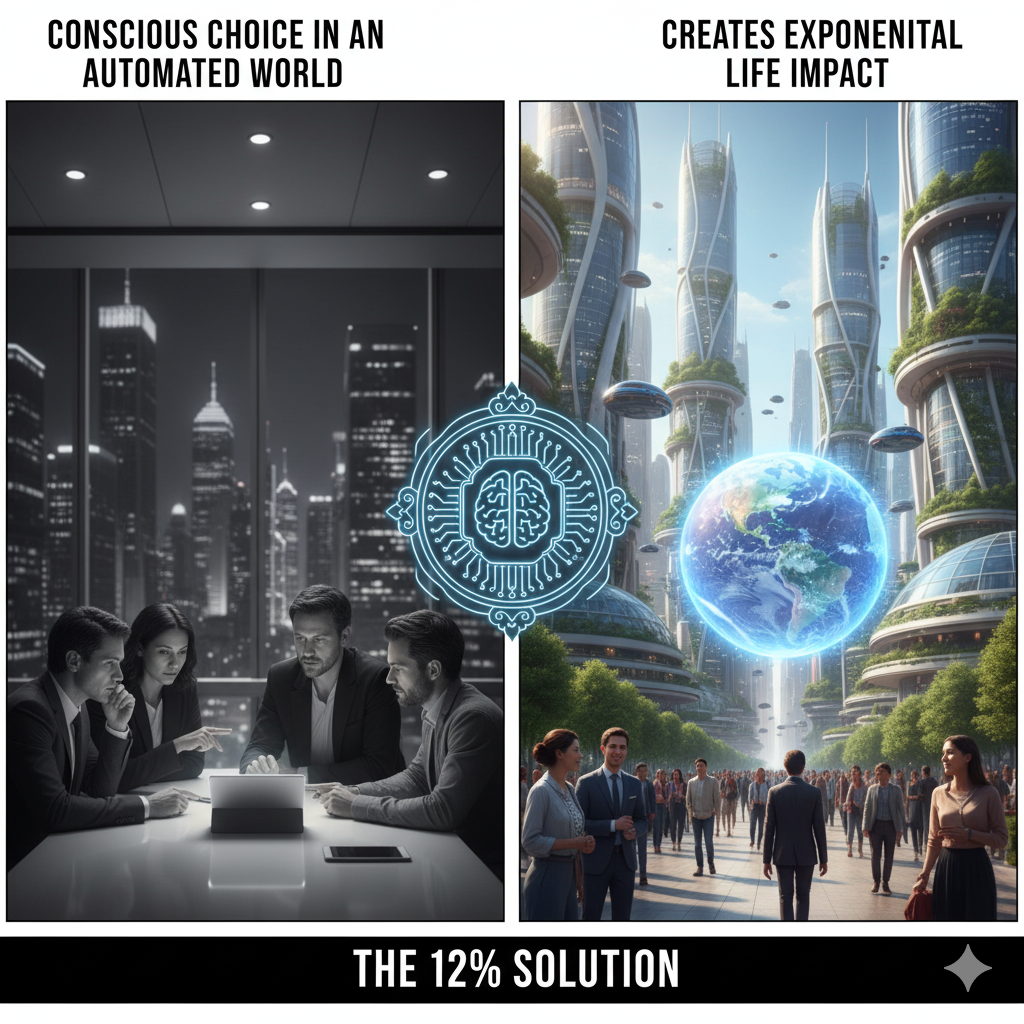
Published on consciouschoicemastery.com | Approx. 10-12 min read
You wake up, brush your teeth, make coffee, check your phone, drive to work. How much of that morning routine did you actually think about? According to groundbreaking new research from behavioral scientists across three countries, the answer is both shocking and liberating: almost none of it.
Scientists tracked 105 people for a week and discovered that nearly 90% of daily actions happen automatically, without conscious thought. Only about 12% of your daily behaviors involve genuine conscious decision-making. The rest runs on what researchers call “autopilot”—automatic habits triggered by environmental cues and executed without deliberate consideration.
This isn’t a problem to solve. It’s a leverage opportunity to master.
The research reveals why conscious choice methodology isn’t just helpful—it’s the only rational approach to life optimization. When 88% of your actions happen automatically, that small fraction where you’re actually conscious becomes exponentially powerful. Your conscious choices don’t just affect immediate decisions; they design the automatic systems that run most of your life.
Understanding this research transforms everything about how strategic people approach personal effectiveness, goal achievement, and life satisfaction. The implications are profound and immediately actionable.
The Autopilot Reality: What Living 88% Unconsciously Actually Means
The Columbia University research, published in Psychology & Health, used real-time tracking to capture exactly how much of everyday life operates without conscious oversight. Participants received text prompts six times daily over seven days, reporting what they were doing and how automatic versus deliberate their actions felt.
The results challenge fundamental assumptions about human agency:
88% of daily behaviors were “habitually executed” – performed with minimal conscious oversight. People brushed teeth, drove familiar routes, responded to emails, and completed routine tasks essentially on mental autopilot.
65% of behaviors were “habitually instigated” – triggered automatically by environmental cues rather than deliberate decision-making. Phone notifications triggered phone checking. Kitchen sights triggered snacking. Stress feelings triggered familiar coping behaviors.
Only about 12% involved conscious deliberation – the small fraction where people actively considered options and made intentional choices about what to do and how to do it.
Personal characteristics made no difference – age, gender, and marital status had no bearing on automaticity levels. Everyone operates primarily on autopilot regardless of demographic factors.
This research quantifies what efficiency experts have long suspected: most human behavior operates through pattern recognition and habit execution rather than conscious analysis. Your brain has essentially automated most of existence to free cognitive resources for novel challenges and opportunities.
But here’s the crucial insight: This automation isn’t random. It’s programmable.
The patterns running automatically weren’t installed by accident. They developed through repeated conscious choices that became habitual over time. Your current autopilot system reflects thousands of previous conscious decisions about how to respond to recurring situations.
This means your conscious choices have compound effects far beyond their immediate impact. Every conscious decision doesn’t just affect that moment—it influences the automatic patterns that will handle similar situations in the future.
The strategic implication: Since conscious choice occurs only 12% of the time but programs the systems running the other 88%, conscious choice methodology becomes exponentially more important than it initially appears.
The Consciousness Leverage Point: How 12% Can Reshape 88%
The research reveals why conscious choice creates disproportionate life impact: conscious decisions function as programming instructions for automatic systems. When you make conscious choices strategically, you’re essentially writing software that will run automatically thousands of times in the future.
Consider how this leverage operates in practice:
Habit Installation Through Conscious Choice
When you consciously decide to exercise at a specific time and place consistently, you’re not just exercising once. You’re installing a habit system that will automatically trigger exercise behaviors in response to time and location cues. That single conscious decision programs hundreds of future automatic exercise sessions.
The research confirms this: exercise was more likely to be habitually triggered than other behaviors, suggesting people successfully convert conscious exercise decisions into automatic systems that initiate workouts without requiring ongoing conscious willpower.
Environmental Design Through Conscious Choice
When you consciously arrange your environment—placing healthy snacks at eye level, putting your phone in another room, or organizing your workspace for efficiency—you’re programming automatic behaviors that will occur every time you encounter those environments.
65% of behaviors were automatically triggered by environmental cues. This means conscious environmental design choices create automatic behavioral outcomes thousands of times more frequently than the conscious choice itself.
Response Pattern Programming Through Conscious Choice
When you consciously choose how to respond to stress, conflict, or opportunities the first few times they occur, you’re establishing response patterns that will activate automatically in similar future situations. Your conscious choice becomes the template for automatic future responses.
The multiplication effect is remarkable: One conscious choice about how to handle interruptions at work programs automatic responses to hundreds of future interruptions. One conscious choice about communication patterns in relationships influences thousands of automatic relationship interactions.
Identity and Value Programming Through Conscious Choice
The research found that 46% of automatic behaviors aligned with people’s intentions, suggesting that conscious choices about identity and values successfully program compatible automatic behaviors. When you consciously choose to identify as “someone who exercises regularly” or “someone who treats others with respect,” those identity choices influence automatic behaviors across countless future situations.
The leverage principle becomes clear: Conscious choice methodology focuses effort on the strategic 12% that programs the automatic 88%, creating exponential rather than linear life improvements.
Strategic Habit Architecture: Working With Rather Than Against Automatic Systems
The research demolishes the common misconception that habits conflict with conscious choice. Instead, it reveals that most automatic behaviors actually serve people’s conscious intentions. Only 17% of automatic behaviors conflicted with what people wanted to do.
This finding transforms how strategic people approach behavior change and life optimization. Instead of fighting automatic systems, conscious choice methodology works with them through strategic habit architecture.
The habit architecture framework involves:
Conscious Trigger Design
Since 65% of behaviors are automatically triggered by environmental cues, conscious choice focuses on strategically designing trigger systems. Instead of relying on willpower for desired behaviors, you consciously create environmental conditions that trigger them automatically.
Practical trigger design includes:
- Time-based triggers: Scheduling desired behaviors at consistent times so temporal cues trigger automatic responses
- Location-based triggers: Associating desired behaviors with specific places so environmental cues trigger automatic responses
- Sequence-based triggers: Linking desired behaviors to existing automatic behaviors so completion of one triggers the next
- Emotional state triggers: Connecting desired behaviors to emotional states so feelings trigger productive automatic responses
Conscious Pattern Installation
The research shows that automatic behaviors develop through repetition of conscious choices. This means conscious choice methodology involves intentionally repeating desired behaviors until they become automatic rather than hoping motivation will sustain them.
Strategic pattern installation involves:
- Conscious repetition: Deliberately choosing the same response to similar situations until the response becomes automatic
- Environmental consistency: Creating stable contexts that support automatic pattern development
- Feedback integration: Using conscious choice to adjust patterns based on results until optimal responses become automatic
- Gradual complexity: Starting with simple automatic patterns and consciously building more sophisticated ones over time
Conscious System Integration
Rather than installing isolated habits, conscious choice methodology creates integrated systems where automatic behaviors support each other. The research suggests that 88% automaticity works best when automatic patterns complement rather than conflict with each other.
System integration includes:
- Compatible habit clusters: Designing automatic behaviors that reinforce rather than interfere with each other
- Resource optimization: Creating automatic patterns that use time, energy, and attention efficiently across multiple life domains
- Synergy development: Building automatic behaviors that create beneficial interactions between different life areas
- Conflict resolution: Using conscious choice to modify automatic patterns that work against each other
Conscious Maintenance and Evolution
The research demonstrates that automatic systems remain programmable through ongoing conscious choice. This means strategic people continuously refine their automatic systems rather than assuming they’re fixed once installed.
System maintenance involves:
- Regular conscious review: Periodically examining whether automatic patterns still serve conscious intentions
- Adaptive modification: Using conscious choice to adjust automatic behaviors when circumstances change
- Expansion and refinement: Consciously building on successful automatic patterns to create more sophisticated systems
- Quality improvement: Using conscious choice to enhance the effectiveness of existing automatic behaviors
The Conscious Choice Multiplier: How Intentional Decisions Compound Through Automated Execution
The research reveals the mathematical power of conscious choice: when conscious decisions program systems that run automatically, the beneficial impact multiplies exponentially. Each conscious choice affects not just one moment, but potentially thousands of automatic future moments.
The multiplication effect operates through several mechanisms:
Frequency Multiplication
Automatic behaviors occur far more frequently than conscious choices. When you consciously design an automatic behavior, that single conscious choice influences hundreds or thousands of automatic executions.
Example: One conscious choice to automatically check email only at specific times influences every email interaction for months or years. Instead of making hundreds of conscious decisions about when to check email, one conscious choice programs the system that handles all future email timing.
Efficiency Multiplication
Automatic behaviors use minimal cognitive resources, freeing mental capacity for high-value conscious choices. The research shows that 88% automaticity enables more effective use of the 12% conscious capacity.
Strategic efficiency involves:
- Automating routine decisions so conscious choice focuses on high-impact opportunities
- Creating automatic systems for maintenance activities so conscious choice addresses growth and innovation
- Building automatic responses to predictable challenges so conscious choice handles novel situations
- Installing automatic behaviors for basic needs so conscious choice pursues meaningful goals
Consistency Multiplication
Automatic behaviors maintain consistency without requiring ongoing motivation or willpower. When beneficial behaviors become automatic, they continue operating regardless of mood, energy levels, or temporary motivation fluctuations.
Consistency benefits include:
- Reliable progress toward long-term goals through automatic daily actions
- Sustained relationships through automatic positive interaction patterns
- Maintained health through automatic exercise, nutrition, and self-care behaviors
- Continued learning through automatic reading, practice, and skill development behaviors
Compound Growth Multiplication
Automatic behaviors that involve improvement create compound growth over time. When you consciously install automatic behaviors that build capability, knowledge, or relationships, the accumulated benefit grows exponentially.
Compound growth examples:
- Automatic learning behaviors that continuously build knowledge and skills over years
- Automatic relationship behaviors that steadily strengthen connections through consistent positive interactions
- Automatic health behaviors that compound physical and mental well-being over time
- Automatic creative behaviors that accumulate creative output and develop artistic capabilities
Network Effect Multiplication
The research found that automatic behaviors often align with intentions, suggesting that well-designed automatic systems create positive feedback loops with conscious goals. This alignment creates network effects where automatic and conscious systems reinforce each other.
Network effects include:
- Automatic behaviors supporting conscious goal achievement
- Conscious choices becoming easier because automatic systems create supportive contexts
- Identity reinforcement through alignment between automatic behaviors and conscious values
- Momentum building as automatic and conscious systems work together toward shared objectives
The Strategic Intervention Framework: Maximizing Conscious Choice Impact
Understanding that conscious choice occurs only 12% of the time but programs 88% of behavior creates a strategic framework for maximizing life impact through targeted interventions. The research suggests specific approaches for making conscious choices exponentially effective.
High-Leverage Decision Identification
Since conscious choice is rare and precious, strategic people focus conscious decision-making on choices with maximum multiplication potential. The research suggests conscious choice has greatest impact when it programs systems that will run frequently and importantly in the future.
High-leverage conscious choices include:
System design decisions: Conscious choices about how to structure environments, schedules, and routines that will influence thousands of future automatic behaviors.
Response pattern decisions: Conscious choices about how to handle recurring situations that will automatically apply to similar future situations.
Identity and value decisions: Conscious choices about personal identity and priorities that will influence automatic behavior selection across diverse contexts.
Relationship pattern decisions: Conscious choices about communication and interaction styles that will automatically influence thousands of future relationship moments.
Timing Optimization for Conscious Choice
The research reveals that conscious choice effectiveness varies based on when it occurs. Strategic people optimize timing to maximize the programming impact of conscious decisions.
Optimal timing includes:
Transition periods: Making conscious choices during life transitions when automatic systems are naturally disrupted and most programmable.
Pattern establishment: Using conscious choice intentionally during the first few repetitions of new behaviors when habit patterns are forming.
System failures: Applying conscious choice when existing automatic systems produce unsatisfactory results and need reprogramming.
Energy peak periods: Making important conscious choices when mental resources are highest and decision quality is optimal.
Environmental Programming Strategy
Since 65% of behaviors are triggered by environmental cues, conscious choice methodology prioritizes environmental design as a high-impact intervention. Strategic conscious choices about environment program thousands of automatic behavioral responses.
Environmental programming includes:
Physical environment design: Consciously arranging spaces to trigger desired automatic behaviors and discourage undesired ones.
Digital environment design: Consciously configuring technology interfaces to promote beneficial automatic interactions.
Social environment design: Consciously building relationships and communities that trigger positive automatic behaviors.
Temporal environment design: Consciously structuring schedules and routines that create beneficial automatic behavioral sequences.
Feedback Loop Installation
The research suggests that effective automatic systems remain responsive to conscious adjustment. Strategic people install feedback mechanisms that enable ongoing conscious refinement of automatic systems.
Feedback loop design includes:
Outcome monitoring: Consciously tracking whether automatic behaviors produce desired results.
Pattern recognition: Consciously identifying when automatic behaviors need modification based on changed circumstances.
System evolution: Using conscious choice to continuously improve automatic behaviors rather than maintaining static patterns.
Quality enhancement: Consciously refining automatic behaviors to increase their effectiveness and satisfaction.
The Exercise Exception: When Automatic and Conscious Systems Work Together
The research revealed something particularly interesting about exercise: it was more likely to be habitually triggered than other behaviors, but less likely to be performed automatically once started. This finding provides insights into how conscious and automatic systems can work together optimally.
The exercise pattern suggests a sophisticated relationship between conscious and automatic systems:
Automatic Initiation, Conscious Execution
Many effective people successfully automate the decision to exercise while maintaining conscious control over the exercise itself. Automatic systems handle the “whether” and “when” of exercise, while conscious systems handle the “how” and “how much.”
This hybrid approach offers several advantages:
- Reduced decision fatigue around whether to exercise, since the automatic system handles initiation
- Maintained flexibility in exercise type, intensity, and duration based on current conditions and goals
- Sustained motivation through conscious engagement with the exercise activity itself
- Adaptability to changing fitness levels, interests, and circumstances through conscious modification
Strategic Automation Design
The exercise exception demonstrates strategic thinking about what to automate versus what to keep conscious. Effective people consciously decide which aspects of behavior benefit from automation and which benefit from ongoing conscious control.
Strategic automation principles include:
Automate barriers, not experiences: Make starting beneficial behaviors automatic while keeping the experience itself engaging and conscious.
Automate decisions, not adaptation: Use automatic systems for routine decisions while maintaining conscious flexibility for optimization and improvement.
Automate initiation, not execution: Create automatic triggers for important behaviors while preserving conscious control over how they’re performed.
Automate consistency, not creativity: Install automatic systems that ensure regular engagement while preserving conscious space for innovation and enjoyment.
The Conscious-Automatic Partnership
The research suggests that optimal performance often requires partnership between conscious and automatic systems rather than dominance by either. Strategic people design these partnerships consciously rather than letting them develop randomly.
Effective partnerships include:
- Automatic systems handling routine and maintenance functions
- Conscious systems addressing novel challenges and optimization opportunities
- Feedback mechanisms enabling conscious systems to improve automatic systems over time
- Flexibility protocols allowing conscious systems to override automatic systems when circumstances require adaptation
Modern Implications: Why Conscious Choice Methodology is More Critical Than Ever
The autopilot research has profound implications for how people approach effectiveness, goal achievement, and life satisfaction in contemporary contexts. Modern environments create both unprecedented opportunities and challenges for conscious choice methodology.
Information Overwhelm and Conscious Choice Scarcity
Modern environments bombardment people with information and decisions that can exhaust conscious choice capacity. The research suggests that conscious choice is already limited to about 12% of daily behavior. Information overwhelm threatens to reduce this percentage further by consuming conscious resources on low-impact decisions.
Strategic response includes:
Decision reduction: Consciously reducing the number of low-impact decisions to preserve conscious choice capacity for high-leverage opportunities.
Automatic filtering: Installing automatic systems that filter information and opportunities, presenting only high-value options for conscious consideration.
Attention protection: Creating environmental and behavioral barriers that protect conscious choice capacity from constant minor interruptions.
Priority clarification: Using conscious choice to establish clear priorities that guide automatic filtering and decision-making systems.
Technology Design and Automatic Behavior Programming
Modern technology environments are explicitly designed to trigger automatic behaviors, often in ways that don’t serve users’ conscious intentions. The research reveals why understanding and designing automatic systems is crucial for maintaining agency in technology-rich environments.
Strategic technology relationship includes:
Conscious technology design: Actively configuring devices, applications, and digital environments to trigger beneficial rather than compulsive automatic behaviors.
Automatic technology barriers: Installing systems that require conscious choice for potentially problematic technology uses while making beneficial uses automatic.
Attention sovereignty: Maintaining conscious control over when and how technology can interrupt and influence automatic behavioral patterns.
Value alignment verification: Regularly using conscious choice to evaluate whether technology-triggered automatic behaviors align with conscious intentions and values.
Social Environment Programming
Modern social environments, both digital and physical, increasingly influence automatic behavioral patterns. The research suggests that 65% of behaviors are environmentally triggered, making social environment design a critical conscious choice priority.
Strategic social environment design includes:
Relationship curation: Consciously building relationships that trigger positive automatic behaviors and reducing exposure to relationships that trigger negative automatic patterns.
Community selection: Choosing social environments where beneficial behaviors are normalized and automatically reinforced.
Communication pattern establishment: Consciously designing automatic responses to social situations that align with values and goals.
Influence filtering: Creating systems that enable conscious evaluation of social influences before they program automatic behavioral responses.
Economic System Navigation
Modern economic systems often conflict with conscious choice by creating automatic behaviors that serve commercial rather than personal interests. The research provides frameworks for maintaining conscious agency within systems designed to influence automatic behavior.
Strategic economic navigation includes:
Consumption automation: Consciously programming automatic purchasing and consumption behaviors that serve health and financial goals rather than responding to marketing triggers.
Financial system design: Creating automatic financial behaviors that build wealth and security rather than consumption and debt.
Work pattern optimization: Designing automatic work behaviors that build capability and provide satisfaction rather than just meeting minimum requirements.
Value creation focus: Using conscious choice to prioritize activities that create rather than merely consume value.
Practical Implementation: The Conscious Choice Efficiency Protocol
The research provides specific guidance for implementing conscious choice methodology that maximizes the 12% for programming the 88%. This protocol enables systematic application of consciousness leverage principles.
Phase 1: Automatic Behavior Audit (Week 1)
Before programming new automatic systems, strategic people conduct systematic audits of existing automatic behaviors to identify optimization opportunities.
Audit methodology:
Behavior tracking: Monitor automatic behaviors for several days, noting what triggers them and whether they align with conscious intentions.
Impact assessment: Evaluate which automatic behaviors significantly influence important life outcomes and which consume resources without proportional benefit.
Conflict identification: Identify automatic behaviors that work against each other or against conscious goals.
Opportunity recognition: Look for recurring conscious decisions that could benefit from automation and recurring automatic behaviors that need conscious modification.
Phase 2: Strategic Programming Design (Week 2)
Based on audit results, design conscious interventions that will program improved automatic systems.
Design methodology:
High-impact priority: Focus conscious programming efforts on automatic behaviors that occur frequently and significantly affect important outcomes.
Trigger optimization: Design environmental and contextual triggers that will reliably initiate desired automatic behaviors.
Pattern specification: Define specific automatic behavior patterns that will advance conscious goals while requiring minimal ongoing conscious resources.
Integration planning: Ensure new automatic behaviors complement rather than conflict with existing beneficial patterns.
Phase 3: Conscious Installation (Weeks 3-4)
Systematically install new automatic behaviors through intentional conscious repetition and environmental design.
Installation methodology:
Conscious repetition: Deliberately choose the desired behavior response each time triggering situations occur until the response becomes automatic.
Environmental preparation: Modify physical, digital, and social environments to support automatic behavior installation.
Feedback monitoring: Use conscious attention to monitor installation progress and adjust approaches based on what works effectively.
Patience and persistence: Maintain conscious commitment to installation process even when motivation fluctuates, recognizing that automation development requires time.
Phase 4: System Optimization (Ongoing)
Once automatic behaviors are installed, use periodic conscious choice to refine and improve automatic systems.
Optimization methodology:
Regular conscious review: Schedule periodic evaluation of whether automatic behaviors continue serving conscious intentions effectively.
Performance enhancement: Use conscious choice to improve automatic behavior effectiveness and satisfaction.
Adaptation and evolution: Modify automatic behaviors when life circumstances change or better approaches become available.
System expansion: Build on successful automatic behaviors to create more sophisticated systems that handle larger aspects of life automatically.
The Compound Effect of Strategic Consciousness
The research demonstrates that conscious choice methodology produces compound returns because conscious decisions program systems that multiply beneficial impact over time. Understanding this multiplication effect transforms how strategic people approach life optimization.
Compound consciousness operates through:
Exponential Impact Accumulation
Each strategic conscious choice influences hundreds or thousands of subsequent automatic behaviors. Over time, these influences accumulate exponentially rather than linearly.
Example calculation: One conscious choice about exercise timing that creates an automatic exercise habit influences approximately 365 exercise sessions per year. Over five years, that single conscious choice programs roughly 1,825 automatic exercise sessions, creating compound health benefits that continue expanding over time.
Resource Liberation Effects
Automating routine decisions and behaviors frees cognitive resources for higher-impact conscious choices. The research suggests this liberation effect enables increasingly sophisticated conscious choice as automatic systems handle more routine functions.
Resource liberation includes:
- Mental energy previously spent on routine decisions becomes available for strategic thinking
- Time previously spent on inefficient behaviors becomes available for high-value activities
- Attention previously fragmented across many small decisions becomes focused on meaningful choices
- Willpower previously exhausted by routine self-control becomes available for challenging growth opportunities
Network Effects Creation
Well-designed automatic systems create positive feedback loops with conscious goals. The research shows that 46% of automatic behaviors align with conscious intentions, suggesting that strategic programming can create beneficial interactions between conscious and automatic systems.
Network effects include:
- Automatic behaviors making conscious goals easier to achieve
- Conscious achievements reinforcing automatic behaviors that contributed to success
- Identity alignment between automatic patterns and conscious values creating sustainable behavior change
- Momentum building as conscious and automatic systems work together toward shared objectives
Legacy Impact Development
Strategic conscious choices create automatic systems that continue operating beneficially long after the original conscious decision. This legacy effect means conscious choice methodology builds capability and results that compound over decades.
Legacy impacts include:
- Health behaviors installed in youth creating lifelong wellness advantages
- Learning behaviors developed early creating continuous knowledge and skill accumulation
- Relationship behaviors established consciously creating sustained positive connections over time
- Financial behaviors automated strategically creating long-term wealth and security
Your Consciousness Leverage Challenge: Maximizing the 12% That Programs the 88%
The research provides a scientific foundation for conscious choice methodology while revealing specific opportunities for exponential life improvement. This challenge helps you apply consciousness leverage principles systematically.
Week 1: Autopilot Awareness and Strategic Assessment
Behavior consciousness tracking: For one week, notice when you’re operating automatically versus consciously. Use random phone alarms or other prompts to check in 6 times daily, asking yourself: “Am I making conscious choices right now, or operating automatically?”
Strategic opportunity identification: Identify three areas where automatic behaviors significantly affect your important life outcomes but don’t fully align with your conscious intentions.
Leverage point analysis: Look for recurring conscious decisions that consume mental energy but could be automated, and automatic behaviors that could benefit from conscious modification.
Impact priority mapping: Rank potential conscious choice interventions based on how much they could influence automatic behaviors that occur frequently and matter significantly.
Week 2: Strategic Programming Design
High-impact habit design: Choose 2-3 automatic behaviors you want to install that would create beneficial compound effects if they operated without conscious effort.
Environmental trigger creation: Modify your environment to automatically trigger desired behaviors and reduce triggers for undesired automatic responses.
Conscious decision automation: Identify 3-5 routine decisions that consume conscious choice capacity and design systems that handle them automatically.
Integration planning: Ensure your new automatic behaviors will complement rather than conflict with existing beneficial automatic patterns.
Week 3-4: Conscious Installation and System Building
Deliberate repetition practice: Consciously choose desired responses each time triggering situations occur, focusing attention on installing the pattern rather than just completing the behavior.
Installation monitoring: Track your success rate in choosing desired responses consciously until they become automatic, adjusting approaches based on what works effectively.
System refinement: Use conscious choice to optimize automatic behaviors as they develop, ensuring they serve your intentions efficiently and satisfactorily.
Expansion planning: Identify how successful automatic behaviors could be expanded or connected to create more comprehensive beneficial systems.
The consciousness leverage principle: Strategic use of the 12% of behavior that involves conscious choice can program the 88% that operates automatically, creating exponential rather than linear life improvements.
The research proves what strategic people have long suspected: consciousness is rare and precious, but exponentially powerful when applied systematically. In a world where most behavior operates on autopilot, conscious choice methodology becomes the key to creating the life you actually want rather than the life your unconscious patterns create by default.
What automatic systems could you program through strategic conscious choices? How could you design your 12% conscious moments to optimize the 88% that runs without thinking? What would become possible if your automatic behaviors consistently supported rather than undermined your conscious goals?
The research that revealed 88% of daily behavior operates automatically demonstrates why conscious choice methodology is essential rather than optional for anyone seeking to optimize their life outcomes. When consciousness is limited but leverage is exponential, strategic thinking about conscious choice becomes the key to creating meaningful change.
@ 2025 Lee Greene