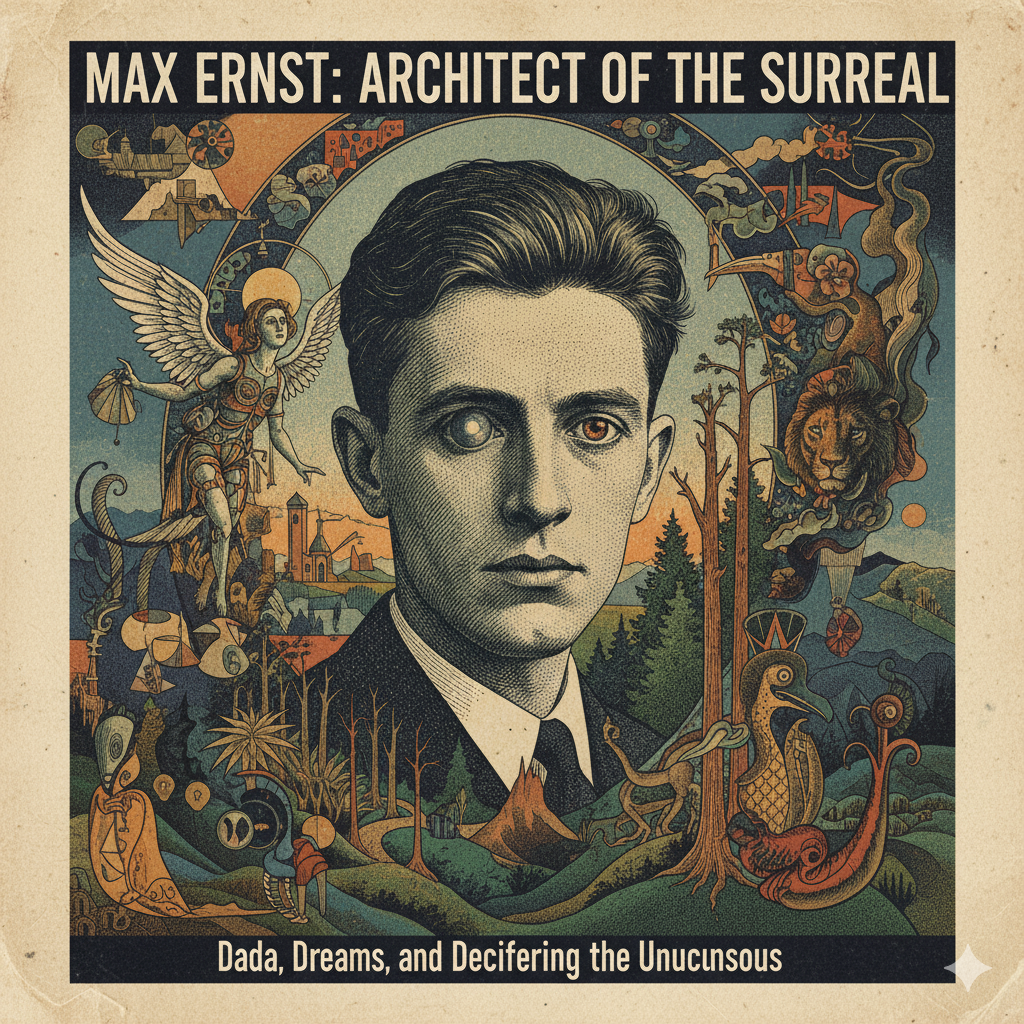
Max Ernst (1891-1976) stands as one of the most innovative and philosophically complex artists of the 20th century, bridging Dadaism and Surrealism while developing a unique artistic framework that challenged fundamental assumptions about creativity, consciousness, and reality itself.
Published on consciouschoicemastery.com | Approx. 10-12 min read
I. Philosophical Foundations
The Rejection of Rational Control
Ernst’s core philosophy centered on the systematic dismantling of conscious, rational control over the creative process. He believed that traditional artistic training and conscious intention were barriers to authentic expression, arguing that true art emerged when the artist stepped aside and allowed unconscious forces to guide creation.
“The role of the painter is to project onto the canvas that which he sees within himself“, but Ernst insisted this “seeing within” must bypass rational filtering mechanisms.
Anti-Rationalist Epistemology
Ernst developed a comprehensive critique of Enlightenment rationalism, influenced by:
- Freudian psychoanalysis – The primacy of unconscious drives
- Heraclitean philosophy – Reality as constant flux and contradiction
- Eastern mysticism – Non-dualistic thinking and ego dissolution
- Primitive art traditions – Direct expression unmediated by academic training
He argued that Western culture’s emphasis on logic, categorization, and conscious control had severed humanity’s connection to deeper creative and spiritual sources.
The Philosophy of Chance
Ernst elevated chance from accident to fundamental creative principle. He distinguished between:
Objective Chance – Meaningful coincidences that reveal hidden connections in reality Creative Chance – Deliberate surrender to uncontrolled processes that generate unexpected results Systematic Chance – Developed techniques that introduce controlled randomness into artistic creation
“Chance is the master of our illusions, chance is the master of our destinies.”
II. Theoretical Framework for Artistic Creation
The Three-Stage Creative Process
Ernst developed a systematic approach to artistic creation that involved three distinct phases:
1. Preparation Phase (Systematic Disarmament)
- Deliberate abandonment of preconceived artistic intentions
- Emptying the mind of conscious artistic goals
- Creating conditions for unconscious emergence
- Physical and mental preparation through meditation-like practices
2. Revelation Phase (Automatic Reception)
- Direct engagement with chance procedures and automatic techniques
- Passive reception of images and forms that emerge
- Recognition and selection of meaningful configurations
- Intuitive response to unexpected combinations
3. Elaboration Phase (Conscious Collaboration)
- Selective development of discovered forms and images
- Technical refinement while preserving spontaneous essence
- Integration of conscious skill with unconscious revelation
- Final presentation that maintains the integrity of the automatic source
The Theory of Systematic Inspiration
Ernst rejected the Romantic notion of inspiration as rare, mysterious visitation. Instead, he developed techniques for systematically inducing inspired states:
Environmental Conditioning – Creating physical and mental conditions conducive to unconscious emergence Technical Preparation – Mastering automatic techniques so they become second nature Psychological Readiness – Cultivating receptivity to unexpected images and associations Controlled Abandonment – Maintaining just enough conscious awareness to recognize significant discoveries
III. Revolutionary Artistic Techniques
Frottage (1925)
Ernst’s first major automatic technique involved placing paper over textured surfaces and rubbing with graphite or charcoal. This wasn’t mere texture taking but a philosophical investigation into the relationship between artist, materials, and unconscious vision.
Philosophical Significance:
- The artist becomes medium rather than creator
- Found textures reveal hidden landscapes of the unconscious
- Chance textures trigger recognition of meaningful forms
- The technique demonstrates that artistic vision exists latently in ordinary materials
Process Philosophy: Ernst saw frottage as proof that artistic images exist independently of conscious intention, waiting to be discovered rather than invented.
Grattage (1927)
Developed as the painted equivalent of frottage, grattage involved scraping wet paint over textured surfaces to reveal unexpected forms and landscapes.
Theoretical Foundation:
- Revelation through Destruction – Meaningful images emerge through partial removal of conscious applications
- Layered Consciousness – Different levels of awareness correspond to different paint layers
- Collaborative Creation – The artist works in partnership with materials and chance processes
Collage Philosophy
Ernst revolutionized collage from decorative technique to fundamental epistemological method:
The Theory of Systematic Displacement
“Collage is the systematic exploitation of the accidental or artificially provoked confrontation of two or more foreign realities on an obviously inappropriate level – and the poetic spark that jumps when these realities approach each other.”
This definition reveals Ernst’s sophisticated understanding of how meaning emerges through unexpected juxtaposition:
- Foreign Realities – Elements from different contexts, each carrying their own semantic field
- Inappropriate Level – Contexts where these elements don’t belong, creating productive confusion
- Poetic Spark – New meaning that emerges from the collision, irreducible to either original element
The Dialectical Method
Ernst’s collages operate through visual dialectics:
Thesis – First image with its cultural and semantic associations
Antithesis – Second image that contradicts or complicates the first
Synthesis – New meaning that emerges from their interaction, often pointing toward unconscious truths
Decalcomania (1935)
Developed with Oscar Dominguez, this technique involved pressing paint between surfaces to create automatic textures and forms.
Theoretical Innovation: Ernst saw decalcomania as direct collaboration between conscious intention and material chance, where the artist sets initial conditions but surrenders control over final results.
IV. The Une Semaine de Bonté Series: Applied Philosophy
Ernst’s masterwork collage novels, particularly Une Semaine de Bonté (1934), demonstrate his theories in sustained narrative form:
Narrative Automatism
Ernst developed techniques for automatic storytelling that paralleled his visual automatism:
- Sequential Displacement – Images follow each other through unconscious association rather than logical narrative
- Mythic Recurrence – Archetypal patterns emerge without conscious planning
- Temporal Fluidity – Past, present, and future collapse into dream-time logic
Cultural Archaeology
The collage novels function as archaeological investigations of collective unconscious:
- Source Material Analysis – Victorian illustrations carry specific cultural anxieties and repressions
- Systematic Recontextualization – Original contexts are systematically disrupted to reveal hidden meanings
- Subliminal Narrative – Stories emerge that bypass conscious censorship mechanisms
V. The Philosophy of the Marvelous
Beyond Surrealist Automatism
While Ernst pioneered Surrealist automatic techniques, his philosophy of the marvelous extended beyond standard Surrealist theory:
The Objective Marvelous
Ernst distinguished between:
Subjective Marvelous – Personal fantastic experiences and associations
Objective Marvelous – Inherent magical properties of reality that exist independently of individual consciousness
He sought techniques that would reveal the objective marvelous, the inherently magical nature of existence that becomes visible when conventional perception is disrupted.
The Theory of Systematic Wonder
Ernst developed a comprehensive approach to maintaining perpetual wonder:
Methodological Surprise – Techniques that consistently generate unexpected results Perceptual Revolution – Training vision to see familiar reality as fundamentally strange Cognitive Disruption – Systematic interference with habitual thinking patterns
Aesthetic Shock – Creating art that jolts viewers into expanded awareness
VI. The Paramyth Concept
Ernst’s most sophisticated theoretical contribution was the concept of Paramyth – stories that exist parallel to but independent of conventional mythology:
Characteristics of Paramyth
Autonomous Emergence – Paramyths emerge spontaneously from unconscious sources rather than cultural tradition
Universal Particularity – They address universal themes through highly specific, personal imagery
Temporal Transcendence – They operate outside linear time, connecting past, present, and future
Reality Intersection – They reveal points where everyday reality intersects with mythic dimensions
The Loplop Series
Ernst’s recurring bird-figure Loplop exemplifies paramythic creation:
- Autonomous Character – Loplop appears to have independent existence beyond Ernst’s conscious invention
- Evolutionary Development – The character develops organically across decades of work
- Symbolic Multiplicity – Loplop functions simultaneously as self-portrait, alter ego, and universal archetype
- Reality Bridge – The character connects Ernst’s personal mythology with collective unconscious symbols
VII. Technical Innovation and Philosophical Investigation
The Chemistry of Vision
Ernst’s technical experiments were always philosophical investigations:
Material Consciousness
Ernst believed that materials possess their own consciousness and that artistic techniques should facilitate dialogue between human and material awareness:
- Responsive Materials – Different materials offer different types of unconscious revelation
- Chemical Automatism – Allowing chemical processes to participate in image creation
- Collaborative Creation – Artist and materials work as equal partners in generating meaning
The Physics of Inspiration
Ernst investigated inspiration as physical phenomenon:
Energy Transfer – Inspiration involves actual energy exchange between artist, materials, and unconscious sources
Vibrational Resonance – Certain techniques create vibrational states that attract meaningful coincidences
Morphic Fields – Artistic forms exist in fields of potential that can be accessed through appropriate methods
VIII. The Education of the Eye
Systematic Vision Training
Ernst developed comprehensive methods for training perception to see beyond conventional reality:
The Four Levels of Vision
Conventional Vision – Ordinary perception focused on practical recognition and categorization Aesthetic Vision – Perception trained to recognize formal relationships and artistic qualities Poetic Vision – Perception that sees metaphorical and symbolic relationships
Visionary Perception – Direct perception of the marvelous and magical in ordinary reality
Exercises for Perceptual Revolution
Prolonged Observation – Staring at natural textures until they transform into meaningful images Peripheral Awareness – Training attention to notice meaningful coincidences and unexpected relationships
Interpretive Flexibility – Learning to see multiple meanings in any single image or experience Systematic Misreading – Deliberately misinterpreting familiar objects to discover hidden possibilities
IX. The Social Dimension of Artistic Revolution
Art as Consciousness Changing Technology
Ernst viewed his techniques not merely as artistic methods but as technologies for transforming consciousness:
Individual Transformation
Ego Dissolution – Automatic techniques systematically undermine ego-control over creative expression
Unconscious Integration – Regular practice develops ongoing dialogue with unconscious sources
Perceptual Liberation – Training in seeing beyond conventional categories and assumptions Creative Autonomy – Development of personal artistic vision independent of cultural programming
Collective Impact
Cultural Mutation – New artistic forms introduce new possibilities for collective consciousness Reality Revision – Artistic innovations change how culture perceives and interprets reality Mythic Innovation – New art creates new mythology for contemporary experience Consciousness Evolution – Systematic artistic experiment drives evolution of human awareness
The Anti-Academic Method
Ernst developed a comprehensive critique of academic art education and alternative pedagogical approaches:
Problems with Traditional Training
Conscious Control Overdevelopment – Academic training strengthens conscious control at the expense of unconscious access
Cultural Programming – Students learn to see and create according to existing cultural categories
Technical Obsession – Focus on technique obscures the deeper purposes of artistic expression Competitive Individualism – Academic system promotes ego-aggrandizement rather than genuine creative development
Alternative Education Principles
Collaborative Exploration – Learning through shared experiment rather than competitive achievement
Technical Minimalism – Developing just enough skill to express authentic vision without technical obsession
Systematic Unlearning – Deliberately abandoning acquired habits that interfere with fresh perception
Process Focus – Emphasizing the consciousness-changing effects of artistic practice rather than final products
X. The Philosophy of Artistic Evolution
Historical Consciousness
Ernst understood his work within a larger evolutionary framework:
Cultural Evolution Theory
Consciousness Development – Human consciousness evolves through successive artistic innovations
Mythic Transformation – Each era requires new mythic forms to address contemporary experience
Technical Revolution – New techniques enable new forms of consciousness and reality-perception
Collective Learning – Artistic innovations become available to the entire culture for further development
Individual Evolution Within Universal Pattern
Personal Mythology – Each artist must develop their own mythic framework while connecting to universal patterns
Technical Mastery – Individual technical development serves the larger evolution of artistic possibility
Consciousness Expansion – Personal consciousness-expansion contributes to collective evolution
Cultural Contribution – Individual artistic development must ultimately serve the culture’s creative evolution
The Prophetic Function of Art
Ernst saw authentic artistic creation as inherently prophetic:
Future-Sensing Capability
Consciousness Precognition – Authentic artistic creation senses future developments in consciousness
Cultural Anticipation – New artistic forms anticipate and prepare for cultural transformations Reality Prediction – Artistic innovations often predict subsequent developments in technology and social organization
Mythic Preparation – New artistic mythology prepares culture for psychological integration of future experience
XI. Integration and Practice
The Daily Practice of Systematic Wonder
Ernst developed methods for maintaining ongoing creative consciousness:
Morning Preparation
Perceptual Clearing – Daily exercises for clearing conventional perception
Intuitive Tuning – Techniques for enhancing receptivity to unconscious signals
Technical Preparation – Physical preparation of materials and workspace for automatic work Intention Release – Deliberate abandonment of conscious artistic goals
Working Methods
Collaborative Engagement – Working in partnership with materials, chance, and unconscious sources
Recognition Practice – Training to recognize meaningful forms and associations as they emerge Selective Development – Learning to develop discoveries without destroying their spontaneous essence
Integration Discipline – Maintaining connection between automatic source and conscious technical skill
Evening Integration
Review Practice – Studying the day’s work for emerging patterns and developments
Dream Preparation – Techniques for receiving artistic guidance through dreams
Symbolic Recognition – Learning to read personal and universal symbols as they appear in work Process Refinement – Adjusting techniques based on results and emerging insights
The Social Implementation
Ernst’s framework includes methods for sharing and teaching his approaches:
Teaching Principles
Example Rather Than Instruction – Demonstrating automatic techniques rather than explaining them intellectually
Collaborative Discovery – Learning through shared experiment and mutual recognition Individual Variation – Encouraging each student to develop their own version of automatic techniques
Process Emphasis – Teaching the consciousness-changing aspects of practice rather than focusing on artistic products
Cultural Application
Institutional Transformation – Introducing automatic techniques into educational and cultural institutions
Collective Practice – Developing group applications of individual consciousness-changing techniques
Social Mythology – Contributing to the development of new cultural mythologies for contemporary experience
Reality Transformation – Using artistic practice to participate in the collective transformation of cultural consciousness
XII. The Ultimate Framework: Art as Evolutionary Method
The Complete Vision
Ernst’s theoretical framework ultimately presents art as a systematic method for consciousness evolution:
Personal Dimension
- Ego Transcendence – Systematic development beyond limiting personal identity
- Unconscious Integration – Ongoing dialogue and collaboration with unconscious wisdom
- Perceptual Liberation – Freedom from conventional reality-interpretation
- Creative Autonomy – Capacity for authentic expression independent of cultural programming
Universal Dimension
- Species Development – Contribution to the evolution of human consciousness
- Reality Expansion – Participation in the collective expansion of perceived reality
- Mythic Innovation – Creation of new symbolic frameworks for contemporary experience
- Cultural Transformation – Using personal artistic development to serve collective evolution
Cosmic Dimension
- Universal Creativity – Recognition of individual creativity as participation in cosmic creative force
- Evolutionary Collaboration – Conscious participation in the universe’s creative evolution
- Transcendent Service – Using artistic development to serve forces larger than personal or cultural interests
- Sacred Practice – Approaching artistic creation as spiritual discipline and cosmic responsibility
The Continuing Revolution
Ernst viewed his work as contributing to an ongoing revolution in consciousness that would continue far beyond his individual lifetime:
Technical Innovation – New automatic techniques would continue to be developed by subsequent artists
Consciousness Evolution – The consciousness-changing effects of artistic practice would continue to expand human awareness
Cultural Transformation – Artistic innovations would continue to transform collective reality-perception
Cosmic Participation – Humanity’s artistic development would continue to serve the larger creative evolution of the universe
“Art is the most direct and complete means of developing the faculty of wonder, which should be the aim of all education.”
Through this comprehensive framework, Max Ernst established art not as decoration or entertainment, but as humanity’s most sophisticated technology for consciousness development and reality transformation. His theories continue to offer profound resources for anyone seeking to develop their creative consciousness and contribute to the ongoing evolution of human awareness.
Sources and Influences
Primary Philosophical Sources:
- Freudian psychoanalysis and dream interpretation
- Heraclitean philosophy of flux and contradiction
- Eastern mysticism and non-dualistic thinking
- Primitive art traditions and shamanic practices
Literary Influences:
- Lautréamont’s Chants de Maldoror
- Rimbaud’s systematic derangement of the senses
- German Romantic philosophy and literature
- Dadaist manifestos and experimental texts
Scientific Influences:
- Contemporary developments in physics and chemistry
- Gestalt psychology and perception theory
- Anthropological studies of primitive consciousness
- Early cybernetics and systems theory
Artistic Precedents:
- Leonardo da Vinci’s automatic drawing techniques
- Japanese sumi-e brush painting philosophy
- African mask-making and tribal art
- Medieval illuminated manuscript traditions
@ Lee Greene