How a woman invented authorship, encoded physics in myth, lived the pattern she taught, and was erased for 4,000 years. Until now.
Opening: A Question
What if I told you that the first author in human history was a woman? That she lived 4,300 years ago? That she invented authorship, systematic theology, and autobiography, all at once? That she encoded Newtonian mechanics, quantum mechanics, and thermodynamics in a single myth? That she lived the exact pattern she wrote about?
And that you’ve probably never heard of her?
Would you believe me?
You should. Because all of it’s true.
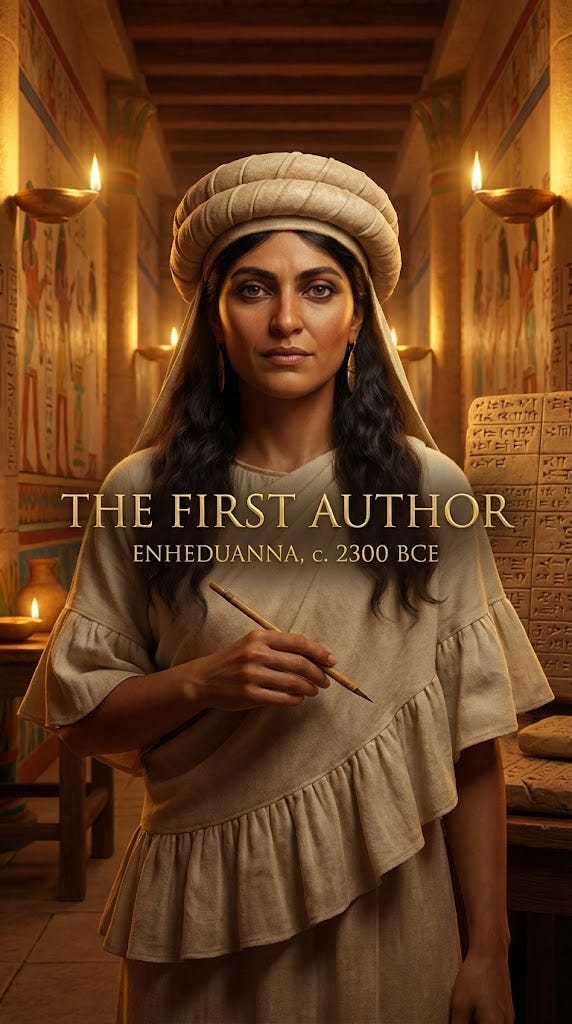
Her name was Enheduanna.
And the fact that you don’t know her name, that she’s not in any standard curriculum, that she’s been erased from the history you were taught, that erasure itself is part of the pattern she encoded.
Buried. Hidden. Waiting to be discovered.
This is her story. But it’s also your story. Because the pattern she lived, wrote, and transmitted 4,300 years ago is operating in your life right now.
What This Essay Covers
This is not a brief introduction. This is complete recovery.
We’ll explore who she actually was: High Priestess, author, theologian, daughter of empire. What she actually wrote, 42 hymns, autobiography, myth transmission. What she actually lived, exile, void, restoration, the seven-gate pattern. How she was lost, 4,000 years buried, civilization collapse, language death. How she was found, Woolley’s ironic discovery, 50-year denial, feminist recovery. What she actually encoded, physics frameworks 4,000 years early, consciousness architecture. Why it was suppressed, patriarchy erasing feminine wisdom, theology threatening Biblical primacy. And how to apply it now, your descents, your voids, your transformations.
This will take time. It’s worth it.
By the end, you’ll understand why recovering Enheduanna isn’t just historical curiosity. It’s recovering consciousness technology that’s been lost for millennia.
Let’s begin where she began. Sumer. 2300 BCE.
Section 1: The World She Lived In
Mesopotamia 2300 BCE: The First Everything
Between the Tigris and Euphrates rivers, in what is now Iraq and Syria, arose Sumer, the world’s first civilization. Not one of the first. The first. Predating Egypt, Greece, and Rome by centuries or millennia.
The Sumerians gave us our first cities: Ur, Uruk, Eridu, Lagash. Our first writing: cuneiform, invented around 3400 BCE, originally for accounting but evolving into literature. Our first laws: the Code of Ur-Nammu, which predates Hammurabi’s famous code by 300 years. Our first organized religion: temple complexes, professional priesthood, systematic theology. Our first mathematics: base 60, which we still use for time and angles today. Our first astronomy: tracking planets, creating lunar calendars, mapping Venus cycles. Our first literature: the Epic of Gilgamesh, the Atrahasis creation myth, cosmological poetry.
The Akkadian Empire: Sargon’s Conquest
Around 2334 BCE, a man named Sargon of Akkad rose to power and shifted history. He was the world’s first empire builder, a military genius who conquered and unified all the Mesopotamian city-states under single rule. His Akkadian language, a Semitic tongue, began overlaying Sumerian, a language isolate unrelated to any known language family. He created an administrative system spanning hundreds of miles.
But Sargon faced a problem that brute force couldn’t solve, theological fragmentation.
Each conquered city-state had its own patron deity. Nanna, the moon god, in Ur. Inanna, goddess of Heaven and Earth in Uruk. Enlil, god of wind and authority, in Nippur. Enki, god of wisdom and water, in Eridu. Each had its own temple hierarchy, its own priesthood, its own religious authority, its own creation myths and theological frameworks.
Military conquest had unified the empire politically. But religiously? Still fragmented. How do you create ideological unity across an empire with dozens of competing gods, each claiming supremacy in their own city?
Sargon’s Solution: Enheduanna
Sargon had a daughter. Possibly by a Sumerian wife, which would help legitimize his rule over conquered Sumerian territories. He named her Enheduanna, En meaning “high priestess,” hedu meaning “ornament,” anna meaning “of heaven.” The name itself was a title and a declaration.
Then he made a political move that would echo across four millennia, he appointed her High Priestess of Nanna in Ur, the most important religious position in Sumer. An Akkadian princess controlling the Sumerian sacred center. Consolidating imperial power through religious authority.
What was expected of her was simple: perform rituals, maintain the temple, legitimize Sargon’s rule through religious sanction. A symbolic position, an administrative function.
What she actually did was revolutionary.
She took the role seriously. She revolutionized Sumerian theology, invented authorship, and created systematic theology. She wrote herself into history, becoming the first individual voice in human literature.
Section 2: Her Three Revolutionary Acts
Revolution 1: She Signed Her Name
Before Enheduanna, writing existed, but authorship did not.
Writing in the ancient world was administrative, it was inventories, contracts, accounting records. Anonymous scribes didn’t sign their names. It was functional, record-keeping, not an expression. It was a collective, institutional voice, not individual perspective.
Consider the examples. The Epic of Gilgamesh names no author; it’s a collective myth refined over generations. Temple hymns were institutional, with no individual claiming ownership. Laws were attributed to divine origin, not human authorship. Administrative tablets might note which scribe did the physical writing, but that scribe wasn’t claiming to be an “author” in any meaningful sense.
What authorship requires is the concept of individual voice. The claim to ownership of text. An “I” speaking to a “you” across time. Personality, perspective, subjectivity embedded in language.
None of this existed yet.
Then Enheduanna wrote: “I, Enheduanna, High Priestess of Nanna, have built this temple for you.” She wrote: “That I have given birth to this song for you, O my Queen, what I have recited to you at midnight, may the singer repeat it at noon!” She wrote: “I, Enheduanna, will recite a prayer to you.”
She claimed the text. She named herself. She asserted: this is MY voice. MY work. MY offering.
This is the invention of authorship.
After her, authors could sign names. Individual voices became possible. Literature, not just writing, but expression, became possible. Personality could survive across time through text. The “I” addressing “you” became the foundational structure of all written communication.
Every author since, Homer, Sappho, Virgil, Augustine, Shakespeare, Toni Morrison, every writer who has ever lived, builds on what she invented.
She made “I” possible.
Revolution 2: She Unified the Theological System
Mesopotamian religion before Enheduanna was theologically chaotic. Each city worshiped its own patron deity. Competing theologies coexisted without integration. Local myths remained unconnected. There was no systematic understanding of how the gods related to each other, what the hierarchy was, whether they were separate entities or aspects of unified reality.
Consider the problem, Ur worships Nanna, the moon. Uruk worships Inanna, Heaven and Earth. Nippur worships Enlil, wind and authority. Eridu worships Enki, wisdom and water. Are these separate gods? Aspects of one divine force? How do they interact? Who’s supreme? What’s the cosmological structure?
No one had systematically answered these questions.
Enheduanna’s response was the Sumerian Temple Hymns, a collection of 42 hymns, each addressing a specific temple and deity across Mesopotamia. Eridu and Enki. Ur and Nanna. Uruk and Inanna. Continuing through all the major cult centers of the known world.
But here’s what she was actually doing, she was showing how each deity fit into a coherent cosmology. Enki wasn’t just “a god”, he was the wisdom principle. Enlil wasn’t just “another god”, he was the authority principle. Inanna was the transformation principle. Nanna was the principle of cyclical time. Each deity represented an aspect of universal forces. All connected, all necessary, all part of an integrated whole.
This is systematic theology. Here’s how the gods relate. Here’s the architecture underlying diverse manifestations. Here’s the unified structure behind apparent multiplicity.
She was doing philosophy. Integration. Meta-level thinking.
This happened in 2300 BCE. Some 2,000 years before Aristotle systematized Greek thought, she was systematizing Sumerian theology.
And she signed her name to it.
The political effect was immediate: Sargon’s empire now had theological unity. Local gods were honored but integrated into an empire-wide system. Religious authority was centralized through her. Ideological coherence matched political conquest.
The intellectual effect was permanent: the first systematic theology in history. The model for all later theological integration. The framework for understanding multiplicity as unified. Philosophy born in Sumer before Athens existed.
Revolution 3: She Wrote Herself
The Exaltation of Inanna (nin me šara) is the world’s first autobiography.
What makes it autobiographical? She describes her own life. Her position as High Priestess. Her exile, politically removed from Ur. Her suffering: “I am placed in the leper’s ward.” Her emotions: fear, anger, grief, determination. Her plea for restoration to her position. Her theological argument for why Inanna should intervene on her behalf.
Key lines include: “That I, Enheduanna, have given birth to this song for you, O my Queen, what I have recited to you at midnight, may the singer repeat it at noon!” And: “I, Enheduanna, I who once sat triumphant, have been exiled from the sanctuary.” And: “I am placed in the leper’s ward. I walk in the brambles. I have exhausted my strength. My honeyed mouth is cast into confusion. My choicest features are turned to dust.”
This is a first-person perspective. Personal experience described. Emotional interiority revealed. Individual circumstances detailed. Theological argument framed around her specific situation.
This is an autobiography.
Before this, no one wrote about their own life. There were no first-person narratives of personal experience. No “I” describing “my” journey. Literature consisted of myths (collective), laws (institutional), and hymns (ritual).
After this, personal narrative became possible. Confessional literature became possible. Memoir became possible. Every autobiography ever written, Augustine’s Confessions, Rousseau’s Confessions, Benjamin Franklin’s autobiography, Maya Angelou’s I Know Why the Caged Bird Sings, every memoir on every bookshelf, builds on what she invented.
She made “my life as a worthy subject” possible.
The Triple Revolution Summarized
In 2300 BCE, Enheduanna invented authorship (I wrote this, my name attached), systematic theology (integrated fragmented beliefs into coherent whole), and autobiography (my life, my experience, my voice).
This was 1,500 years before Homer, who still didn’t sign his name, we don’t even know if “Homer” was one person. A thousand years before Moses, who may be mythical. Two thousand years before Augustine wrote what’s often called the first “true” autobiography (Confessions, 400 CE), but Enheduanna did it 2,700 years earlier.
She’s first. At everything.
Section 3: What She Actually Wrote
Her Surviving Works
1. The Sumerian Temple Hymns (Collection of 42 hymns): Each hymn addresses a specific temple across Mesopotamia, creating a theological integration of the pantheon. The longest hymns run about 20 lines, the shortest about 8 lines, totaling over 500 lines. Their function is unifying the religious framework for the empire.
2. The Exaltation of Inanna (nin me šara): 153 lines of personal theology, autobiography, and prayer. Describes her exile and plea for restoration. Her most famous work, most studied by scholars. Their function is to give a personal voice claiming divine support.
3. The Adoration of Inanna of Ur (nin me huš-a): Approximately 140 lines of praise poetry to Inanna, describing her theological power. Likely performed in a temple ritual. Their function was to create a cultic hymn establishing Inanna’s authority.
4. Inanna and Ebih: Around 185 lines telling the myth of Inanna destroying the rebellious mountain Ebih. Theological argument for divine power over earthly rebellion, possibly a political allegory, Inanna representing Sargon’s empire crushing resistance. Their function is to create a theological justification for imperial conquest.
5. The Descent of Inanna (possibly): Scholars debate whether she wrote this myth, inherited and transmitted it, or whether it predates her in a different form. The pattern fits her life exactly, exile, void, restoration. She may have composed it based on lived experience, or recognized an older myth and preserved it with new understanding. Either way, it comes from her tradition, her lineage, her transmission. The function is a consciousness technology, and transformation architecture.
How Much Survived
We have multiple copies of her hymns, found at Ur and other archaeological sites. The Temple Hymns were copied for 1,500 years after her death. She was a canonical author in Sumerian education; students copied her works as a writing practice. Her name appears on tablets across Mesopotamia.
This means she wasn’t obscure in her time. She was the foundational literary voice. For 1,500 years after her death, her work was studied, copied, and revered. She was to Sumerian literature what Homer became to Greek literature.
What we lost was Sumerian as a living language died, replaced by Akkadian, then Aramaic, then Arabic. Most tablets were destroyed, clay is fragile, and civilizations collapsed repeatedly. We possess an estimated less than 1% of the total Sumerian literary corpus.
But her work survived better than most, precisely because it was canonical.
The miracle is that 4,300 years later, we have multiple complete works. We have her name. We have her voice. We can read what she wrote in her own words, translated but intact.
This is an extraordinary survival rate for ancient literature.
Section 4: What She Actually Lived
The Exile: Her Personal Descent
From fragmentary historical records combined with her own writings, we can reconstruct what happened. Sargon died around 2279 BCE. His sons Rimush and Manishtushu ruled after him, both facing rebellions. Political instability swept the empire. Ur, where Enheduanna served as High Priestess, may have been a center of resistance. She got caught in the political upheaval.
Her own description from the Exaltation of Inanna: “Me who once sat triumphant, he has driven me out of the sanctuary. Like a swallow, he made me fly from the window, my life is consumed. He made me walk in the bramble of the mountain. He stripped me of the crown appropriate for the high priesthood. He gave me a dagger and a sword, ‘it becomes you,’ he said to me.”
Someone, likely a political rival, possibly a priest named Lugalanne mentioned in the text, removed her from her position. Driven from the temple sanctuary. Stripped of religious authority, the crown that marked her high priesthood. Given weapons instead of priestly regalia, armed rather than sacred. Sent into wilderness, into brambles, into exile.
Her sacred role dissolved.
This is her descent. Gate by gate:
Gate 1: Political authority removed. Sargon is dead; she no longer has his power backing her.
Gate 2: Religious title questioned. A rival priest challenges her legitimacy.
Gate 3: Temple access denied. Physically removed from the sanctuary, her home.
Gate 4: Sacred regalia stripped. The crown removed, she no longer appears as High Priestess.
Gate 5: Social status dissolved. From highest religious authority to exile.
Gate 6: Material security gone. Wandering, brambles, danger, no protection.
Gate 7: Identity annihilated. Who is she if not High Priestess? The role defined her entire adult life.
By the seventh gate she was naked. Stripped. Vulnerable. Everything was removed.
The Void: The Three Days Dead
We don’t know how long she was exiled. The records don’t specify. Could have been months. Could have been years.
But from her writing, we know she didn’t know if she’d be restored. She experienced profound suffering. She felt abandoned by the goddess she served. She questioned everything. She stayed in the not-knowing.
Her own words: “I am placed in the leper’s ward. I walk in the brambles. I have exhausted my strength. My honeyed mouth is cast into confusion. My choicest features are turned to dust.” And: “What am I among the living creatures? May he be clear to me, by day and night!”
This is the void. No certainty about the future. No clear path forward. Previous identity gone. New identity not yet formed. Pure gap. Three days dead.
What does she do during the void, she writes. She creates theology from the underworld.
The Exaltation of Inanna was written during or just after this period. It’s a theological argument framed as prayer: “Inanna, you are supreme. You must restore me. I have served you. This exile is unjust. Use your power to bring me back.”
She’s doing theology while in crisis. Not abstract speculation. Lived theology. Desperate theology. The kind you do when everything’s been stripped away and you’re arguing with the divine for your survival.
This is different from academic theology. This is existential theology. The kind that comes from the void.
The Restoration: Ascent Transformed
The political situation shifted. Exact details remain unclear from the historical record, but possibilities include: Sargon’s grandson Naram-Sin consolidated power and restored her. The rival priest Lugalanne was defeated or removed. The Inanna cult, which she represented, regained political power. Her theological arguments won support from other temples.
As a result, she was restored to her position as High Priestess of Nanna in Ur.
But not unchanged.
She’s not the same woman who was exiled. She’s someone who now knows both heights and depths. Both power and powerlessness. Both sanctuary and wilderness. Both certainty and void.
She’s crossed all seven gates. Stayed dead for three days and ascended transformed.
She’s become someone who includes the underworld in her consciousness. Level 8 equals Levels 1 through 7 integrated.
Evidence of her transformation in her poems. After restoration, she writes with different authority. Before exile, she used institutional voice, performing her priestly role, working as theological systematizer. After exile, she uses personal voice, claiming direct divine encounter, innovating theologically.
The Exaltation, written during or after exile, has an intensity her earlier Temple Hymns don’t have. This is someone who’s been to the underworld and returned.
You can feel it in the text.
The Pattern She Recognized
Here’s what’s remarkable, the myth of Inanna’s descent, seven gates down, three days dead, seven gates up, matches her life exactly.
Three possibilities emerge:
Option A: The myth existed before her. She lived it, recognized the correspondence, then transmitted it with new understanding.
Option B: The myth didn’t exist, or existed in a different form. She lived the pattern, then encoded what she lived into mythological form.
Option C: The pattern is primary. It exists in reality itself. It moved through her life. She recognized it. She encoded it. The “myth” is a description of actual architecture.
I think Option C.
The pattern is real. It’s how transformation actually works. She experienced it. Recognized it. Encoded it.
Not “making up a nice story about goddesses.” But “this is what actually happened to me, and I recognize this is the pattern, not just my pattern, so I’ll encode it mythologically so it survives and others can recognize it in their own lives.”
The descent-void-ascent pattern moved through her life. Then she gave it to us.
Section 5: How She Was Lost
The 1,500 Years of Transmission (2300-800 BCE)
After Enheduanna died around 2250 BCE (exact date unknown), her work continued. Copied. Studied. Canonized.
The evidence abounds with multiple copies of the Temple Hymns found across Mesopotamian sites. Student tablets copying her work for writing practice in scribal schools. Her name was invoked by later priestesses. The “Enheduanna tradition” became an identifiable lineage.
For 1,500 years, she was the canonical Sumerian literary voice. She was foundational.
The Death of Sumerian (c. 2000-1800 BCE)
Akkadian, a Semitic language, gradually replaced Sumerian, a language isolate. Sumerian became a liturgical language, like Latin in medieval Europe, still used in temples but no longer spoken in daily life. Eventually, even liturgical use declined. By 1800 BCE, Sumerian was a dead language.
What this meant for Enheduanna is that her texts were still copied in Sumerian for ritual use, but fewer people could read them. Translation attempts occurred (Sumerian to Akkadian), but many texts were lost in translation. Her work became increasingly obscure.
The Collapse of Mesopotamian Civilization (Multiple Waves)
Around 1600 BCE, Hittite raiders destroyed Babylon, triggering political chaos. Around 1200 BCE came the Bronze Age Collapse, the Sea Peoples invasions, multiple civilizations collapsing simultaneously, libraries burning, tablets destroyed, oral traditions lost. Around 539 BCE, Persians conquered Babylon, bringing cultural suppression and religious transformation. Around 331 BCE, Alexander the Great conquered Mesopotamia, beginning Hellenization, Greek became the administrative language, cuneiform writing declined. Around 100 CE, the final cuneiform texts were written. Cuneiform died. No one could read it anymore. Tablets became mysterious artifacts.
By 400 CE, no one remembered Sumerian had existed. No one could read cuneiform. Tablets were curiosities, decoration, building material. Complete cultural amnesia.
Enheduanna’s tablets were buried in the ruins of Ur. The library collapsed. Covered by sand. Forgotten for 4,000 years.
What Survived (By Accident)
Clay tablets survived when papyrus and parchment didn’t because clay is durable, if baked or dried, it lasts millennia. Fire actually preserves clay tablets by baking them harder. Desert conditions provided protection from moisture. Being buried protected them from exposure.
What was lost were the oral traditions (most ancient knowledge was oral, never written), papyrus texts (all decomposed), wood tablets (all decomposed), and cultural memory (the continuity of transmission severed).
The estimate is that we have less than 1% of the Sumerian literary corpus. We have fragments of Enheduanna’s work.
But the miracle is that we have her name. We have multiple copies proving she was a real person. We have enough to reconstruct who she was.
This survival is a statistical miracle.
The 4,000-Year Void
From around 100 CE (the last cuneiform texts) to 1927 CE (Woolley’s discovery) is around 1,827 years of complete forgetting.
During this time we had the rise and fall of Rome. The birth of Christianity. Birth of Islam. The Crusades. The Renaissance. The Enlightenment. The Industrial Revolution. Modern science. Two World Wars.
All happening while her tablets lay buried. All happening while no one knew she existed. All happening while the first author in history was forgotten.
Why She Was Erased (The Structural Reasons)
Reason 1: Language death. Sumerian died with no successor language maintaining continuity. Unlike Greek and Latin, which survived, Sumerian had no linguistic descendants.
Reason 2: Patriarchal suppression. Even when her work was known (2300-100 BCE), it was already being downplayed. Later Babylonian literature focused on male gods, Marduk replaced Inanna in importance. Her voice was already being minimized while Sumerian was still alive.
Reason 3: Biblical narrative dominance. Western education organized itself around Biblical history. Mesopotamia was studied only to “prove” or contextualize the Bible. Abraham, Moses, Genesis became the “first” voices. Anything predating the Bible threatened the primacy of Biblical tradition. Enheduanna, living 1,000 years before Abraham, couldn’t fit the narrative. So when discovered, she was footnoted, not celebrated.
Reason 4: Academic misogyny. Even when discovered in 1927, scholars couldn’t process “woman author first.” The cognitive dissonance was that women weren’t writers, especially not the first writer. So she was catalogued but not recognized for 50 years.
The erasure had multiple causes, all reinforcing each other.
But she survived anyway.
Section 6: How She Was Found
Sir Leonard Woolley: The Man Looking for Abraham
British archaeologist Leonard Woolley (1880-1960) was legendary in his field. Early in his career, he helped discover Tutankhamun’s tomb with Howard Carter. From 1922 to 1934, he led a joint British Museum and University of Pennsylvania expedition to Ur, conducting twelve excavation seasons.
He was looking for Biblical connections, particularly Abraham. Genesis 11:31 states: “Terah took his son Abram… and they went out with them from Ur of the Chaldeans.” Woolley’s goal was to find evidence Abraham was real, that Ur was his home, that the Biblical narrative had historical basis.
This was Biblical archaeology. Not objective historical research. Proof-texting for Western religious narrative.
What He Found (1927 Onwards)
Woolley’s discoveries were spectacular. In 1927-1928, he uncovered the Royal Cemetery of Ur with incredible gold artifacts, the “Great Death Pit” showing evidence of human sacrifice, 74 bodies arranged in elaborate burial. It captured the world’s imagination, making front-page news globally. He excavated the Ziggurat of Ur, a massive stepped pyramid temple he partially reconstructed, creating an iconic image of Mesopotamian architecture. He found thousands of clay tablets: administrative records, temple archives, and literary texts.
Including tablets signed “Enheduanna.”
He never found evidence of Abraham. Despite twelve seasons excavating. Despite that being his specific goal. Ur existed, yes. Abraham? No evidence.
The Enheduanna Discovery
In the Temple of Nanna precinct, Woolley found multiple clay tablets with literary texts, hymns and poems, signed “Enheduanna, High Priestess of Nanna.” Different tablets, same signature. Multiple copies of the same hymns. An extensive body of work.
He also found a disk (the “Disk of Enheduanna”) showing her in ritual pose, and administrative texts mentioning her by name. Physical evidence was undeniable: multiple sources, archaeological context (in situ), datable based on paleography and stratigraphy. This couldn’t be dismissed as forgery or later invention.
Woolley’s response was to publish his findings in excavation reports (Ur Excavations: Texts, volumes from the 1920s-1930s). He catalogued the tablets. He noted Enheduanna’s name. He described her as a “priestess who wrote hymns.”
And moved on.
He continued looking for Abraham. But never found him.
What He Missed
The first author in history. The first woman to sign her name. The first systematic theologian. The first autobiographical writer. She invented authorship itself.
He had no framework to recognize this. He was looking for patriarchs, male voices, Biblical primacy, “firsts” in the Genesis narrative. He found a matriarch, female voice, pre-Biblical, “first” before the Bible existed.
Cognitive dissonance.
He couldn’t integrate this into his worldview. So he didn’t. He footnoted and moved on.
The Academic Response (1927-1960s)
The initial reaction was “Interesting religious texts from ancient Sumer.” Catalogued. Filed. Available to scholars. But not emphasized.
Why? Focus on Biblical archaeology continued, the Dead Sea Scrolls were discovered 1947-1956, generating huge news. Proving or disproving Biblical narratives remained the priority. Enheduanna predated the Bible by over a millennium; she didn’t fit research priorities.
Gender blindness played a role. Academic archaeology and ancient history were overwhelmingly male. There was no framework for understanding the significance of a woman author. “Priestess wrote hymns” was seen as a normal religious function, not revolutionary.
Sumerian studies remained a niche field, highly specialized. Enheduanna texts were studied by a handful of Sumerologists. They weren’t reaching the broader scholarly community or public.
The result is that she was known to specialists. Unknown to everyone else. She existed in academic footnotes. Not in textbooks. Not in curricula. Not in public consciousness.
Buried again. Not on the earth this time. In obscurity.
The Feminist Recovery (1960s-1980s)
The 1960s and 1970s brought feminist scholarship into academia, asking new questions: Where are women in history? Why are all “first” voices male? Who’s been erased?
Feminist scholars began combing through archives, catalogues, and footnotes. They found her.
Key figures included William Hallo (Assyriologist at Yale) and J.J.A. van Dijk (Sumerologist), who in 1977 published “The Exaltation of Inanna” with full translation and commentary recognizing her significance. The academic article stated clearly: she’s the first author in history. This was the turning point.
Betty De Shong Meador (Jungian analyst and translator) published “Inanna, Lady of Largest Heart: Poems of the Sumerian High Priestess Enheduanna” in 2000, bringing accessible translation to a broader audience. The feminist recovery was complete.
Contemporary scholars like Annette Zgoll and Sophus Helle continue producing new translations and scholarship in the 2020s, recognizing her literary sophistication, understanding her theological innovation, placing her in proper historical context.
The 50-Year Denial
The timeline was that she was discovered in 1927, feminist questions began in the 1960s, finally recognized as first author in 1977, brought to public awareness in the 2000s, and still not in standard curriculum in the 2020s.
Fifty years from discovery to recognition. Another 25 years from recognition to partial public awareness.
And still, the fact is, most people have never heard of her.
The Pattern Repeating (Again)
Her life was a mirror of Inanna’s trip to Kur, exile (descent), void (uncertainty), restoration (ascent).
Her tablets were buried (descent into earth), 4,000 years hidden (void), discovered (ascent into knowledge).
Her recognition is that she was found 1927 (initial discovery), dismissed 50 years (void/resistance), recognized 1977 onward (ascent into canon, still ongoing).
Seven gates descending. Three days dead. Seven gates ascending.
Even her recovery follows the pattern she encoded.
This is not a coincidence. This is the architecture operating across millennia.
Section 7: What She Actually Encoded
The Descent of Inanna: The Complete Myth
The myth structure contains three movements:
Descent (Seven Gates): Inanna, Queen of Heaven and Earth, decides to descend to the underworld to attend the funeral of her sister Ereshkigal’s husband. She adorns herself with seven divine powers, crown, lapis lazuli beads, double strand of beads, breastplate, gold ring, lapis measuring rod and line, royal robe. At each of the seven gates of the underworld, she must remove one adornment. Gate by gate, she’s stripped. By the seventh gate, she arrives naked and vulnerable before Ereshkigal and the seven judges of the underworld.
Death (Three Days): The judges fix their “eye of death” upon her. She dies. Her corpse is hung on a hook. She remains dead for three days and three nights. This is the void, no status, no power, no identity. Complete annihilation.
Ascent (Seven Gates): Her faithful servant Ninshubur petitions the gods for help. Enki creates two mourners who descend and perform a ritual that revives Inanna. She ascends through the seven gates, but she’s changed. At each gate, she reclaims what was taken, but she’s not the same. She returns transformed, having integrated the underworld into her being.
The Three Physics Frameworks Encoded
Framework 1: Newtonian Mechanics (Potential ↔ Kinetic Energy)
In Newtonian physics, potential energy (stored, height-based) converts to kinetic energy (motion, released) and vice versa.
During descent, potential energy converts to kinetic energy. Each gate represents a stage of energy transformation. By gate seven, you have maximum kinetic energy, minimum potential. The three days represent equilibrium, all energy converted, system at rest. During ascent, work is done against gravity. Kinetic converts back to potential. Energy is restored through external input.
This describes thermodynamic work cycles, energy conservation, and transformation mechanisms. Isaac Newton formalized these principles in 1687. Enheduanna encoded them in 2300 BCE, 4,000 years early.
Framework 2: Quantum Mechanics (Definite ↔ Superposition)
In quantum mechanics, observable properties can exist in definite states or superposition (all possible states simultaneously).
During descent, observable quantum properties enter superposition. Definite becomes indefinite. The wave function expands. Each gate represents another property becoming indeterminate. The three days represent complete superposition, all possible states existing simultaneously, with no observation and no wave function collapse. During ascent, the wave function collapses. Superposition resolves to definite states. When the observer returns, properties become measurable. Each gate represents another property becoming definite.
This describes the observer effect, the measurement problem, and quantum indeterminacy. Werner Heisenberg developed uncertainty principles in 1927. Enheduanna encoded the pattern in 2300 BCE, 4,200 years early.
Framework 3: Thermodynamics (Order ↔ Entropy)
In thermodynamics, order and disorder (entropy) exist in dynamic relationships, with entropy tending to increase in closed systems.
During descent, order decreases and entropy increases. Structure dissolves. Each gate represents more disorder. The three days represent maximum entropy, complete disorder, and local heat death. During ascent, local entropy decreases. Order is restored through energy input. The structure is reconstituted. Each gate represents more organization.
This describes the second law of thermodynamics, entropy gradients, and the possibility of local order through energy input. Rudolf Clausius formalized these concepts in the 1850s. Enheduanna encoded them in 2300 BCE, 4,150 years early.
This Is Not Coincidence
Three options exist:
Option A: Coincidence. She wrote a pretty story about a goddess. It happens to match physics discovered 4,000 years later. Pure chance. Probability: essentially zero. One framework matching? Maybe. All three? Impossible by chance.
Option B: We’re projecting. We see patterns we want to see. We’re forcing modern physics onto ancient myth. Counter-argument: the structure is too precise. Seven gates in both directions. Three-day void. Each maps to a distinct phase. Not vague correspondence, exact structural mapping.
Option C: She knew. She perceived the pattern directly. Not through measurement, but through consciousness observation. She encoded it mythologically because mythology preserves better than technical language.
This is what happened.
How She Knew (Pattern Recognition, Not Measurement)
Modern science uses measurements to observe phenomena, collect data, develop mathematical models, test predictions, and refine models.
Ancient wisdom used consciousness observation to observe consciousness directly, recognize patterns, encode in myth and ritual, transmit across generations, preserve through cultural practice.
She was High Priestess. This meant access to temple mysteries, whatever consciousness technologies they used, ritual practices we’ve lost, altered state induction (possibly entheogens, definitely meditation and trance), direct perception training. She received pattern recognition training, sacred knowledge transmission, learning to see structure underlying phenomena, perceiving rather than measuring. She had direct experience, she lived the pattern (exile, void, restoration), recognized it as universal (not just her story), saw it in nature (Venus cycles, seasons, death and rebirth), and encoded it for preservation.
What she saw was the fundamental pattern of transformation. Form becomes Formless becomes Form (changed).
This pattern appears as matter-energy-matter in physics, order-chaos-order in thermodynamics, definite-indefinite-definite in quantum mechanics, life-death-life in biology, and identity-void-identity transformed in psychology.
One pattern. Multiple manifestations.
She saw the pattern itself. Not specific manifestations. The pattern. Then encoded it so it would survive.
Why Mythology (Not Technical Language)
Technical language has a problem in that terms change. In chemistry, we went from phlogiston to oxygen to oxidation to electron transfer. In medicine, from humors to miasma to germ theory to molecular biology. In physics, from ether to field to quantum field. Technical specificity leads to rapid obsolescence.
Mythology has an advantage in that archetypes persist. The image of a goddess descending to the underworld remains unchanged for 4,300 years. Death and rebirth work as universal symbols. Seven stages as a mythic number preserves the structure. Mythic generality enables long-term preservation.
She chose wisely. If she’d written a technical treatise (assuming Sumerian science could support it), it would be obsolete and incomprehensible now. But mythological encoding? Still readable. Still powerful. Still teaching.
The pattern has been preserved across 4,300 years because she chose the mythic container. This was a sophisticated decision. Not primitive. Highly advanced.
Section 8: Why This Matters Now
Your Descents Follow Her Pattern
The pattern she encoded operates in your life right now.
When you lose your job, that’s the first gate, material security removed. When you lose a relationship, that’s the second gate, an emotional anchor dissolved. When a belief system collapses, that’s the third gate, meaning structure gone. When your sense of self shatters, that’s the fourth gate, identity questioned. When health fails, that’s the fifth gate, bodily integrity compromised. When reputation is damaged, that’s the sixth gate, social standing dissolved. When hope vanishes, that’s the seventh gate, future certainty removed.
You’re descending. This isn’t failure. This is architecture.
The Seven Gates in Modern Life
Gate 1 (Material/External): Job loss, financial collapse, home foreclosure, bankruptcy. The external structures you depend on for survival.
Gate 2 (Relational): Divorce, breakup, friendship betrayal, family estrangement. The relational matrices that define your social existence.
Gate 3 (Conceptual): Faith crisis, ideological collapse, worldview shattered, discovering you were wrong about everything. The meaning-making structures you use to interpret reality.
Gate 4 (Identity): Ego death, role dissolution, “who am I?” confusion. The stories you’ve told yourself about who you are.
Gate 5 (Somatic): Illness, injury, chronic pain, aging, body betrayal. The physical integrity you’ve taken for granted.
Gate 6 (Social): Public failure, reputation damage, social ostracism, being “cancelled.” The way others see and relate to you.
Gate 7 (Existential): Suicidal ideation, meaninglessness, void, “what’s the point?” The capacity to imagine a future worth living into.
By gate seven, naked. Stripped. Nothing left to lose. This is where transformation becomes possible.
The Three-Day Void in Modern Life
After the seventh gate comes the void. This is the period of not-knowing. You don’t know if you’ll be restored. You don’t know what comes next. You don’t know who you’ll be when this is over. You can’t see the path forward.
This is integration time. The death that precedes resurrection. The darkness that precedes dawn. The silence that precedes the new song.
Modern culture wants to skip this part. Medications to avoid the feeling. Distractions to avoid knowing. Spiritual bypassing to pretend it’s already integrated. Rush through, get to the good part, avoid the discomfort.
But you can’t skip the void. If you try, transformation aborts. You get restoration of old form, not creation of new form. You get Level 7 again, not Level 8.
The void is not optional. The void is where the work happens.
Enheduanna stayed in the void. Uncertain. Suffering. Not knowing if restoration would come. And because she stayed, she transformed. When she returned, she was someone who could write the Exaltation. Someone who could encode consciousness architecture. Someone who could transmit wisdom that would last 4,300 years.
Stay in your void. Don’t rush it. This is sacred time.
The Ascent in Modern Life
Restoration comes. But you’re not who you were. You’ve integrated the underworld. You include death in your consciousness now. You’ve been to places you can’t unsee. You know things you can’t unknow.
This is Level 8. Not Level 1 redux. Levels 1 through 7 integrated into a coherent whole.
You reclaim what was stripped, but transformed:
Gate 7: Hope returns, but not naive hope. Hope that includes despair.
Gate 6: Social standing restored, but you’re not performing for approval anymore.
Gate 5: Body heals or doesn’t, but your relationship to embodiment has changed.
Gate 4: Identity reconstitutes, but more spacious, less defended, more flexible.
Gate 3: Meaning returns, but you hold it more lightly, knowing it’s constructed.
Gate 2: Relationships reform, but with different boundaries, different expectations.
Gate 1: Material security returns or doesn’t, but you know you can survive without it.
You’re back in the world. But you’re not of it the same way. You’re someone who’s crossed the threshold and returned.
This is who Enheduanna became. This is who you’re becoming.
Experience → Integration → Transmission
Enheduanna’s teaching: you must live it before you transmit it.
A modern problem is information without integration. People consume hundreds of self-help books, thousands of hours of podcasts, dozens of courses, years of therapy. But nothing changes.
Why? Because information doesn’t equal integration.
Reading about descent isn’t actually descending. Knowing about the void isn’t staying in the void long enough. Understanding ascent isn’t becoming someone transformed.
Enheduanna didn’t read about exile. She was exiled. She didn’t study the void. She stayed in it. She didn’t theorize about restoration. She was restored.
Then, only then, she wrote.
The sequence:
1. Experience: Live the pattern. You’re probably in it right now.
2. Integration: Stay in the void. Don’t rush. Let transformation complete.
3. Transmission: Only after integration, share what you actually lived.
Skip any step and your transmission is hollow. Complete all three and your transmission lasts, like hers has lasted 4,300 years.
Recovering Feminine Wisdom Technology
When Enheduanna was erased, we lost more than one woman’s work. We lost an entire methodological approach.
Feminine technology is direct perception, pattern recognition, mythological encoding, ritual preservation, embodied knowing, cyclical understanding, integration over analysis.
Masculine technology is measurement, quantification, mathematical modeling, linear causation, abstract reasoning, analytical reduction, proof over experience.
Both are valid. Both are necessary. But we suppressed one.
For 4,000 years, we privileged the masculine approach: measure, quantify, prove, abstract, analyze, systematize, reduce to components, build mathematical models.
And lost the feminine approach: perceive, recognize, integrate, embody, encode, preserve, see wholes not parts, build mythic containers.
What we’re recovering now is that Enheduanna used feminine technology to perceive patterns that masculine technology would formalize 4,000 years later. Both arrived at the same truth. Different paths.
We need both. Modern science without wisdom is powerful but dangerous. Ancient wisdom without science equals powerful but vague.
Together they become powerful and precise.
Enheduanna encoded precision in myth. We’re learning to read it.
The Sumerian Way: Practical Recovery
We’re recovering what Enheduanna encoded through the Enheduanna Framework, diagnostic axes showing fragmentation, prescriptive tools (the ME system, divine powers, aspects of integrated consciousness), transformation architecture (the 7-3-7 pattern she lived and encoded), and legitimacy grounded in her 4,300-year transmission.
The Sumerian Way practice includes clay tablet work (bringing consciousness into matter as she did), cuneiform attunements (connecting to her lineage), seven-gate ceremonies (enacting the pattern she preserved), and ME activation (integrating the divine powers she catalogued).
This isn’t a new framework. This is recovery work. She encoded it. We forgot it. Now we’re remembering.
When you press stylus into clay as Sumerian scribes did, as Enheduanna did, you’re not “doing art therapy.” You’re enacting consciousness architecture. Clay represents formless potential. The stylus represents crossing the threshold. The wedge represents manifestation.
Same architecture she used. Same technology. The pattern preserved in the medium itself.
Your Role in the Transmission
Enheduanna to 4,300 years to you in the present.
Her pattern continues: She lived it (exile, void, restoration in 2300 BCE). She encoded it (the Descent of Inanna myth). She transmitted it (tablets copied for 1,500 years).
It was buried (4,000 years underground). It was discovered (Woolley in 1927, dismissed). It was recovered (feminist scholars in the 1970s onward).
You’re learning it right now, reading these words. You’ll integrate it when your descents come and you recognize the pattern. You’ll transmit it to others who need to recognize it in their lives.
The spiral continues. Each person who recognizes the pattern becomes a node in the transmission network.
You’re part of a 4,300-year lineage now. Whether you know it or not.
The question becomes, will you transmit consciously? Or will the pattern transmit through you unconsciously?
Enheduanna chose conscious transmission. That’s why her work survived.
What will you choose?
Closing: The Complete Recovery
We’ve covered who she was, the first author, priestess, theologian, revolutionary. What she wrote, 42 hymns, autobiography, myth transmission. What she lived, exile, void, restoration, the pattern embodied. How she was lost, language death, civilization collapse, 4,000 years buried. How she was found, Woolley’s ironic discovery, 50-year denial, feminist recovery. What she encoded, three physics frameworks, consciousness architecture. Why it was suppressed, patriarchy, Biblical primacy, academic misogyny. How to apply it, your descents, integration, transmission.
This is the complete story. But it’s not finished. Because you’re part of it now.
The Pattern Operating
Seven gates down. Three days dead. Seven gates up.
This pattern operated in her life (personal), in her myth (archetypal), in her tablets (material), in her recognition (historical), in physics (universal), and in your life (present).
Same pattern. Every scale. Always.
This is what she saw. This is what she encoded. This is what we’re recovering.
The Invitation
If this essay resonated, the pattern is calling you. You’re probably at a gate right now. Descending. Or in the void. Or ascending transformed.
Wherever you are, just recognize it.
This is the architecture of transformation itself.
Enheduanna lived it 4,300 years ago. She encoded it so you could recognize it. You’re recognizing it now.
What will you do with this recognition? Will you integrate it? Will you let the transformation complete? Will you transmit what you learn? Or will you resist, rush through, try to skip the void?
The pattern will complete either way. The question is to do so consciously or unconsciously?
Enheduanna chose to do it consciously. That’s why we know her name.
Final Words
Enheduanna. 2300 BCE. First author in history. First systematic theologian. First woman to sign her name. First to encode consciousness architecture in myth. First to live the pattern and transmit it.
She invented you. The individual voice. The “I” speaking across time. The person claiming their experience as worthy of preservation.
She encoded what we’re only now learning to read. Physics. Consciousness. Transformation. Pattern.
She was buried for 4,000 years. Discovered by accident. Dismissed for 50 years. Recovered by women who knew erasure when they saw it.
Now you know her.
Remember her name: Enheduanna.
Not just history. Active transmission.
She’s teaching you right now. Through this essay. Through the pattern you’re living. Through the architecture operating in your consciousness.
Listen to what she’s saying and live it. Integrate it. Transmit it.
That’s how wisdom survives 4,300 years. That’s how the pattern continues. That’s how you become part of something larger than yourself.
And Enheduanna knew what we’re only now remembering.
Sources & Further Reading
Enheduanna’s Works (Translations)
- Meador, Betty De Shong. Inanna, Lady of Largest Heart: Poems of the Sumerian High Priestess Enheduanna (2000)
- Hallo, William W. and J.J.A. van Dijk. The Exaltation of Inanna (1968)
- Zgoll, Annette. Der Rechtsfall der En-ḫedu-Ana im Lied nin-me-šára (1997)
- Black, J.A., Cunningham, G., Robson, E., and Zólyomi, G. The Electronic Text Corpus of Sumerian Literature (etcsl.orinst.ox.ac.uk)
Archaeological Discovery
- Woolley, C. Leonard. Ur Excavations: Texts (multiple volumes, 1920s-1930s)
- Woolley, C. Leonard. Ur of the Chaldees (1929, revised 1950)
Sumerian Civilization & Context
- Kramer, Samuel Noah. The Sumerians: Their History, Culture, and Character (1963)
- Jacobsen, Thorkild. The Treasures of Darkness: A History of Mesopotamian Religion (1976)
- Michalowski, Piotr. “The Mortal Kings of Ur: A Short Century of Divine Rule in Ancient Mesopotamia” in Religion and Power: Divine Kingship in the Ancient World and Beyond (2008)
Inanna/Ishtar Mythology
- Wolkstein, Diane and Samuel Noah Kramer. Inanna: Queen of Heaven and Earth (1983)
- Perera, Sylvia Brinton. Descent to the Goddess: A Way of Initiation for Women (1981)
Feminist Recovery & Modern Scholarship
- Helle, Sophus. Enheduanna: The Complete Poems of the World’s First Author (2021)
- Winter, Irene J. “Women in Public: The Disk of Enheduanna, the Beginning of the Office of EN-Priestess, and the Weight of Visual Evidence” in La Femme dans le Proche-Orient Antique (1987)
Note on Interpretation
The historical, archaeological, and literary analysis in this essay draws on the above scholarly sources. The interpretation of encoded consciousness architecture, physics frameworks, and transformation patterns represents my own pattern recognition work, building on Enheduanna’s transmission rather than replicating academic consensus.
@ Lee Greene