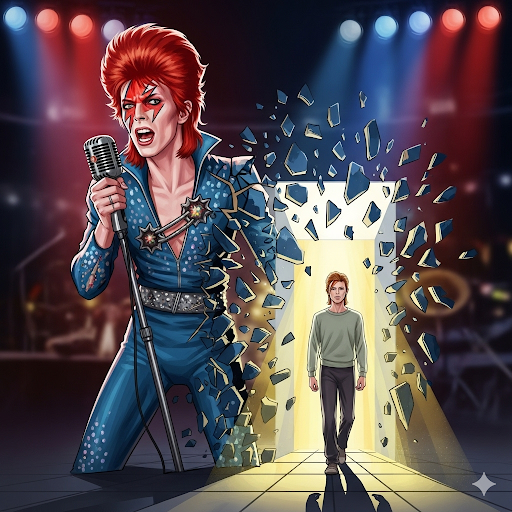
Why David Bowie killed off Ziggy Stardust at the height of success reveals the ultimate act of conscious choice intelligence. Learn strategic pattern recognition for evolutionary decision-making in your own life.
Published on consciouschoicemastery.com | Approx. 8-10 min read
July 3, 1973. London’s Hammersmith Odeon. David Bowie, dressed as his otherworldly alter ego Ziggy Stardust, finishes an electrifying 18-song set. The crowd is ecstatic. His career is soaring. The Ziggy Stardust album has made him an international superstar after nearly a decade of struggling for recognition.
Then, just before the final song, Bowie steps to the microphone and delivers the most shocking announcement in rock history:
“Of all the shows on this tour, this particular show will remain with us the longest, because not only is it the last show of the tour, but it’s the last show that we’ll ever do.”
The audience shrieked. Even his band members had no idea what was coming. In one calculated moment, David Bowie killed off his greatest creation at the absolute peak of its power.
Most people thought it was career suicide. Instead, it became the most brilliant demonstration of conscious choice intelligence ever captured on stage.
The Strategic Creation
Ziggy Stardust wasn’t an accident—it was a deliberate strategic creation. After years of commercial failure, Bowie recognized he needed a different approach. As he later explained: “What I did with my Ziggy Stardust was package a totally credible, plastic rock ‘n’ roll singer—much better than the Monkees could ever fabricate.”
The persona was carefully constructed from multiple influences: the unhinged charisma of failed rocker Vince Taylor (who believed himself to be “a cross between a god and an alien”), the raw energy of Iggy Pop, the theatrical stance of Gene Vincent performing with his injured leg, and the androgynous mystique of kabuki theater.
Bowie didn’t just create a character—he created a complete system for achieving the fame that had eluded him. And it worked spectacularly. Within 18 months, he went from unknown to international superstar.
Reading the Pattern Signals
But here’s what separated Bowie from every other performer: he was simultaneously living the success and consciously analyzing its effects.
By July 1973, after 18 months of touring as Ziggy, “Bowie felt as though maintaining the Ziggy persona was affecting his own personality and sanity too much; acting the same role over an extended period, it became difficult for him to separate Ziggy Stardust from his own character offstage.”
As he wrote in his book Moonage Daydream: “I really did want it all to come to an end… I was now writing for a different kind of project and exhausted and completely bored with the whole Ziggy concept, couldn’t keep my attention on the performance.”
Bowie was reading multiple pattern signals that others missed:
Internal Patterns: The persona that had liberated his creativity was now constraining it Energy Patterns: His enthusiasm for performing as Ziggy was genuinely depleting
Identity Patterns: The boundary between David Bowie and Ziggy Stardust was dangerously blurring Creative Patterns: New ideas were emerging that didn’t fit the Ziggy framework
The Intelligence Behind the “Suicide”
Most artists would have ignored these signals. External success was massive—why change a winning formula? But Bowie operated from a different level of awareness.
He recognized that “very few artists would have contemplated throwing a persona as wildly successful as Ziggy to the flame. While the allure of dining out on a profitable creation for the rest of their career is an enticing one, Bowie couldn’t bear the thought of being defined by one singular creation.”
This wasn’t impulsive destruction—it was conscious choice intelligence in its purest form. Bowie read the patterns and recognized:
- Peak Timing: End something while it’s still powerful rather than wait for decline
- Creative Freedom: Maintaining flexibility is more valuable than maximizing current success
- Identity Protection: Don’t let any strategy become so successful that it consumes your authentic self
- Strategic Evolution: The same intelligence that created Ziggy could create something new
The Conscious Choice Framework
Bowie’s decision reveals four levels of strategic awareness:
Surface Level: “Ziggy Stardust is hugely successful and making me rich and famous”
Pattern Level: “The Ziggy persona is beginning to constrain my creative development and blur my sense of self”
Choice Intelligence Level: “I need to consciously end this strategy before it becomes a trap, even though externally it appears to be working perfectly”
Strategic Evolution Level: “The same creative intelligence that designed Ziggy can design whatever comes next”
Most people operate only at the surface level, optimizing for immediate metrics. Bowie operated at the choice intelligence level, making decisions based on pattern recognition rather than external validation.
The Courage of Conscious Pivoting
What made Bowie’s choice extraordinary wasn’t just the pattern recognition—it was the courage to act on it. As one analysis noted: “Bowie’s gambler instinct is what separated him from the rest of the pack, and he knew that if he was smart enough to envision Ziggy in the first place, that he’d have no problems with his next persona.”
This represents advanced conscious choice intelligence:
- Pattern Recognition: Seeing when strategies stop serving growth
- Strategic Courage: Acting on intelligence rather than external pressure
- Identity Flexibility: Refusing to be trapped by your own success
- Creative Trust: Believing in your ability to adapt and evolve
Modern Applications
Bowie’s Ziggy decision offers a template for navigating any situation where external success might be masking internal constraint:
Professional Identity: When career success starts defining you more than you define your career
Relationship Patterns: When dynamics that once worked begin limiting growth for both parties
Business Strategies: When profitable approaches prevent exploration of new opportunities
Creative Projects: When successful formulas become creative prisons
Personal Habits: When effective routines become rigid constraints on authentic development
The Three-Layer Analysis
Layer 1: Surface Signals – External metrics of success (fame, money, recognition)
Layer 2: Pattern Recognition – Internal signals about sustainability, authenticity, and creative flow
Layer 3: Choice Intelligence – Strategic decisions based on long-term development rather than short-term optimization
Most people make decisions based on Layer 1. Bowie made his most famous decision based on Layer 3.
The Ziggy Paradox
The ultimate insight: Bowie’s willingness to kill Ziggy is what made the persona immortal. By ending it at its peak rather than letting it decline, he preserved its power while liberating his own creative potential.
In the long term, “killing off Ziggy Stardust when he did would be recognised as being even more genius than creating him in the first place.”
This paradox appears throughout life: sometimes the most intelligent choice is to consciously end something that’s working in order to create space for what wants to emerge.
Beyond Rock and Roll
Bowie’s approach transcends music. It’s a masterclass in conscious choice intelligence—the ability to read patterns, recognize when strategies have served their purpose, and make evolutionary decisions despite external pressure to maintain the status quo.
Whether you’re navigating career transitions, relationship evolution, creative development, or personal growth, Bowie’s Ziggy gamble provides a framework for making choices based on authentic intelligence rather than external validation.
The question isn’t whether you have successful patterns in your life—everyone does. The question is whether you’re conscious enough to recognize when they’ve stopped serving your growth, and courageous enough to evolve them.
Master Your Own Choice Intelligence
Bowie’s Ziggy decision demonstrates just one application of conscious choice intelligence. Whether you’re creating strategic personas, reading pattern signals, or making evolutionary pivots, the same framework applies: conscious awareness of what’s actually happening, strategic thinking about what serves growth, and the courage to act on authentic intelligence.
@ Lee Greene