Stars as Scripture: The Development of Astrological Thought Across World Cultures Series
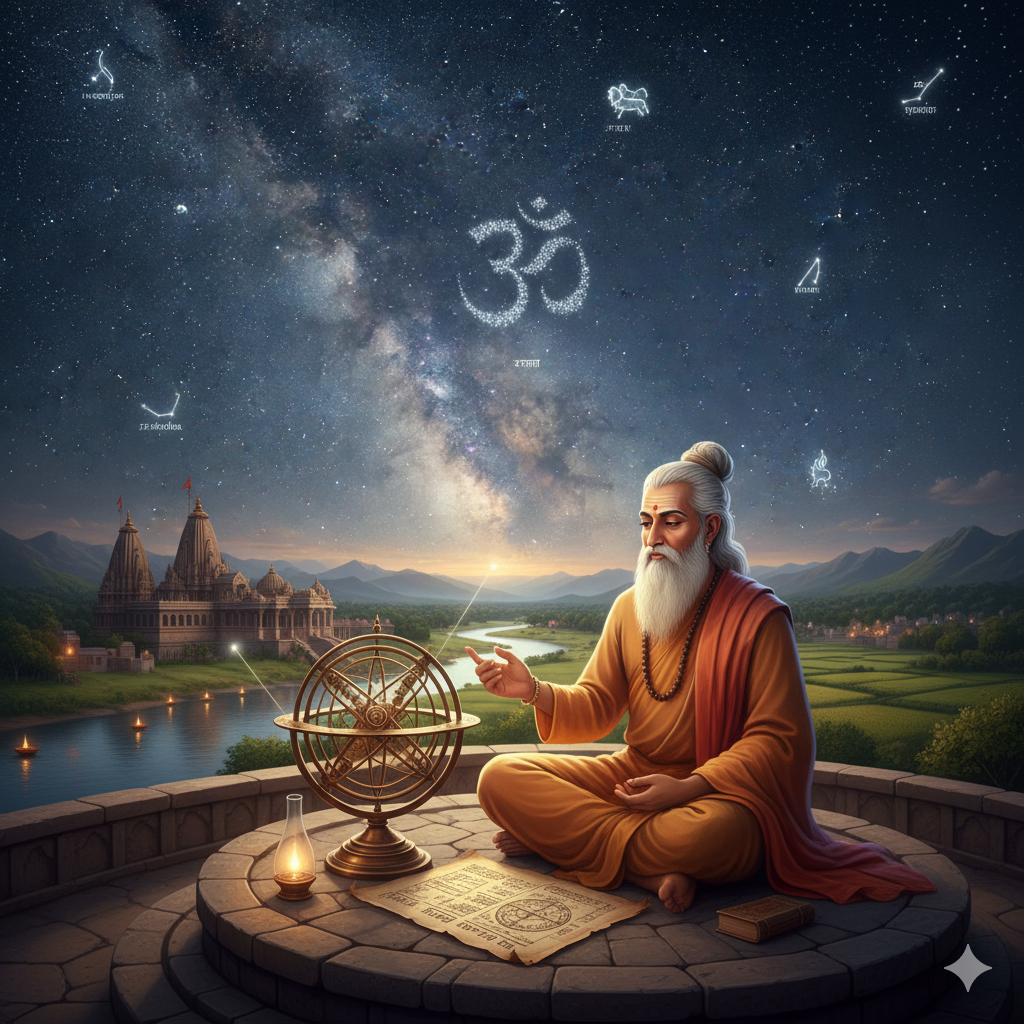
Published on consciouschoicemastery.com | Approx. 10-12 min read
This article continues a comprehensive analysis of how different civilizations developed astrological systems integrated with their mythological and cosmological frameworks:
- The First Stargazers: Sumerian Origins
- The Eternal Return: Egyptian Stellar Mythology and Calendar Systems
- The Mathematical Sky: Babylonian Systematization of Celestial Science
- The Harmonious Cosmos: Greek Synthesis and Philosophical Integration
- The Science of Light: Hindu Jyotisha and Vedic Cosmology
- The Mandate of Heaven: Chinese Bureaucratic Astrology and Imperial Order
- The Sacred Calendar: Maya Precision and Cosmic Cycles
- The Preserved Wisdom: Islamic Translation and Mathematical Refinement
- Universal Patterns: Comparative Analysis of Celestial Meaning-Making
Jyotisha: The Sacred Science of Cosmic Light
In the vast subcontinent of India, across millennia of continuous cultural development from Vedic origins through classical Hindu civilization, Indian astronomers and mathematician-philosophers created what they called Jyotisha—literally “the science of light”—a comprehensive system integrating precise mathematical astronomy with spiritual philosophy, karmic theory, and practical guidance for both individual and collective well-being.
Unlike the primarily practical focus of Mesopotamian astronomy, the mythological integration of Egyptian stellar science, or the geometric theorizing of Greek mathematical astronomy, Hindu Jyotisha developed as explicitly sacred science, understanding astronomical calculation as spiritual practice and celestial knowledge as pathway to both practical wisdom and ultimate liberation from the cycles of birth and death that govern individual existence.
This unique integration of mathematical precision with spiritual philosophy produced remarkable innovations in computational astronomy, including the invention of the decimal positional notation system, sophisticated trigonometric methods, and mathematical concepts like zero that revolutionized global mathematical development, while maintaining consistent frameworks for understanding astronomical knowledge as sacred wisdom rather than merely technical calculation.
The Hindu achievement in astronomical science emerged from cultural circumstances that combined continuous institutional preservation of Vedic knowledge through oral and written transmission, philosophical traditions that understood cosmic order as divine manifestation requiring systematic study, mathematical innovation motivated by precise ritual timing requirements, and spiritual practices that integrated astronomical observation with contemplative development and ethical living.
Understanding Hindu contributions to astronomical knowledge requires examining how their distinctive integration of mathematical innovation with spiritual philosophy created approaches to celestial science that served simultaneously as technical calculation, religious practice, philosophical investigation, and practical guidance for navigating both earthly affairs and spiritual development.
Vedic Foundations: Cosmic Order and Sacred Time
The Rig Veda: Astronomical Hymns and Cosmic Principles
The earliest Hindu astronomical concepts appear in the Rig Veda (c. 1500-1200 BCE), where hymns dedicated to solar, lunar, and stellar deities establish both observational knowledge and theological frameworks that understand celestial phenomena as divine activities requiring human recognition, celebration, and practical coordination.
The Surya Sukta (Rig Veda 1.115) demonstrates early integration of astronomical observation with spiritual understanding:
“Behold the rays of Dawn, the harbinger, have risen on high, lifting up her banner of light. She has come, making the world bright, she who spreads afar. Rise up! The breath, the life has come back to us, darkness has departed, light is approaching.”¹
This solar hymn establishes several principles fundamental to Hindu astronomical development:
- Celestial phenomena as divine activities worthy of systematic observation and spiritual recognition
- Light as fundamental cosmic principle manifesting through astronomical phenomena
- Human coordination with celestial cycles as spiritual practice rather than merely practical necessity
- Integration of observational knowledge with devotional practice and philosophical understanding
The Atharva Veda: Time Cycles and Cosmic Mathematics
The Atharva Veda (c. 1200-900 BCE) contains more systematic astronomical and mathematical concepts, including detailed descriptions of temporal cycles, calendar systems, and the mathematical relationships underlying cosmic order.
The Kala Sukta (Atharva Veda 19.53-54) presents sophisticated temporal philosophy:
“Time is the horse with seven reins, thousand-eyed, unaging, rich in seed. The sages, thinking holy thoughts, mount him, all the beings are his wheels. With seven wheels does this Time ride, seven naves has he, immortality is his axle. He carries hither all these beings. Time, the first god, now hastens onward.”²
This temporal cosmology establishes:
- Mathematical frameworks for understanding cyclical time through numerical symbolism
- Integration of astronomical observation with cosmological speculation about time’s nature
- Spiritual significance of temporal cycles requiring systematic study and practical application
- Foundation concepts for later sophisticated mathematical astronomy and calendar calculation
Vedic Calendar Systems: Ritual Precision and Astronomical Coordination
Vedic civilization developed elaborate calendar systems coordinating lunar months with solar years and stellar observations to ensure precise timing of religious rituals, agricultural activities, and social celebrations.
The Taittiriya Samhita preserves early calendar methodology:
“The year has 360 days, plus 5 or 6 additional days to maintain seasonal coordination. The lunar months are coordinated with the solar year through systematic intercalation. The nakshatras [lunar mansions] provide daily timing for ritual activities according to stellar positions.”³
Vedic calendar innovations included:
- Sophisticated luni-solar coordination requiring precise mathematical calculation
- Integration of stellar observation with practical religious and social timing requirements
- Systematic intercalation methods maintaining long-term calendar accuracy
- Foundation frameworks for later classical Hindu astronomical and astrological development
Classical Mathematical Astronomy: The Siddhantic Tradition
The Surya Siddhanta: Comprehensive Astronomical Treatise
The Surya Siddhanta (traditional dating varies; extant versions c. 400-800 CE) represents the pinnacle of classical Hindu mathematical astronomy, providing comprehensive computational methods for planetary calculation, eclipse prediction, and calendar coordination with remarkable mathematical sophistication.
The text establishes its methodology and scope:
“The Surya Siddhanta teaches the calculation of the true motions of the sun, moon, and planets; the determination of eclipses; the construction of the calendar; and the mathematical methods needed for precise astronomical computation. This knowledge enables both practical applications and spiritual understanding of cosmic order.”⁴
The Surya Siddhanta achievements include:
- Comprehensive mathematical methods for all planetary calculations
- Sophisticated trigonometric techniques enabling precise astronomical computation
- Integration of theoretical astronomy with practical calendar and ritual timing applications
- Systematic presentation enabling widespread education in mathematical astronomical methods
Aryabhata: Mathematical Innovation and Astronomical Theory
Aryabhata (476-550 CE) created revolutionary innovations in both mathematical technique and astronomical theory, including the first systematic use of sine functions in astronomical calculation and theoretical proposals about planetary motions that anticipated later European developments.
Aryabhata’s Aryabhatiya demonstrates mathematical precision:
“The sine differences: 225, 224, 222, 219, 215, 210, 205, 199, 191, 183, 174, 164, 154, 143, 131, 119, 106, 93, 79, 65, 51, 37, 22, 7. These differences enable calculation of sines for any arc, providing the mathematical foundation for precise astronomical computation.”⁵
Aryabhata’s innovations included:
- Systematic trigonometric methods revolutionizing astronomical calculation accuracy
- Theoretical proposals including Earth’s rotation and explanations for planetary retrograde motion
- Mathematical innovations including place-value decimal notation and computational algorithms
- Integration of mathematical precision with traditional astronomical applications
Brahmagupta: Algebraic Methods and Theoretical Refinement
Brahmagupta (628-668 CE) advanced Hindu mathematical astronomy through algebraic methods, theoretical corrections to earlier work, and systematic integration of mathematical innovation with traditional astronomical knowledge.
Brahmagupta’s Brahmasphuta Siddhanta presents algebraic astronomical methods:
“To find the true longitude of a planet: take the mean longitude, apply the equation of center using sine tables, correct for the planet’s equation, and adjust for precession. These calculations require systematic application of algebraic methods to astronomical problems.”⁶
Brahmagupta’s contributions included:
- Algebraic methods enabling more sophisticated astronomical calculation
- Systematic correction and refinement of earlier astronomical theories
- Integration of mathematical innovation with observational verification
- Educational frameworks enabling widespread dissemination of advanced astronomical knowledge
The Decimal Revolution: Mathematical Innovations with Global Impact
The Invention of Zero and Positional Notation
Hindu mathematicians developed the decimal positional notation system with zero as placeholder, creating mathematical innovations that revolutionized global calculation while serving the practical needs of precise astronomical computation required by Hindu calendar and ritual systems.
Brahmagupta systematically describes zero’s mathematical properties:
“When zero is added to a number or subtracted from it, the number remains unchanged; and a number multiplied by zero becomes zero. Positive or negative numbers when divided by zero become fractions having zero as denominator.”⁷
The decimal system innovation enabled:
- Unprecedented precision in astronomical calculation through efficient computational methods
- Global mathematical revolution as decimal notation spread through Islamic and European mathematical development
- Integration of practical calculation requirements with systematic mathematical theoretical development
- Foundation tools enabling increasingly sophisticated astronomical and astrological applications
Trigonometric Advances: Sine Tables and Computational Precision
Hindu astronomers developed the most advanced trigonometric methods in the ancient world, creating sine tables and computational techniques that enabled astronomical calculation accuracy exceeding contemporary Greek and Islamic methods.
Bhaskara I (c. 600-680 CE) refined trigonometric approximation:
“For finding sines without tables: sin x = (16x(180-x))/(5(180²) – 4x(180-x)), where x is in degrees. This approximation enables precise calculation when tables are unavailable.”⁸
Hindu trigonometric innovations included:
- Systematic sine tables enabling precise astronomical calculation
- Computational algorithms reducing calculation complexity while maintaining accuracy
- Integration of trigonometric methods with practical astronomical applications
- Foundation techniques influencing Islamic and later European mathematical development
Algebraic Astronomy: Equation-Solving and Parameter Determination
Hindu mathematicians developed algebraic methods specifically for astronomical applications, creating systematic approaches to parameter determination, equation solving, and theoretical verification that advanced both mathematical and astronomical knowledge.
Bhaskara II (1114-1185 CE) demonstrates algebraic astronomical application:
“To find when planets return to conjunction: set up equations expressing each planet’s position as function of time, solve for time values when positions are equal. This requires systematic algebraic methods applied to astronomical problems.”⁹
Algebraic astronomical methods enabled:
- Systematic solution of complex astronomical problems through mathematical rather than purely computational approaches
- Parameter determination enabling refinement of astronomical models through observational data analysis
- Integration of mathematical theoretical development with practical astronomical applications
- Foundation methods influencing later European algebraic and astronomical development
Spiritual Integration: Astronomy as Sacred Science
Karmic Astrology: Individual Development and Cosmic Law
Hindu astrological theory integrated astronomical calculation with philosophical understanding of karma, dharma, and individual spiritual development, creating approaches to astrological interpretation that served both practical guidance and spiritual development.
The Brihat Parashara Hora Shastra explains karmic astrological principles:
“The planetary positions at birth reflect the karmic patterns accumulated through previous actions. Understanding these patterns through precise astronomical calculation enables conscious participation in spiritual development rather than unconscious subjection to karmic consequences.”¹⁰
Hindu karmic astrology featured:
- Integration of precise astronomical calculation with philosophical understanding of individual development
- Astrological interpretation serving spiritual development rather than merely predictive consultation
- Systematic correlation between celestial patterns and karmic principles governing individual experience
- Cultural frameworks enabling both practical and spiritual applications of astronomical knowledge
Dharmic Timing: Social Order and Cosmic Coordination
Hindu civilization integrated astronomical knowledge with dharmic principles governing social organization, creating systematic approaches to temporal coordination that served both practical social needs and spiritual understanding of cosmic order.
The Dharma Shastra literature explains dharmic temporal coordination:
“Different activities are appropriate at different times according to solar, lunar, and planetary cycles. Proper timing coordination enables individual actions to support rather than conflict with cosmic order, serving both personal dharma and collective harmony.”¹¹
Dharmic timing applications included:
- Integration of astronomical calculation with ethical and social guidance
- Systematic coordination between individual actions and cosmic cycles for optimal outcomes
- Cultural frameworks understanding temporal coordination as spiritual practice
- Practical applications ranging from agricultural timing to religious ceremony coordination
Moksha and Astronomical Wisdom: Liberation Through Cosmic Understanding
Hindu philosophical traditions understood astronomical study as potential pathway to moksha (liberation), integrating mathematical precision with contemplative practice and ethical development.
Varahamihira explains astronomy’s spiritual significance:
“The study of celestial motions purifies the mind, develops discrimination, and reveals the mathematical order underlying apparent natural diversity. For those who approach with proper understanding, astronomical knowledge becomes pathway to recognition of eternal principles governing all existence.”¹²
Astronomical spiritual practice included:
- Mathematical calculation as contemplative practice developing mental clarity and discrimination
- Astronomical observation integrated with philosophical inquiry about cosmic principles
- Integration of technical astronomical education with ethical development and spiritual practice
- Cultural understanding of astronomical knowledge as sacred wisdom rather than merely practical calculation
Observational Traditions: Systematic Sky Watching and Data Collection
The Jantar Mantar Observatories: Architectural Astronomical Instruments
During the 18th century, Maharaja Jai Singh II of Jaipur constructed massive astronomical observatories (Jantar Mantar) that combined Hindu mathematical astronomical methods with Mughal architectural techniques, creating precision instruments for systematic observation and calendar coordination.
Contemporary accounts describe the observatory achievements:
“The great instruments at Delhi, Jaipur, Ujjain, Mathura, and Varanasi enable precise measurement of solar, lunar, and planetary positions. These architectural astronomical instruments demonstrate the continued vitality of Hindu mathematical astronomy under Mughal patronage.”¹³
The observatory achievements included:
- Precision architectural instruments enabling accurate positional measurement
- Integration of Hindu mathematical methods with contemporary observational requirements
- Cultural preservation and development of traditional astronomical knowledge through royal patronage
- International recognition of Hindu astronomical capability and theoretical sophistication
Traditional Observational Methods: Systematic Data Collection
Hindu astronomers developed systematic observational techniques and long-term data collection methods that enabled verification of theoretical calculations and refinement of mathematical parameters.
Brahmagupta describes observational methodology:
“Systematic observation requires careful attention to instrumental accuracy, precise timing methods, atmospheric correction, and long-term record keeping. Only through systematic data collection can theoretical calculations be verified and refined.”¹⁴
Hindu observational traditions included:
- Systematic instrumental techniques enabling precise positional measurement
- Long-term data collection enabling verification of theoretical predictions
- Integration of observational data with mathematical modeling for parameter refinement
- Cultural frameworks understanding systematic observation as both practical necessity and spiritual practice
Regional Variations: Diverse Approaches Within Unified Tradition
Kerala School: Advanced Mathematical Techniques
The Kerala school of mathematics and astronomy (14th-16th centuries CE) developed advanced mathematical techniques including infinite series, calculus-like methods, and sophisticated trigonometric approximations that anticipated later European mathematical developments by centuries.
Madhava (c. 1340-1425 CE) developed infinite series for trigonometric functions:
“The arc is equal to the sine minus one-third of the cube of the sine divided by the square of the cosine, plus one-fifth of the fifth power of the sine divided by the fourth power of the cosine, and so on. This series enables calculation of sines to any desired precision.”¹⁵
Kerala school innovations included:
- Advanced mathematical techniques centuries before similar European developments
- Integration of mathematical innovation with practical astronomical applications
- Systematic development of computational methods reducing calculation complexity
- Cultural preservation of advanced mathematical knowledge through institutional educational continuity
Regional Calendar Systems: Local Adaptations of Universal Principles
Different regions of India developed distinct calendar systems adapted to local agricultural, cultural, and administrative requirements while maintaining coordination with pan-Indian astronomical and religious frameworks.
The Siddhanta Shiromani explains regional calendar coordination:
“Different regions require calendar systems adapted to local conditions while maintaining coordination with universal astronomical principles. This enables both local practical applications and participation in pan-Indian religious and cultural activities.”¹⁶
Regional variations included:
- Local calendar adaptations serving specific agricultural and cultural requirements
- Coordination mechanisms maintaining religious and cultural unity across regional diversity
- Integration of local observational traditions with universal astronomical principles
- Cultural frameworks enabling diversity within unity through systematic astronomical coordination
International Influence: Hindu Astronomy’s Global Impact
Islamic Transmission and Development
Islamic astronomers extensively studied Hindu astronomical texts, translating major works and incorporating Hindu mathematical methods into Islamic astronomical practice while adding original developments and observational refinements.
Al-Biruni (973-1048 CE) describes Hindu astronomical achievement:
“The Indians have methods of astronomical calculation that surpass those of other nations in certain respects. Their understanding of mathematical relationships, their computational techniques, and their integration of astronomical knowledge with philosophical wisdom deserve careful study and systematic development.”¹⁷
Islamic engagement with Hindu astronomy included:
- Systematic translation of major Hindu astronomical texts into Arabic
- Mathematical refinement of Hindu computational methods using Islamic algebraic techniques
- Observational verification and correction of Hindu theoretical parameters
- Cultural synthesis creating new approaches combining Hindu and Islamic astronomical traditions
European Renaissance Reception
European scholars during the Renaissance and early modern period studied Hindu astronomical knowledge through Islamic translations and direct contact, leading to adoption of Hindu mathematical techniques and theoretical insights.
John Wallis (1616-1703) acknowledges Hindu mathematical contributions:
“The Indians have achieved remarkable sophistication in arithmetical and algebraic methods. Their systematic approaches to calculation, their understanding of infinite series, and their integration of mathematical precision with astronomical applications provide valuable insights for European mathematical development.”¹⁸
European reception of Hindu astronomy included:
- Adoption of Hindu decimal notation and computational methods
- Recognition of Hindu contributions to trigonometric and algebraic development
- Integration of Hindu astronomical parameters and theoretical insights
- Cultural acknowledgment of Hindu contributions to global mathematical and astronomical advancement
Institutional Preservation: Education and Cultural Transmission
Gurukula System: Traditional Astronomical Education
Hindu civilization preserved and transmitted astronomical knowledge through the gurukula system, where students lived with teachers for extended periods, mastering not only technical calculation but also philosophical understanding and practical application of astronomical wisdom.
Traditional gurukula curriculum combined multiple learning approaches:
“Students must master computational techniques, understand theoretical principles, develop observational skills, integrate philosophical frameworks, and learn practical applications. This comprehensive education enables both technical competence and cultural understanding of astronomical knowledge as sacred science.”¹⁹
The gurukula system provided:
- Comprehensive education combining technical, theoretical, and practical astronomical knowledge
- Cultural transmission integrating astronomical learning with spiritual and ethical development
- Institutional continuity enabling preservation and development of astronomical knowledge across generations
- Personal mentorship ensuring quality control and adaptation to individual learning needs
Sanskrit Scholarly Tradition: Literature and Commentary
Hindu astronomical knowledge was preserved and developed through extensive Sanskrit literature including original treatises, mathematical commentaries, and philosophical integrations that maintained both technical precision and cultural meaning.
The Sanskrit scholarly tradition demonstrated:
- Systematic literary preservation of astronomical knowledge through multiple textual traditions
- Commentary systems enabling continuous refinement and development of inherited knowledge
- Integration of astronomical learning with broader philosophical and cultural frameworks
- International communication through Sanskrit as scholarly lingua franca
Contemporary Relevance: Traditional Wisdom and Modern Applications
Modern Recognition of Historical Contributions
Contemporary scholarship increasingly recognizes the sophistication and global influence of Hindu mathematical and astronomical achievements, particularly in computational methods, theoretical insights, and systematic approaches to scientific investigation.
Recent analysis demonstrates Hindu astronomical accuracy:
“Computer verification of medieval Hindu astronomical calculations shows precision comparable to modern computation using historical observational data. Hindu mathematical methods achieved accuracy levels that remained unsurpassed until the development of modern computational techniques.”²⁰
Modern recognition includes:
- Historical verification of Hindu computational accuracy through computer analysis
- Academic acknowledgment of Hindu contributions to global mathematical development
- Cultural appreciation of Hindu integration of scientific precision with philosophical wisdom
- Contemporary applications of traditional Hindu astronomical knowledge to current research
Traditional Knowledge and Contemporary Science
Contemporary researchers investigate traditional Hindu astronomical knowledge for insights applicable to current scientific and technological development, particularly in computational methods, observational techniques, and theoretical approaches.
Traditional knowledge applications include:
- Computational algorithms derived from Hindu mathematical techniques
- Observational methods adapted from traditional Hindu astronomical practice
- Theoretical frameworks integrating Hindu philosophical insights with contemporary scientific understanding
- Educational approaches combining traditional Hindu learning methods with modern scientific training
Philosophical Integration: Science as Spiritual Practice
Sat-Chit-Ananda: Existence-Consciousness-Bliss as Cosmic Principles
Hindu philosophical traditions understood astronomical study as investigation into the fundamental nature of reality, integrating mathematical precision with contemplative practice aimed at recognizing the unity of existence, consciousness, and bliss underlying apparent cosmic diversity.
Shankaracharya explains astronomical study’s spiritual significance:
“The regular motions of celestial bodies reveal the mathematical order underlying apparent natural diversity. For those who study with proper understanding, astronomical investigation becomes recognition that the same consciousness manifesting as observer also manifests as the observed cosmic phenomena.”²¹
Philosophical integration enabled:
- Understanding of astronomical study as spiritual practice rather than merely technical learning
- Integration of mathematical precision with contemplative development
- Recognition of cosmic order as expression of fundamental consciousness principles
- Cultural frameworks enabling both practical and spiritual applications of astronomical knowledge
Yoga and Astronomical Practice: Contemplative Integration
Hindu traditions developed approaches to astronomical study that integrated mathematical calculation with contemplative practices (yoga) aimed at purifying consciousness and enabling direct recognition of the principles underlying cosmic order.
Traditional yoga applications to astronomical study included:
- Contemplative practices purifying mental clarity for precise calculation and theoretical understanding
- Integration of mathematical learning with ethical development and spiritual practice
- Recognition of astronomical knowledge as pathway to understanding consciousness itself
- Systematic approaches enabling both practical competence and spiritual development through astronomical education
Conclusion: The Sacred Science Legacy
Hindu civilization’s development of Jyotisha as sacred science created unique integration of mathematical precision with spiritual philosophy that advanced both computational astronomy and contemplative understanding while contributing fundamental innovations to global mathematical development. Their understanding of astronomical knowledge as sacred wisdom rather than merely practical calculation enabled cultural frameworks that preserved, developed, and transmitted astronomical learning across millennia while maintaining relevance for both practical applications and spiritual development.
The Hindu achievement in mathematical astronomy demonstrates the possibility of scientific investigation that serves simultaneously as technical knowledge, spiritual practice, and philosophical inquiry. Their computational innovations including decimal notation, trigonometric methods, and algebraic techniques revolutionized global mathematical development while their theoretical insights about cosmic order and individual development created frameworks for understanding astronomical knowledge that continue to influence contemporary thought.
Hindu contributions to astronomical science challenge contemporary assumptions about relationships between scientific precision and spiritual understanding, demonstrating approaches to natural investigation that enhance rather than diminish recognition of cosmic meaning and purpose. Their integration of mathematical rigor with philosophical depth created precedents for scientific investigation that serves both practical knowledge and contemplative development.
Understanding Hindu astronomical achievements provides essential context for appreciating both the global development of mathematical science and the possibility of approaches to natural investigation that integrate precision with meaning, technique with wisdom, and practical application with spiritual development. The mathematician-philosophers of classical India created more than computational methods—they established approaches to sacred science that continue to influence human understanding of the mathematical order underlying the cosmos they studied with such remarkable precision and philosophical depth.
Their legacy persists in every decimal calculation, every trigonometric computation, every integration of mathematical precision with contemplative inquiry—testament to the enduring possibility of scientific investigation as spiritual practice and mathematical wisdom as pathway to understanding the infinite consciousness expressing itself through the cosmic order that inspired their lifelong devotion to both calculation and contemplation.
Sources:
- Rig Veda, trans. Wendy Doniger (London: Penguin Classics, 1981), Mandala 1, Sukta 115, verses 1-6.
- Atharva Veda, trans. William Dwight Whitney, in Atharva-Veda Samhita (Cambridge: Harvard University Press, 1905), Book 19, Hymns 53-54.
- Taittiriya Samhita, trans. A. B. Keith, in The Veda of the Black Yajus School (Cambridge: Harvard University Press, 1914), Book 7, Chapter 4, Section 8.
- Surya Siddhanta, trans. Ebenezer Burgess, in Translation of the Surya-Siddhanta (New Haven: American Oriental Society, 1860), Chapter 1, verses 1-3.
- Aryabhatiya, trans. Walter Eugene Clark, in The Aryabhatiya of Aryabhata (Chicago: University of Chicago Press, 1930), Ganitapada, verse 12.
- Brahmasphuta Siddhanta, trans. H. T. Colebrooke, in Algebra, with Arithmetic and Mensuration (London: John Murray, 1817), Chapter 2, verses 9-12.
- Brahmasphuta Siddhanta, trans. H. T. Colebrooke, Chapter 18, verses 30-35.
- Bhaskara I, quoted in Kim Plofker, Mathematics in India (Princeton: Princeton University Press, 2009), 178-181.
- Siddhanta Shiromani, trans. Lancelot Wilkinson, in Translation of the Siddhanta Shiromani (Calcutta: Asiatic Society of Bengal, 1842), Ganitadhyaya, Chapter 3.
- Brihat Parashara Hora Shastra, trans. R. Santhanam (New Delhi: Ranjan Publications, 1984), Chapter 2, verses 1-5.
- Manusmriti, trans. Patrick Olivelle, in Manu’s Code of Law (Oxford: Oxford University Press, 2004), Chapter 4, verses 95-100.
- Brihat Samhita, trans. M. Ramakrishna Bhat, in Varahamihira’s Brihat Samhita (Delhi: Motilal Banarsidass, 1981), Chapter 2, verses 12-16.
- Jantar Mantar, description in Virendra Nath Sharma, Sawai Jai Singh and His Astronomy (Delhi: Motilal Banarsidass, 1995), 89-134.
- Brahmasphuta Siddhanta, trans. H. T. Colebrooke, Chapter 24, verses 40-45.
- Madhava, quoted in C. K. Raju, Cultural Foundations of Mathematics (Delhi: Pearson Longman, 2007), 234-267.
- Siddhanta Shiromani, trans. Lancelot Wilkinson, Goladhyaya, Chapter 1, verses 58-62.
- Al-Biruni, Kitab fi Tahqiq ma li’l-Hind (Alberuni’s India), trans. Edward C. Sachau (London: Kegan Paul, 1910), Volume 2, 16-23.
- John Wallis, Algebra, quoted in Kim Plofker, Mathematics in India (Princeton: Princeton University Press, 2009), 298-301.
- Traditional Gurukula curriculum, described in Kapila Vatsyayan, Traditional Indian Theatre: Multiple Streams (New Delhi: National Book Trust, 1980), 67-89.
- Modern Analysis, David Pingree, “The Logic of Non-Western Science,” in Jyotihsastra: Astral and Mathematical Literature (Wiesbaden: Otto Harrassowitz, 1981), 45-78.
- Shankaracharya, Vivekachudamani, trans. Swami Madhavananda (Calcutta: Advaita Ashrama, 1921), verses 234-238.
@ 2025 Lee Greene