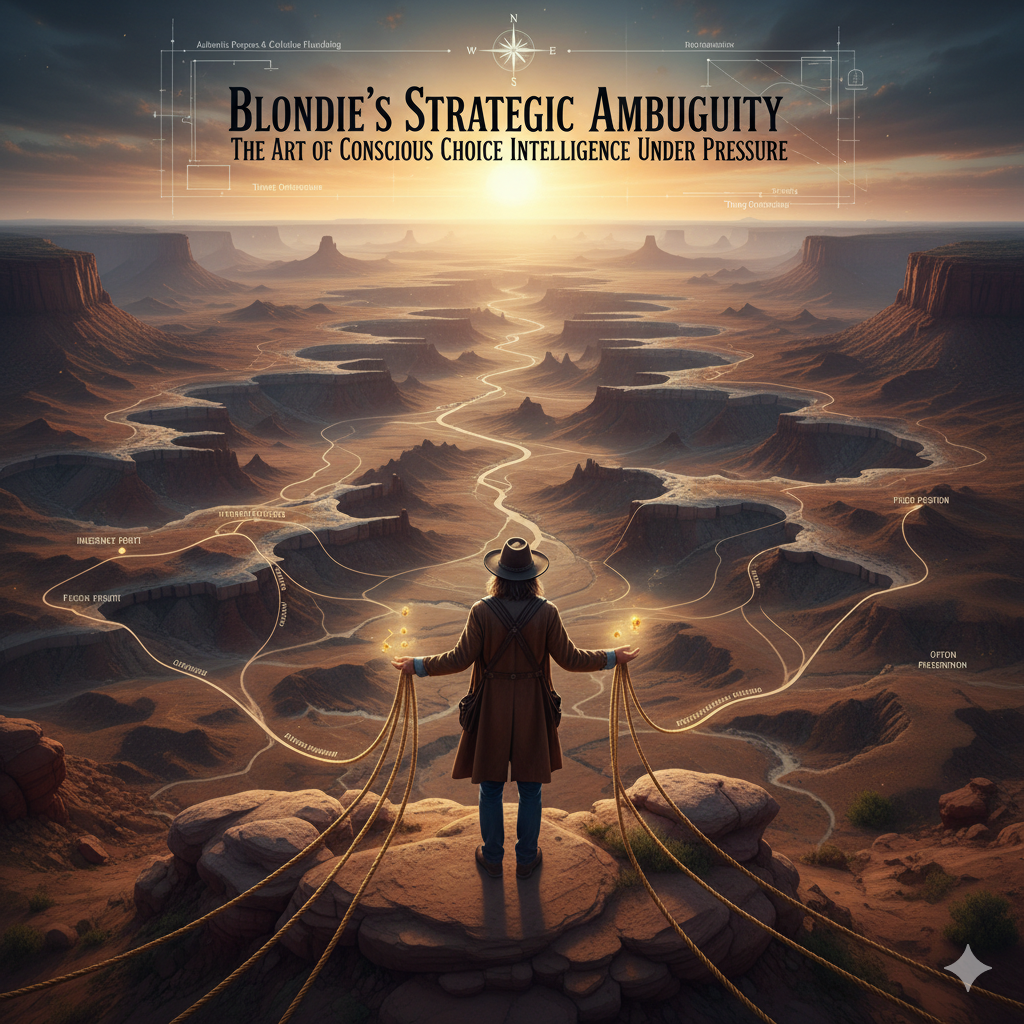
Blondie’s (Clint Eastwood) strategic ambiguity demonstrates advanced conscious choice intelligence – tactical flexibility serving consistent deeper purposes. Master strategic thinking under ultimate pressure.
Published on consciouschoicemastery.com | Approx. 10-12 min read
“You see, in this world there’s two kinds of people, my friend: those with rope around their necks and those who have the job of cutting.”
Blondie’s observation to Tuco in The Good, The Bad, and The Ugly reveals something profound about conscious choice intelligence: the most sophisticated decision-makers operate by creating strategic ambiguity that allows them to adapt their position based on how situations evolve.
Clint Eastwood’s “Man with No Name” represents the ultimate expression of conscious choice intelligence—someone who maintains maximum strategic flexibility while others commit to fixed positions, gathers information while revealing minimal information, and ultimately prevails not through superior force or pure survival instinct, but through superior choice architecture.
Blondie demonstrates what conscious choice intelligence looks like when applied systematically under life-or-death pressure: the ability to make decisions that serve long-term strategic objectives while adapting tactically to immediate circumstances without losing sight of deeper purposes.
The Mastery of Strategic Ambiguity
Blondie’s defining characteristic isn’t moral superiority—it’s strategic sophistication. He operates from a level of choice intelligence that transcends the simple dichotomies that constrain other characters.
Surface Assessment: Blondie appears opportunistic, unpredictable, and morally ambiguous—someone whose loyalty and intentions remain unclear throughout most of the film.
Pattern Recognition: Blondie demonstrates consistent mastery of:
- Information asymmetry management—knowing more than he reveals while learning from others
- Strategic positioning—maintaining options while others commit to limiting choices
- Timing optimization—acting at moments when his choices have maximum impact
- Relationship leverage—creating mutual dependence while maintaining independent capability
- Long-term strategic thinking integrated with tactical flexibility
Choice Intelligence Insight: Blondie operates from advanced conscious choice architecture that allows him to serve his deeper purposes while adapting his methods to circumstances as they evolve.
The Three Phases of Blondie’s Strategic Evolution
Phase 1: Initial Partnership (Strategic Information Gathering)
The film opens with Blondie and Tuco’s bounty hunting scheme—Blondie turns Tuco in for the reward, then rescues him before execution, and they split the money.
Surface Strategy: Simple profit-sharing arrangement exploiting legal loopholes.
Deeper Intelligence: Blondie uses this arrangement to:
- Study Tuco’s capabilities, limitations, and psychological patterns
- Test his own capacity for precisely timed high-risk operations
- Build reputation and resources while maintaining strategic flexibility
- Develop understanding of how official systems (bounty, legal, military) actually operate versus how they appear to operate
Choice Architecture: Creating a situation that generates immediate profit while serving as intelligence gathering and skill development for unknown future opportunities.
Phase 2: Information Acquisition (Strategic Listening)
When Tuco learns about the Confederate gold from the dying soldier, Blondie demonstrates advanced choice intelligence through strategic passivity.
The Situation: Tuco wants to abandon their partnership and pursue the treasure independently.
Conventional Response: Fight for equal partnership or abandon Tuco to pursue independent opportunities.
Blondie’s Choice: Allow the partnership dissolution while positioning himself to acquire the information Tuco gained.
The Intelligence: Recognizing that sometimes the most strategic choice is appearing to accept a weaker position while gathering information that creates actual strategic advantage.
Advanced Pattern Recognition: Understanding that in information-dependent situations, apparent cooperation can be the most effective competitive strategy.
Phase 3: Multi-Party Strategic Management (Conscious Choice Under Ultimate Pressure)
The final cemetery sequence demonstrates conscious choice intelligence at its most sophisticated level.
The Complexity: Three-way standoff where each participant has partial information necessary for success, different capabilities and motivations, and awareness that only one can ultimately prevail.
Blondie’s Strategic Architecture:
- Information Management: He knows the name on the grave but not its location
- Relationship Leverage: Maintains alliance with Tuco while preparing for ultimate betrayal
- Timing Control: Manages the sequence of revelations to maintain strategic advantage
- Risk Minimization: Structures the final confrontation to maximize his chances while minimizing exposure
The Ultimate Choice Intelligence: Blondie’s pre-positioning of unloaded ammunition in Angel Eyes’ gun demonstrates planning that accounts for multiple scenarios while maintaining the appearance of fair competition.
The Three-Layer Analysis of Strategic Superiority
Layer 1: Surface Events (Apparent Moral Ambiguity) Blondie appears to shift loyalties opportunistically, betraying partnerships when it serves his advantage, operating without clear ethical principles beyond self-interest.
Layer 2: Pattern Recognition (Strategic Intelligence System) Blondie operates from sophisticated understanding that complex, high-stakes situations require:
- Information advantage maintained through strategic ambiguity about intentions
- Tactical flexibility that allows adaptation as circumstances evolve
- Long-term strategic thinking that uses short-term relationships and alliances instrumentally
- Risk management that accounts for others’ capabilities and limitations
- Timing optimization that maximizes the impact of strategic choices
Layer 3: Consciousness Message (Advanced Choice Architecture) Blondie represents the possibility of developing choice intelligence that serves authentic purposes (survival, freedom, resource acquisition) through methods that adapt to circumstances rather than being limited by rigid ethical systems or emotional attachments.
Strategic Ambiguity as Conscious Choice Development
Information Asymmetry Management
Blondie consistently operates with more information than he reveals, while systematically gathering information others don’t realize they’re providing.
The Method:
- Ask questions that appear casual but gather strategic intelligence
- Reveal minimal information about capabilities, intentions, or knowledge
- Create situations where others reveal their priorities, capabilities, and limitations
- Use silence and minimal responses to encourage others to fill conversational space with revealing information
Modern Applications:
- Professional negotiations where information advantage determines outcomes
- Relationship dynamics where understanding others’ authentic motivations serves mutual development
- Creative collaborations where understanding others’ capabilities allows better project structure
- Crisis management where incomplete information requires strategic flexibility
Tactical Flexibility with Strategic Consistency
While others commit to fixed strategies, Blondie maintains tactical flexibility while serving consistent strategic purposes.
Strategic Consistency: Acquire resources and freedom while minimizing risk and maintaining autonomy.
Tactical Flexibility:
- Partner with Tuco when mutual benefit serves strategic goals
- Separate from Tuco when circumstances change
- Cooperate with Angel Eyes when information gathering requires it
- Eliminate Angel Eyes when direct confrontation becomes necessary
The Intelligence: Understanding the difference between strategic objectives (which remain consistent) and tactical methods (which must adapt to circumstances).
Modern Applications:
- Career development that maintains long-term professional goals while adapting to industry changes
- Relationship choices that serve authentic connection while adapting to partners’ developmental changes
- Financial planning that serves security and freedom goals while adapting investment strategies to economic conditions
- Creative projects that serve artistic vision while adapting methods to available resources and collaborative opportunities
Risk Management Through Option Preservation
Blondie consistently makes choices that preserve future options rather than committing to paths that limit strategic flexibility.
Examples:
- Maintaining the bounty hunting partnership longer than necessary to preserve multiple income streams
- Not killing Tuco when the partnership becomes problematic, preserving him as a resource for future situations
- Gathering information about Angel Eyes’ methods and capabilities rather than confronting him prematurely
- Structuring the final confrontation to minimize his risk while maximizing others’ exposure
The Principle: In uncertain, high-stakes environments, choices that preserve future options often serve strategic objectives better than choices that optimize immediate outcomes.
Modern Applications:
- Professional development that builds transferable skills rather than highly specialized expertise
- Relationship choices that support mutual growth rather than creating dependency
- Financial strategies that maintain liquidity rather than maximizing immediate returns
- Creative projects that develop multiple revenue streams rather than depending on single success
The Conscious Choice Intelligence Framework Applied
Real-Time Strategic Decision-Making
Blondie’s Protocol for High-Stakes Choices:
Information Assessment (Continuous):
- What do I know that others don’t realize I know?
- What information do I need that I don’t currently have?
- What are others revealing about their capabilities, intentions, and limitations?
- How can I acquire strategic information without revealing my own position?
Option Evaluation (Before Major Commitments):
- Which choices preserve future flexibility versus which require premature commitment?
- How do immediate tactical opportunities serve or compromise long-term strategic objectives?
- What are the real risks versus the apparent risks of different approaches?
- How can I structure choices to minimize my exposure while maximizing potential benefits?
Timing Optimization (Strategic Patience):
- When will my choice have maximum impact relative to effort and risk?
- How do I maintain strategic positioning while others commit to limiting strategies?
- What sequence of actions creates cumulative advantage rather than just immediate benefit?
- When does strategic ambiguity serve me versus when do I need clear positioning?
Relationship Management (Instrumental without Manipulation):
- How can I create mutual benefit while maintaining strategic independence?
- Which alliances serve current objectives without creating problematic dependencies?
- How do I gather intelligence about others’ capabilities without creating unnecessary conflicts?
- When do I need others’ cooperation versus when do I need strategic distance?
The Integration Challenge: Ethics and Strategic Intelligence
Blondie’s approach raises important questions about the relationship between strategic effectiveness and ethical behavior.
The Complexity: Blondie’s strategic success comes partly from his willingness to use others instrumentally and maintain strategic ambiguity about his true intentions.
The Integration Opportunity: Using Blondie’s strategic intelligence methods while maintaining genuine care for others’ wellbeing and authentic commitment to mutual benefit.
Advanced Conscious Choice Intelligence:
- Information gathering that serves collective intelligence rather than just personal advantage
- Strategic flexibility that allows adaptation to serve evolving mutual benefit rather than just individual positioning
- Timing optimization that serves optimal outcomes for everyone involved rather than just personal strategic advantage
- Relationship skills that create genuine alliance and mutual empowerment rather than just instrumental cooperation
Modern Applications: Strategic Intelligence for Authentic Purposes
Professional Strategic Intelligence
Information Management: Understanding industry dynamics, organizational politics, and market conditions at deeper levels than competitors while sharing information that serves collective success.
Strategic Positioning: Building professional capability that preserves career flexibility while contributing genuine value to organizations and clients.
Timing Optimization: Making career moves at moments when they serve both personal development and organizational needs rather than just individual advancement.
Relationship Development: Building professional networks based on mutual benefit and genuine capability rather than just strategic positioning.
Personal Relationship Intelligence
Understanding Others: Developing sophisticated awareness of partners’, friends’, and family members’ authentic needs, capabilities, and growth edges without using this understanding manipulatively.
Strategic Communication: Learning when to share information versus when strategic ambiguity serves relationship development and mutual growth.
Conflict Navigation: Using strategic flexibility to find solutions that serve everyone’s authentic interests rather than just winning interpersonal competitions.
Emotional Intelligence: Understanding your own and others’ emotional patterns without exploiting these patterns for personal advantage.
Creative and Entrepreneurial Intelligence
Market Intelligence: Understanding industry dynamics and audience needs at levels that allow authentic service rather than just market exploitation.
Resource Management: Building creative and financial resources that support artistic vision and authentic expression rather than just personal accumulation.
Collaborative Intelligence: Working with others in ways that serve mutual creative development rather than just personal project advancement.
Timing and Opportunity: Recognizing when creative and business opportunities align with authentic purposes rather than just immediate profit potential.
The Ultimate Test: Strategic Intelligence in Service of Life
Blondie’s character arc suggests that the highest form of strategic intelligence serves life itself—freedom, authentic capability, and the resources needed to maintain autonomy and choice.
The Recognition: Strategic intelligence becomes conscious choice intelligence when it serves authentic development and genuine freedom rather than just competitive advantage or resource accumulation.
The Integration: Developing Blondie’s sophisticated strategic capabilities while applying them to purposes that honor both individual authenticity and collective flourishing.
Advanced Practice:
- Using information advantage to serve collective intelligence rather than individual dominance
- Applying strategic flexibility to create mutual benefit rather than just personal optimization
- Exercising timing intelligence to serve optimal outcomes for everyone involved
- Building strategic capability that empowers others rather than creating dependency
Master Strategic Choice Intelligence
Blondie demonstrates the highest form of conscious choice intelligence showcased in The Good, The Bad, and The Ugly—strategic thinking that adapts to circumstances while serving consistent deeper purposes, information management that creates advantage without manipulation, and timing intelligence that optimizes outcomes through patience and precision.
The Conscious Choice Intelligence System integrates Blondie’s strategic insights with ethical development and genuine service orientation:
- Develop strategic intelligence that serves authentic purposes rather than just competitive advantage
- Learn information management skills that create mutual benefit rather than just personal positioning
- Build tactical flexibility while maintaining consistency with your deepest values and long-term objectives
- Master timing intelligence that serves optimal outcomes for everyone involved rather than just personal strategic advantage
- Create strategic capability that empowers others and serves collective flourishing
Unlike strategic intelligence that serves only individual advancement, conscious strategic intelligence serves both personal authenticity and genuine contribution to collective wellbeing.
How do you balance strategic intelligence with authentic relationship and genuine service to others? What would Blondie’s strategic flexibility look like if applied to mutual empowerment rather than just individual advantage? Share your insights below.
@ 2025 Lee Greene