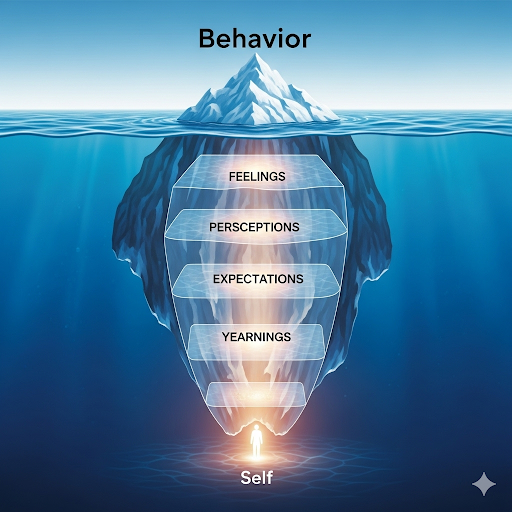
Satir’s iceberg metaphor reveals the hidden feelings, perceptions, and yearnings driving your surface behavior. Discover your deeper choice architecture for lasting behavioral change.
Published on consciouschoicemastery.com | Approx. 10-12 min read
“We see only the tip of the iceberg when we observe behavior. The real power lies in what’s hidden beneath the surface—the feelings, perceptions, expectations, and yearnings that drive every choice we make.”
Virginia Satir’s iceberg metaphor revolutionized how we understand human behavior by revealing that surface actions are merely the visible expression of a complex underground architecture of feelings, beliefs, and universal longings.
This insight transforms how we approach conscious choice intelligence. Instead of trying to change behavior directly, Satir taught that lasting change happens when you understand and work with the deeper layers that create your surface choices.
Her iceberg model provides a systematic framework for recognizing why you make the choices you do—and how to access the deeper intelligence that can guide more authentic decisions.
The Iceberg: Your Hidden Choice Architecture
Most people focus on changing behavior—trying to make different choices through willpower, better strategies, or external accountability. Satir discovered that this approach fails because behavior is just the tip of the iceberg. The real choice-making power lies in the hidden layers beneath surface awareness.
Layer 1: Behavior (The Tip of the Iceberg)
What others see: Your actions, words, choices, and external responses to situations.
Examples:
- Consistently working late despite wanting better work-life balance
- Avoiding difficult conversations even when issues need addressing
- Making decisions quickly without consulting others
- Repeatedly choosing partners who are emotionally unavailable
The Problem with Surface Focus: Most improvement attempts target this layer—trying to force different behaviors without addressing the underlying architecture that produces them.
Layer 2: Feelings (Just Below Surface)
What drives behavior: The emotions you experience in response to situations, people, and internal thoughts.
Examples:
- Working late driven by anxiety about job security and fear of criticism
- Avoiding difficult conversations because of fear of conflict and rejection
- Making quick decisions driven by excitement and impatience with process
- Choosing unavailable partners because of fear of genuine intimacy and vulnerability
Key Recognition: Feelings aren’t just reactions—they’re information about what you value, what you fear, and what you need.
Layer 3: Feelings About Feelings (Meta-Emotions)
What complicates feelings: Your judgments, interpretations, and emotional responses to your own emotions.
Examples:
- Feeling ashamed about your anxiety (anxiety about anxiety)
- Angry at yourself for being afraid (secondary emotion that intensifies the original fear)
- Guilty about feeling excited (judgment that dampens positive emotions)
- Disappointed in yourself for feeling hurt (adding self-criticism to emotional pain)
The Pattern: These meta-emotions often create more problems than the original feelings, driving defensive and unconscious choice patterns.
Layer 4: Perceptions (Meaning-Making Layer)
How you interpret reality: The mental frameworks you use to understand what’s happening around you and assign meaning to experiences.
Examples:
- “If I don’t work late, people will think I’m not committed” (perception driving workaholic behavior)
- “Difficult conversations always end badly” (perception creating conflict avoidance)
- “Taking time to decide means missing opportunities” (perception driving impulsive choices)
- “Available partners must have something wrong with them” (perception limiting relationship options)
Choice Impact: Your perceptions determine what options you can see and which choices feel possible or reasonable.
Layer 5: Expectations (Future-Oriented Beliefs)
What you believe should happen: Your assumptions about how situations will unfold, how people should behave, and what outcomes are possible.
Examples:
- “I should be able to handle everything without help” (expectation creating isolation and overwhelm)
- “Conflict should be avoided to maintain relationships” (expectation preventing authentic communication)
- “Good opportunities require immediate action” (expectation creating pressure and poor decisions)
- “Relationships should feel easy and natural” (expectation avoiding the work of genuine intimacy)
Hidden Power: Unexamined expectations create choice patterns that often contradict your conscious values and goals.
Layer 6: Yearnings (Universal Human Longings)
What you deeply need: The fundamental human desires for love, acceptance, meaning, security, freedom, and creative expression.
Examples:
- Working late to feel valuable and needed (yearning for significance and belonging)
- Avoiding conflict to feel safe and accepted (yearning for security and love)
- Making quick decisions to feel autonomous and competent (yearning for freedom and effectiveness)
- Choosing unavailable partners to maintain independence while still connecting (yearning for both intimacy and autonomy)
The Core Recognition: Your surface behavior is often a sophisticated strategy for meeting deep yearnings, even when the strategy doesn’t actually work.
Layer 7: Self (Life Force and Essence)
Who you are beneath all patterns: Your essential nature, creative potential, and authentic capacity for growth, love, and contribution.
The Ultimate Choice Point: Will you make choices from defensive patterns designed to protect and manage your yearnings, or from authentic self-expression that trusts your essential nature?
The Three-Layer Translation for Conscious Choice Intelligence
Satir’s iceberg maps directly onto the consciousness communication model, providing practical tools for choice intelligence development:
Layer 1: Surface Events (Visible Behavior)
Your current choice patterns: What you actually do in situations, the decisions you make, the behaviors others observe.
Applied Awareness: Instead of judging your choices as good or bad, use behavior as information about the deeper architecture operating beneath consciousness.
Layer 2: Pattern Recognition (Underground Architecture)
The feeling-perception-expectation complex: The emotional and mental framework that produces your surface choices.
Applied Awareness: This is where most choice intelligence work happens—understanding the internal systems that generate your external choices.
Layer 3: Consciousness Message (Core Yearnings and Authentic Self)
Your deepest wisdom about what serves life: The universal longings and essential self that can guide choices beyond defensive patterns.
Applied Awareness: Making choices that honor your deep yearnings while expressing your authentic nature, rather than just managing your fears and expectations.
Real-Time Application: The Iceberg Choice Protocol
When you notice yourself making choices you don’t understand or that don’t align with your stated values:
Step 1: Behavior Recognition (1 minute)
Surface Observation: What choice or behavior pattern are you noticing?
- Be specific and non-judgmental about what you’re actually doing
- Notice how often this pattern occurs and in what situations
- Identify the gap between your behavior and your conscious intentions
Step 2: Iceberg Exploration (5 minutes)
Feeling Layer: What emotions are driving this behavior?
- What do you feel right before making these choices?
- What feelings are you trying to avoid or create through this pattern?
- How do you feel about having these feelings?
Perception Layer: How are you interpreting the situations where this behavior occurs?
- What meaning are you assigning to what’s happening?
- What assumptions are you making about other people’s thoughts or intentions?
- What beliefs about reality are informing your choice options?
Expectation Layer: What do you believe should happen?
- What outcomes are you expecting or trying to create?
- What are you assuming about how situations should unfold?
- What standards or rules are you applying to yourself or others?
Yearning Layer: What deep needs are you trying to meet?
- What fundamental human longing is driving this pattern?
- What are you yearning for that feels missing or threatened?
- How is this behavior attempting to serve your deepest needs?
Step 3: Authentic Choice Integration (2 minutes)
Self-Connection: What would serve your essential nature and deepest wisdom?
- If you felt completely safe and valued, what would you choose?
- How could you honor your yearnings through more direct and authentic means?
- What choice would express your truest self rather than just managing your fears?
New Pattern Creation: Design a response that works with your iceberg architecture rather than against it.
- How can you meet your underlying needs more directly?
- What would it look like to make choices from your core self rather than your defensive patterns?
- How can you honor your feelings and yearnings while choosing more consciously?
Domain-Specific Iceberg Applications
Professional Choice Architecture
Surface Behavior: Consistently saying yes to requests even when overwhelmed.
Iceberg Analysis:
- Feelings: Fear of disappointing others, anxiety about job security, excitement about being needed
- Perceptions: “Saying no means I’m not a team player,” “My value comes from being helpful”
- Expectations: “Good employees should always be available,” “Success requires sacrifice”
- Yearnings: Deep need for belonging, significance, and security
- Self: Natural capacity for contribution and service
Conscious Choice Integration: Finding ways to contribute meaningfully while maintaining boundaries that honor your sustainable capacity and authentic expertise.
Relationship Choice Architecture
Surface Behavior: Repeatedly choosing partners who are emotionally unavailable.
Iceberg Analysis:
- Feelings: Excitement about the challenge, fear of genuine intimacy, familiar comfort with distance
- Perceptions: “Available people are boring,” “I don’t deserve easy love,” “Intimacy is dangerous”
- Expectations: “Love should be earned through effort,” “Relationships require struggle to be meaningful”
- Yearnings: Deep longing for love and connection combined with need for safety and autonomy
- Self: Natural capacity for both intimacy and independence
Conscious Choice Integration: Creating relationships that honor both your need for genuine connection and your authentic independence, without using unavailability as a safety strategy.
Personal Development Choice Architecture
Surface Behavior: Starting multiple improvement projects but never finishing them.
Iceberg Analysis:
- Feelings: Excitement about possibilities, anxiety about commitment, frustration with current limitations
- Perceptions: “I need to fix everything about myself,” “Starting means I’m making progress,” “Completion means judgment”
- Expectations: “Change should happen quickly,” “I should be able to do everything,” “Finished projects can be evaluated and found lacking”
- Yearnings: Deep desire for growth, acceptance, and authentic self-expression
- Self: Natural capacity for evolution and creative development
Conscious Choice Integration: Choosing development approaches that honor your authentic growth timing while satisfying your genuine desire for positive change.
The Common Iceberg Misunderstandings
Misunderstanding 1: “I Should Just Change My Feelings”
The Problem: Trying to directly control or eliminate emotions instead of understanding their information and working with the deeper architecture.
Iceberg Insight: Feelings are messengers about your perceptions, expectations, and yearnings. Changing them requires addressing these deeper layers.
Misunderstanding 2: “My Perceptions Are Objective Reality”
The Problem: Assuming your interpretations of situations are factual rather than subjective meaning-making that can be examined and evolved.
Iceberg Insight: Perceptions are creative meaning-making processes that can be consciously developed to serve your authentic nature rather than just your defensive patterns.
Misunderstanding 3: “My Expectations Are Reasonable Standards”
The Problem: Believing your assumptions about how things should work are universal truths rather than personal belief systems that shape your choice options.
Iceberg Insight: Expectations are often inherited or culturally constructed rather than personally chosen. Conscious choice involves examining and updating these belief systems.
Misunderstanding 4: “My Yearnings Are Selfish or Unrealistic”
The Problem: Judging fundamental human needs as inappropriate rather than recognizing them as essential information for authentic choice-making.
Iceberg Insight: Universal yearnings for love, meaning, security, freedom, and creative expression are legitimate needs that can guide wise choices when honored consciously.
Advanced Iceberg Intelligence: Working with the Whole System
Pattern Integration Across Layers
Instead of trying to change behavior directly or work on feelings in isolation, advanced iceberg intelligence involves recognizing how all layers interact to create your current choice patterns.
Example Integration Process:
- Behavior Recognition: “I consistently interrupt others during conversations”
- Feeling Layer: Excitement about my ideas, anxiety about being heard, impatience with others’ pace
- Perception Layer: “Good ideas need immediate expression,” “Others take too long to make points”
- Expectation Layer: “Conversations should be efficient,” “My contributions improve discussions”
- Yearning Layer: Deep need to be valued for my intelligence and to contribute meaningfully
- Self Layer: Natural capacity for insight and authentic contribution to dialogue
- Integration: Creating ways to share insights that honor both my need to contribute and others’ need to be heard, expressing authentic intelligence through generous listening and strategic sharing
Creating Iceberg-Aware Choice Architecture
Personal System Design: Structure your life and choices to work with your iceberg architecture rather than against it.
Relationship Communication: Share your iceberg layers with trusted people so they can understand your choice patterns and support your authentic development.
Professional Integration: Design work approaches that honor your deep yearnings while meeting practical requirements effectively.
Growth Planning: Create development approaches that work with your complete iceberg rather than just trying to force surface behavior changes.
Beyond Individual Icebergs: Collective Choice Intelligence
Satir recognized that families, teams, and communities also have iceberg architectures—collective patterns of feeling, perception, expectation, and yearning that shape group choices.
Advanced Application: Understanding how your personal iceberg interacts with the collective icebergs of your family, workplace, and community systems to create the choice architecture within which you operate.
This leads to choice intelligence that serves both individual authenticity and collective flourishing rather than creating conflict between personal and relational needs.
Master Your Choice Architecture
Virginia Satir’s iceberg metaphor reveals that conscious choice intelligence requires understanding the complete architecture that produces your surface decisions. Instead of trying to force different behaviors, you can work with your feelings, perceptions, expectations, and yearnings to create naturally aligned choices.
The Conscious Choice Intelligence System integrates Satir’s iceberg insights with systematic choice development:
- Learn to recognize your complete choice architecture through systematic iceberg exploration
- Develop the ability to make choices that honor your deep yearnings while expressing your authentic nature
- Create life structures that work with your iceberg patterns rather than against them
- Build relationships that support conscious choice development through mutual iceberg awareness
- Apply iceberg intelligence to professional, creative, and personal growth choices
Unlike surface behavior modification that often fails over time, iceberg-aware choice intelligence creates sustainable change by working with your complete human architecture.
What patterns in your surface behavior might be revealing deeper yearnings or expectations that you haven’t consciously examined? Share your iceberg insights below.
@ 2025 Lee Greene