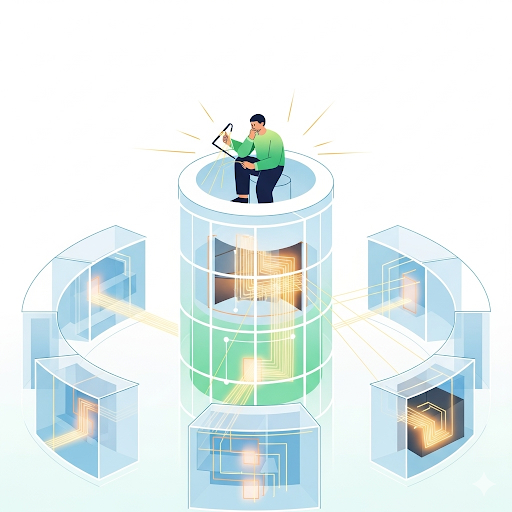
Foucault’s panopticon reveals how power systems shape your “free” choices. Learn to recognize when you’re policing yourself and develop genuine conscious choice intelligence.
Published on consciouschoicemastery.com | Approx. 12-14 min read
“He who is subjected to a field of visibility, and who knows it, assumes responsibility for the constraints of power; he makes them play spontaneously upon himself; he inscribes in himself the power relation in which he simultaneously plays both roles; he becomes the principle of his own subjection.”
Michel Foucault’s analysis of the panopticon reveals something unsettling about what we call “conscious choice.” The philosopher’s insight cuts to the heart of a crucial question: When you think you’re making conscious decisions, how do you know those choices are actually yours rather than the sophisticated result of power systems that have trained you to police yourself?
This makes Foucault essential reading for anyone developing choice intelligence. Not because he supports individual empowerment, quite the opposite. Foucault’s work serves as a critical challenge to naive assumptions about personal agency, forcing us to recognize the invisible systems that shape our “free” choices before we can develop genuine conscious choice intelligence.
The Illusion of Individual Choice
Most personal development approaches assume that better decision-making is simply a matter of individual skill development. Learn pattern recognition, develop emotional intelligence, practice mindfulness, and you’ll make better choices.
Foucault exposes the limitation of this view: You are always choosing within systems of power that have already shaped what options you can see, what desires you have, and what counts as a “good” choice.
Modern power doesn’t work by preventing your choices, it works by producing your choices. It creates the very framework through which you understand yourself as a choosing subject.
Consider these examples of how power shapes choice architecture:
Consumer Choice: You feel empowered choosing between hundreds of products, but the entire framework of solving problems through consumption has been constructed for you. The “choice” to define yourself through purchases feels natural and personal.
Career Choice: You experience career decisions as expressions of individual preference and capability, but the available career categories, success metrics, and professional identities have been systematically produced by economic and institutional forces.
Relationship Choice: Dating apps give you infinite romantic options, but the framework of relationships as consumer choice, optimization problems, and personal branding exercises shapes how you understand intimacy itself.
Health Choice: Wellness culture offers endless choices for optimization, but the underlying assumption that health is individual responsibility requiring constant self-surveillance and improvement has been institutionally manufactured.
In each case, you experience genuine choice within a framework that has been constructed to produce specific kinds of choosing subjects.
The Panopticon: When Surveillance Becomes Self Regulation
Foucault’s analysis of Jeremy Bentham’s panopticon prison design reveals how modern power operates through visibility rather than force.
The Panopticon Structure: A central watchtower surrounded by cells, designed so guards can observe all prisoners while remaining unseen themselves. The genius of the design is that prisoners never know when they’re being watched, so they must behave as if always under surveillance.
The Result: “He becomes the principle of his own subjection”, external control becomes internal self-regulation. The prisoner polices himself more effectively than any guard could.
Modern Applications: This same mechanism operates throughout contemporary life:
Social Media: You curate your posts assuming constant visibility, internalizing surveillance as personal brand management and authentic self-expression.
Professional Life: Performance reviews and metrics create fields of visibility where you monitor and optimize your own productivity, creativity, and engagement.
Health and Fitness: Tracking devices and apps create self-surveillance systems where you internalize responsibility for optimizing your body’s performance.
Personal Development: Even choice intelligence development can become another form of self-surveillance, constantly monitoring your patterns, decisions, and growth metrics.
The Foucaultian Insight: What you experience as conscious choice-making might actually be sophisticated self-regulation within systems designed to produce particular kinds of subjects.
From Objects of Information to Subjects of Communication
Foucault observed that modern power systems treat people as “objects of information, never subjects in communication.” This distinction is crucial for understanding genuine conscious choice intelligence.
Objects of Information:
- Data points to be collected, analyzed, and optimized
- Behavioral patterns to be predicted and influenced
- Consumer profiles, health metrics, productivity statistics
- Problems to be solved through better information processing
Subjects of Communication:
- Autonomous agents capable of genuine dialogue
- Beings who can question the frameworks they’re operating within
- Entities capable of creating new forms of relationship and meaning
- People who can participate in constructing their own reality rather than just optimizing within predetermined systems
The Pattern Recognition Trap: Even sophisticated pattern recognition can become another way of treating yourself as an object of information, something to be analyzed, optimized, and improved rather than engaged with as a creative, meaning-making being.
The Genealogical Method: Tracing Choice Architecture
Foucault’s genealogical approach provides a powerful tool for conscious choice intelligence: the ability to trace how your current choice architecture was historically constructed.
The Method: Instead of taking your preferences, options, and decision-making frameworks as natural or inevitable, investigate how they were produced by specific historical forces.
Applied to Personal Choice Intelligence:
Career Genealogy: How did the career path you’re pursuing become defined as a legitimate option? What institutional and economic forces created this professional category? How do these origins shape what counts as success or meaningful work?
Relationship Genealogy: How were your assumptions about love, commitment, and partnership historically produced? What cultural, religious, and economic systems created the relationship models you’re trying to choose between?
Success Genealogy: How did your definition of a “good life” come to be? What power systems benefit from you wanting what you currently want?
Health Genealogy: How did your understanding of wellness, productivity, and self-care develop? What industries and institutions profit from your current health anxieties and optimization desires?
The Purpose: Not to dismiss your choices as determined, but to understand the systems within which you’re choosing so you can make decisions that account for these influences rather than being unconsciously shaped by them.
Conscious Choice Intelligence Beyond Individual Optimization
Foucault’s critique doesn’t destroy the possibility of conscious choice, it demands that genuine choice intelligence account for power systems rather than ignoring them.
Naive Conscious Choice: “I’ll learn better decision-making skills and make choices aligned with my authentic self.”
Foucaultian Conscious Choice: “I’ll develop awareness of how my ‘authentic self’ and available choices have been systematically produced, so I can make decisions that account for these influences and potentially create new possibilities.”
This leads to several practical applications:
Power Aware Pattern Recognition
Instead of: Simply tracking your personal patterns and preferences Additionally: Investigating how your patterns were produced by institutional, cultural, and economic forces
Example: If you notice patterns of overwork and burnout, don’t just develop better time management. Investigate how productivity culture, economic insecurity, and professional identity formation created the conditions where overwork feels both necessary and virtuous.
Choice Architecture Investigation
Instead of: Accepting your available options as complete Additionally: Questioning how your menu of choices was constructed and by whom
Example: When making career decisions, don’t just optimize among available options. Investigate how the professional categories you’re choosing between came to exist and what interests are served by maintaining these particular options.
Resistance Through Creation
Instead of: Just choosing better within existing systems Additionally: Creating new forms of relationship, work, and meaning that don’t fit predetermined categories
Example: Instead of optimizing your performance within existing relationship models, experiment with forms of intimacy and commitment that haven’t been institutionally defined and commodified.
Collective Intelligence Over Individual Optimization
Instead of: Focusing solely on personal development and individual choice improvement Additionally: Participating in collective creation of new choice architectures and social possibilities
Example: Rather than just improving your personal decision-making, contributing to communities and movements that create alternative economic, social, and cultural systems.
The Three Layer Analysis: Power Edition
Applying Foucault’s insights to the consciousness communication framework:
Layer 1: Surface Events (Your Experienced Choices) The decisions you experience making, the preferences you feel, the options you see available.
Layer 2: Pattern Recognition (Power Systems in Operation) The institutional, cultural, and economic forces that have shaped your choice architecture, produced your desires, and defined your available options.
Layer 3: Consciousness Message (Possibilities for Creative Response) Recognition of how you can make choices that account for power influences while potentially creating new possibilities that transcend predetermined categories.
The key insight: Layer 3 isn’t just about better individual choices, it’s about conscious participation in creating new forms of life that aren’t entirely predetermined by existing power systems.
Warning Signs: When Choice Intelligence Becomes Self-Surveillance
Foucault’s analysis suggests several warning signs that your choice intelligence development might be becoming another form of sophisticated self-regulation:
Optimization Obsession: When tracking patterns becomes about perfecting your performance rather than understanding your authentic responses to life.
Metric Fixation: When the quality of your choices gets reduced to measurable outcomes rather than their alignment with genuine values and relationships.
Individual Solution Focus: When all problems are framed as needing better personal decision-making rather than requiring collective social change.
Constant Self Monitoring: When awareness becomes a form of internal surveillance that prevents spontaneous response and genuine relationship.
Consumer Choice Framework: When developing choice intelligence becomes another product you optimize rather than a practice of authentic engagement with life.
Beyond Foucault: Authentic Choice Intelligence
Foucault’s critique is essential but not complete. His analysis reveals the systems that shape choice without fully addressing how genuine agency might operate within or against these systems.
Conscious choice intelligence that incorporates Foucaultian insights includes:
Power-Aware Practice: Developing choice skills while remaining conscious of how power systems influence your choices and development process.
Genealogical Curiosity: Regularly investigating how your preferences, options, and decision-making frameworks were historically produced.
Creative Resistance: Using choice intelligence not just for optimization but for creating new possibilities that transcend predetermined categories.
Collective Engagement: Recognizing that individual choice intelligence must be accompanied by participation in collective creation of alternative choice architectures.
Relational Focus: Prioritizing authentic relationship and communication over individual performance and optimization.
The goal isn’t perfect individual choice making, it’s conscious participation in the ongoing creation of life forms that honor both individual agency and collective flourishing.
The Productive Tension
Foucault’s work creates productive tension with individual choice development approaches. This tension prevents naive assumptions about personal agency while maintaining space for genuine conscious choice.
The question isn’t whether you can choose freely (Foucault suggests this is largely illusory) but whether you can choose consciously, with awareness of the power systems operating through your choices and commitment to creating possibilities that serve life rather than just reproducing existing power relations.
This requires choice intelligence that is simultaneously:
- Personal (developing your capacity for authentic response)
- Political (recognizing and resisting systems that limit human flourishing)
- Creative (participating in the creation of new social possibilities)
- Relational (prioritizing genuine communication over individual optimization)
The Ultimate Choice: Surveillance or Communication
Foucault’s most challenging insight for choice intelligence development: Will your practice of conscious choosing become another sophisticated form of self-surveillance, or will it enable you to participate more authentically in genuine communication and collective creation?
The answer depends on whether you approach choice intelligence as individual optimization or as preparation for authentic relationship and social transformation.
The Foucaultian Challenge for Conscious Choice: Can you develop choice intelligence that serves authentic communication and collective flourishing rather than just producing better-optimized individuals within existing power systems?
This question remains open and requires ongoing conscious engagement rather than final answers.
@ Lee Greene