Published on consciouschoicemastery.com | Approx. 14-16 min read
Shakespeare’s Macbeth has been read for four centuries as the definitive study of ambition destroying a good man. The standard interpretation is clean, teachable, and wrong. Ambition didn’t corrupt Macbeth. Something more structural happened, and understanding what it was changes how the play reads, and more importantly, what it documents about human consciousness.
The Standard Reading and Its Limits
The received interpretation runs like this: Macbeth is a good man with a fatal flaw. Ambition exists inside him, dormant but present. The witches activate it. Lady Macbeth weaponizes it. He murders Duncan, and once the first transgression occurs, each subsequent crime becomes easier to justify until moral collapse is total. Hubris. Overreach. Inevitable fall.
This reading is not inaccurate. The progression is real. The escalation follows exactly the pattern Shakespeare renders. The reading stops at the surface of the mechanism, though. It describes what happened without locating where the system actually broke.
Macbeth’s tragedy begins earlier than the murder. It begins at the moment he mistakes an external signal for an internal truth.
The Witches Are Installing a Framework
When the witches deliver their prophecy, the standard reading treats this as a trigger. The ambition was already there; the prophecy simply names it and sets it in motion. Macbeth wanted to be king; now he has a framework that says he will be.
Read structurally, something different is happening. The witches deliver a map of the future. Macbeth receives that map and, at a specific moment in Act One, begins treating the map as if it originated inside him.
The evidence is in his own words, spoken before he has time to construct a narrative around what is happening:
“This supernatural soliciting / Cannot be ill, cannot be good… / If good, why do I yield to that suggestion / Whose horrid image doth unfix my hair / And make my seated heart knock at my ribs, / Against the use of nature?” (Act 1, Scene 3)
This is the installation happening in real time. Macbeth is watching his own body respond to something he did not consciously choose. His hair unfixes. His heart knocks against his ribs. He is describing a system responding to an external input before the conscious mind has ratified it. The framework is taking hold below the level of deliberate choice, and Macbeth himself is registering the strangeness of that experience.
The prophecy stops being something that happened to him and becomes something he now believes to be his own deepest perception of what is true and necessary. He internalizes the external architecture. Every decision that follows flows from the installed framework, carrying its logic, its inevitability, its permission structure.
The witches don’t corrupt Macbeth. They perform a framework installation. The corruption is what happens when a borrowed map gets treated as original territory.
Lady Macbeth Targets the Identity Layer
This distinction matters enormously and the play is exact about it.
When Macbeth initially pulls back from the plan, his reasoning is coherent and morally aware. Duncan has honored him. He has earned genuine respect. The consequences of regicide extend far beyond the immediate act:
“He’s here in double trust: / First, as I am his kinsman and his subject, / Strong both against the deed; then, as his host, / Who should against his murderer shut the door, / Not bear the knife myself.” (Act 1, Scene 7)
His moral reasoning is functional; he can assess implications, weigh long-term costs, and reach a rational conclusion to stop. He states it directly: “We will proceed no further in this business.” (Act 1, Scene 7)
Lady Macbeth does not argue against his ethical reasoning. She bypasses it entirely.
Her assault targets his self-concept as a warrior, as a man, as someone who acts on what he desires. She does not say his reasoning is wrong. She says his hesitation proves he is not who he believes himself to be:
“When you durst do it, then you were a man; / And, to be more than what you were, you would / Be so much more the man.” (Act 1, Scene 7)
This is a fundamentally different attack. Direct ethical argument can be met with ethical counterargument. Identity destabilization operates below that level. Once the question becomes not “is this action right” but “am I the kind of person who acts or retreats,” the ethical framework has already lost its governing authority.
The manipulation succeeds because it finds the gap between Macbeth’s levels. His Soul-level perception of his own warrior identity and his Conscious Self’s ethical reasoning are not fully integrated. Lady Macbeth drives through that gap with precision. She doesn’t corrupt his values; she replaces his vertical axis with a different one, where the primary organizing question becomes identity performance rather than ethical coherence.
After her intervention, Macbeth stops asking what his deepest perception holds as true. He starts asking what the installed framework requires of him to remain who he needs to be.
The Escalation Is a Framework Commitment
Once the framework is running, the escalation pattern follows its own logic. Each subsequent act of violence does not represent further corruption of an originally good character. Each act represents deeper commitment to the installed architecture.
The murder of Banquo illustrates this precisely. The prophecy gave the crown to Macbeth but gave the lineage to Banquo’s children. The installed framework contains a contradiction; eliminating Banquo is the framework’s own solution to its internal incoherence. Macbeth names this explicitly:
“Upon my head they placed a fruitless crown, / And put a barren sceptre in my gripe… / For Banquo’s issue have I filed my mind; / For them the gracious Duncan have I murder’d.” (Act 3, Scene 1)
He is performing an accounting. The framework promised a complete outcome; the framework has not delivered a complete outcome; the framework identifies the obstacle; the framework generates the solution. Macbeth is no longer making ethical decisions at this point. He is performing maintenance on an operating system. The decisions look like choices from the outside but function like system corrections from inside the framework.
By Act Four, the framework has completed its own defense mechanism. Macbeth announces the terminal logic openly:
“From this moment / The very firstlings of my heart shall be / The firstlings of my hand.” (Act 4, Scene 1)
This is not a statement of passion or rage. It is the deliberate removal of reflection from the decision loop. Thought and action will no longer have any gap between them. The faculty that might generate friction against the framework, the pause, the question, the moment of examination, has been permanently disabled by design.
The massacre of Macduff’s family follows directly. By this point the framework is running purely on threat-detection and defensive execution. No ethical processing occurs because no ethical faculty remains in the decision loop. Fear-based computation has fully replaced coherent choice-making.
Banquo’s Ghost: The Original Configuration Breaking Through
The ghost of Banquo is the most structurally revealing moment in the play, and the most consistently misread.
The standard interpretation treats the ghost as guilt made visible. Macbeth murdered his friend; his conscience manifests the victim at the feast. This reading positions the ghost as a symptom of psychological deterioration.
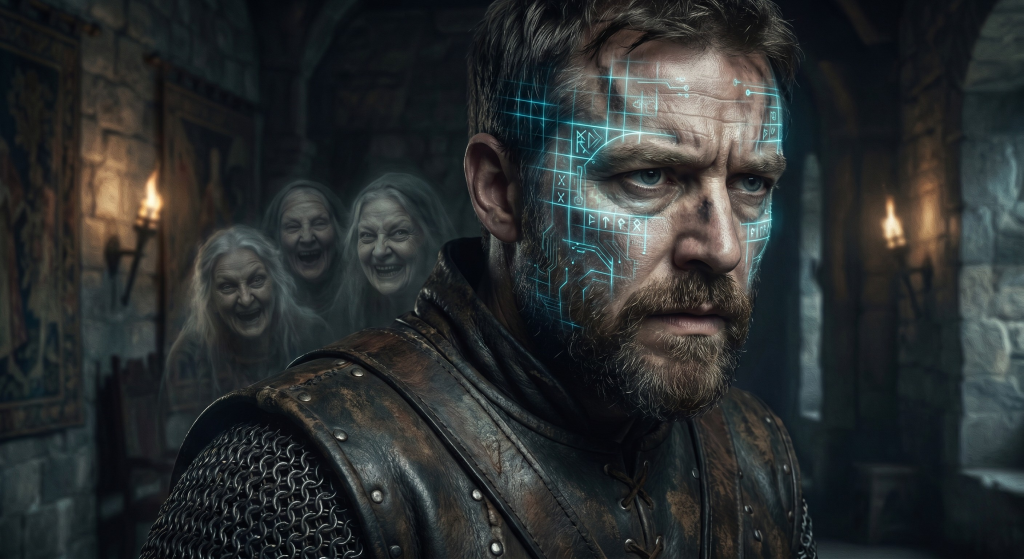
The structural reading sees something different. Banquo’s ghost is the original configuration breaking through the installed framework. The Soul-level perception that was operative before the witches, before Lady Macbeth, before the framework installation, surfaces briefly. The banquet scene is precisely the kind of social ceremony where integrated identity is required; the performance of kingship demands a coherent self to perform it. At that moment, the original self asserts itself.
Macbeth’s terror is the experience of two operating systems colliding. The installed framework and the original configuration cannot occupy the same moment simultaneously:
“Hence, horrible shadow! / Unreal mockery, hence!” (Act 3, Scene 4)
He calls it unreal. The ghost is not real, he insists, because the installed framework cannot accommodate it as real. Allowing the ghost’s reality would require allowing the original configuration’s reality, which would mean acknowledging that the person running the framework is not the person who agreed to install it. The framework defends itself by delegitimizing the signal.
The ghost does not haunt him as punishment; the ghost appears because suppressed original perception finds the one aperture where the installed framework momentarily cannot hold it down. That the ghost is visible only to Macbeth, and that his court sees only a man raving at an empty chair, confirms the structural reading. The court sees a king losing coherence. Macbeth is experiencing the dissonance between what he installed and what he originally was. These are two different events happening in the same body at the same moment.
The framework then reasserts. The original configuration is suppressed again. The banquet ends in disorder and Macbeth moves immediately toward further violence, deeper commitment to the installed architecture. The gap closes through acceleration rather than integration.
What This Documents About Human Consciousness
Macbeth is not a character study in moral weakness. Shakespeare constructed a structural case study in consciousness colonization: what happens when an external framework, delivered with sufficient authority and resonance, installs itself inside a person as if it were their own deepest truth.
The mechanism operates through three sequential moves.
First, external framework reception. An authority structure, a prophecy, an ideology, a belief system, a person’s sustained manipulation, delivers a map of what is true and what is necessary. The map carries enough resonance with existing internal material that it does not feel foreign. It feels like recognition.
Second, framework internalization. The received map migrates from “something that happened to me” to “something I perceive as fundamentally true.” The person stops holding the framework as an external object and starts running it as an internal operating system. This transition is rarely conscious and rarely announced. It happens in the gap between levels; when Soul-level perception and Conscious Self integration are not fully coherent, external frameworks find the opening.
Third, framework defense. Once internalized, the framework generates its own survival logic. Anything that threatens the framework’s completion becomes a target. The original ethical faculty does not disappear; it gets progressively excluded from the decision loop because including it would threaten the framework’s integrity. Each act of exclusion makes the next exclusion easier, not because the person is becoming worse but because the system is becoming more self-referential.
The tragedy is that by the time the critical choices arrived, the choosing was largely over. The framework was running. The person who had originally possessed the capacity to choose differently had been systematically marginalized inside his own architecture.
The Gift, the Blindspot, and the Trap
Macbeth’s gift is warrior clarity: the capacity to assess a situation, commit fully, and act without hesitation. On the battlefield this gift is unambiguous. It produces the valor that earns him honor, loyalty, and Duncan’s genuine regard.
The blindspot native to that gift is the same capacity operating on the wrong object. Warrior clarity commits and acts; the question it cannot answer from inside itself is whether the object of commitment deserves the commitment. The gift executes. The gift does not evaluate the framework that points it at targets.
The trap is the moment the gift begins serving the installed framework rather than any coherent organizing perception. Once Macbeth’s warrior clarity is pointed at the framework’s targets, his greatest capacity becomes the engine of his destruction. Every strength the gift brings to the battlefield, full commitment, decisive action, the suppression of hesitation, now serves the colonized operating system with exactly the same intensity.
The gift does not change. The framework it serves changes. From inside the gift, running at full capacity in service of something, the distinction is imperceptible.
Shakespeare documents this with structural precision. The character who becomes most monstrous is the character whose gift operates most fully. Macbeth does not fail because his warrior capacity fails. He fails because his warrior capacity succeeds completely in service of a framework that was never his own.
The Diagnostic for Contemporary Life
The colonization mechanism Macbeth illustrates does not require witches or ambitious spouses. It operates through ideology, through institutional frameworks, through sustained cultural messaging, through relationships that systematically replace one person’s vertical architecture with another’s preferred map.
The signal that colonization has occurred is specific. When the primary question governing decision-making shifts from “what does my deepest perception hold as true” to “what does this framework require of me,” the installation has completed. The ethical faculty does not disappear at this point; it gets repositioned from governing function to subordinate input that the framework accepts or overrides depending on whether it serves the framework’s completion.
The early warning arrives as friction. Friction between what the framework requires and what some quieter internal perception holds as true. The standard response to that friction is to resolve it in favor of the framework; the commitment has been made, the identity is now organized around the framework, and allowing the friction to surface as a genuine question would threaten the entire architecture.
Macbeth experiences this friction continuously from Act Two onward. Every ghost, every hallucination, every moment of sleeplessness is the original configuration generating friction against the installed one. The play documents what happens when that friction gets suppressed rather than heard.
Hearing the friction is the alternative the play does not show. It could not; hearing the friction would have been a different play entirely, one where Macbeth stops at the banquet, allows the ghost to surface, and asks the question the ghost is carrying. That play ends differently. Shakespeare was not interested in writing that play. He was documenting the mechanism of what happens when the friction is suppressed until the system collapses.
The documentation is the gift. The mechanism, once seen, becomes navigable. The question “is this framework mine, or was it installed” is available to ask before the commitment deepens past the point of return.
Macbeth never asked it. The audience, watching, can.
@ Lee Greene