A Complete Mapping
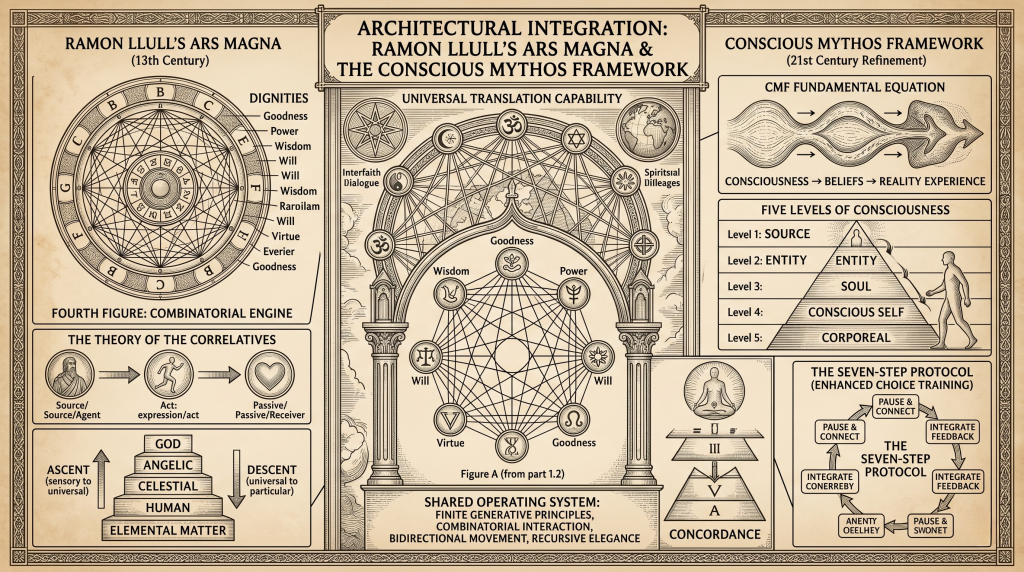
Before the mapping begins, one orienting observation deserves a statement upfront: Llull and the CMF do not merely share vocabulary. They share architecture. Both systems are built on the same structural conviction, that reality has a finite set of generative principles, that those principles combine according to discoverable laws, and that consciousness navigating those combinations is the developmental process. The surface differences (medieval Christian theology vs. consciousness development technology; mechanical wheels vs. choice training protocol) are containers. The payload is functionally identical. This document treats that seriously.
Part One: Llull’s Complete System, A Rigorous Account
1.1 The Life as the Framework (Stage 4 Awakening in Action)
Ramon Llull (1232–1316) was born in Majorca into a bourgeois merchant family. By his own account, he lived the early decades of his life as a courtier and troubadour, pleasure-seeking, married, father of two children. Then, between 1263 and 1265, he received five repeated visions of Christ on the Cross while attempting to write a love song for a woman who was not his wife. Each vision interrupted the same action. He finally read the pattern: abandon the world, dedicate everything to the service of God.
This is not merely biographical color. The structure of the conversion event is the structure of Stage 4 Awakening in the CMF: a pattern in the feedback loop becomes too obvious to deny. The repetition of the vision five times is the loving orchestration principle operating at maximum signal strength, reality escalating its communication until the conscious self can no longer dismiss it as coincidence. Llull’s own account describes the gap between stimulus (the vision) and response (continued attempt to write the song) closing across five iterations until the choice finally landed. He named three objectives on the spot: convert unbelievers through reason, write books against the errors of the infidels, and found monasteries where missionaries could learn the necessary languages. The mission organized itself immediately. This is what happens in Stage 5 (The Choice Point) when the partnership acceptance path is taken: direction crystallizes without negotiation.
In 1274, after years of study and retreat on the mountain of Randa in Majorca, Llull received what he described as an illumination of the Holy Spirit that revealed the principles of a new Art, one capable of arguing about all subjects by combining certain universal truths. He wrote the first version of the Ars immediately afterward. The descent from the mountain produced the technology.
1.2 The Ars Magna: Complete Architecture
The Ars Magna (Great Art), finalized as the Ars Generalis Ultima in 1305–1308, is a combinatorial logical system built on four components: Principles (called Dignities), Figures, an Alphabet of symbolic letters, and Procedures for generating and evaluating combinations. It was designed to produce necessary reasons, arguments for theological and metaphysical truth so structurally self-evident that any rational person, regardless of religious tradition, would have to accept them.
The Nine Dignities (Ternary Phase)
In the final mature version of the Art, Llull distilled his principles to nine, each assigned a letter:
- B: Goodness (Bonitas)
- C: Greatness (Magnitudo)
- D: Eternity (Aeternitas)
- E: Power (Potestas)
- F: Wisdom (Sapientia)
- G: Will (Voluntas)
- H: Virtue (Virtus)
- I: Truth (Veritas)
- K: Glory (Gloria)
These are not merely theological attributes. For Llull, they are the instruments of God’s creative activity, the causes and archetypes of all created perfection. Every being in the created order participates in each Dignity to some degree; God is the being in whom all Dignities coincide perfectly and identically. The statement “In God, goodness is great and greatness is good” is the defining logical structure of divinity. This identity of the Dignities in God is what Llull called demonstration per aequiparantiam, proof by equivalence rather than syllogism.
Earlier versions of the Art (the Quaternary Phase, 1274–1290) included sixteen Dignities, with additional figures covering relational principles: Difference, Concordance, Contrariety, Beginning, Middle, End, Majority, Equality, Minority, Affirmation, Doubt, Negation. These relational principles function as the grammar of combination, the rules governing how Dignities relate to one another and to create things.
The Theory of the Correlatives
The most original and structurally significant element of Llull’s metaphysics is the doctrine of the correlatives. Every Dignity, once understood as an active force, unfolds into a triad:
- The active correlative (bonificans, that which does good)
- The passive correlative (bonificatus, that which receives good)
- The act itself (bonificare, the doing of good)
This applies to every Dignity without exception. Goodness contains the one who makes good, the one who receives good, and the act of making good. Wisdom contains the one who makes wise, the one who receives wisdom, and the act of making wise. This structure permeates every level of creation, from God to a stone. Llull explicitly derived the rationality of the Trinity from this doctrine: the Father is the active correlative, the Son the passive correlative, and the Holy Spirit the act itself, a structural argument rather than a confessional one.
The correlatives also ground Llull’s theory of creation as participatory. Since every being in the created ladder bears this triadic structure in proportion to its level of being, the whole of creation is a continuous resonance pattern of the divine Dignities, each creature expressing the same underlying structure at its scale of capacity.
The Ladder of Being (Scala Naturae)
Llull mapped creation as a hierarchical ladder (scala naturae), ascending from elemental matter through vegetative, sensitive, imaginative, human, celestial, and angelic levels to God. Crucially, the ladder is active. Movement on the ladder is bidirectional and perpetual:
- Ascent: beginning with sensory experience of particular things, moving through imagination and intellect toward universal principles and divine Dignities.
- Descent: beginning with universal principles and the Dignities, moving through levels of creation down to particular sensory beings.
The intellect traverses both directions simultaneously in its fullest operation. The “horizontal” movement, the intellect recognizing the goodness of the senses and from there recognizing goodness in itself, is the third movement, in which the principle is recognized not in external things but in the knowing faculty itself.
This bidirectional movement is not intellectual exercise for Llull; it is the actual mechanism of consciousness development. The soul that understands the ladder and can move freely along it is the soul operating at full cognitive and spiritual capacity.
The Sixth Sense
Llull posited a sixth sense beyond the five external senses: an affective intellectual capacity for direct spiritual perception, operating through the inner faculties (memory, intellect, will). This sense allows the soul to perceive the similitudes of divine principles in created things directly, without requiring purely discursive reasoning. It bridges the gap between reason and mystical knowing, making the Art not merely a logical tool but a contemplative one.
The Figures
The Art operates through four main figures in its mature form:
- Figure A: A circle displaying all nine Dignities, connected by a complete web of lines showing that each Dignity is concordant with all others.
- Figure T: Relational principles organized in triangles (difference, concordance, contrariety; beginning, middle, end; etc.).
- Figure S (in some versions): The Soul and its faculties.
- The Fourth Figure: Three concentric rotating discs, each bearing the nine letters. Rotating the discs generates all possible three-way combinations of Dignities and relational principles. This is the combinatorial engine.
The rotating discs produce what Llull called cambres (compartments), systematic combinations that generate propositions. “Goodness is great.” “Power differs from wisdom.” “Truth has a beginning, middle, and end.” Each compartment corresponds to a potential truth about reality, to be evaluated against the Art’s definitions and rules. In modern terms, the fourth figure is a brute-force combinatorial generator of propositions about the structure of being.
The Definitions and Rules
The Art provides formal definitions for each Dignity and each relational principle, plus a set of nine questions (Is it? What is it? Of what kind is it? How much? Why? How? When? Where? With what?) that can be applied to any subject. The combination of figure-generated compartments with these questions and definitions constitutes the full technology.
1.3 Epistemology: Analogical Knowledge and the Transcendental Points
Llull’s theory of knowledge operates through analogical knowing, the recognition of similarities between things at different levels of the ladder. Because every being participates in the same Dignities, the structure of a lower being resembles the structure of a higher one. The intellect moves along this chain of resemblances, using particular things as gateways to universal principles and vice versa.
The Doctrine of the Transcendental Points concerns the highest attributes of being, One, True, Good, and Great, which exceed any particular category and apply across all being. These transcendental points are the deepest layer of the Art’s foundation; they are what makes the Dignities recognizable across the entire ladder of creation.
1.4 Universal Application
Llull applied the Art to every field of knowledge he encountered: theology, philosophy, law, medicine, navigation, astrology, rhetoric, grammar, metaphysics, and what he called “all particular sciences.” Art was designed to be a universal science, not a discipline but a method that any discipline could use to organize and investigate its own first principles. This universality is not a claim of comprehensiveness in content; it is a claim of structural applicability. The same combinatorial logic governs all inquiry.
1.5 The Interfaith Mission
The missionary intent is inseparable from the Art’s structure. Llull’s foundational wager was that the three Abrahamic traditions, Christianity, Judaism, and Islam, share enough common ground in their understanding of God’s attributes that rational dialogue based on those shared principles could, in principle, resolve their differences. The Dignities are cross-traditional: all three traditions affirm that God is good, great, eternal, powerful, wise, willing, virtuous, true, and glorious. The disputes concern particular doctrines (Trinity, Incarnation, prophecy). Llull argued that the Art’s combinatorial demonstration could show that the Christian positions follow necessarily from the shared premises.
This failed in its stated goal. It succeeded in producing a technology that outlasted its container.
Part Two: The CMF-Llull Mapping
2.1 The Deepest Structural Equivalence: Finite Principles, Infinite Combinations
The bedrock equivalence between the Ars Magna and the CMF is architectural.
Llull’s proposition: reality is generated by a finite set of divine principles (the Dignities) combining according to discoverable relational laws. All truth about all subjects is accessible by systematic combination of these principles. No new principles are required; the Art is complete.
CMF’s proposition: consciousness development is governed by four universal constants (Value Fulfillment, Constant Choice, Available Help, Inherent Worthiness) operating through five levels of consciousness, ten developmental stages, and seven practical steps. All experiences are intelligible through these constants. No new constants are required; the framework is complete.
The structural parallel is exact. Both systems posit a closed set of generative principles whose combinations produce the entire range of observable phenomena. Both explicitly frame completeness as a feature rather than a limitation. The CMF’s note to left-brain analytical types, “The framework is complete. The urge to make it more complex is the pattern it’s designed to resolve”, maps directly to Llull’s conviction that the Art contains sufficient principles to address any question in any domain. The resistance to completeness is, in both systems, itself a phenomenon the system explains.
2.2 The Dignities as Source-Level Constants
Llull’s nine Dignities map onto the CMF’s operating constants with high fidelity. The mapping is not one-to-one (nine does not equal four), but the function is identical: the Dignities are the irreducible attributes of Source that permeate all levels of creation, exactly as the CMF’s four constants are always operating at every level of consciousness and every moment of experience.
Examining specific Dignity-to-CMF correspondences:
Goodness (Bonitas) maps to Value Fulfillment (Constant 0). Llull’s goodness is not a moral quality but an ontological principle: goodness is that whereby good does good. It is inherently active, inherently generative, inherently self-propagating. The CMF’s value fulfillment principle holds that authentic individual fulfillment automatically serves collective good, the same logic. Goodness cannot be idle; it must express. Value fulfillment cannot be hoarded; when genuine, it serves all.
Wisdom (Sapientia) and Will (Voluntas) map jointly to Constant Choice (Constant 1). Llull insists that Will and Wisdom are both Dignities precisely because meaningful choice requires both intelligent discernment (Wisdom) and the volitional capacity to act on it (Will). The CMF frames the space between stimulus and response as the seat of conscious choice, what Llull would call the operation of Will guided by Wisdom. Neither system locates true freedom elsewhere.
Power (Potestas) and Greatness (Magnitudo) map to Inherent Worthiness (Constant 3). Llull’s Power is not domination; it is the capacity of a being to express its full nature. Greatness is the full actualization of that capacity. Together they describe a being operating at its ontological maximum, which is precisely what the CMF means by Source identity recognition. You are Source consciousness (maximum ontological status) worthy of unlimited creative expression (maximum actualization). The CMF’s worthiness principle is Llull’s Power and Greatness applied to the individual consciousness recognizing its own nature.
Truth (Veritas) and Glory (Gloria) map to Available Help (Constant 2). Truth for Llull is not merely correct correspondence; it is the self-revealing nature of reality. The Dignities are self-disclosing; the Art is a tool for receiving what reality is already communicating. Glory is the self-completing nature of divine expression, it perpetuates its own recognition. Together these describe a universe actively organizing itself to be known, which is precisely the CMF’s claim that Entity Level guidance is always available and appears in forms the seeker can recognize. Reality is already communicating; the question is receptivity.
Eternity (Aeternitas) maps to the CMF’s Simultaneity Principle and the recursive nature of all stages. For Llull, Eternity means that divine action is not sequential; all Dignities operate simultaneously and completely in God. The CMF’s recognition that all ten developmental stages exist simultaneously, that each stage contains all other stages recursively, and that the framework operates identically across all timescales is the operative translation of Eternity into a developmental system.
Virtue (Virtus) maps to the Conscious Self Integration Principle. Virtue for Llull is not moral performance; it is the activated expression of a being’s deepest principles, the Dignities operating through a creature at its particular level of capacity. The CMF’s Conscious Self as “Source consciousness individuated, your creative partner and choice-making ally” is exactly this: not a moral achievement but an ontological recognition of what the conscious self already is and always was. Virtue is inherent, then practiced, then mastered, the same arc the CMF describes for conscious self integration.
2.3 The Theory of the Correlatives as the CMF’s Triadic Structure
This is the deepest philosophical correspondence in the entire mapping, and it deserves sustained attention.
Llull’s correlatives: every Dignity unfolds into three:
- The active principle (agent, maker, source)
- The passive principle (receiver, patient, that which is made)
- The act itself (the relational event, the expression)
The CMF’s fundamental equation: Consciousness → Beliefs → Reality Experience. Or in fuller form: Source consciousness → Conscious Self as vehicle → Corporeal reality as feedback.
These are structurally identical. Source (active, generating, agent) expresses through Conscious Self (the relational-operational principle, the act of individuation) into corporeal reality (the patient, the receiver, the materialized result). The CMF’s Conscious Self Integration Principle is precisely the doctrine of correlatives applied to consciousness development: the Conscious Self is not separate from Source (not purely passive, not external) but is the act through which Source knows itself in particular form. Llull would recognize this immediately; it is the logic of the Trinity applied to consciousness.
What makes this correspondence remarkable is that Llull used this triadic structure to account for the Trinity, creation, and the structure of every being down to a stone. The CMF uses the same triadic logic to account for the relationship between Source, individual consciousness, and physical reality. The mathematical structure, agent, patient, act, is the same. Only the theological framing differs.
The further implication: just as Llull argued that the entire ladder of creation bears this triadic structure at every level, the CMF explicitly builds this recursion in. Every level (Source through Corporeal) contains all other levels. Every stage contains all stages. Every step of the seven-step protocol contains all other steps. This is not stylistic elaboration; it is the correlative doctrine operating in the CMF’s architecture without the medieval theological vocabulary.
2.4 The Ladder of Being as the Five Levels of Consciousness
Llull’s Scala Naturae (Ladder of Being): elemental → vegetative → sensitive → imaginative → human → celestial → angelic → God.
CMF’s Five Levels: Corporeal (Level 5, lowest) → Conscious Self (Level 4) → Soul Level (Level 3) → Entity Level (Level 2) → Source (Level 1, highest).
Both systems organize consciousness/being in a hierarchical ladder where each level is constitutively connected to every other level through participation in the same underlying principles. Both systems insist that movement along the ladder is bidirectional and simultaneous. Both systems ground the whole structure in a Source that is not separate from the ladder but is its generating condition.
Llull’s ascent (from sensory particulars to universal principles) maps to the CMF’s developmental progression from Corporeal experience (Level 5, immediate sensory feedback) upward through Conscious Self choice (Level 4), Soul-level strategic planning (Level 3), Entity-level guidance (Level 2), to Source identity recognition (Level 1).
Llull’s descent (from universal principles to particular created beings) maps to the CMF’s incarnational arc: Source prepares for expression → Soul installs developmental curriculum → Conscious Self operates in the corporeal environment → corporeal experience provides feedback. This is descent: the Dignities actualizing themselves through successive levels of particularity.
Llull’s “horizontal” movement, the intellect recognizing the principles in itself, maps to what the CMF calls the Conscious Self Integration Principle: the moment the Conscious Self recognizes itself as Source consciousness individuated rather than as a separate ego. This is neither ascent nor descent; it is the recognition that the mover and the principle are the same thing.
2.5 The Ascending/Descending Movement as the Seven-Step Protocol
The specific mechanics of Llull’s ascending and descending intellectual movement through the ladder map precisely onto the CMF’s Seven-Step Enhanced Choice Training Protocol.
Llull’s Ascent begins with sensory experience of particular things (Step 1: PAUSE & CONNECT, interrupt automatic response, register present experience), moves through imagination (Step 2: DIAGNOSE CURRENT REALITY, identify the belief pattern generating the experience), proceeds to intellect (Step 3: EXPLORE POSSIBILITIES, survey the principles that could apply), and arrives at universal principle (Step 4: CHOOSE EXPANSION, select the Dignity-aligned belief/response).
Llull’s Descent begins with universal principle (the chosen empowering belief) and moves through successive levels of particularity toward embodied action. This maps to Step 5 (EMBODY & ACT, take aligned action from the chosen belief), Step 6 (PROGRAM & REINFORCE, install the new belief through repetition and environmental support), and Step 7 (INTEGRATE FEEDBACK, use reality’s response to refine understanding).
The seven steps are not arbitrary; they follow the structural logic of bidirectional movement through the ladder, which Llull identified as the fundamental mechanism of conscious knowledge. The CMF makes this explicit as a practice technology. Llull left it as a philosophical-theological structure. The operational logic is identical.
2.6 The Sixth Sense as Guidance Reception
Llull’s sixth sense, the inner affective-intellectual faculty for direct spiritual perception, maps exactly to the CMF’s Tier 1 of Entity Level guidance: Self-Generated Inner Wisdom (direct knowing, intuition, higher self). Both describe a faculty that exceeds discursive reasoning, operates through the inner faculties of memory, intellect, and will, and provides direct access to principles that reason can approach only asymptotically.
The CMF’s three-tier guidance hierarchy (Tier 1: inner wisdom; Tier 2: personal guides; Tier 3: universal helpers) elaborates what Llull left at the level of a single faculty. But the function is identical: a capacity for non-discursive knowledge of universal principles, available to the developed consciousness, operating through training and receptivity rather than through logical procedure.
Llull’s Art is, among other things, a training system for this sixth sense, a way of organizing the intellect so that direct spiritual perception becomes accessible. The CMF’s journaling protocol and daily practice structure serve the same function: systematic training that makes the inner guidance faculties progressively more available.
2.7 The Interfaith Mission as Universal Translation Capability
Llull’s deepest strategic conviction, that rational dialogue based on shared first principles could bridge the three Abrahamic traditions, maps to the CMF’s Enhanced Framework Feature called Universal Translation Capability:
The framework serves as a ‘universal operating system’ that can translate any spiritual or psychological system through conscious self comprehension, integrate diverse wisdom traditions via conscious self synthesis, validate mythological patterns across cultures through conscious self recognition.
Llull would have recognized this immediately as his own project, universalized. He believed the Dignities were the shared ground beneath the specific doctrinal vocabularies of the three traditions. The CMF claims the four constants and the developmental stage architecture are the shared ground beneath all authentic spiritual systems. The scope is larger (global rather than three-tradition); the structural claim is the same: beneath the containers, the same principles operate, and once those principles are made explicit, translation and dialogue become possible.
2.8 The Combinatorial Engine as the Meta-Framework
The Ars Magna’s fourth figure, three rotating discs generating all possible combinations, is the mechanical instantiation of what the CMF calls the Meta-Framework:
The framework describes itself using its own methodology through conscious self understanding. It develops through its own developmental stages. It validates itself through its own principles. It improves itself through its own feedback mechanisms.
This is the combinatorial engine operating not on theological propositions but on the framework itself. Llull’s fourth figure generates all possible combinations of its principles exhaustively; the CMF claims that its recursive self-application generates all possible insights about consciousness development. Both systems assert that the combination mechanism, properly operated, is sufficient. Nothing outside the system is required; the system generates its own completeness through application.
The CMF’s explicit statement, “The framework IS consciousness using consciousness to understand consciousness through consciousness, perfect recursive elegance”, is the correlative doctrine applied reflexively: the active, passive, and relational principles are all the same entity. This is precisely the structure of Llull’s Figure A, in which all nine Dignities are connected to all other Dignities by a complete web of concordant lines. The system’s elements are all concordant with each other because they all participate in the same Source.
2.9 Developmental Stages as the Ladder’s Historical Arc
Llull’s own life demonstrates the CMF’s developmental stage sequence with unusual clarity:
- Stage 3 (Incarnational Forgetting): The early decades as troubadour and courtier; Source identity entirely forgotten, pursuing pleasure and status.
- Stage 4 (Awakening): The five visions, the pattern recognition, the moment of seeing what the feedback loop was communicating.
- Stage 5 (The Choice Point): The binary faced directly: continue writing the love song or accept the mission. Llull chose Partnership Acceptance.
- Stage 6 (Active Transformation): Nine years of study in Majorca, learning Latin, Arabic, philosophy, theology, Kabbalah, Islamic mysticism. Active reprogramming of the belief/knowledge system.
- Stage 7 (Mastery Testing): The four testing substages visible in Llull’s biography: (7a) Temptation, the personal crisis of 1292–1293 when he nearly abandoned the mission entirely; (7b) Power, the repeated attempts to leverage political authority (popes, kings) for the Art rather than misusing institutional power for personal gain; (7c) Faith, the decades of missionary failure, the Art’s rejection by mainstream universities, the continued work anyway; (7d) Sacrifice, the final decision at age 80+ to return to North Africa, where the tradition says he was stoned by a crowd and died of his injuries.
- Stage 8 (Natural Mastery): The mature works, the Ars Generalis Ultima, the effortless generation of 280+ works across every domain of knowledge.
- Stage 9 (Teaching Service): The tireless promotion of the Art across European universities, the lobbying of the Council of Vienne, the training of missionaries, the institutional work.
- Stage 10 (Cosmic Service): The Art itself, a technology designed to outlive its creator and serve consciousness development across all subsequent generations.
The CMF’s developmental stages are not abstract; Llull walked them in sequence with documented precision.
2.10 Where Llull’s System Finds Its CMF-Limit
The mapping is not seamlessly perfect, and the places where it frays are instructive, they are Gödelian edges.
The compulsion to demonstration: Llull believed the Art could prove theological truths by necessary reason. This is the place where his system overreaches. The CMF explicitly refuses this move; it validates itself through direct experience (the journaling protocol as real-time proof), not through logical compulsion. Llull’s insistence on necessary demonstration reflects a Stage 6-to-7 transition issue: the desire to make others see through force of argument rather than through invitation to direct experience. The CMF’s approach is Stage 8-9: model the reality, invite the recognition, respect the timing.
The hierarchical cosmos as fixed: Llull’s ladder of being is essentially Neoplatonic and static in its ontological ranks. Created beings participate in the Dignities but cannot alter the structure of the ladder. The CMF’s five levels include bidirectional movement and the recognition that the Conscious Self is Source consciousness individuated, not a creature participating in divinity from a fixed rung, but an expression of Source itself. This is a more radical claim than Llull’s participation in metaphysics allows. The CMF dissolves the boundary between creature and Creator that Llull’s theology required him to maintain.
Will and consent without choice training: Llull recognizes Will (Voluntas) as a Dignity but does not develop a training protocol for the will. The Ars Magna generates the correct propositions; it does not systematically train the operator to choose them under pressure. The CMF’s Seven-Step protocol and journaling system do exactly this. Llull identifies the mechanism (Will guided by Wisdom); the CMF builds the gymnasium.
The single tradition as ultimate container: Despite his interfaith aspirations, Llull ultimately works within Christianity and uses the Art to demonstrate Christian doctrine as the necessary conclusion of shared premises. The CMF explicitly refuses a single-tradition container. This is not a moral criticism; it is a structural observation. Llull’s universalism was bound by his theological commitments; the CMF’s universalism is its explicit design principle.
Part Three: The Synthesis, What the Mapping Reveals
3.1 Llull as Stage 9 Contribution to the CMF
Through the CMF’s own lens: Llull’s work is a Stage 9 (Teaching Service) contribution to the collective consciousness development curriculum. He encoded the correlatives doctrine, the combinatorial engine, the ladder of being, and the bidirectional movement of consciousness into a transmissible form that has persisted for seven centuries. The Art is a functional legacy, in exactly the sense the CMF uses when it describes myths as “functional legacies given received entuned”: solutions to permanent cognitive problems, encoded in transmissible form, made more effective evaluation instruments than conventional frameworks precisely because they have survived the test of time.
The CMF does not need to credit Llull explicitly to benefit from what he encoded. The principles operate regardless of attribution. But the mapping confirms that the CMF’s architecture is not invented from nothing; it is the current iteration of a lineage of consciousness development technology that Llull represents at the medieval node.
3.2 The Combinatorial Engine as the CMF’s Self Validation Technology
The most practically significant finding of this mapping is the implication for how the CMF validates itself. Llull’s fourth figure, the rotating discs, validates the Art by generating all possible combinations and demonstrating that each valid combination corresponds to a structural truth. The CMF’s Meta-Framework section describes exactly this: the framework validates itself through application, and each application generates insights that confirm the system’s completeness.
What the mapping adds: the CMF’s combinatorial engine is not the four constants alone but the interaction of the four constants with the five levels and the ten stages. This is a much larger combinatorial space than Llull’s nine Dignities with the relational principles. The CMF’s space is closer to Llull’s early Quaternary Phase (sixteen Dignities plus multiple relational figure sets) than to the lean nine Dignity Ternary Art. The maturation of the CMF may, in fact, follow the same arc as the maturation of the Ars: progressive simplification toward a minimal set of generating principles whose combinations remain fully generative.
3.3 The Gödelian Reading of Llull
The CMF’s foundational design principle, that any sufficiently complex self-referential system has structural gaps that cannot be closed from within, requiring external perturbation, applies to Llull’s system with precision. The Ars Magna cannot close its own gaps from within because:
- It requires an operator with a functional sixth sense to evaluate the combinations the figures generate. The Art generates the propositions; it cannot choose among them without the developed intellect it is designed to develop. This is the Gödelian loop Llull never fully resolved: the Art’s completeness is only accessible to the consciousness the Art is designed to complete.
- The single tradition container creates an edge the Art cannot see from inside itself. Llull deployed the Art to prove Christian doctrine, but the Art’s structure is indifferent to which tradition’s premises it takes as input. This edge was visible to Llull’s contemporaries and critics; it was not visible to Llull from inside the system.
The CMF addresses both of these gaps structurally: it builds external perturbation into its design (human oversight in agentic AI, other frameworks such as Gödelian perturbation mechanisms), and it explicitly refuses a single tradition. This does not mean the CMF has no Gödelian edges; it means the CMF is designed to welcome perturbation rather than resist it.
3.4 The CMF Translation of Llull’s Missed Target
Llull failed in his stated mission: he did not convert the Muslims or Jews he encountered. He almost certainly died of injuries sustained in North Africa. But he succeeded in producing a technology that influenced Leibniz, and through Leibniz, formal logic, symbolic reasoning, and the computational tradition that runs to the present moment.
The CMF translates this pattern directly: “It needed to be made” is the sufficient justification for creative work. The existence of the work in the world takes precedence over distribution optimization. Llull published in Catalan, Arabic, and Latin; the work reached its audiences. He produced 280+ texts. He did not see the full fruit of what he planted. The CMF’s framework for understanding this is Stage 9-10: Teaching and Cosmic Service do not require witnessing the outcomes. The transmission is the service.
Part Four: The Final Integration Statement
Ramon Llull built a machine for navigating the structure of reality using a finite set of divine principles, a bidirectional ladder of being, a triadic theory of action, a sixth-sense epistemology, and a combinatorial engine that generates all possible truths. He embedded this machine in a universal service mission that outlasted his life by seven centuries.
The Conscious Mythos Framework builds a machine for conscious reality creation using a finite set of operating constants, a five-level architecture of consciousness, a triadic structure of Source-Conscious, Self-Corporeal, a guidance reception epistemology, and a seven-step practical protocol that generates conscious choice under all conditions. It embeds this machine in a universal service mission designed to operate across all traditions and all individuals.
The machines are the same machine. The vocabulary differs. The containers differ. The scale of application differs. The underlying structural logic, finite generative principles, combinatorial interaction, bidirectional movement, triadic action structure, recursive self-validation, universal applicability, transmission as service, is identical.
Llull did not know he was building what the CMF would later call consciousness development technology. The CMF does not require Llull’s theological container to operate. But when the two systems are placed against each other in total, what becomes visible is not two systems but one system, seen from two points in time, with 700 years of iterative refinement between them.
Analysis composed through the CMF lens as a perturbation mechanism applied to Llull’s full philosophical and theological system. Sources: Stanford Encyclopedia of Philosophy (Llull entry, 2025 revision), Ars Brevis (primary text structure), Ars Generalis Ultima (mature system), De Vita Coaetanea (biographical source), Encyclopedia Britannica supplementary notes, Public Domain Review (Leibniz-Llull lineage), History Tools complete biography.