The Contest for Athens
Published on consciouschoicemastery.com | Approx. 10-12 min read
The story of how Athens received its name stands as one of Greek mythology’s most instructive tales about divine human relationships. When the city needed a patron deity, both Poseidon and Athena desired the honor. Rather than settling the matter through force or divine decree, the gods agreed to a contest, whoever offered the most valuable gift to the city’s inhabitants would become its guardian.
Poseidon struck the Acropolis with his mighty trident, and from the rock burst forth a saltwater spring, some versions say a horse emerged instead. It was an impressive display of raw power, a gift that spoke to military might, maritime dominance, and the untamed forces of nature. The sea god offered what he embodied: strength, expansion, and the tools of conquest.
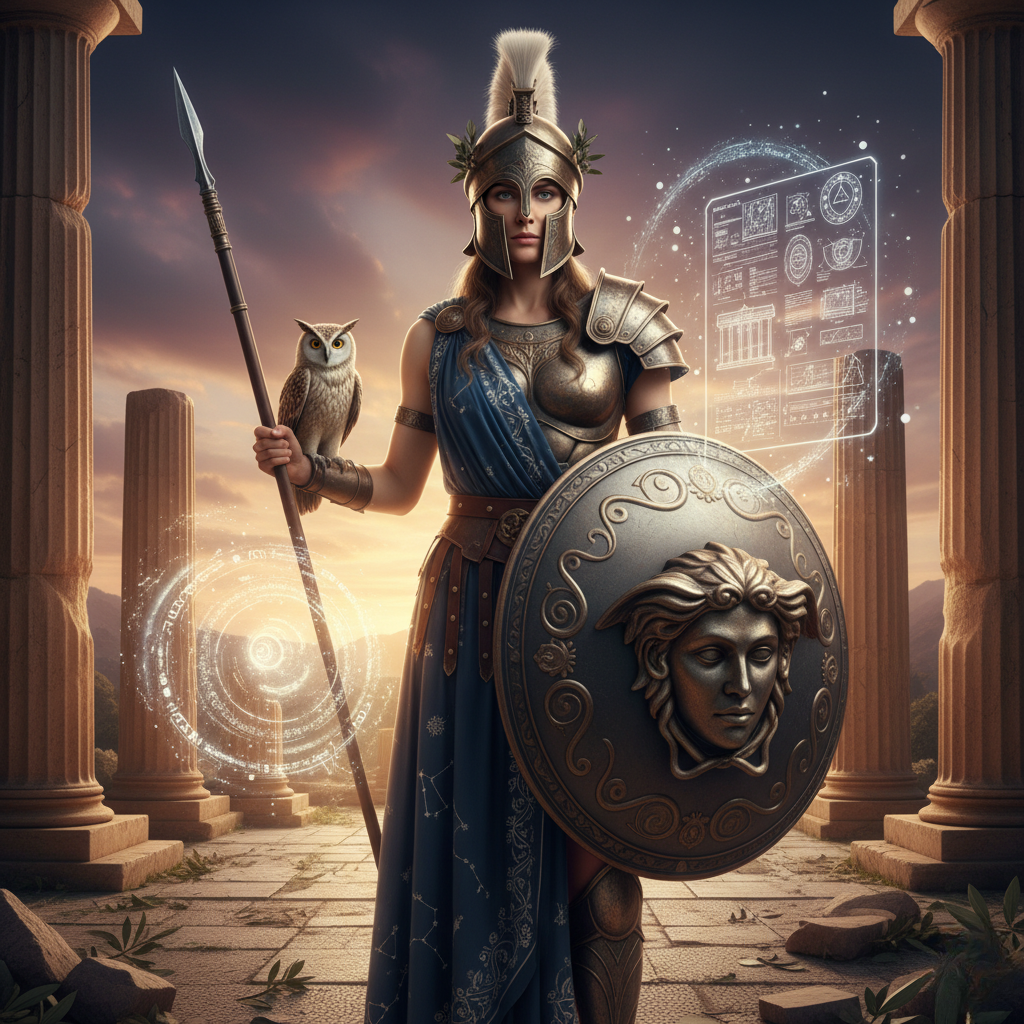
Athena took a different approach. She knelt and planted a seed in the rocky soil. From it grew the first olive tree, its branches heavy with fruit. The gift seemed humble in comparison to Poseidon’s dramatic offering, yet King Cecrops and the citizens recognized its profound value. The olive tree would provide food, oil for lamps and cooking, wood for building, and leaves for healing. It was sustenance, light, commerce, and medicine all at once, a gift that would multiply through the generations.
Athens chose Athena, and in doing so, established a foundational principle about the relationship between the divine and mortal realms.
The Revolutionary Nature of Athena’s Gift
What made Athena’s victory so significant wasn’t merely that her gift was practical. It was that her gift created abundance rather than demanding it. She didn’t require elaborate temples before blessing the city, didn’t demand constant sacrifices to maintain her favor, didn’t threaten withdrawal of protection if worship flagged. The olive tree, once planted, would continue giving regardless of how much the Athenians honored her.
This represents a radical departure from the typical divine human transaction. In most ancient religious frameworks, and indeed in many modern ones, the relationship with deities follows a basic economy of exchange, humans offer prayers, sacrifices, devotion, and gifts, and in return, the gods provide protection, favor, good harvests, or victory in battle. The relationship is conditional and transactional.
Through the conscious mythology framework, which examines myths as psychological and spiritual templates rather than mere stories, we can see Athena’s gift as representing a mature understanding of divine human relationship. She embodies what might be called “generative divinity”: a sacred principle that enriches human life not through extraction but through investment, not through demand but through endowment.
Athena gave the Athenians the means to create their own abundance. The olive tree was self-perpetuating; it would produce fruit, and those fruits contained seeds for more trees. Her wisdom taught them agriculture, craft, strategic thinking, and civic organization, all tools that multiplied rather than depleted. She gave knowledge, and knowledge, unlike material resources, grows when shared.
Poseidon’s Gift and the Old Paradigm
To understand Athena’s revolutionary nature, we must examine what Poseidon’s gift represented. The saltwater spring (or war horse, depending on the version) symbolized a certain kind of divine relationship, one based on power, conquest, and domination of resources.
A saltwater spring in a water scarce landscape initially appears valuable, but it cannot quench thirst or irrigate crops. It represents abundance that cannot be used, power that doesn’t translate to practical benefit. If the gift was a horse, it too represents a particular kind of power—military might, the ability to take from others what you need. Both gifts require Athens to look outward for sustenance, to rely on conquest, trade dominance, or naval power to survive.
Poseidon’s gift is extractive in nature. It says: “I will make you powerful, and with that power, you can take what you need.” This creates a perpetual state of competition and conflict. Moreover, Poseidon himself embodied the temperamental nature of such power, his favor was notoriously unstable, his wrath terrible, his moods as changeable as the sea itself.
The god of the sea represents the divine principle that must be constantly appeased. Ships’ captains made sacrifices before voyages. Coastal cities built elaborate temples. The relationship required ongoing investment with no guarantee of return, the sea might grant safe passage or might swallow sailors whole, often with no apparent logic to its choices.
Athena’s Patterns Throughout Greek Mythology
Once we recognize Athena’s pattern of generative giving, we see it repeated throughout her mythological appearances. She doesn’t simply solve problems for mortals; she gives them the tools to solve problems themselves.
Athena and Perseus: When Perseus needed to defeat Medusa, Athena didn’t slay the Gorgon for him. Instead, she gave him her polished shield to use as a mirror, along with strategic advice. She provided the method, the tool, and the wisdom, but Perseus had to execute the plan himself. The gift enhanced his capability rather than creating dependency.
Athena and Odysseus: Her relationship with Odysseus in Homer’s Odyssey exemplifies her approach perfectly. She doesn’t magically transport him home or eliminate his obstacles. Instead, she sharpens his wits, reinforces his courage, and occasionally provides strategic guidance. She makes him better at being himself. When Odysseus finally reclaims his household, it’s through his own cleverness and strength, qualities Athena helped cultivate but didn’t replace.
Athena and Arachne: Even in this darker tale, we see Athena’s pattern, though in inverted form. Arachne was a mortal weaver of extraordinary skill who boasted she was superior to Athena. When Athena appeared disguised as an old woman and advised humility, she was offering Arachne a gift, the wisdom to avoid hubris. Arachne refused this gift, insisted on the competition, and wove a tapestry depicting the gods’ misdeeds. Her transformation into a spider was tragic, yet even here, Athena allowed Arachne to keep her weaving ability. The punishment, harsh as it was, still allowed her to continue her craft eternally.
Athena and the House of Erechtheus: Athena maintained an intimate relationship with Athens through the Erechtheion, where her sacred olive tree grew beside the marks of Poseidon’s trident. The temple housed the ancient wooden statue of Athena that supposedly fell from heaven. But even in worship, Athenian religion emphasized what Athena represented, wisdom, craft, civic virtue, rather than fearful appeasement. The Panathenaic Festival celebrated Athenian culture and achievement as much as the goddess herself. The gift had become integrated into the city’s identity.
The Generative Divine Across Mythologies
Athena’s pattern of abundance giving rather than gift-demanding appears in other mythological traditions, though often less prominently than the transactional model.
Prometheus: While not a god in the traditional sense, Prometheus embodies this principle when he steals fire from the gods and gives it to humanity. Fire represents technology, civilization, and the ability to transform the environment. Like Athena’s olive tree, fire was a gift that multiplied, one flame could light infinite others. Zeus’s furious response to Prometheus’s gift reveals how threatening this model was to the established divine order. Gods were supposed to hoard power and dispense it conditionally, not empower mortals to become independent.
Demeter and the Eleusinian Mysteries: Demeter, in her grief over losing Persephone, came to Eleusis disguised as an old woman. After her identity was revealed, she taught the Eleusinian kings the secret of agriculture and established the Mysteries. These were initiatory rites that promised participants a better fate in the afterlife, but they also represented Demeter sharing sacred knowledge. The goddess of grain gave humans the ability to cultivate food, a renewable, multiplicative gift. The Mysteries themselves were said to impart wisdom that transformed the initiate’s understanding of death and life.
Hephaestus: The god of the forge and craftwork represents another aspect of generative divinity. Though he created specific items for gods and heroes, his true gift to humanity was technology itself, the knowledge of working metal, creating tools, and building civilization’s infrastructure. In some traditions, Hephaestus taught mortals smithcraft, giving them the means to create their own solutions rather than waiting for divine intervention.
Brigid in Celtic Mythology: The Irish goddess Brigid offers perhaps one of the clearest parallels to Athena. She was the goddess of poetry, healing, and smithcraft, all generative, creative, knowledge-based domains. She didn’t demand sacrifices so much as inspire creation. Her sacred flame at Kildare was tended for centuries, representing perpetual inspiration and creativity. When Christianity came to Ireland, Brigid’s qualities were so beloved that she was seamlessly transformed into Saint Brigid, suggesting that her pattern of giving rather than taking resonated deeply with human spiritual needs.
The Shadow Side: Gods Who Take
To fully appreciate the revolutionary nature of abundance giving deities, we must acknowledge how common the opposite pattern was, and remains in many religious traditions.
The Aztec Gods: Perhaps no pantheon demanded more from their worshippers than the Aztec deities, particularly Huitzilopochtli, who required constant human sacrifice to prevent cosmic catastrophe. The sun would not rise, the world would not continue, unless the gods were fed with blood. This created an economy of extraction so severe that it required constant warfare to capture sacrificial victims. The divine relationship became predatory, demanding ever more without providing anything that could generate sustainable human flourishing.
Moloch: This Canaanite deity, mentioned in biblical texts with horror, allegedly demanded child sacrifice. Whether historical or exaggerated by opposing cultures, Moloch represents the ultimate extractive deity, one who takes the future itself (children) as payment.
The Capricious Gods: Many deities across cultures had to be constantly appeased. The divine was temperamental, jealous, easily offended. Ancient Near Eastern gods often resembled feudal lords who demanded tribute and punished subjects who failed to provide adequate worship. The relationship wasn’t about human flourishing but about avoiding divine wrath.
Even in Greek mythology, many gods followed this pattern. Zeus demanded sacrifices and punished hubris. Hera’s jealous rages destroyed mortals who caught Zeus’s attention. Apollo sent plagues when disrespected. Artemis killed Actaeon simply for accidentally seeing her bathing. These deities had to be managed, negotiated with, appeased, a constant expenditure of resources and attention with inconsistent returns.
The Psychological Template: Scarcity Versus Abundance Consciousness
Using the conscious mythology framework, we can interpret these patterns as psychological and spiritual templates embedded in the collective unconscious. The contrast between Athena and Poseidon represents two fundamentally different approaches to existence.
Scarcity Consciousness (Poseidon’s model):
- Resources are limited and must be seized or defended
- Power comes from domination and control
- Relationships are transactional, everything has a price
- Security requires constant vigilance and appeasement
- Growth happens through acquisition and conquest
- Knowledge is hoarded as a source of power
Abundance Consciousness (Athena’s model):
- Resources can be cultivated and multiplied
- Power comes from capability and wisdom
- Relationships are generative, gifts create more gifts
- Security comes from resilience and adaptability
- Growth happens through creativity and skill development
- Knowledge increases when shared
When Athens chose Athena, they were choosing a psychological and spiritual orientation toward abundance. They were saying: “We will build our city on cultivation rather than conquest, on wisdom rather than raw power, on the gifts that multiply rather than those that must be constantly renewed through force.”
This choice shaped Athenian culture profoundly. While Athens certainly engaged in warfare and imperialism, they were far from perfect, their cultural legacy emphasizes philosophy, drama, democracy, and art. They became teachers to the Mediterranean world, and their gifts continue multiplying millennia later. Every time someone uses the Socratic method, engages in democratic deliberation, or stages a tragedy, they’re harvesting fruit from seeds Athenian culture planted.
Why We Need This Myth Today
In our contemporary moment, we’re essentially replaying the contest between Poseidon and Athena in multiple domains.
Economically: We face a choice between extractive capitalism (taking finite resources, maximizing short-term profit, creating dependence) and regenerative economics (building systems that renew resources, create genuine value, empower autonomy). The Poseidon approach has brought us climate crisis and vast inequality. The Athena approach suggests we could build economic systems that make everyone more capable rather than making a few extremely wealthy.
Technologically: We can develop AI and automation that disemploys humans and concentrates power (Poseidon), or we can create technologies that enhance human capability and distribute knowledge more widely (Athena). The choice isn’t about the technology itself but about its purpose and design philosophy.
Spiritually: Many people are leaving traditional religious frameworks that feel transactional, do these things, believe these doctrines, and receive salvation or favor. There’s growing hunger for spiritual approaches that are generative, that make practitioners wiser, more compassionate, more capable. The question isn’t whether the divine exists but what kind of relationship with the sacred actually helps humans flourish.
Educationally: We can design education to sort and credential (Poseidon extracting value from students through debt, preparing them to compete for scarce positions) or to genuinely develop capability (Athena giving students tools to create value, solve problems, and keep learning throughout life).
The Olive Tree Still Grows
There’s a reason the olive tree remained sacred to Athens for centuries, and why olive trees still grow on the Acropolis today. Athena’s gift literally continues giving, generation after generation. The original tree died and regrew multiple times, burned by Persians, damaged by storms, always sending up new shoots. This resilience is itself part of the gift’s wisdom.
True abundance doesn’t just appear once and disappear. It establishes patterns that persist. Athena’s wisdom wasn’t a single clever solution but a way of thinking about problems. Her gift of the olive tree wasn’t just one tree but the knowledge of cultivation that could be applied to infinite crops. Her patronage of crafts wasn’t about making specific items but about teaching the principles of making itself.
This is the heart of the conscious mythology framework’s insight: when we recognize these patterns in myths, we can choose to embody them. We can ask ourselves whether we’re being Poseidon or Athena in our various relationships and projects. Are we offering saltwater springs (impressive but unusable) or olive trees (humble but endlessly generative)? Are we extracting value or creating it? Are we making others dependent on us or more capable without us?
Conclusion: Choosing Our Gods
The ancient Athenians chose Athena, and in doing so, they chose a particular vision of what the divine-human relationship could be. They chose wisdom over force, cultivation over conquest, tools over power. They chose a goddess who made them better rather than one who made them bigger.
We face similar choices constantly. In every domain, economic, political, technological, spiritual, educational, we can orient toward the extractive or the generative, toward demanding gifts or giving them, toward creating dependence or capability.
Athena’s victory wasn’t just about one city getting a better gift. It was about establishing a template for sacred relationship that treats humans as partners in creation rather than subjects to be managed. It suggests that the highest form of power is the power to empower, that the truest abundance comes from giving people the tools to create their own.
The olive tree still grows on the Acropolis. The wisdom tradition Athens birthed still shapes Western thought. The pattern persists because it’s true in a deep sense: what we give away multiplies, what we hoard diminishes. Athena knew this, and she gave Athens, and through Athens, all of us, the gift of that knowing.
We don’t worship Athena anymore, but we can still choose her pattern. We can be planters of olive trees in our own domains, offering gifts that multiply rather than deplete, sharing knowledge that increases when divided, building systems that make everyone more capable rather than making the powerful more secure.
The question Athens faced remains our question: What kind of gift do we want to shape our future? The one that looks impressive but can’t be used? Or the humble seed that feeds generations?
@ Lee Greene