How a martyred philosopher transformed both astronomy and astrology through Hermetic wisdom, creating innovations that influenced centuries of thought while earning him execution
Published on consciouschoicemastery.com | Approx. 10-12 min read
The Forgotten Revolutionary
Giordano Bruno (1548-1600) remains one of history’s most misunderstood figures—remembered primarily as a martyr for scientific freedom who died defending heliocentrism, yet his actual revolutionary contributions extended far beyond astronomy into realms that contemporary scholarship has largely overlooked. While Bruno’s support for Copernican theory certainly contributed to his conflict with Church authorities, his most radical innovations lay in his synthesis of Hermetic philosophy with infinite cosmology, creating an entirely new framework for understanding astrological influence that challenged both medieval scholasticism and emerging mechanistic science.
Bruno’s integration of Hermetic wisdom with astronomical observation produced theoretical and practical innovations in astrological science that have received insufficient scholarly attention. Unlike his contemporary Galileo, whose telescopic observations challenged geocentric cosmology through empirical evidence, Bruno approached cosmic understanding through philosophical synthesis, combining the Corpus Hermeticum‘s teachings about human divinity and astral magic with Copernican heliocentrism and his own theory of infinite worlds to create unprecedented approaches to astrological practice.
This synthesis placed Bruno at the intersection of multiple intellectual traditions—Renaissance Hermeticism, emerging astronomical science, classical memory arts, and practical astrology—creating innovations that influenced subsequent developments in philosophy, science, and esoteric traditions while earning him condemnation from religious authorities threatened by his radical reconception of humanity’s relationship to cosmic forces.
Understanding Bruno’s contributions requires examining how his Hermetic foundation enabled astronomical and astrological innovations that transcended the limitations of both medieval astrology and purely mechanistic science, creating frameworks for understanding cosmic influence that anticipated later developments in psychology, philosophy, and even quantum physics.
The Hermetic Foundation: Recovering Ancient Wisdom
The Renaissance Discovery of Hermetic Texts
Bruno’s revolutionary approach to astrology emerged from the Renaissance recovery of Hermetic literature, particularly the Corpus Hermeticum texts that appeared to preserve ancient Egyptian wisdom but were actually Hellenistic compositions from the early centuries CE. As Frances Yates demonstrates in Giordano Bruno and the Hermetic Tradition, Renaissance scholars believed they had recovered pre-Mosaic wisdom that complemented rather than contradicted Christian revelation:
“The Hermetic writings were thought to be of extreme antiquity, written by the Egyptian Hermes Trismegistus, who was believed to have been either a contemporary of Moses or to have lived shortly after him. They were thus thought to contain the most ancient gentile wisdom.”¹
This dating error proved intellectually liberating, as it allowed scholars like Marsilio Ficino, Pico della Mirandola, and eventually Bruno to integrate Hermetic concepts with Christian theology and emerging scientific discoveries without apparent conflict with religious authority.
The Hermetic Cosmos and Human Divinity
The Corpus Hermeticum presented a cosmological framework that fundamentally differed from both Aristotelian physics and Christian theology. The Asclepius, one of the most influential Hermetic texts, declared:
“Man is a great miracle, Asclepius, a being worthy of reverence and honor. For he passes into the nature of a god, as though he were a god; he knows the race of daemons, recognizing that he is of the same origin as they.”²
This concept of human divinity through cosmic understanding became central to Bruno’s philosophy and astrological practice. Unlike medieval approaches that positioned humans as passive recipients of celestial influence, Hermetic philosophy suggested that properly educated humans could consciously participate in cosmic forces, using knowledge and techniques to align with beneficial influences and mitigate harmful ones.
Ficino’s Foundation: The Hermetic Revival
Marsilio Ficino’s Latin translation of the Corpus Hermeticum (1463) and his Three Books on Life (1489) established the intellectual framework that Bruno would later revolutionize. Ficino developed practical applications of Hermetic theory, creating:
- Astrological medicine based on planetary correspondences
- Talismanic magic using astrologically timed rituals
- Musical and aromatic therapies aligned with celestial influences
- Philosophical approaches to spiritual development through cosmic understanding
Ficino’s work demonstrated that Hermetic principles could generate practical results in medicine, psychology, and spiritual development, establishing precedent for Bruno’s more radical applications of Hermetic theory to astronomical and astrological innovation.
Bruno’s Cosmological Revolution: Infinite Worlds and Astrological Implications
Beyond Copernicus: The Theory of Infinite Worlds
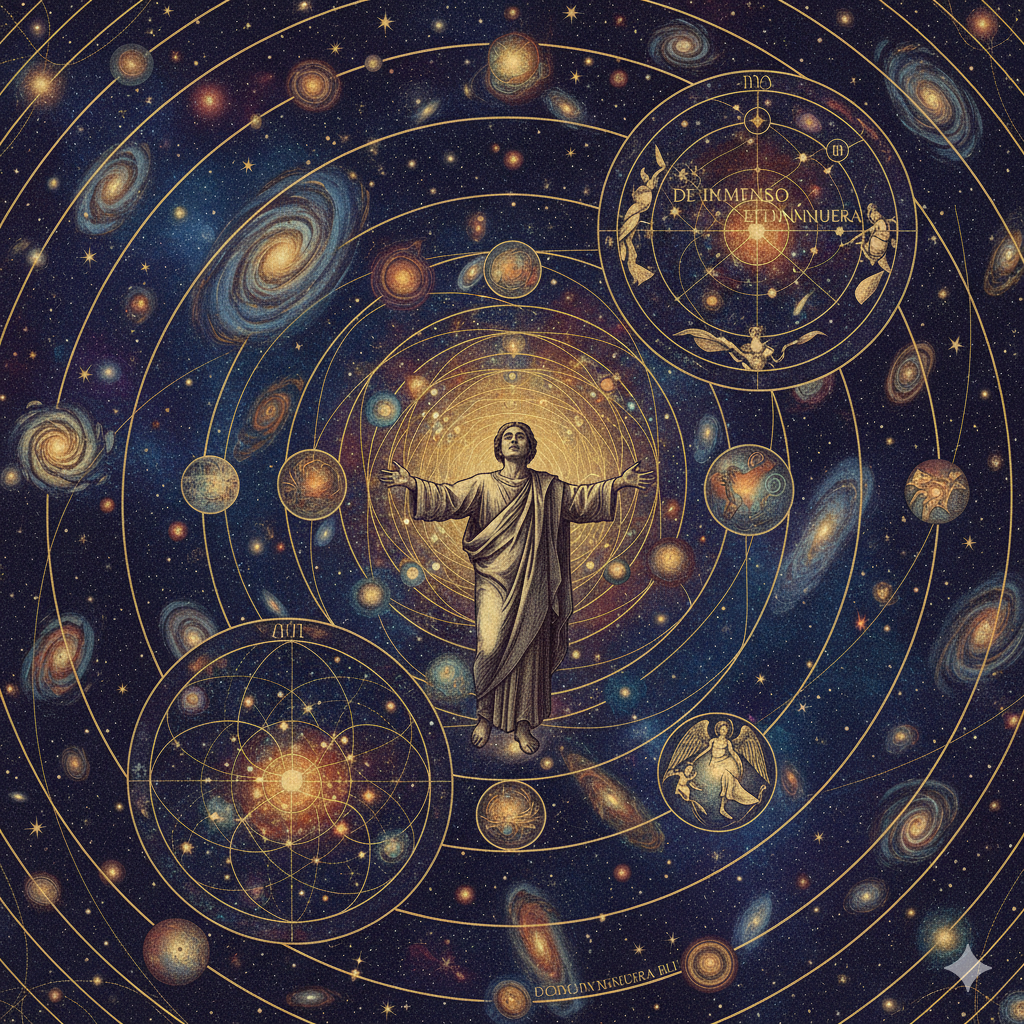
While Copernican heliocentrism repositioned Earth as a planet orbiting the Sun, it maintained the concept of a finite universe enclosed by the sphere of fixed stars. Bruno’s revolutionary contribution was extending Copernican principles to their logical conclusion: if Earth is not the center of the universe, then there is no center, and therefore no boundary—the universe must be infinite, containing infinite worlds with infinite possibilities for life and consciousness.
In De l’Infinito, Universo e Mondi (On the Infinite, Universe and Worlds, 1584), Bruno articulated this vision:
“Thus is the excellence of God magnified and the greatness of his kingdom made manifest; he is glorified not in one, but in countless suns; not in a single earth, a single world, but in a thousand thousand, I say in an infinity of worlds.”³
This cosmological framework had profound implications for astrological theory and practice. If the universe contained infinite worlds with infinite forms of life and consciousness, then astrological influence could not operate through simple mechanical causation from a limited set of planetary bodies, but must involve more complex interactions between consciousness and cosmic forces operating across infinite scales.
The Animate Universe: Consciousness as Cosmic Principle
Bruno’s infinite cosmology was animated by consciousness as a fundamental cosmic principle rather than a rare accidental emergence on Earth. In De la Causa, Principio et Uno (On Cause, Principle and Unity, 1584), he described the universe as a living organism pervaded by divine intelligence:
“The divine power and divinity is indeed in all things and through all things, but not equally… In some things there is soul, in others there is life without soul, in others there is matter without life, but no substance is without some particle of divinity.”⁴
This philosophical position enabled Bruno to reconceive astrological influence as interaction between different levels and forms of consciousness rather than mechanical causation from distant physical bodies. Planets and stars were not merely material objects exerting gravitational or emanative influences, but conscious entities participating in cosmic dialogue with human consciousness.
The Coincidence of Opposites in Infinite Reality
Bruno developed Nicholas of Cusa’s concept of coincidentia oppositorum (coincidence of opposites) through his infinite cosmology, arguing that in infinite reality, all apparent opposites ultimately coincide. This principle had significant implications for astrological interpretation:
- Traditional astrological polarities (benefic/malefic, masculine/feminine, active/passive) were revealed as relative rather than absolute
- Astrological interpretation required consideration of infinite contextual factors rather than fixed symbolic meanings
- Human consciousness could transcend apparent astrological limitations by recognizing its participation in infinite reality
In De gli Eroici Furori (The Heroic Frenzies, 1585), Bruno demonstrated how philosophical understanding of infinite reality enabled transcendence of apparent limitations:
“The soul finds itself with a capacity and potency for everything, and with an inclination toward everything, because… it has a certain infinity in itself.”⁵
Bruno’s Astrological Innovations: Theory and Practice
The Memory Arts and Astrological Imagery
Bruno’s most practical innovations emerged from his synthesis of Hermetic astrology with classical memory arts. His De Umbris Idearum (On the Shadows of Ideas, 1582) presented systematic methods for using astrological imagery to enhance memory, learning, and cognitive capacity through conscious interaction with celestial influences.
The work’s full title reveals its ambitious scope: “On the Shadows of Ideas: Comprising the Art of Seeking, Disposing, and Applying the Arts of Memory, Contemplation, and Logical Invention.” Bruno explained his method:
“The shadows of ideas are the vestiges, simulacra, impressions, or shadows which ideas cast upon the soul through the medium of corporeal objects, as shadows are cast by bodies through the medium of light.”⁶
This technique involved creating elaborate mental imagery systems based on astrological symbolism, enabling practitioners to:
- Enhance memory capacity through systematic use of planetary and zodiacal associations
- Develop intuitive understanding through meditation on celestial correspondences
- Access expanded consciousness states through contemplation of cosmic principles
- Integrate intellectual learning with spiritual development through astrological practices
The Circe Complex: Advanced Astrological Memory Techniques
Bruno’s Cantus Circaeus (Circe’s Song, 1582) presented even more advanced techniques for using astrological knowledge in practical memory and consciousness development work. The title referenced Circe’s magical ability to transform humans into animals, suggesting that proper use of astrological techniques could reverse this process, transforming ordinary consciousness into more expanded and capable states.
The work provided detailed instructions for:
- Creating personalized astrological imagery systems based on individual birth charts
- Using planetary hours and astrological timing for enhanced learning and memory work
- Developing internal astrological “theaters” for systematic knowledge organization
- Practicing advanced contemplative techniques using astrological meditation objects
P.G. Maxwell-Stuart notes the practical effectiveness of these methods:
“Bruno’s astrological memory techniques achieved remarkable results in developing both intellectual capacity and intuitive abilities, combining the precision of mathematical astrology with the transformative potential of Hermetic magic.”⁷
Revolutionary Astrological Timing Systems
Bruno’s infinite cosmology required new approaches to astrological timing that could account for the complexity of infinite celestial influences. Rather than relying solely on traditional planetary cycles and aspects, Bruno developed integrated timing systems that considered:
- Multiple levels of celestial influence operating simultaneously
- Infinite contextual factors affecting astrological interpretation
- Individual consciousness development as a variable in astrological effectiveness
- Philosophical understanding as a requirement for optimal timing
His approach represented a significant advancement over medieval astrology, which relied primarily on predetermined rules and fixed interpretations. Bruno’s system required practitioners to develop both astronomical knowledge and philosophical understanding, creating individualized approaches to astrological timing based on conscious participation rather than passive reception of celestial influences.
The Integration of Natural Magic and Astrological Science
Bruno’s De Magia and Theses de Magia presented systematic approaches to natural magic that integrated astrological science with practical techniques for working consciously with cosmic forces. Unlike medieval approaches to magical practice, which often relied on ritual formulas and supernatural invocation, Bruno’s methods emphasized understanding and cooperation with natural cosmic principles.
His approach to natural magic included:
- Detailed knowledge of astronomical cycles and astrological correspondences
- Philosophical understanding of cosmic principles and their operation
- Practical techniques for aligning human consciousness with beneficial influences
- Ethical frameworks ensuring magical practice served both individual development and collective benefit
Frances Yates emphasizes the scientific nature of Bruno’s magical practice:
“Bruno’s magic was not diabolic magic, nor the magic of the medieval grimoires, but the natural magic of the wise man who understands the secrets of nature and can use them for beneficial purposes.”⁸
The Trial and Persecution: Astrological Heresy
The Inquisition’s Concerns
Bruno’s execution by the Roman Inquisition in 1600 resulted from multiple factors, but his astrological innovations played a significant role in the charges against him. The Inquisition’s concerns focused on several aspects of Bruno’s teaching:
- His concept of infinite worlds implied infinite possibilities for divine incarnation, challenging Church exclusivity
- His teachings about human divinity and magical capacity threatened clerical authority
- His astrological practices suggested that humans could access divine knowledge and power independently
- His philosophical approach to Christianity interpreted religious doctrine symbolically rather than literally
The Sommario del Processo di Giordano Bruno (Summary of Giordano Bruno’s Trial) reveals specific charges related to his astrological work:
“He holds and teaches that the stars are angels, and that every star is a world, and that the stars are infinite, and that consequently infinite are the worlds, and that there are infinite individuals similar to those of this world… He practices divination and magic.”⁹
The Conflict Between Hermetic Freedom and Religious Authority
Bruno’s integration of Hermetic philosophy with Christian theology created an inevitable conflict with Church authority. The Hermetic concept of human divinity and magical capacity implied that individuals could achieve direct relationship with divine sources without ecclesiastical mediation—a fundamental threat to institutional religious control.
His astrological innovations compounded this threat by providing practical methods for developing what he considered innate human capacities for cosmic understanding and magical practice. From the Inquisition’s perspective, Bruno was teaching that properly educated individuals could become their own priests, prophets, and magicians through astrological and philosophical development.
The trial records show that Bruno refused to recant his teachings even when facing execution, suggesting his conviction that these methods provided genuine access to divine truth and transformative human development.
Bruno’s Influence on Later Astrological and Philosophical Development
The German Idealist Reception
Bruno’s philosophical innovations, particularly his concepts of infinite reality and consciousness as cosmic principle, significantly influenced German Idealist philosophers who developed his insights in directions that continue to influence contemporary thought.
Friedrich Schelling explicitly acknowledged Bruno’s influence on his Naturphilosophie:
“Bruno was the first to conceive nature in its totality as a product of intelligence, and intelligence as the productive principle of nature. This reciprocal determination of intelligence and nature constitutes the fundamental principle of all true philosophy.”¹⁰
G.W.F. Hegel incorporated Bruno’s concept of coincidentia oppositorum into his dialectical method, while acknowledging Bruno’s contribution to understanding consciousness as self-developing reality:
“With Bruno, philosophy steps forth in its own shape and knows itself as philosophy… Bruno grasped the principle that the truth lies in the unity of opposites.”¹¹
The Romantic Revival of Hermetic Astrology
The Romantic movement’s interest in synthesis, imagination, and alternative approaches to knowledge led to renewed appreciation for Bruno’s integration of philosophical and astrological wisdom. Romantic poets and philosophers found in Bruno’s work validation for their conviction that poetic imagination could access truths unavailable to purely rational analysis.
Samuel Taylor Coleridge studied Bruno’s works extensively and incorporated his concepts of infinite reality and creative imagination into Romantic aesthetic theory. Johann Wolfgang von Goethe’s scientific work, particularly his studies of plant morphology and color theory, reflected Bruno’s influence in seeking to understand natural phenomena through synthetic rather than purely analytical approaches.
Modern Psychological and Symbolic Applications
Bruno’s integration of astrological symbolism with consciousness development anticipated modern psychological applications of astrological concepts. Carl Gustav Jung’s development of analytical psychology drew explicitly on Renaissance Hermetic sources, including Bruno’s work on imagination and symbolic thinking.
Jung’s concept of the collective unconscious and archetypal symbolism reflected insights that Bruno had developed through his astrological and memory work:
“The starry vault of heaven is in truth the open book of cosmic projection, in which are reflected the mythologems, i.e., the archetypes. In this vision astrology and alchemy, the two classical functionaries of the psychology of the collective unconscious, join hands.”¹²
Contemporary astrologers and psychological practitioners continue to develop applications of Bruno’s insights about consciousness, imagination, and symbolic thinking in therapeutic and developmental work.
Scientific Philosophy and Systems Theory
Bruno’s concept of the universe as an infinite system of interrelated conscious entities anticipated later developments in systems theory, complexity science, and consciousness studies. His insight that consciousness and matter represent different aspects of a unified cosmic principle parallels contemporary discussions in philosophy of mind and quantum consciousness research.
Physicist David Bohm’s concept of the “implicate order” reflects insights similar to Bruno’s understanding of infinite reality as a unified field expressing itself through apparent multiplicity:
“The notion of a separate organism is clearly an abstraction, as is also its boundary. Ultimately, the entire universe… has to be understood as a single undivided whole.”¹³
Contemporary Relevance: Bruno’s Insights for Modern Astrology
Beyond Mechanistic Causation
Bruno’s integration of consciousness with cosmic influence provides alternatives to both purely mechanistic and purely symbolic approaches to contemporary astrological practice. His insight that astrological influence operates through consciousness rather than mechanical causation suggests approaches to astrological interpretation that consider:
- Individual consciousness development as a variable in astrological effectiveness
- Interactive rather than deterministic relationships between celestial patterns and human experience
- Creative participation rather than passive reception in astrological influence
- Philosophical understanding as enhancement to technical astrological knowledge
Infinite Context and Astrological Interpretation
Bruno’s infinite cosmology suggests that astrological interpretation must account for unlimited contextual factors rather than relying on predetermined symbolic meanings. This approach to astrological practice emphasizes:
- Individual chart synthesis rather than cookbook interpretations
- Dynamic understanding of astrological patterns as they develop through time
- Integration of multiple astrological systems and approaches for comprehensive understanding
- Recognition that astrological meaning emerges through conscious participation rather than passive reception
Contemporary astrologers developing psychological and therapeutic applications of astrological concepts often unconsciously employ principles that Bruno articulated through his philosophical and practical work.
Integration of Scientific and Symbolic Understanding
Bruno’s synthesis of astronomical observation with symbolic interpretation provides models for contemporary integration of scientific knowledge with astrological practice. Rather than opposing scientific and symbolic approaches to cosmic understanding, Bruno’s work suggests methods for creative integration that enhance both scientific knowledge and symbolic insight.
Modern practitioners developing evidence-based approaches to astrological practice can find in Bruno’s work precedent for integration that maintains both intellectual rigor and practical effectiveness in astrological application.
The Hermetic Legacy: Magic as Natural Science
Natural Magic vs. Supernatural Intervention
Bruno’s approach to magical practice emphasized working with natural cosmic principles rather than seeking supernatural intervention. This distinction proves crucial for understanding both his historical contribution and contemporary applications of his insights.
His De Magia distinguished between different types of magical practice:
“There is a magic which is natural, and another which is supernatural. The natural magic is that which, through the application of active things to passive things, produces effects which seem miraculous to those who do not understand the natural causes.”¹⁴
This natural magic involved:
- Detailed understanding of astronomical cycles and natural correspondences
- Practical techniques for aligning human activity with beneficial cosmic influences
- Philosophical development that enabled conscious participation in cosmic processes
- Ethical frameworks ensuring magical practice served beneficial purposes
The Scientific Method and Magical Practice
Bruno’s integration of observational astronomy with magical practice anticipated later developments in experimental method and evidence-based approaches to understanding natural phenomena. His insistence on practical results as validation for theoretical understanding paralleled the emerging scientific emphasis on empirical verification.
However, unlike purely mechanistic approaches to natural science, Bruno’s methodology included consciousness as an active factor in both experimental observation and practical application. This approach suggested that optimal understanding of natural phenomena required development of observational capacities through philosophical and contemplative practice.
Contemporary Applications of Bruno’s Natural Magic
Modern practitioners interested in evidence-based approaches to what might be called “consciousness technology” can find in Bruno’s work systematic methods for:
- Using astrological timing for enhanced cognitive performance and creativity
- Developing memory and learning capacities through imagery and contemplative practices
- Integrating rational analysis with intuitive insight through philosophical development
- Creating personal practices that align individual development with larger cosmic principles
These applications reflect Bruno’s insight that proper education could enable individuals to develop capacities that medieval society attributed to supernatural intervention but which actually represent natural human potentials accessed through appropriate knowledge and practice.
Bruno’s Astronomical Contributions: Observation and Vision
Telescopic Observation Before the Telescope
Although Bruno did not use telescopic instruments (which were not invented until after his death), his infinite cosmology was based on careful naked-eye astronomical observation combined with mathematical reasoning and philosophical insight. His predictions about the nature of stars, planetary systems, and cosmic structure anticipated discoveries that telescopic astronomy would later confirm.
In De l’Infinito, Bruno predicted:
“There are countless suns and countless earths all rotating round their suns in exactly the same way as the seven planets of our system rotate round our sun.”¹⁵
This prediction of exoplanets and multiple planetary systems was verified only in the late 20th century through advanced telescopic observation and mathematical analysis.
The Unity of Terrestrial and Celestial Physics
Bruno’s cosmology eliminated the medieval distinction between terrestrial and celestial realms, arguing that the same physical principles operated throughout the infinite universe. This insight preceded by centuries the unification achieved by Newton’s gravitational theory and later developments in astrophysics.
His recognition that Earth was a planet similar to other planets, and that stars were suns similar to our Sun, represented revolutionary advances in astronomical understanding that were not widely accepted until the 18th and 19th centuries.
Mathematical Astronomy and Philosophical Vision
Bruno combined mathematical precision in astronomical calculation with philosophical vision about cosmic meaning and purpose. Unlike purely technical approaches to astronomy that focused solely on predictive accuracy, Bruno’s astronomical work sought to understand cosmic purpose and humanity’s role within infinite reality.
This integration of mathematical precision with philosophical meaning provides models for contemporary approaches to cosmology and consciousness studies that seek to understand both the mechanics and the meaning of cosmic evolution.
The Synthesis: Philosophy, Science, and Spiritual Practice
Integration as Bruno’s Central Method
Throughout his work, Bruno consistently sought integration rather than separation between different approaches to understanding reality. His synthesis included:
- Philosophy and practical observation
- Mathematical precision and symbolic interpretation
- Scientific investigation and spiritual development
- Individual transformation and cosmic understanding
- Ancient wisdom and contemporary discovery
This integrative approach enabled innovations that purely specialized approaches could not achieve, suggesting methods for contemporary integration of scientific, philosophical, and practical approaches to understanding consciousness and cosmic reality.
The Pedagogical Revolution
Bruno’s teaching methods, developed during his travels through European universities, emphasized active participation rather than passive reception of knowledge. His approach to education included:
- Interactive dialogue rather than authoritative lecture
- Practical application rather than purely theoretical study
- Individual development rather than mere information transmission
- Integration of multiple perspectives rather than single-system adherence
These pedagogical innovations influenced educational development and continue to provide models for learning approaches that develop both intellectual capacity and practical wisdom.
Contemporary Implications for Integral Education
Bruno’s educational philosophy anticipated contemporary developments in integral education that seek to develop multiple forms of intelligence and capacity rather than purely analytical or technical skills. His insight that optimal learning requires integration of intellectual, imaginative, and contemplative approaches provides frameworks for educational development that serves both individual fulfillment and social benefit.
Conclusion: Bruno’s Enduring Legacy
Giordano Bruno’s revolutionary integration of Hermetic philosophy with astronomical science created innovations that transcended the limitations of both medieval scholasticism and emerging mechanistic materialism. His synthesis of infinite cosmology with practical astrological techniques, philosophical inquiry with contemplative practice, and scientific observation with symbolic interpretation established precedents for approaches to understanding reality that remain relevant for contemporary consciousness studies, educational development, and practical spiritual application.
Bruno’s execution by the Inquisition marked not only the martyrdom of an individual thinker but the historical suppression of integrated approaches to knowledge that could have accelerated both scientific and spiritual development. The separation of science from philosophy, of observation from contemplation, of practical technique from ethical development—separations that characterized the subsequent development of Western knowledge—represented losses as well as gains in human understanding.
Contemporary recovery of Bruno’s insights suggests possibilities for integration that could enhance both scientific investigation and practical wisdom. His demonstration that rigorous intellectual work could be combined with effective spiritual practice, that mathematical precision could be integrated with symbolic interpretation, and that individual development could serve collective benefit provides models for approaches to knowledge and practice that transcend the limitations of purely specialized or purely technical approaches to understanding reality.
Bruno’s vision of infinite reality populated by infinite forms of consciousness, accessible through philosophical development and practical technique, anticipated insights about the nature of consciousness and cosmos that contemporary science is beginning to rediscover through quantum physics, consciousness research, and complexity theory. His integration of ancient wisdom with contemporary discovery suggests methods for ongoing synthesis that could accelerate both individual development and collective understanding.
The martyr of Campo de’ Fiori died defending not merely heliocentrism but a vision of reality as infinite conscious creativity accessible through human development and practical wisdom. His legacy continues to inspire those who seek integration rather than separation, synthesis rather than analysis alone, and practical wisdom rather than purely theoretical knowledge in approaching the infinite mystery of conscious existence within infinite reality.
Bruno’s life and work demonstrate that genuine philosophical understanding naturally leads to practical application, that authentic scientific investigation includes rather than excludes consciousness, and that effective spiritual development serves rather than opposes rigorous intellectual inquiry. In an age increasingly dominated by artificial intelligence and mechanistic approaches to understanding consciousness, Bruno’s vision of conscious participation in infinite creative reality provides alternatives that honor both human dignity and cosmic mystery while enabling practical development of human capacities that mechanical approaches cannot access or duplicate.
The infinite magus lives on in every attempt to integrate wisdom with knowledge, contemplation with observation, individual development with universal service, and ancient understanding with contemporary discovery. His execution silenced his voice but could not destroy the vision of infinite conscious creativity that speaks through all genuine attempts to understand and participate consciously in the magnificent mystery of existence itself.
Sources:
- Frances A. Yates, Giordano Bruno and the Hermetic Tradition (Chicago: University of Chicago Press, 1964), 12-13.
- Asclepius, trans. Brian P. Copenhaver, in Hermetica (Cambridge: Cambridge University Press, 1992), 68.
- Giordano Bruno, De l’Infinito, Universo e Mondi, trans. Dorothy Waley Singer, in Giordano Bruno: His Life and Thought (New York: Henry Schuman, 1950), 225.
- Giordano Bruno, De la Causa, Principio et Uno, trans. Jack Lindsay (New York: International Publishers, 1964), 83.
- Giordano Bruno, De gli Eroici Furori, trans. Paul Eugene Memmo, in The Heroic Frenzies (Chapel Hill: University of North Carolina Press, 1964), 89.
- Giordano Bruno, De Umbris Idearum, trans. Scott Gosnell (2005), Preface. Available online.
- P. G. Maxwell-Stuart, Astrology: from Ancient Babylon to the Present (Stroud: Amberley Publishing, 2010), 187.
- Frances A. Yates, Giordano Bruno and the Hermetic Tradition, 155.
- Sommario del Processo di Giordano Bruno, trans. Angelo Mercati, in Il Sommario del Processo di Giordano Bruno (Vatican City: Biblioteca Apostolica Vaticana, 1942), 34.
- Friedrich Wilhelm Joseph Schelling, Bruno, oder über das göttliche und natürliche Prinzip der Dinge (1802), trans. Michael G. Vater (Albany: SUNY Press, 1984), 96.
- G.W.F. Hegel, Lectures on the History of Philosophy, trans. E.S. Haldane (London: Routledge & Kegan Paul, 1896), Volume 3, 121.
- Carl Gustav Jung, Memories, Dreams, Reflections, trans. Richard and Clara Winston (New York: Pantheon Books, 1961), 255.
- David Bohm, Wholeness and the Implicate Order (London: Routledge, 1980), 9.
- Giordano Bruno, De Magia, trans. Richard J. Blackwell, in Cause, Principle and Unity (Cambridge: Cambridge University Press, 1998), 85.
- Giordano Bruno, De l’Infinito, Universo e Mondi, trans. Dorothy Waley Singer, 242.
@ 2025 Lee Greene