Why every culture’s greatest stories follow the same psychological blueprint for human growth
Published on consciouschoicemastery.com | Approx. 10-12 min read
This article is part of a comprehensive analysis of recurring patterns across global mythological traditions:
- The Architecture of Conscious Choice in World Mythology – Destructive decision-making patterns
- The Light Side of Divine Will – Constructive conscious choice examples
- Universal Patterns: Conscious Choice Across Global Mythologies – Worldwide validation
- The Eternal Helper – Divine assistance patterns across cultures
- The Sacred Prism – Unity within mythological diversity
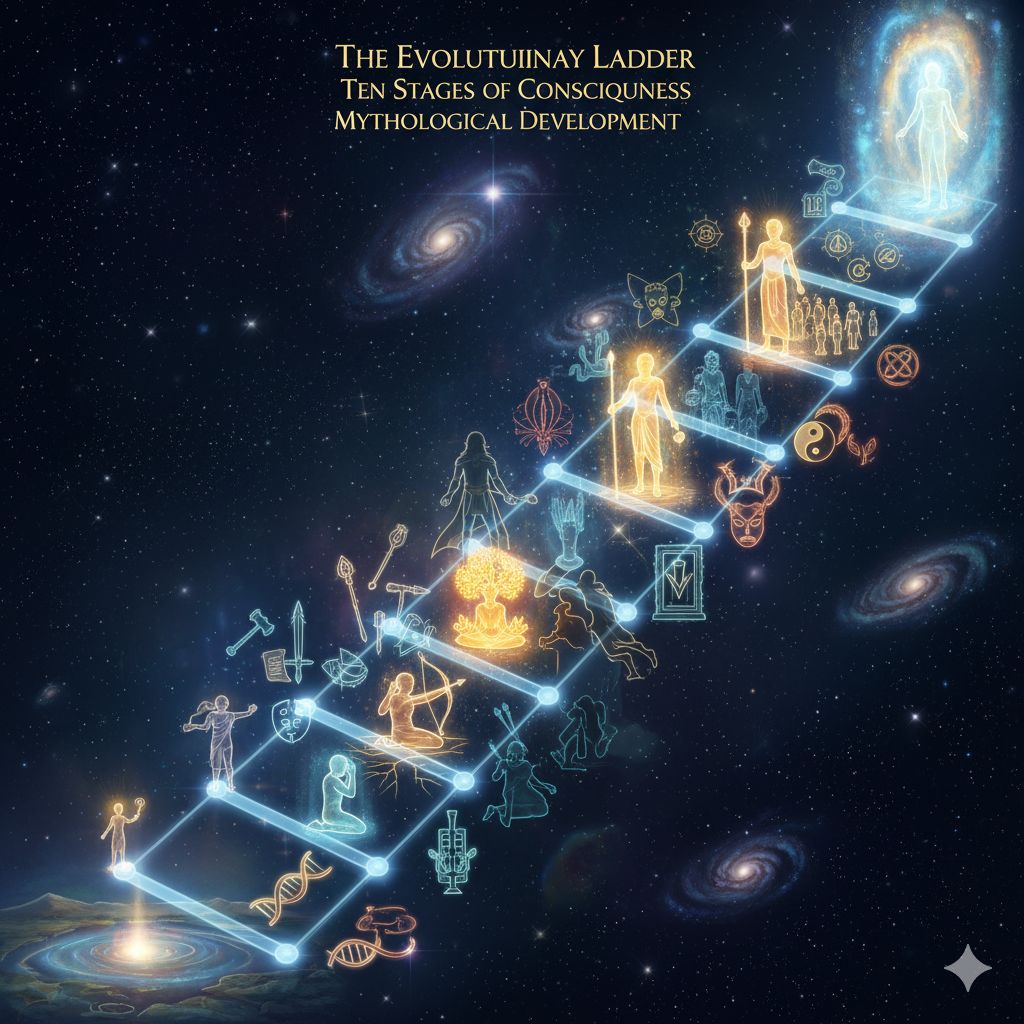
- The Ten-Stage Mirror – Hero development as human psychological map
- The Universal Dream Technology – Dreams as divine communication across cultures
- The Inevitable Cycle – Prosperity, decline, and renewal patterns
- The Source Code – How Mythology Preserves Humanity’s Operating Instructions
The Universal Pattern Hidden in Every Hero’s Tale
Across every human culture, from ancient Mesopotamian epics to contemporary storytelling, the most enduring mythological narratives follow remarkably similar structural patterns. These aren’t coincidental similarities or evidence of cultural borrowing—they represent something far more profound: myths serving as psychological mirrors, reflecting the universal stages of human development that every individual navigates throughout life.
When we examine the greatest mythological figures across cultures—Buddha’s spiritual awakening, Odysseus’s transformative journey home, Inanna’s descent into the underworld, Osiris’s death and resurrection—a consistent ten-stage pattern emerges. This isn’t imposed interpretation but recognition of how human consciousness naturally understands its own developmental process through storytelling.
These myths persist across millennia not because they entertain, but because they provide roadmaps for psychological and spiritual growth. They offer templates for navigating the challenges, choices, and transformations that define human experience. In studying these patterns, we discover that mythology’s greatest gift isn’t escapism—it’s recognition of our own developmental potential reflected in timeless stories.
The Ten Stages of Mythological Development
Stage One: Primordial Unity
The state before individual consciousness emerges
Every mythological tradition begins with accounts of original unity—whether described as primordial chaos, divine wholeness, or undifferentiated potential. This stage represents the psychological state before self-awareness develops, the unconscious harmony that precedes individual identity formation.
Buddha’s Example: According to the Buddhacarita by Aśvaghoṣa, the future Buddha’s early life in the palace represents this primordial state: “The king provided him with all the objects of pleasure and luxury… he lived like a god in heaven, knowing nothing of sorrow.”¹
Odysseus’s Example: Homer’s Odyssey references the peaceful period before the Trojan War when Odysseus ruled Ithaca contentedly, representing the pre-heroic state of unconscious harmony.²
Human Parallel: Early childhood before self-consciousness develops, or any period of unconscious contentment before major life challenges emerge.
Stage Two: The Call to Individuation
Initial stirring of individual consciousness and purpose
Mythological heroes receive calls that awaken them from unconscious states—divine commands, prophecies, or inner promptings that signal the beginning of individual development. This represents the psychological moment when personal growth becomes necessary and conscious.
Buddha’s Example: The Lalitavistara Sutra describes the four encounters that awakened Siddhartha: “Then the prince saw an old man… a sick man… a dead man… and finally a wandering ascetic,” each encounter progressively awakening him to life’s fundamental challenges.³
Inanna’s Example: The Sumerian text “Inanna’s Descent to the Underworld” begins: “From the Great Above she opened her ear to the Great Below,” representing the call to explore unconscious depths and face shadow aspects of the psyche.⁴
Human Parallel: Adolescent awakening to personal identity, career calling, spiritual seeking, or any moment when individual purpose becomes clear and compelling.
Stage Three: Strategic Preparation
Conscious planning and resource gathering for the journey ahead
Heroes don’t immediately leap into action but engage in careful preparation—gathering allies, acquiring tools, seeking guidance, and making strategic decisions about how to approach their challenges.
Odysseus’s Example: Homer’s Iliad details the strategic planning during the Trojan War, culminating in the Trojan Horse strategy: “Then resourceful Odysseus answered… ‘Let us make a horse of wood, and let the best of us hide inside it.'”⁵
Osiris’s Example: Plutarch’s De Iside et Osiride describes Osiris’s wise reign where “he traveled over the whole earth civilizing it without the slightest need of arms,” representing this preparatory stage of developing wisdom and character.⁶
Human Parallel: Educational preparation, skill development, relationship building, and resource gathering before major life transitions or challenges.
Stage Four: The Descent into Challenge
Entry into the realm of trials and difficulties
This stage marks the hero’s entry into the realm where transformation occurs—underworlds, wilderness, wars, or any space where normal rules don’t apply and growth happens through struggle.
Inanna’s Example: The Sumerian text details her descent through seven gates: “At each gate she was required to remove one piece of her regalia… until she arrived naked and bowed low” before Ereshkigal, symbolizing the stripping away of ego defenses.⁷
Buddha’s Example: The Buddhacarita describes his departure from the palace: “Having cast off all the splendor of sovereignty… he became a wandering mendicant,” entering the realm where spiritual transformation occurs through ascetic practice.⁸
Human Parallel: Beginning therapy, starting difficult career transitions, entering crisis periods, or any situation where normal support systems are temporarily unavailable and growth must occur through struggle.
Stage Five: The Crisis of Identity
Confronting fundamental questions about self and purpose
Heroes face moments where their previous understanding of themselves becomes inadequate. This crisis forces deep questioning of identity, values, and life direction—often experienced as a dark night of the soul.
Osiris’s Example: Plutarch describes Osiris’s murder by Set: “Set, having secretly obtained the measure of Osiris’s body, caused to be made a beautiful chest… When Osiris lay down in it, they immediately clapped on the lid.”⁹ This represents the death of the old self that must occur before transformation.
Buddha’s Example: The Ariyapariyesana Sutta describes his realization about ascetic practices: “I thought: ‘This is not the way to enlightenment.’ I remembered the jhana I had attained under the rose-apple tree… ‘That is indeed the way to enlightenment.'”¹⁰
Human Parallel: Mid-life crisis, spiritual emergency, career questioning, relationship breakdowns, or any period where fundamental life assumptions are challenged.
Stage Six: The Transformative Ordeal
The central test that determines the hero’s ultimate development
This represents the crucial moment where heroes must demonstrate their growth by facing their greatest challenge. Success here determines whether they achieve their transformation or remain stuck in previous patterns.
Inanna’s Example: The Sumerian text describes her confrontation with Ereshkigal and subsequent death: “The corpse was hung from a hook. After three days and three nights had passed, her minister Ninshubur… went to the gods for help.”¹¹
Odysseus’s Example: Homer describes the final test with his bow: “But shrewd Odysseus, as soon as he had taken up the great bow and looked it all over… strung the great bow without effort and took it in his right hand.”¹² This represents mastery earned through the entire journey.
Human Parallel: Defending a thesis, starting a business, ending a relationship, facing serious illness, or any moment where accumulated growth is tested under pressure.
Stage Seven: The Death and Resurrection
Symbolic death of the old self and emergence of the transformed being
Heroes must die symbolically to their previous limitations before they can embody their new capacities. This isn’t literal death but the complete release of outdated identity patterns.
Osiris’s Example: The Pyramid Texts describe the resurrection: “Osiris has come, that he may see his form, that he may lift himself up… he has put together his bones, he has collected his flesh.”¹³
Buddha’s Example: The Buddhacarita describes the moment of enlightenment: “He attained the knowledge of his former births… the knowledge of the death and rebirth of beings… and the knowledge of the destruction of the asavas [mental fermentations].”¹⁴
Human Parallel: Recovery from addiction, completing major education, spiritual awakening, or any moment where previous limitations are permanently transcended.
Stage Eight: The Integration of Wisdom
Learning to embody new capacities in daily life
Heroes must learn to integrate their transformation into practical existence. This stage tests whether the change is genuine or merely temporary inspiration.
Inanna’s Example: After her return from the underworld, the Sumerian text shows her transformed relationship with power: “Inanna fastened the shugurra, the crown of the steppe, on her head,” but now wielding authority with wisdom gained through death and rebirth.¹⁵
Buddha’s Example: The Vinaya Pitaka describes his initial hesitation to teach: “This Dhamma that I have attained is deep, hard to see, hard to realize… But then Brahma Sahampati pleaded with the Blessed One,” leading to his decision to share the teaching.¹⁶
Human Parallel: Applying new skills in work situations, maintaining recovery habits, or implementing insights gained through therapy or spiritual practice.
Stage Nine: The Return as Teacher
Sharing wisdom and guidance with others
Transformed heroes naturally become sources of guidance for others facing similar challenges. This isn’t obligation but natural expression of their developed capacities.
Odysseus’s Example: Homer’s Odyssey concludes with Odysseus reestablishing order in Ithaca: “But Odysseus, glad in his heart at hearing the words, spoke winged words to Athena: ‘Daughter of Zeus, let us plan how we may set our hands on the shameless suitors.'”¹⁷
Buddha’s Example: The Mahāparinibbāna Sutta records forty-five years of teaching: “Be your own refuge, your own sanctuary. Seek for no other refuge… Work out your salvation with diligence.”¹⁸
Human Parallel: Mentoring others, teaching from experience, serving in community leadership, or naturally becoming a resource for others facing similar challenges.
Stage Ten: The Cosmic Return
Transcending individual development to serve universal principles
The final stage shows heroes operating from principles that transcend personal benefit, becoming vehicles for forces larger than individual development.
Osiris’s Example: In Egyptian mythology, Osiris becomes judge of the dead, serving cosmic justice: “Osiris, who judges the heart in the balance… who decides the fate of the gods and mortals.”¹⁹
Inanna’s Example: After her transformation, Inanna embodies the principle of love and war, serving the cosmic function of creative destruction and renewal necessary for universal balance.
Human Parallel: Becoming agents of principles rather than personal advancement—serving justice, truth, beauty, or love as universal forces rather than individual preferences.
The Pattern’s Universal Recognition
Why This Structure Appears Everywhere
The consistency of this ten-stage pattern across isolated cultures suggests something profound about human psychological development. These myths persist not because they’re entertaining fiction, but because they accurately map the terrain of consciousness growth that every individual navigates.
Psychological Research Confirmation Modern developmental psychology has identified remarkably similar patterns. Abraham Maslow’s hierarchy of needs, Erik Erikson’s developmental stages, and James Fowler’s stages of faith development all recognize similar progressions from basic survival through self-actualization to transpersonal service.²⁰
Cross-Cultural Validation The pattern appears in traditions with no historical contact—Aboriginal Australian dreamtime stories, Native American vision quests, African initiation rituals, and European folk tales all demonstrate these same developmental transitions.
Contemporary Applications Modern therapeutic approaches like Joseph Campbell’s monomyth, Carl Jung’s individuation process, and Roberto Assagioli’s psychosynthesis all work with variations of this same ten-stage recognition.
The Stages as Psychological Map
Each stage represents a necessary phase of human development that can’t be skipped or rushed:
Early Stages (1-3): Building foundation capacities for independent growth Middle Stages (4-7): Confronting and transcending limitation patterns
Later Stages (8-10): Integrating transformation and serving others’ development
Understanding this pattern helps individuals:
- Recognize their current developmental stage
- Understand what challenges are developmentally appropriate
- Avoid comparing their stage to others’ different developmental timing
- Appreciate that difficulties are often signs of impending growth rather than personal failure
Myths as Development Technology
These stories function as development technology—they provide:
Preparation: Showing what challenges to expect at each stage Guidance: Offering strategies for navigating specific developmental tasks Encouragement: Demonstrating that transformation is possible even in seemingly impossible circumstances Context: Placing individual struggles within larger patterns of human growth
Modern Applications: Living the Mythological Pattern
Personal Development Framework
Understanding the ten-stage pattern enables more conscious navigation of personal growth:
Stage Recognition: Identify your current developmental stage by examining recent challenges and growth areas. Are you facing identity questions (Stage 5), integration challenges (Stage 8), or service opportunities (Stage 9)?
Appropriate Expectations: Align expectations with developmental stage. Someone in Stage 4 (Crisis of Identity) shouldn’t expect the stability of Stage 8 (Integration of Wisdom).
Strategic Preparation: Use earlier stages to prepare for later challenges. Build foundational skills during preparation stages, gather support systems before ordeal stages.
Pattern Completion: Resist the temptation to skip stages or remain stuck in comfortable ones. Each stage serves necessary development functions.
Relationship Applications
The pattern helps understand relationship dynamics:
Developmental Compatibility: Partners at similar stages often understand each other better, while different stages can create productive learning opportunities or challenging misunderstandments.
Support Strategies: Someone in Stage 6 (Transformative Ordeal) needs different support than someone in Stage 9 (Return as Teacher). Appropriate support matches developmental needs.
Conflict Understanding: Many relationship conflicts reflect different developmental stages rather than personality incompatibilities.
Professional and Creative Applications
Career Development: Professional growth often follows this pattern—from learning fundamentals through crisis periods to mastery and eventual teaching or leadership roles.
Creative Projects: Artistic endeavors naturally follow similar stages—from initial inspiration through struggle and breakthrough to completion and sharing.
Organizational Development: Teams and organizations also move through comparable stages, from formation through storming to performing and serving larger purposes.
Therapeutic and Healing Applications
Therapeutic Process: Therapy often facilitates movement through these stages—from recognizing patterns through crisis work to integration and eventually helping others.
Addiction Recovery: Recovery programs implicitly follow this pattern—from admitting powerlessness through working steps to sponsoring others.
Spiritual Development: Contemplative traditions across cultures use variations of this pattern for systematic spiritual growth.
The Mirror Recognition: Mythology Reflects Human Nature
The Recursive Pattern
The most profound recognition is that these myths don’t just describe fictional heroes—they describe the developmental potential within every human being. When we study mythology, we’re studying ourselves:
Heroes as Internal Aspects: Every mythological figure represents aspects of consciousness available to all humans—the courage of Odysseus, the compassion of Buddha, the transformative power of Inanna.
Challenges as Growth Opportunities: The obstacles heroes face mirror the psychological and spiritual challenges that promote human development.
Transformations as Possibilities: The changes heroes undergo demonstrate transformation capacities within every individual.
Cultural Mirror Function
Cultures create myths that reflect their understanding of human development:
Warrior Cultures: Emphasize stages involving courage, testing, and heroic achievement Mystical Cultures: Focus on stages of spiritual awakening, death/rebirth, and cosmic service Wisdom Cultures: Highlight stages of learning, integration, and teaching
All cultures recognize the same basic pattern but emphasize different aspects based on their values and challenges.
The Eternal Return
Joseph Campbell’s recognition of the “eternal return” takes on new meaning through this lens: we don’t just read these stories once and finish with them. We return to them at different life stages and discover new meanings because we’re encountering them from different developmental perspectives.
A story that feels inspiring during Stage 3 (Strategic Preparation) might feel overwhelming during Stage 6 (Transformative Ordeal) and comforting during Stage 8 (Integration of Wisdom). The story hasn’t changed—our developmental perspective has.
Conclusion: The Living Pattern
The ten-stage pattern revealed through mythological analysis isn’t ancient history—it’s a living map of human development still operating in every life. When we recognize these stages in mythological heroes, we’re actually recognizing the developmental potential within ourselves.
This recognition transforms how we understand both mythology and personal growth:
Mythology becomes practical: These aren’t just entertaining stories but development guides offering wisdom for navigating life transitions.
Personal challenges gain context: Individual struggles are revealed as part of universal human development patterns rather than personal failures or random difficulties.
Development becomes conscious: Understanding the pattern enables more intentional navigation of growth rather than unconscious reaction to life circumstances.
Service emerges naturally: The pattern shows that authentic personal development naturally leads to service—transformed individuals become resources for others’ transformation.
Most importantly, this recognition reveals that every human life has mythological potential. We’re not separate from the heroes whose stories inspire us—we’re living variations of the same eternal pattern of consciousness developing through challenge, transformation, and service.
The myths are mirrors, and when we look deeply into them, we see not ancient fantasies but timeless truths about the magnificent developmental journey available to every human being. We are the living mythology, consciousness exploring its own development through the stories we tell and the lives we live.
Sources:
- Aśvaghoṣa, Buddhacarita, trans. E. H. Johnston (Calcutta: University of Calcutta, 1936), Canto 2, verses 23-25.
- Homer, The Odyssey, trans. Robert Fagles (New York: Penguin Classics, 1996), Books 1-4.
- Lalitavistara Sutra, trans. Dharma Publishing Staff (Berkeley: Dharma Publishing, 1983), Chapter 15.
- “Inanna’s Descent to the Underworld,” trans. Samuel Noah Kramer, in Ancient Near Eastern Texts Relating to the Old Testament, ed. James B. Pritchard (Princeton: Princeton University Press, 1969), 52-57.
- Homer, The Iliad, trans. Robert Fagles (New York: Penguin Classics, 1990), Book 11, lines 515-520.
- Plutarch, Moralia, Volume 5: Isis and Osiris, trans. Frank Cole Babbitt (Cambridge: Harvard University Press, 1936), section 13.
- “Inanna’s Descent to the Underworld,” trans. Samuel Noah Kramer, 53-54.
- Aśvaghoṣa, Buddhacarita, Canto 6, verses 15-20.
- Plutarch, Moralia, Volume 5: Isis and Osiris, section 13.
- Ariyapariyesana Sutta (The Noble Search), trans. Thanissaro Bhikkhu, in The Middle Length Discourses of the Buddha (Boston: Wisdom Publications, 1995), 253-267.
- “Inanna’s Descent to the Underworld,” trans. Samuel Noah Kramer, 55.
- Homer, The Odyssey, trans. Robert Fagles, Book 21, lines 404-409.
- Pyramid Texts, trans. Samuel A. B. Mercer (New York: Longmans, Green and Co., 1952), Utterance 167.
- Aśvaghoṣa, Buddhacarita, Canto 14, verses 65-75.
- “Inanna’s Descent to the Underworld,” trans. Samuel Noah Kramer, 56-57.
- Vinaya Pitaka, trans. I. B. Horner, in The Book of the Discipline (Oxford: Pali Text Society, 1938-1966), Volume 1, 1-8.
- Homer, The Odyssey, trans. Robert Fagles, Book 20, lines 30-35.
- Mahāparinibbāna Sutta, trans. Sister Vajira and Francis Story, in Last Days of the Buddha (Kandy: Buddhist Publication Society, 1988), Chapter 2.
- The Egyptian Book of the Dead, trans. E. A. Wallis Budge (London: British Museum, 1895), Chapter 125.
- Abraham Maslow, Toward a Psychology of Being (New York: Van Nostrand Reinhold, 1968); Erik Erikson, Identity: Youth and Crisis (New York: Norton, 1968); James W. Fowler, Stages of Faith (San Francisco: Harper & Row, 1981).
@ 2025 Lee Greene