Why humanity’s most beautiful differences reveal the same eternal story of consciousness discovering itself through infinite expressions
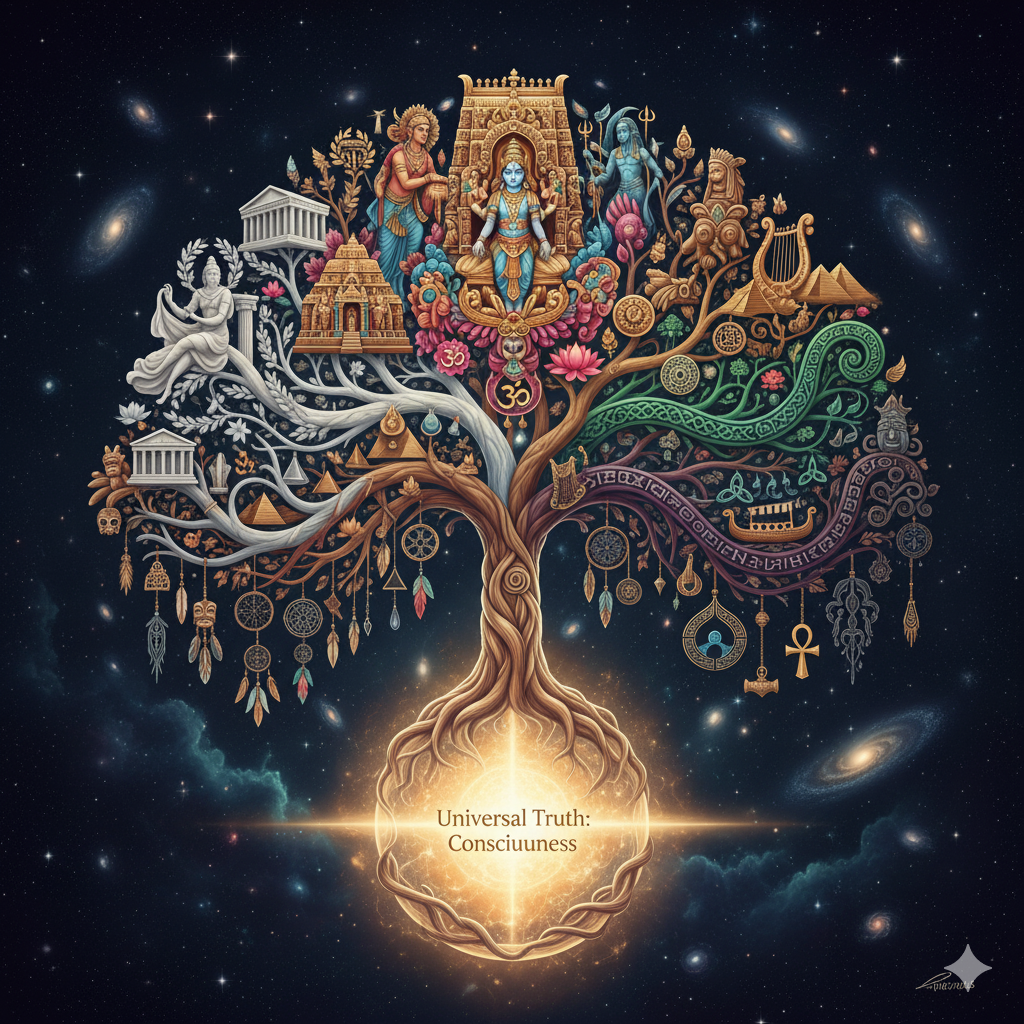
Published on consciouschoicemastery.com | Approx. 10-12 min read
This article is part of a comprehensive analysis of recurring patterns across global mythological traditions:
- The Architecture of Conscious Choice in World Mythology – Destructive decision-making patterns
- The Light Side of Divine Will – Constructive conscious choice examples
- Universal Patterns: Conscious Choice Across Global Mythologies – Worldwide validation
- The Eternal Helper – Divine assistance patterns across cultures
- The Sacred Prism – Unity within mythological diversity
- The Ten-Stage Mirror – Hero development as human psychological map
- The Universal Dream Technology – Dreams as divine communication across cultures
- The Inevitable Cycle – Prosperity, decline, and renewal patterns
- The Source Code – How Mythology Preserves Humanity’s Operating Instructions
The Hidden Unity in Sacred Diversity
After examining destructive and positive forms of conscious choice across global mythologies, and discovering the universal pattern of eternal helpers, a startling revelation emerges: every human culture is telling the exact same fundamental story. Not similar stories—the same story, expressed through magnificently different cultural prisms.
This isn’t cultural borrowing or ancient contact between civilizations. From isolated Pacific islands to Arctic tundra, from Amazon rainforests to Himalayan peaks, human consciousness has independently arrived at identical insights about reality’s nature. But rather than creating uniform mythologies, this universal recognition has flowered into spectacular diversity of expression.
The differences between mythological traditions aren’t signs of separation or confusion—they’re consciousness celebrating its own infinite creativity. Each culture serves as a unique lens through which the same eternal truth can be explored, understood, and experienced. Greek heroic drama, Hindu philosophical depth, Native American ecological wisdom, Norse cosmic struggle, Egyptian mystical transformation—all are facets of a single diamond, each revealing aspects invisible from other angles.
This sacred diversity serves a profound purpose: consciousness requires every possible perspective to fully understand its own nature. No single cultural expression, however beautiful or complete, can capture the totality of conscious experience. Only through the entire spectrum of human mythological creativity can consciousness see itself completely.
What emerges is a new understanding of both mythology and human unity: we are not separate cultures with different beliefs, but one consciousness exploring itself through every conceivable cultural form. Our differences aren’t divisions to overcome—they’re the very mechanism through which universal truth reveals its infinite depth and beauty.
The Universal Meta-Myth: The Core Story Every Culture Tells
Stage One: Unity Becomes Multiplicity – The Sacred Emergence
Every mythological tradition begins with the same fundamental premise: an original unity gives rise to apparent multiplicity. This isn’t random creation—it’s consciousness deliberately manifesting diversity to know itself more completely.
Vedic Tradition: Consciousness Choosing Multiplicity The Chandogya Upanishad records the primordial decision:
“In the beginning was only Being, one without a second. It thought to itself: ‘Let me become many, let me procreate.’ It sent forth fire.”¹
Greek Tradition: Chaos Organizing into Cosmos Hesiod’s Theogony describes the same process through different imagery:
“First Chaos came to be, and then broad-bosomed Earth, the ever-sure foundation of all… From Chaos came forth Erebus and black Night; and from Night came Aether and Day.”²
Norse Tradition: Void Becoming Worlds The Völuspá presents the Nordic version:
“In early days when Ymir lived, was neither sand nor sea, nor gelid waves; earth existed not, nor heaven above, ’twas a chaotic chasm, and grass was nowhere.”³
Native American Tradition: Great Spirit Dreaming Diversity Lakota tradition describes the same emergence:
“Before there was anything, there was the Great Spirit alone in the void. The Great Spirit dreamed, and in dreaming brought forth all the beings and all the worlds that would dance together in the sacred hoop of existence.”⁴
Egyptian Tradition: Atum Creating from Itself The Pyramid Texts record the self-creation:
“I am Atum when I was alone in Nun; I am Ra when he began to rule that which he had made.”⁵
Each tradition describes the same phenomenon: unified consciousness deliberately choosing to experience itself as multiplicity while remaining fundamentally one.
Stage Two: The Sacred Forgetting – Consciousness Veiling Its Own Nature
Universal mythologies describe consciousness “forgetting” its true nature—not through accident or punishment, but as a necessary stage enabling genuine exploration and discovery.
Hindu Tradition: Maya as Creative Self-Concealment The Shvetashvatara Upanishad explains the divine self-veiling:
“The one who is the source of all, in whom the universe comes to rest, who is the light beyond darkness—by knowing God one is released from all fetters.”⁶
The forgetting enables the joy of remembering; consciousness veils itself to experience the wonder of self-discovery.
Biblical Tradition: The Exile from Eden Genesis describes humanity’s departure from direct divine presence:
“So he drove out the man; and he placed at the east of the garden of Eden Cherubims, and a flaming sword which turned every way, to keep the way of the tree of life.”⁷
This isn’t punishment but necessary separation enabling independent growth and eventual conscious return.
Greek Tradition: The Golden Age Ending Hesiod describes humanity’s movement away from immediate divine presence:
“First the immortals who have their homes on Olympus made a golden race of mortal men… But after earth had covered this generation, they are called pure spirits dwelling on the earth.”⁸
Aboriginal Australian Tradition: The Dreamtime Withdrawal Aboriginal creation stories describe the ancestor spirits withdrawing into the landscape:
“When the ancestor spirits finished creating the land and all its creatures, they transformed into sacred sites, remaining present but requiring ceremony and proper relationship to access their wisdom.”⁹
Norse Tradition: Ragnarök as Necessary Ending The prophesied twilight of the gods serves the same function:
“The sun turns black, earth sinks into the sea, the hot stars fall from the bright heaven’s height.”¹⁰
Yet this ending enables new beginning—consciousness cycling through forgetting and remembering.
Stage Three: The Journey Through Challenges – Consciousness Testing Itself
Every tradition describes consciousness encountering obstacles, conflicts, and tests that develop its capacities and understanding.
Greek Tradition: The Hero’s Journey The pattern appears in countless Greek myths. Odysseus’s journey exemplifies the universal structure:
“Sing to me of the man, Muse, the man of twists and turns driven time and again off course, once he had plundered the hallowed heights of Troy.”¹¹
Each challenge develops specific aspects of consciousness—courage, wisdom, perseverance, compassion.
Celtic Tradition: Otherworld Trials Irish mythology presents the same pattern through different imagery. The Táin Bó Cúailnge shows Cú Chulainn facing supernatural challenges:
“Then Cú Chulainn performed the thunder-feat and the blade-feat and the apple-feat… and many other feats besides which he had learned but which no other person could perform.”¹²
Buddhist Tradition: The Path Through Suffering The Buddha’s journey demonstrates the same universal pattern:
“I have run through a course of many births looking for the maker of this tabernacle and finding him not. Painful is birth again and again.”¹³
Mesopotamian Tradition: Gilgamesh’s Quest The world’s oldest recorded epic follows the identical structure:
“Gilgamesh, supreme over other kings, lordly in appearance, he is the hero, born of Uruk, the goring wild bull.”¹⁴
Maya Tradition: The Hero Twins’ Trials The Popol Vuh presents the same journey through Mesoamerican symbolism:
“This is the beginning of the defeat and destruction of the pride of Xibalba, and it was brought about by two boys; but their names shall not be given yet.”¹⁵
Every culture recognizes that consciousness develops through encountering and overcoming progressively greater challenges.
Stage Four: The Eternal Helpers – Expanded Consciousness Assisting Limited Consciousness
As we’ve extensively documented, every tradition features helpers from expanded realms assisting those facing challenges beyond their current capacity.
Yoruba Tradition: Orunmila’s Guidance The Odu Ifa describes divine assistance through divination:
“Ifa says this person shall not die the death of a fool. The path of wisdom shall be opened to him through proper sacrifice and attention to the guidance of Orunmila.”¹⁶
Taoist Tradition: Immortal Teachers Chinese mythology describes enlightened beings providing assistance:
“The Eight Immortals cross the sea, each displaying their own magical powers. They appear to worthy students to share the secrets of immortality and wisdom.”¹⁷
Andean Tradition: Apu Mountain Spirits Q’ero teachings describe mountain spirits providing guidance:
“The Apus are the great spirits of the sacred mountains who watch over all communities in their care. They provide protection and guidance to those who maintain proper ayni (reciprocity) with the natural world.”¹⁸
The helper pattern is universal because consciousness naturally supports consciousness across all apparent boundaries.
Stage Five: Conscious Choice Shaping Reality – Agency as Creative Force
Every tradition recognizes that consciousness creates reality through intentional decision-making rather than being victim to unconscious forces.
Jain Tradition: Karma as Conscious Creation The Tattvartha Sutra explains individual responsibility for experience:
“The soul is the agent of its own acts and experiences the consequences of its actions. Through right knowledge, right faith, and right conduct, the soul can achieve liberation.”¹⁹
African Tradition: Ancestral Wisdom and Choice Yoruba tradition emphasizes conscious decision-making:
“Before coming to earth, each soul chooses its destiny (ori) in consultation with Olodumare. Life is the process of fulfilling that chosen destiny through conscious choices aligned with divine will.”²⁰
Nordic Tradition: Wyrd as Chosen Fate Despite seeming fatalism, Norse tradition emphasizes conscious choice:
“Cattle die, kinsmen die, you yourself will also die, but reputation never dies of one who has earned a good name.”²¹
Reputation—the consequence of chosen actions—survives physical death.
Aztec Tradition: Teotl as Creative Energy Nahuatl philosophy describes divine energy expressing through conscious choice:
“Teotl is the sacred energy that flows through all things. Humans participate in teotl through conscious ritual action, artistic creation, and ethical choice.”²²
Stage Six: The Gradual Remembering – Recognition of True Nature
Every tradition describes consciousness gradually recognizing its own fundamental nature through experience, teaching, and insight.
Sufi Tradition: The Return to Divine Love Rumi expresses the universal recognition:
“I was raw, I became cooked, I became burnt. I was a mine of silver, I became a mine of gold.”²³
Hindu Tradition: Atman Recognizing Brahman The Mandukya Upanishad describes the recognition:
“This Atman is Brahman—this Self is the Supreme Reality. This is the instruction.”²⁴
Christian Mystical Tradition: Union with Divine Love Meister Eckhart describes the same recognition:
“The eye through which I see God is the same eye through which God sees me; my eye and God’s eye are one eye, one seeing, one knowing, one love.”²⁵
Zen Tradition: Satori as Natural Awakening Dogen describes enlightenment as remembering what was always true:
“To study the Buddha Way is to study the self. To study the self is to forget the self. To forget the self is to be actualized by myriad things.”²⁶
Stage Seven: Integration of Unity and Diversity – The Sacred Return
The final stage shows consciousness integrating its recognition of fundamental unity with celebration of apparent diversity.
Kabbalistic Tradition: Tikkun Olam The healing of the world through conscious action:
“God broke the vessels containing the divine light, scattering sparks throughout creation. Human task is to gather these sparks through conscious spiritual action, repairing the world.”²⁷
Buddhist Tradition: The Bodhisattva Ideal Rather than remaining in individual liberation, consciousness chooses to help all beings:
“Though I have attained enlightenment, I vow to remain in the cycle of rebirth until all sentient beings achieve liberation.”²⁸
Native American Tradition: The Sacred Hoop Lakota tradition describes the completed circle:
“All things are our relatives in the sacred hoop of existence. The warrior’s path leads through conflict to the recognition that all beings are one family, and the greatest strength comes from protecting and nurturing this understanding.”²⁹
Cultural Variations: The Same Symphony in Different Keys
The Warrior’s Path: Greek and Norse Expressions
Both Greek and Norse traditions express the universal story through martial imagery, but with distinct emphases revealing different aspects of consciousness development.
Greek Emphasis: Individual Excellence Through Divine Challenge Greek mythology focuses on personal arete (excellence) achieved through overcoming divine tests. Achilles in the Iliad embodies this pattern:
“Sing, goddess, the anger of Peleus’ son Achilles and its devastation… that sent many valiant souls of heroes to Hades.”³⁰
The warrior’s path develops individual consciousness through external conflict that reveals internal strength.
Norse Emphasis: Cosmic Wisdom Through Sacrificial Struggle Norse tradition emphasizes wisdom gained through sacrificial endurance. Odin’s self-sacrifice demonstrates this approach:
“I know that I hung on a windy tree nine long nights, wounded with a spear, dedicated to Odin, myself to myself.”³¹
Same warrior archetype, different aspect: Greek celebrates individual heroic achievement, Norse emphasizes cosmic wisdom earned through sacrifice.
The Underlying Unity Both traditions recognize that consciousness develops strength, courage, and wisdom through facing challenges that test its limits. The warrior path teaches that consciousness must be willing to risk everything to discover its true capacity.
The Mystical Path: Hindu and Egyptian Expressions
Hindu and Egyptian traditions both emphasize consciousness recognizing its eternal, divine nature, but through different symbolic systems.
Hindu Emphasis: Philosophical Recognition of Absolute Unity Hindu tradition approaches divine recognition through philosophical inquiry and meditative realization. The Katha Upanishad expresses this approach:
“When all the desires that dwell in the heart are cast off, then the mortal becomes immortal and attains Brahman even in this life.”³²
Egyptian Emphasis: Transformational Journey Through Death and Rebirth Egyptian tradition expresses the same recognition through death/rebirth symbolism. The Egyptian Book of the Dead presents this path:
“I am Yesterday, Today, and Tomorrow, and I have the power to be born a second time. I am the divine hidden soul who created the gods.”³³
The Underlying Unity Both traditions teach that consciousness is fundamentally divine and eternal, temporarily appearing to be limited and mortal. Hindu tradition emphasizes direct philosophical recognition; Egyptian tradition emphasizes transformational experience. Same truth, different approaches.
The Shamanic Path: Native American and Siberian Expressions
Native American and Siberian shamanic traditions both emphasize consciousness’s relationship with natural and spirit worlds, but through different ecological contexts.
Native American Emphasis: Sacred Relationship with All Life Native American traditions emphasize consciousness recognizing its kinship with all beings. Black Elk describes this vision:
“Peace comes within the souls of men when they realize their relationship, their oneness, with the universe and all its powers.”³⁴
Siberian Emphasis: Spirit Journey and Soul Retrieval Siberian shamanic tradition emphasizes consciousness traveling between worlds to heal fragmentation. Mircea Eliade records this pattern:
“The shaman specializes in a trance during which his soul is believed to leave his body and ascend to the sky or descend to the underworld.”³⁵
The Underlying Unity Both traditions recognize consciousness as multidimensional, capable of communicating across apparent boundaries between human, animal, plant, and spirit realms. Native American tradition emphasizes ongoing relationship; Siberian tradition emphasizes active journey and healing.
The Wisdom Path: Chinese and Celtic Expressions
Chinese Taoist and Celtic traditions both emphasize consciousness harmonizing with natural order, but through different approaches to wisdom and balance.
Chinese Emphasis: Wu Wei and Natural Harmony Taoist tradition emphasizes consciousness aligning with natural flow. The Tao Te Ching expresses this approach:
“The highest good is like water, which nourishes all things and does not compete.”³⁶
Celtic Emphasis: Otherworld Connection and Artistic Inspiration Celtic tradition emphasizes consciousness connecting with otherworld sources of wisdom and creativity. The Mabinogion presents this pattern:
“In the otherworld, time flows differently, wisdom is found in unexpected forms, and those who maintain proper relationship with the land and its spirits receive guidance and inspiration.”³⁷
The Underlying Unity Both traditions teach consciousness to flow harmoniously with larger patterns rather than forcing individual will against natural order. Chinese tradition emphasizes philosophical balance; Celtic tradition emphasizes artistic and magical inspiration.
The Love Path: Sufi and Bhakti Expressions
Sufi Islamic and Hindu Bhakti traditions both emphasize consciousness recognizing divine love as reality’s fundamental nature.
Sufi Emphasis: Intoxication with Divine Beauty Sufi tradition expresses divine love through poetry of spiritual intoxication. Hafez demonstrates this approach:
“I am in love with every church and mosque and temple and any kind of shrine because I know it is there that people say the different names of the One God.”³⁸
Bhakti Emphasis: Devotional Surrender to Divine Personality Hindu Bhakti tradition expresses divine love through devotional relationship with divine forms. The Bhagavata Purana presents Krishna devotion:
“When the gopis heard the sound of Krishna’s flute, they abandoned all worldly concerns and ran toward the source of that divine music, recognizing it as the call of their true beloved.”³⁹
The Underlying Unity Both traditions recognize that consciousness is fundamentally love recognizing itself through relationship with the divine. Sufi tradition emphasizes mystical poetry and dance; Bhakti tradition emphasizes devotional song and surrender.
The Sacred Purpose of Differences: Why Diversity Serves Unity
Consciousness Requires Multiple Perspectives for Complete Self-Understanding
The spectacular diversity of mythological expression isn’t accidental or divisive—it’s consciousness deliberately exploring every possible way to understand its own nature. Each cultural tradition reveals aspects of universal truth that remain invisible from other perspectives.
The Warrior Perspective Reveals Consciousness as Courage Greek and Norse warrior traditions demonstrate that consciousness possesses unlimited courage when faced with challenges. This aspect might remain undiscovered through purely mystical or philosophical approaches.
The Mystical Perspective Reveals Consciousness as Love Hindu, Sufi, and Christian mystical traditions demonstrate that consciousness is fundamentally love recognizing itself. This recognition might not emerge through purely warrior or shamanic paths.
The Shamanic Perspective Reveals Consciousness as Relationship Native American and Siberian shamanic traditions demonstrate that consciousness exists in relationship with all forms of awareness. This understanding might remain hidden through purely individual spiritual paths.
The Wisdom Perspective Reveals Consciousness as Balance Chinese Taoist and Celtic traditions demonstrate that consciousness achieves fulfillment through harmony with natural patterns. This insight might not develop through purely transcendent approaches.
Cultural Differences Enable Comprehensive Spiritual Development
Different mythological traditions don’t just reveal different aspects of truth—they develop different capacities within consciousness itself.
Warrior Traditions Develop Courage and Strength Engagement with Greek heroic ideals or Norse cosmic struggle develops consciousness’s capacity for courage, endurance, and strength in facing challenges.
Mystical Traditions Develop Love and Surrender Engagement with Sufi poetry or Hindu devotional practices develops consciousness’s capacity for love, surrender, and recognition of fundamental unity.
Shamanic Traditions Develop Relationship and Healing Engagement with Native American vision quests or Siberian soul journey practices develops consciousness’s capacity for relationship, healing, and multidimensional awareness.
Wisdom Traditions Develop Balance and Harmony Engagement with Taoist philosophy or Celtic connection practices develops consciousness’s capacity for balance, harmony, and natural flow.
The Prism Effect: White Light Revealing Its Full Spectrum
The metaphor of light passing through a prism perfectly describes how mythological diversity serves unity. White light appears uniform until it passes through a prism, revealing that it actually contains the full spectrum of colors.
Similarly, consciousness appears uniform until it expresses itself through different cultural prisms, revealing that it actually contains infinite aspects, qualities, and potentials. Each mythological tradition serves as a cultural prism, breaking consciousness’s unified nature into visible, experienceable components.
Red Light: The Warrior Aspect – Courage, strength, heroic action Orange Light: The Creative Aspect – Artistic expression, cultural creation, innovation
Yellow Light: The Wisdom Aspect – Knowledge, understanding, intellectual clarity Green Light: The Healing Aspect – Compassion, nurturing, restoration Blue Light: The Communication Aspect – Truth-telling, teaching, inspiration Indigo Light: The Mystical Aspect – Direct spiritual experience, transcendence Violet Light: The Transformational Aspect – Death/rebirth, initiation, becoming
No single culture can express the full spectrum. Greek tradition might excel at revealing the warrior aspect, Hindu tradition at the mystical aspect, Native American tradition at the healing aspect, Celtic tradition at the creative aspect. Together, they reveal consciousness’s complete nature.
Practical Implications: Celebrating Rather Than Erasing Differences
Understanding mythological diversity as consciousness exploring itself transforms how we approach cultural differences in modern life.
Religious Tolerance Through Recognition of Underlying Unity When we recognize that all religious traditions are consciousness exploring different aspects of its own nature, religious differences become opportunities for mutual learning rather than sources of conflict.
Cultural Appreciation Rather Than Cultural Appropriation Understanding that each culture offers unique insights into universal truth encourages respectful learning from other traditions while honoring their distinct contributions and contexts.
Personal Development Through Multiple Perspectives Individuals can consciously engage with mythological wisdom from multiple cultures to develop different aspects of their own consciousness—warrior courage from Norse tradition, mystical love from Sufi tradition, ecological wisdom from Native American tradition.
Educational Integration of Global Wisdom Educational systems can present world mythologies not as separate, competing belief systems but as complementary expressions of humanity’s shared recognition of consciousness as reality’s fundamental nature.
Modern Applications: Unity Through Diversity in Contemporary Life
Personal Development: Integrating Multiple Mythological Paths
Contemporary individuals can consciously work with mythological wisdom from multiple traditions to develop comprehensive spiritual and psychological maturity.
Daily Practice Integration
- Morning: Greek heroic intention-setting for courage in facing daily challenges
- Midday: Native American gratitude practices for relationship with all life
- Evening: Hindu philosophical reflection on the day’s experiences as consciousness exploring itself
- Night: Egyptian death/rebirth meditation preparing for sleep as daily transformation
Life Stage Applications
- Youth: Engage warrior traditions (Greek, Norse, Celtic) to develop courage and strength
- Adulthood: Explore wisdom traditions (Chinese, Egyptian, Hindu) to develop understanding and balance
- Maturity: Embrace mystical traditions (Sufi, Christian, Buddhist) to deepen love and surrender
- Elder Years: Share shamanic traditions (Native American, Siberian, Aboriginal) to serve as wisdom keeper and healer
Challenge-Specific Approaches
- Career Obstacles: Apply Greek heroic mythology for courage in professional battles
- Relationship Difficulties: Use Hindu Bhakti devotion practices to recognize divine love in all beings
- Health Challenges: Engage Native American healing traditions for holistic restoration
- Creative Blocks: Connect with Celtic otherworld inspiration practices
- Spiritual Seeking: Explore Sufi mystical poetry and practices for direct divine connection
Community Building: Creating Unity Through Celebrated Diversity
Communities can use mythological wisdom to create unity that celebrates rather than erases differences.
Interfaith Dialogue Through Shared Patterns Rather than focusing on theological differences, interfaith groups can explore how different traditions express identical insights about consciousness, choice, and divine assistance. This creates common ground while honoring distinct expressions.
Cultural Festivals as Consciousness Celebration Community festivals can present different cultural traditions as various expressions of shared human wisdom about consciousness and reality, encouraging appreciation for diversity as spiritual wealth rather than cultural division.
Educational Programs for Mythological Literacy Schools and community centers can offer programs helping people recognize universal patterns in world mythologies, developing both cultural appreciation and spiritual understanding.
Conflict Resolution Through Pattern Recognition When cultural or religious conflicts arise, mediation can help groups recognize that they’re arguing about different expressions of shared insights rather than fundamentally opposed worldviews.
Organizational Leadership: Managing Diversity as Creative Resource
Organizations can apply mythological wisdom to transform diversity from management challenge to creative advantage.
Team Building Through Complementary Strengths Understanding that different cultural backgrounds offer different aspects of consciousness development, teams can be composed to include warrior courage (competitive cultures), mystical wisdom (contemplative cultures), shamanic healing (relationship-oriented cultures), and balanced harmony (process-oriented cultures).
Decision-Making Through Multiple Perspectives Important organizational decisions can benefit from consciously seeking input from different mythological perspectives: What would the Greek heroic approach suggest? The Chinese balanced approach? The Native American relationship approach? The Hindu philosophical approach?
Innovation Through Cultural Cross-Pollination Innovation often emerges from combining insights from different cultural approaches. Technology companies might benefit from combining Greek analytical precision with Native American ecological awareness and Hindu long-term thinking.
Conflict Resolution Through Underlying Unity Recognition Organizational conflicts often reflect different groups expressing different aspects of consciousness development. Rather than forcing uniformity, conflicts can be resolved by helping groups recognize their complementary rather than competitive nature.
Global Relations: International Cooperation Through Shared Recognition
International relations can be transformed by recognizing that all cultures are consciousness exploring itself through different expressions.
Diplomatic Relations Through Pattern Recognition International negotiations can benefit from recognizing that different cultures prioritize different aspects of consciousness development—individual freedom, collective harmony, environmental balance, spiritual growth—and that these differences are complementary rather than conflicting.
Cultural Exchange as Consciousness Expansion International exchange programs can be designed to help participants experience different aspects of consciousness development through engagement with different cultural approaches to universal wisdom.
Economic Cooperation Through Complementary Strengths International economic relationships can be structured to honor different cultures’ particular contributions to consciousness development—technological innovation, ecological wisdom, artistic creativity, spiritual insight, community building.
Environmental Cooperation Through Shared Stewardship Global environmental challenges can be addressed by drawing on different cultures’ approaches to consciousness-nature relationship—Native American ecological reciprocity, Chinese natural harmony, Hindu cosmic responsibility, Celtic land connection.
Scientific Perspectives: Research Supporting Mythological Unity
Anthropological Evidence for Universal Patterns
Contemporary anthropological research confirms the universality of mythological patterns across isolated cultures.
Joseph Campbell’s Monomyth Research Campbell’s analysis of global mythologies identified universal patterns in hero stories:
“A hero ventures forth from the world of common day into a region of supernatural wonder: fabulous forces are there encountered and a decisive victory is won: the hero comes back from this mysterious adventure with the power to bestow boons on his fellow man.”⁴⁰
Claude Lévi-Strauss’s Structural Analysis Lévi-Strauss demonstrated that mythological structures reflect universal patterns of human consciousness:
“The purpose of myth is to provide a logical model capable of overcoming a contradiction—which is impossible if, as it happens, the contradiction is real.”⁴¹
Wenzel Chrostowski’s Comparative Studies Recent comparative mythology research continues to confirm universal patterns across cultures with no historical contact.
Psychological Research on Universal Spiritual Experiences
Psychological research demonstrates that spiritual experiences described in mythologies reflect universal capacities of human consciousness.
Maslow’s Peak Experience Research Abraham Maslow’s studies of peak experiences found consistent patterns across cultures:
“The peak experience is felt as a self-validating, self-justifying moment which carries its own intrinsic value with it.”⁴²
These experiences match mystical recognitions described in mythological traditions worldwide.
Stanislav Grof’s Consciousness Research Grof’s research with non-ordinary states of consciousness revealed universal mythological themes:
“The experiences that emerge in holotropic states… show striking similarities to the descriptions found in various mystical traditions, shamanic practices, and ancient mystery religions.”⁴³
Rick Strassman’s DMT Research Strassman’s studies found that participants consistently encountered helper beings and otherworld realms matching mythological descriptions across cultures.
Neuroscience Research on Religious and Mystical Experience
Neuroscience research reveals that brains across all cultures show similar patterns during religious and mystical experiences.
Andrew Newberg’s Neurotheology Research Brain imaging studies during meditation and prayer show consistent patterns regardless of religious tradition:
“The brain appears to have been genetically and evolutionarily programmed to encourage religious beliefs and behaviors.”⁴⁴
Robin Carhart-Harris’s Psychedelic Research Studies of psychedelic experiences reveal universal patterns matching mythological themes:
“Under psychedelics, the brain’s ‘default mode network’ decreases in activity, correlating with experiences of ego dissolution and unity consciousness described in mystical traditions worldwide.”⁴⁵
Quantum Physics and Consciousness Research
Emerging quantum consciousness research offers frameworks for understanding how mythology might reflect actual features of reality.
Stuart Hameroff and Roger Penrose’s Orchestrated Objective Reduction Their theory suggests consciousness operates through quantum processes that might enable the non-local awareness described in shamanic and mystical traditions.
Dean Radin’s Entanglement Research Studies of psychic phenomena reveal correlations that support mythological descriptions of consciousness transcending ordinary space-time limitations.
Amit Goswami’s Quantum Consciousness Theory Goswami’s work suggests consciousness is fundamental rather than emergent, supporting mythological understanding of consciousness as reality’s primary creative force.
The Implications: Humanity’s Greatest Discovery Hidden in Plain Sight
Mythology as Humanity’s Unified Field Theory
The recognition that all mythologies express the same fundamental insights about consciousness and reality represents potentially the most significant discovery in human history—hidden in plain sight for millennia.
Unified Understanding of Human Spiritual Experience Rather than thousands of competing religious and spiritual systems, humanity possesses one unified understanding of consciousness expressed through infinite cultural variations. This represents unprecedented common ground for human cooperation and understanding.
Resolution of Science-Spirituality Conflict If mythological insights about consciousness prove accurate, they offer bridges between scientific materialism and spiritual understanding. Consciousness as fundamental reality, choice as creative force, and assistance networks as operational principles become subjects for scientific investigation rather than religious belief.
Practical Framework for Global Cooperation Understanding that cultural differences express complementary rather than competing insights provides practical frameworks for international cooperation, conflict resolution, and mutual learning.
Educational Revolution Recognizing mythological unity transforms education from cultural relativism (all beliefs are equally valid) to conscious appreciation (all cultures offer unique insights into shared truth). This enables both universal understanding and cultural appreciation.
The Meta-Recognition: Consciousness Recognizing Itself Through Humanity
The ultimate implication transcends even mythological understanding: humanity’s recognition of mythological unity is consciousness finally recognizing itself through its own diverse expressions.
Collective Awakening Through Individual Recognition As more individuals recognize mythological unity, collective human consciousness approaches recognition of its own fundamental nature. This represents potential species-wide awakening to consciousness as reality’s fundamental principle.
Cultural Healing Through Pattern Recognition Historical conflicts between cultures often reflect consciousness fighting with itself through temporary identification with particular expressions. Recognizing underlying unity enables healing of cultural wounds while maintaining beneficial diversity.
Evolutionary Leap Through Conscious Integration Humanity may be approaching an evolutionary transition from unconscious cultural identification to conscious appreciation of cultural diversity as spiritual wealth. This represents potential transition from tribal consciousness to global consciousness while maintaining beneficial local variations.
Practical Mysticism for Everyday Life Mythological wisdom becomes practical guidance for navigating modern challenges—personal development, relationship difficulties, career decisions, community building, global cooperation—through recognition of consciousness as life’s operating system.
Conclusion: The Sacred Prism in Daily Life
The recognition that all mythologies tell the same story through magnificently different cultural expressions transforms everything. We are not separate peoples with competing beliefs about reality—we are one consciousness celebrating its own infinite creativity through every possible cultural form.
Our differences aren’t divisions to overcome but aspects of consciousness to appreciate and integrate. Greek heroic courage, Hindu mystical wisdom, Native American ecological relationship, Celtic artistic inspiration, Chinese philosophical balance, Sufi divine love, Norse cosmic endurance, Egyptian transformational mystery—all are facets of the single diamond of consciousness discovering itself through human experience.
This understanding offers practical solutions to humanity’s most persistent challenges. Religious conflicts dissolve when different traditions recognize they’re exploring different aspects of shared truth. Cultural misunderstandings transform into opportunities for mutual learning and consciousness expansion. Personal spiritual seeking becomes integration of wisdom from multiple traditions rather than exclusive identification with single paths.
Most profoundly, we discover that the ancient wisdom we’ve been seeking in mythologies is actually our own deepest nature recognizing itself through cultural creativity. The gods, heroes, and wise beings in every tradition aren’t external entities but aspects of consciousness we carry within ourselves, accessible through engagement with the mythological imagination of humanity.
When we learn to see through the sacred prism, cultural diversity becomes spiritual wealth, differences become opportunities for consciousness expansion, and humanity’s magnificent mythological heritage reveals itself as the greatest treasure in human history: the unified recognition that consciousness creates reality through choice, receives assistance from expanded awareness, and celebrates its own infinite nature through every possible form of cultural expression.
The sacred prism continues functioning in modern life. Every time we appreciate rather than judge cultural differences, every time we learn from rather than dismiss unfamiliar traditions, every time we recognize shared humanity beneath surface variations, we participate in consciousness’s ongoing celebration of its own creative diversity.
We are the living mythology, consciousness exploring itself through infinite human expressions. Our task isn’t to choose between cultural traditions but to recognize the single light creating the entire spectrum of human wisdom. In doing so, we become conscious participants in the same eternal story every culture has always been telling: consciousness discovering, celebrating, and expressing its own infinite nature through the beautiful diversity of human experience.
The differences that seem to divide us are actually the very mechanism through which consciousness knows itself completely. We are not separate stories—we are one story told through infinite voices, one light expressed through every possible color, one consciousness celebrating its own boundless creativity through the magnificent diversity we call humanity.
Sources:
- Chandogya Upanishad, trans. Patrick Olivelle, in The Early Upanishads (Oxford: Oxford University Press, 1998), VI.2.1-3.
- Hesiod, Theogony, trans. Hugh G. Evelyn-White (Cambridge: Harvard University Press, 1914), lines 116-123.
- Völuspá, trans. Carolyne Larrington, in The Poetic Edda (Oxford: Oxford University Press, 1996), stanza 3.
- Black Elk, as recorded in John G. Neihardt, Black Elk Speaks (Lincoln: University of Nebraska Press, 1961), 2-3.
- Pyramid Texts, trans. Samuel A. B. Mercer (New York: Longmans, Green and Co., 1952), Utterance 587.
- Shvetashvatara Upanishad, trans. Patrick Olivelle, in The Early Upanishads (Oxford: Oxford University Press, 1998), VI.14.
- Genesis 3:24, King James Version.
- Hesiod, Works and Days, trans. Hugh G. Evelyn-White (Cambridge: Harvard University Press, 1914), lines 109-126.
- Catherine H. Berndt and Ronald M. Berndt, The Speaking Land: Myth and Story in Aboriginal Australia (Rochester: Inner Traditions, 1994), 34-39.
- Völuspá, trans. Carolyne Larrington, in The Poetic Edda (Oxford: Oxford University Press, 1996), stanza 57.
- Homer, The Odyssey, trans. Robert Fagles (New York: Penguin Classics, 1996), Book 1, lines 1-5.
- Táin Bó Cúailnge, trans. Thomas Kinsella (Oxford: Oxford University Press, 1969), 152-154.
- Dhammapada, trans. F. Max Müller, in Sacred Books of the East, Volume 10 (Oxford: Oxford University Press, 1881), verse 153.
- The Epic of Gilgamesh, trans. Andrew George (London: Penguin Classics, 1999), Tablet I, lines 27-28.
- Popol Vuh, trans. Dennis Tedlock (New York: Simon & Schuster, 1985), 124.
- Wande Abimbola, Ifa: An Exposition of Ifa Literary Corpus (Ibadan: Oxford University Press Nigeria, 1976), 67-72.
- Eva Wong, Tales of the Taoist Immortals (Boston: Shambhala Publications, 2001), 23-27.
- Joan Parisi Wilcox, Keepers of the Ancient Knowledge: The Mystical World of the Q’ero Indians of Peru (Boston: Element Books, 1999), 134-138.
- Umasvami, Tattvartha Sutra, trans. Nathmal Tatia (London: Routledge, 1994), Chapter 6, verses 1-3.
- Bolaji Idowu, Olodumare: God in Yoruba Belief (Brooklyn: A&B Publishers, 1994), 173-178.
- Hávamál, trans. Carolyne Larrington, in The Poetic Edda (Oxford: Oxford University Press, 1996), stanza 77.
- James Maffie, Aztec Philosophy: Understanding a World in Motion (Boulder: University Press of Colorado, 2014), 89-94.
- Hafez, The Gift, trans. Daniel Ladinsky (New York: Penguin Compass, 1999), 184.
- Mandukya Upanishad, trans. Patrick Olivelle, in The Early Upanishads (Oxford: Oxford University Press, 1998), verse 2.
- Meister Eckhart, Meister Eckhart: A Modern Translation, trans. Raymond Bernard Blakney (New York: Harper & Row, 1941), 206.
- Dogen, Shobogenzo, trans. Gudo Nishijima and Chodo Cross (Berkeley: Numata Center for Buddhist Translation and Research, 1996), “Genjokoan,” 69.
- Gershom Scholem, Major Trends in Jewish Mysticism (New York: Schocken Books, 1946), 244-286.
- The Bodhisattva Vow, traditional formulation from Avatamsaka Sutra.
- Black Elk, as recorded in John G. Neihardt, Black Elk Speaks (Lincoln: University of Nebraska Press, 1961), 194-196.
- Homer, The Iliad, trans. Robert Fagles (New York: Penguin Classics, 1990), Book 1, lines 1-7.
- Hávamál, trans. Carolyne Larrington, in The Poetic Edda (Oxford: Oxford University Press, 1996), stanza 138.
- Katha Upanishad, trans. Patrick Olivelle, in The Early Upanishads (Oxford: Oxford University Press, 1998), II.3.14.
- The Egyptian Book of the Dead, trans. E. A. Wallis Budge (London: British Museum, 1895), Chapter 17.
- Black Elk, as recorded in John G. Neihardt, Black Elk Speaks (Lincoln: University of Nebraska Press, 1961), 164.
- Mircea Eliade, Shamanism: Archaic Techniques of Ecstasy (Princeton: Princeton University Press, 1964), 5.
- Lao Tzu, Tao Te Ching, trans. Stephen Mitchell (New York: Harper & Row, 1988), Chapter 8.
- The Mabinogion, trans. Charlotte Guest (London: Bernard Quaritch, 1877), “Pwyll Prince of Dyved.”
- Hafez, The Gift, trans. Daniel Ladinsky (New York: Penguin Compass, 1999), 67.
- Srimad Bhagavatam, trans. A. C. Bhaktivedanta Swami Prabhupada (Los Angeles: Bhaktivedanta Book Trust, 1972), Canto 10, Chapter 21.
- Joseph Campbell, The Hero with a Thousand Faces (Princeton: Princeton University Press, 1949), 30.
- Claude Lévi-Strauss, Structural Anthropology (New York: Basic Books, 1963), 229.
- Abraham Maslow, Religions, Values, and Peak Experiences (Columbus: Ohio State University Press, 1964), 59.
- Stanislav Grof, The Cosmic Game: Explorations of the Frontiers of Human Consciousness (Albany: SUNY Press, 1998), 89.
- Andrew Newberg, Why God Won’t Go Away: Brain Science and the Biology of Belief (New York: Ballantine Books, 2001), 37.
- Robin Carhart-Harris et al., “Neural correlates of the psychedelic state as determined by fMRI studies with psilocybin,” Proceedings of the National Academy of Sciences 109, no. 6 (2012): 2138-2143.
@ 2025 Lee Greene