The strategic methodology that enables innovative approaches to overcome established but inefficient systems through superior resource management and systematic advantage
Published on consciouschoicemastery.com | Approx. 10-12 min read
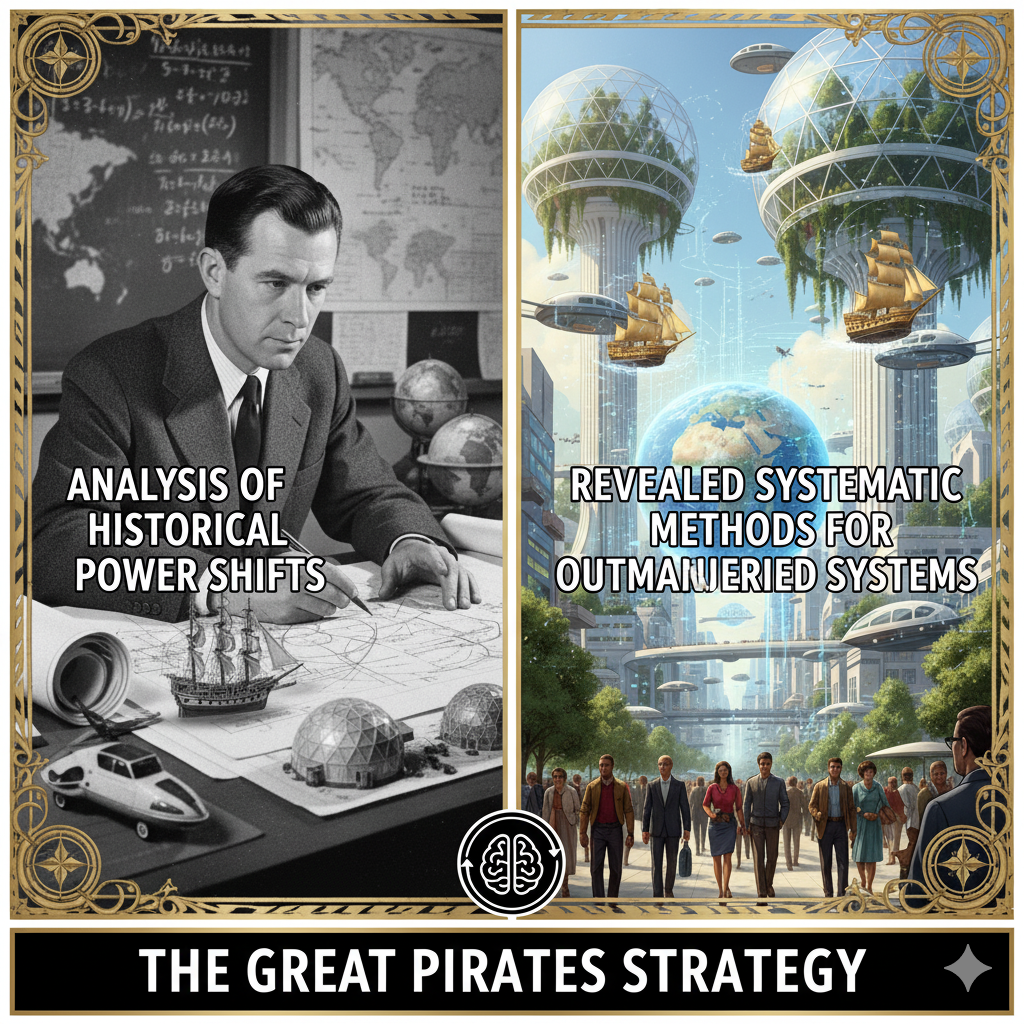
In the late 1960s, Buckminster Fuller was invited to address a gathering of revolutionary students who were frustrated with their inability to change entrenched political and economic systems. Instead of encouraging direct confrontation with established power structures, Fuller surprised his audience with a historical analysis that revealed systematic methods for creating beneficial change.
“The Great Pirates of history,” Fuller explained, “didn’t overthrow kings and emperors through violence. They outmaneuvered them through superior mobility, better information, and more efficient resource utilization. They became more powerful than existing systems not by fighting them directly, but by operating at levels of effectiveness that made old approaches obsolete.”
Fuller’s “Great Pirates” analysis became his systematic methodology for understanding how innovative approaches could overcome entrenched but inefficient systems. His historical research revealed patterns showing how agile, well-organized groups consistently outmaneuvered larger, more established powers through strategic advantages rather than brute force.
This methodology provided frameworks for anyone seeking to create beneficial change in systems resistant to direct reform. Fuller’s Great Pirates Strategy demonstrates how strategic thinking, superior efficiency, and systematic innovation can overcome established limitations without requiring massive resources or formal authority.
The Historical Pattern Analysis: How Agile Innovation Overcomes Established Power
Fuller’s Great Pirates analysis began with systematic historical research examining how power structures actually changed throughout human history. His investigation revealed that sustainable power shifts typically resulted from strategic advantages rather than direct confrontation between competing forces.
Traditional historical narratives focused on wars, revolutions, and dramatic conflicts. Fuller’s systematic analysis revealed subtler but more fundamental patterns where innovative approaches gradually made existing systems irrelevant through superior performance rather than direct displacement.
The historical pattern analysis revealed:
Maritime Innovation and Global Power Shifts
- Navigational advancement: Groups with superior sailing and navigation technology could access resources and opportunities unavailable to land-based powers
- Information advantages: Maritime networks enabled faster communication and better strategic intelligence than existing land-based systems
- Resource mobility: Ship-based operations could move wealth and capabilities beyond the reach of traditional territorial control systems
- Systematic coordination: Maritime powers developed organizational methods that enabled complex coordination across vast distances
Technological Leverage and Economic Transformation
- Tool and weapon innovation: Groups with superior technology could accomplish goals that were impossible for others regardless of numbers or existing resources
- Production efficiency: New manufacturing methods enabled higher quality and lower costs than established approaches
- Communication systems: Better information networks enabled coordination advantages that multiplied other strategic benefits
- Transportation innovations: Superior mobility enabled access to resources and opportunities beyond the reach of static systems
Organizational Advantage and Systems Innovation
- Coordination methods: More effective organizational approaches enabled better resource utilization and strategic implementation
- Decision-making speed: Agile systems could respond to opportunities and challenges faster than bureaucratic established powers
- Adaptation capability: Innovative organizations could adjust to changing conditions while rigid systems remained committed to obsolete approaches
- Knowledge integration: Groups that combined insights from multiple domains achieved advantages that specialized systems couldn’t match
Strategic Positioning and Network Effects
- Resource access: Strategic positioning enabled access to resources that established powers couldn’t control or replicate
- Alliance building: Innovative groups created networks that multiplied their capabilities beyond what individual components could achieve
- Market development: Creating new value systems that served people’s needs better than existing approaches
- Infrastructure creation: Building systems that enabled widespread adoption of innovative approaches
Fuller’s analysis revealed that the most successful “pirates” weren’t violent raiders but systematic innovators who created strategic advantages through superior organization, technology, and resource utilization. Their power came from making existing systems irrelevant rather than destroying them directly.
The pattern recognition principle: Sustainable power shifts result from systematic advantages that make existing approaches obsolete rather than direct confrontation between competing forces.
Modern application: What established systems in your domain might be vulnerable to innovation that provides superior value rather than direct competition? How could strategic advantages make conventional approaches irrelevant?
The Resource Mobility Strategy: Strategic Independence Through Superior Logistics
Fuller’s Great Pirates analysis identified resource mobility as a fundamental strategic advantage that enabled innovative groups to operate independently of established control systems. His systematic study of maritime powers revealed how superior logistics created freedom to pursue beneficial objectives without requiring permission from entrenched authorities.
Traditional power structures controlled people and resources through geographic limitations. Land-based systems depended on fixed territories, permanent installations, and static resource bases that could be controlled, taxed, or destroyed by established authorities. Maritime innovation enabled resource mobility that transcended these limitations.
The resource mobility strategy included:
Asset Portability and Independence
- Mobile resource bases: Developing capabilities that weren’t dependent on fixed locations or permanent infrastructure
- Distributed storage: Maintaining resources across multiple locations so no single authority could control or eliminate them
- Rapid deployment: Building capacity to move resources quickly to where they were most needed or could create maximum advantage
- Self-sufficient operations: Creating systems that could function independently without requiring support from established infrastructure
Strategic Positioning and Access
- Opportunity detection: Maintaining mobility to take advantage of beneficial opportunities as they developed
- Constraint avoidance: Moving operations away from locations where established powers could impose limitations or interference
- Network utilization: Using mobility to connect and coordinate with other innovative groups and resources
- Information gathering: Accessing diverse information sources that weren’t available to geographically fixed systems
Operational Flexibility and Adaptation
- Condition responsiveness: Adjusting operations based on changing circumstances rather than maintaining fixed approaches
- Obstacle circumvention: Finding alternative paths when direct approaches encountered resistance or barriers
- Resource optimization: Moving resources to locations where they could be used most effectively
- Strategic withdrawal: Maintaining ability to disengage from unfavorable situations rather than being forced to fight or surrender
Competitive Advantage Development
- Efficiency multiplication: Using mobility to access better resources, tools, and opportunities than competitors
- Time advantage: Reaching opportunities before slower-moving established systems could respond
- Information arbitrage: Leveraging mobility to gain information advantages that static systems couldn’t access
- Network effects: Building relationships and capabilities that became more valuable through mobile coordination
Fuller’s analysis showed how resource mobility enabled small, agile groups to achieve results that seemed impossible based on their apparent limitations. Maritime powers could access global resources while territorial powers remained restricted to local capabilities.
The resource mobility principle: Strategic independence comes from developing capabilities that aren’t dependent on fixed infrastructure or permission from established authorities.
Modern application: How could you develop resource mobility in your domain? What capabilities could make you less dependent on established systems for achieving your objectives? Where could strategic positioning provide access to opportunities unavailable to less mobile competitors?
The Information Advantage Strategy: Superior Intelligence and Communication Networks
Fuller’s Great Pirates analysis revealed that information advantages often provided more strategic value than material resources. Maritime powers developed superior intelligence and communication networks that enabled better decision-making and coordination than territorial authorities could achieve.
Information advantages operated at multiple levels: better data about opportunities and threats, faster communication enabling superior coordination, and comprehensive understanding that enabled strategic planning beyond the scope of specialized systems.
The information advantage strategy included:
Intelligence Gathering and Analysis
- Diverse source development: Creating information networks that accessed multiple perspectives and data sources
- Pattern recognition: Developing systematic approaches to understanding trends and opportunities from available information
- Competitive analysis: Understanding the capabilities, limitations, and intentions of established systems
- Environmental monitoring: Tracking changing conditions that could create opportunities or threats
Communication Network Development
- Rapid information distribution: Building systems that could share critical information quickly across distributed operations
- Secure communication: Developing methods for sharing sensitive information without exposure to competitors or authorities
- Coordination protocols: Creating systematic approaches for organizing complex activities across multiple locations and participants
- Knowledge preservation: Maintaining institutional memory and learning that could inform future strategic decisions
Strategic Planning and Decision-Making
- Comprehensive analysis: Integrating information from multiple sources to understand complex situations more accurately than specialized systems
- Scenario development: Using information to project likely future developments and prepare responses
- Opportunity identification: Recognizing beneficial possibilities that weren’t obvious to others
- Risk assessment: Understanding potential problems and developing mitigation strategies
Learning and Adaptation Systems
- Experience integration: Systematically learning from outcomes to improve future strategic decisions
- Method refinement: Continuously improving information gathering and analysis approaches based on effectiveness
- Network expansion: Building relationships that enhanced information access and sharing capabilities
- Innovation development: Using information advantages to develop new capabilities and approaches
Fuller documented how maritime powers like Venice and later the British Empire achieved global influence through information networks that enabled superior strategic decision-making. Their intelligence and communication systems provided advantages that multiplied their other capabilities.
Modern examples include how technology companies achieve market dominance through superior data analytics, how financial institutions create advantages through information processing capabilities, and how research organizations influence policy through comprehensive analysis.
The information advantage principle: Superior intelligence and communication networks often provide more strategic value than material resource advantages.
Modern application: What information advantages could you develop in your domain? How could better intelligence gathering and analysis enable superior strategic decisions? What communication networks could multiply your coordination capabilities?
The Innovation Disruption Method: Making Established Systems Obsolete
Fuller’s Great Pirates strategy included systematic approaches for creating innovations that made established systems irrelevant rather than competing with them directly. His analysis revealed how breakthrough innovations could circumvent rather than confront entrenched powers.
Instead of trying to defeat established systems through direct competition, innovative approaches could create entirely new categories of value that existing systems couldn’t match or control. This disruption strategy enabled beneficial changes without requiring formal permission or massive resource conflicts.
The innovation disruption methodology included:
Paradigm Shift Development
- Fundamental assumption challenging: Questioning basic assumptions that established systems used to maintain their advantages
- Alternative approach creation: Developing entirely different methods for achieving desired outcomes
- Value redefinition: Creating new measures of success that highlighted advantages of innovative approaches
- System transcendence: Operating at levels that made established limitations irrelevant rather than trying to overcome them
Technical Advantage Innovation
- Capability multiplication: Developing technologies that enabled dramatically superior performance rather than incremental improvements
- Efficiency breakthroughs: Creating approaches that achieved better results with fewer resources than established methods
- Integration innovations: Combining existing technologies in ways that produced capabilities no individual technology could achieve
- Accessibility improvements: Making valuable capabilities available to people who couldn’t access them through established systems
Economic Model Innovation
- Value creation methods: Developing approaches that created beneficial outcomes for multiple stakeholders rather than extracting value from some to benefit others
- Cost structure innovation: Creating economic models that enabled sustainable operations at price points established systems couldn’t match
- Distribution innovation: Developing methods for delivering value that bypassed established control and distribution systems
- Scalability advantages: Creating approaches that became more efficient and effective as they expanded rather than encountering diminishing returns
Social and Cultural Innovation
- Community building: Creating networks of people who supported and expanded innovative approaches
- Cultural shift facilitation: Helping people understand why innovative approaches served their interests better than established systems
- Demonstration strategy: Proving innovative approaches worked effectively rather than just arguing for their theoretical benefits
- Adoption acceleration: Making innovative approaches easy and attractive for people to implement in their own contexts
Fuller’s geodesic dome innovations exemplify this disruption strategy. Instead of trying to reform the construction industry through arguments or regulations, Fuller created architectural approaches that achieved superior performance at lower cost. Organizations adopted geodesic designs because they worked better, not because they were forced to change.
The innovation disruption principle: Breakthrough innovations can make established systems irrelevant by creating entirely new categories of value that existing approaches cannot match or control.
Modern application: What innovations could make established limitations in your domain irrelevant? How could you create value that transcends rather than competes with existing systems? What breakthrough approaches could circumvent entrenched resistance?
The Network Building Strategy: Creating Alliances and Multiplication Effects
Fuller’s Great Pirates analysis revealed that successful innovative groups consistently built networks that multiplied their capabilities far beyond what individual components could achieve. His systematic study of network effects provides frameworks for creating strategic alliances that enable breakthrough achievements.
Rather than operating in isolation, effective “pirates” created ecosystems of mutual support that enhanced everyone’s capabilities while advancing shared beneficial objectives. These networks provided resources, intelligence, protection, and opportunities that no individual organization could develop alone.
The network building strategy included:
Strategic Alliance Development
- Mutual benefit identification: Finding other groups whose objectives aligned with beneficial innovation goals
- Complementary capability coordination: Combining different types of expertise and resources to achieve comprehensive solutions
- Risk and resource sharing: Distributing challenges and investments across multiple participants to reduce individual burden and increase collective capability
- Competitive advantage multiplication: Creating network effects where alliance members achieved better results together than any could accomplish separately
Knowledge and Resource Sharing Systems
- Information exchange: Creating protocols for sharing intelligence and insights that enhanced everyone’s strategic decision-making
- Technology transfer: Making innovations available to network members to accelerate beneficial adoption
- Resource coordination: Organizing shared access to capabilities that would be too expensive for individual members to develop
- Learning acceleration: Sharing experience and methods so all network members could improve their effectiveness
Coordination and Communication Infrastructure
- Decision-making frameworks: Creating systematic approaches for coordinating complex activities across multiple organizations
- Communication standards: Developing protocols that enabled effective coordination despite different organizational cultures and methods
- Conflict resolution systems: Establishing methods for addressing disagreements without breaking network relationships
- Leadership distribution: Sharing coordination responsibilities based on capabilities and circumstances rather than fixed hierarchies
Expansion and Evolution Mechanisms
- Network growth strategies: Systematic approaches for adding new members who enhanced rather than diluted network capabilities
- Adaptation protocols: Methods for evolving network structures and objectives as conditions and opportunities changed
- Innovation integration: Processes for incorporating new capabilities and approaches developed by network members
- Legacy planning: Ensuring network benefits would continue developing beyond the involvement of founding members
Fuller’s own network building demonstrates this strategy effectively. His relationships with universities, corporations, government agencies, and individual innovators created opportunities for testing, funding, and implementing his innovations that would have been impossible through individual effort alone.
Modern examples include how technology platforms create developer ecosystems that multiply innovation, how research networks accelerate scientific discovery through collaboration, and how social movements build coalitions that achieve policy changes no individual organization could accomplish.
The network building principle: Strategic alliances can multiply individual capabilities exponentially when organized around shared beneficial objectives and mutual advantage.
Modern application: What strategic alliances could multiply your capabilities? How could you contribute to networks that advance beneficial innovations in your domain? What coordination systems could enable effective collaboration without sacrificing individual autonomy?
The Timing and Opportunity Strategy: Strategic Positioning for System Transitions
Fuller’s Great Pirates analysis included systematic study of timing and opportunity recognition. His research revealed that successful innovative groups positioned themselves strategically for system transitions when established powers were most vulnerable to beneficial change.
Rather than trying to create change during periods when established systems were strong and stable, effective “pirates” recognized and utilized transition periods when conditions favored innovative approaches over conventional methods.
The timing and opportunity strategy included:
System Vulnerability Analysis
- Transition period identification: Recognizing when established systems were changing or under stress
- Weakness detection: Understanding where established powers had limitations that innovative approaches could address
- Resource strain assessment: Identifying when established systems were overextended and couldn’t respond effectively to innovation
- Leadership transition monitoring: Recognizing when changes in established authority created openings for beneficial innovation
Preparation and Positioning
- Capability development: Building resources and expertise needed to take advantage of opportunities when they developed
- Strategic positioning: Placing resources and relationships where they could be most effective during favorable timing windows
- Information gathering: Monitoring conditions to recognize opportunities as they emerged rather than after they passed
- Flexibility maintenance: Keeping options open so resources could be deployed rapidly when optimal timing occurred
Opportunity Exploitation Methods
- Rapid response: Moving quickly when favorable conditions developed rather than waiting for perfect circumstances
- Advantage multiplication: Using favorable timing to achieve multiple beneficial objectives simultaneously
- Momentum building: Creating positive feedback loops that strengthened innovative approaches during receptive periods
- Foundation establishment: Using favorable timing to create infrastructure that would support continued beneficial development
Strategic Patience and Persistence
- Long-term perspective: Understanding that beneficial change often required multiple cycles of opportunity development and utilization
- Resource conservation: Maintaining capabilities during unfavorable periods so they would be available when conditions improved
- Learning integration: Using timing experience to improve future opportunity recognition and utilization
- Network maintenance: Preserving relationships and coordination capabilities during periods when they weren’t actively needed
Fuller’s own career demonstrates this timing strategy. His architectural innovations gained adoption during periods when military and civilian organizations needed superior performance solutions. His environmental thinking gained traction when public awareness of ecological challenges was increasing. His educational influence expanded when people were questioning conventional educational approaches.
The timing and opportunity principle: Strategic positioning during system transitions can enable innovative approaches to achieve results that would be impossible during periods of established system stability.
Modern application: What system transitions might create opportunities for beneficial innovations in your domain? How could you position yourself to take advantage of favorable timing when it develops? What preparation would enable rapid response to emerging opportunities?
The Economic Jujitsu Strategy: Using System Forces for Beneficial Change
Fuller’s Great Pirates analysis revealed systematic methods for using the forces of established systems to promote beneficial change rather than opposing those forces directly. His “economic jujitsu” approach enabled innovative groups to achieve their objectives by working with rather than against existing economic and political dynamics.
Instead of trying to overthrow or replace established systems through direct confrontation, effective “pirates” found ways to redirect existing forces toward beneficial outcomes. This approach required understanding system dynamics well enough to identify leverage points where small strategic interventions could produce large beneficial changes.
The economic jujitsu strategy included:
System Force Analysis and Redirection
- Energy flow identification: Understanding how resources, information, and influence moved through established systems
- Momentum utilization: Finding ways to redirect existing system energy toward beneficial objectives rather than opposing it
- Pressure point discovery: Identifying strategic locations where small interventions could influence large system behaviors
- Feedback loop modification: Changing system incentives so beneficial behaviors became more profitable or attractive than harmful ones
Incentive Alignment and Win-Win Creation
- Mutual benefit design: Creating approaches where established powers could achieve their objectives while enabling beneficial innovation
- Competition redirection: Channeling competitive energy toward beneficial outcomes rather than destructive conflict
- Resource leverage: Using established system resources to fund or support innovative approaches that served broader beneficial objectives
- Risk mitigation: Reducing threats that established systems perceived from innovative approaches while maintaining beneficial impact
Strategic Positioning and Influence
- Inside-outside coordination: Working both within and outside established systems to create beneficial change
- Authority borrowing: Using established credibility and influence to advance beneficial innovations
- System improvement: Making established systems work better rather than trying to replace them entirely
- Gradual transition: Creating pathways for beneficial change that allowed established systems to adapt rather than requiring sudden transformation
Value Creation and Demonstration
- Beneficial outcome focus: Concentrating on creating results that served everyone’s legitimate interests rather than defeating opponents
- Proof of concept development: Demonstrating that beneficial approaches worked effectively rather than just arguing for their theoretical advantages
- Success amplification: Using successful examples to encourage broader adoption of beneficial innovations
- Legacy integration: Connecting innovative approaches to established values and traditions rather than presenting them as complete departures
Fuller’s approach to architectural innovation demonstrates economic jujitsu effectively. Instead of criticizing conventional construction methods, he created designs that served existing needs better while using fewer resources. Organizations adopted his innovations because they provided competitive advantages, not because they were forced to change.
The economic jujitsu principle: Understanding system dynamics enables strategic interventions that redirect existing forces toward beneficial outcomes rather than requiring direct confrontation with established powers.
Modern application: How could you work with existing system forces to advance beneficial objectives? What incentive alignments could make beneficial innovations attractive to established powers? Where could strategic positioning enable beneficial change through redirection rather than opposition?
Modern Great Pirates Applications: Strategic Innovation in Contemporary Contexts
Fuller’s Great Pirates methodology provides frameworks that apply to contemporary challenges across technology, business, social innovation, and personal effectiveness. His systematic approaches to outmaneuvering established limitations remain relevant because they address fundamental dynamics of how innovative approaches can overcome entrenched resistance.
Technology and Platform Innovation
Ecosystem disruption strategy: Instead of competing with established technology companies directly, create platforms that enable others to build superior solutions. How could you enable beneficial innovation rather than just creating single products?
Infrastructure leapfrogging: Develop technologies that bypass existing limitations rather than trying to upgrade established systems incrementally. What breakthrough approaches could make current constraints irrelevant?
Network effect acceleration: Build technologies that become more valuable as more people use them, creating adoption momentum that established systems cannot match through direct competition.
Business and Market Innovation
Value network creation: Build business ecosystems where multiple participants benefit from network effects rather than competing directly with established companies for market share.
Resource arbitrage: Use mobility and flexibility to access resources, opportunities, and capabilities that established competitors cannot reach due to their fixed infrastructure and organizational constraints.
Economic model innovation: Create approaches to value creation and distribution that established systems cannot replicate without fundamental organizational changes.
Social and Environmental Innovation
System bypass strategies: Develop approaches that address social and environmental challenges without requiring formal permission or cooperation from resistant established authorities.
Coalition building: Create networks of organizations and individuals who can achieve beneficial changes through coordinated action rather than individual effort.
Cultural shift acceleration: Use demonstration and education to change social norms and expectations in ways that make beneficial behaviors more attractive than harmful ones.
Personal and Professional Development
Career mobility strategy: Develop capabilities that provide independence from single employers or industries, enabling strategic positioning based on opportunities rather than organizational constraints.
Skill arbitrage: Build expertise combinations that create unique value propositions rather than competing directly in established professional categories.
Network leverage: Create relationships and alliances that multiply your effectiveness beyond what individual effort could achieve.
The Innovation Sovereignty Framework: Building Independent Capability
Fuller’s Great Pirates analysis provides systematic frameworks for developing what he called “innovation sovereignty”—the capability to pursue beneficial objectives independently of established systems that might resist or constrain beneficial change.
Innovation sovereignty doesn’t mean isolation or opposition to all existing systems. Rather, it means building sufficient independent capability to pursue beneficial innovation regardless of whether established authorities approve or cooperate.
The innovation sovereignty framework includes:
Independent Resource Development
- Asset mobility: Building resources that aren’t dependent on fixed infrastructure or permission from established authorities
- Skill diversification: Developing capabilities that create value across multiple domains rather than dependence on single specializations
- Network independence: Creating relationships and alliances that provide support and opportunities without requiring formal institutional approval
- Financial autonomy: Building economic models that enable beneficial innovation without requiring funding from sources that might constrain or redirect objectives
Strategic Capability Building
- Information advantages: Developing superior intelligence gathering and analysis capabilities that enable better strategic decision-making
- Technical innovation: Creating technological capabilities that provide advantages over established approaches
- Coordination systems: Building methods for organizing complex activities across distributed networks without bureaucratic overhead
- Adaptation mechanisms: Developing flexibility to respond effectively to changing conditions and unexpected opportunities
Beneficial Impact Focus
- Value creation priority: Concentrating efforts on creating beneficial outcomes rather than defeating established competitors
- Demonstration strategy: Proving innovative approaches work effectively rather than arguing for theoretical advantages
- Network expansion: Building adoption and support for beneficial innovations through results rather than persuasion
- Legacy planning: Creating approaches that will continue generating beneficial impact beyond individual involvement
System Integration Capability
- Compatibility design: Creating innovations that work well with existing beneficial systems while bypassing harmful constraints
- Transition facilitation: Helping established systems adapt to beneficial innovations rather than requiring sudden replacement
- Win-win creation: Developing approaches that serve established interests while advancing beneficial objectives
- Knowledge transfer: Sharing methods and insights that enable others to develop their own innovation sovereignty
Fuller’s own career exemplifies innovation sovereignty development. His systematic approach to life optimization, comprehensive resource analysis, and strategic network building enabled him to pursue beneficial innovations regardless of whether established institutions supported his work.
The innovation sovereignty principle: Independent capability to pursue beneficial innovation provides strategic freedom to create positive change regardless of resistance from established systems.
Modern application: What independent capabilities could enable you to pursue beneficial objectives in your domain? How could you build strategic autonomy while maintaining beneficial relationships with existing systems? What innovation sovereignty would enable breakthrough rather than incremental change?
The Strategic Patience and Persistence Method
Fuller’s Great Pirates analysis included systematic approaches to strategic patience and persistence that enabled long-term beneficial change despite short-term obstacles and resistance. His methodology provides frameworks for maintaining beneficial objectives over time scales that exceed individual motivation cycles.
Rather than expecting immediate success or becoming discouraged by temporary setbacks, effective “pirates” understood that beneficial systemic change often required sustained effort across multiple opportunity cycles and adaptation periods.
The strategic patience methodology included:
Long-Term Vision Development
- Beneficial outcome focus: Maintaining clear understanding of ultimate beneficial objectives rather than getting distracted by immediate obstacles
- System change timeframes: Understanding that meaningful change often requires decades rather than months or years
- Progress measurement: Tracking advancement toward beneficial objectives rather than just immediate project completion
- Legacy perspective: Thinking about beneficial impact that will continue beyond individual involvement
Sustainable Effort Management
- Energy conservation: Maintaining capability for long-term beneficial work rather than exhausting resources in short-term efforts
- Motivation renewal: Developing systematic approaches for maintaining enthusiasm and commitment across extended timeframes
- Burnout prevention: Creating sustainable approaches to beneficial work that maintain effectiveness over years and decades
- Support system development: Building relationships and resources that provide encouragement and assistance during difficult periods
Adaptation and Learning Integration
- Method refinement: Continuously improving approaches based on experience rather than maintaining rigid strategies
- Obstacle reframing: Understanding setbacks as learning opportunities rather than failures
- Strategy evolution: Adapting methods to changing conditions while maintaining beneficial objectives
- Knowledge accumulation: Building expertise and understanding that enhance effectiveness over time
Opportunity Preparation and Recognition
- Readiness maintenance: Keeping capabilities and resources available for when favorable conditions develop
- Timing sensitivity: Recognizing when system conditions favor beneficial change rather than forcing action during unfavorable periods
- Multiple pathway development: Creating diverse approaches to beneficial objectives rather than depending on single strategies
- Network activation: Maintaining relationships that can provide resources and support when opportunities arise
Fuller’s systematic persistence across decades of work demonstrates this methodology effectively. His innovations often required years of development before finding receptive contexts for implementation. His educational influence expanded gradually as people recognized the value of his systematic thinking approaches.
The strategic patience principle: Beneficial systemic change often requires sustained effort across timeframes that exceed individual motivation cycles and immediate project completion.
Modern application: What beneficial objectives could you pursue with strategic patience rather than demanding immediate results? How could you maintain sustainable effort toward long-term beneficial change? What preparation would enable effective response when favorable opportunities develop?
Your Great Pirates Challenge: Implementing Strategic Innovation and System Transformation
Fuller’s Great Pirates methodology provides a framework for creating beneficial change in systems that resist direct reform efforts. His strategic approach to outmaneuvering established limitations can transform how you think about innovation and change-making in any domain.
Week 1: System Analysis and Strategic Positioning
- Identify your system challenge: Choose an established system you want to improve or transcend—organizational, professional, community, or industry-wide
- Analyze system dynamics: Understand how the system maintains its current approaches and what forces might favor beneficial innovation
- Map resource flows: Trace how information, money, influence, and opportunities move through the system
- Identify leverage points: Look for strategic positions where innovative approaches could create beneficial changes
Week 2: Innovation Development and Advantage Building
- Question fundamental assumptions: Challenge basic beliefs the system uses to maintain its current approaches
- Develop distinctive capabilities: Build skills, knowledge, or resources that provide strategic advantages over established methods
- Create proof of concept: Design small-scale demonstrations that prove your innovative approach works effectively
- Build information advantages: Develop superior intelligence gathering and analysis capabilities
Week 3: Network Building and Alliance Development
- Identify potential allies: Find other individuals or groups who could benefit from beneficial changes in the system
- Create mutual benefit opportunities: Design collaborations that serve everyone’s legitimate interests
- Build communication systems: Establish methods for coordinating with allies and sharing strategic information
- Develop resource sharing: Create ways to pool capabilities and reduce individual costs of innovation
Week 4: Implementation and Strategic Patience
- Execute strategic actions: Implement innovative approaches that demonstrate beneficial alternatives to established methods
- Monitor system responses: Track how the system reacts to innovation and adjust strategies accordingly
- Build momentum gradually: Focus on sustainable progress rather than dramatic immediate change
- Document and share methods: Record successful approaches so others can adapt and implement similar strategies
The Great Pirates principle: Strategic innovation and superior resource management can enable beneficial change in resistant systems through systematic advantages rather than direct confrontation.
What established system could benefit from innovative approaches you could develop? How could strategic positioning enable beneficial change without requiring formal permission? What systematic advantages could make your innovative approaches irresistible rather than threatening?
Buckminster Fuller’s Great Pirates Strategy demonstrates that systematic innovation and strategic positioning can create beneficial change in established systems through superior effectiveness rather than direct confrontation. His methodology remains among the most practical frameworks for beneficial system transformation ever developed.
@ 2025 Lee Greene