The systematic methodology that transforms individual contributions into self-sustaining movements through strategic design for multiplicative rather than linear impact
Published on consciouschoicemastery.com | Approx. 10-12 min read
When Buckminster Fuller died in 1983, he left behind more than architectural innovations, mathematical discoveries, or philosophical insights. He had systematically designed his life’s work to continue generating beneficial impact long after his individual contributions ended. The evidence of his success appears everywhere: architects applying comprehensive design principles to sustainable buildings, educators using anticipatory thinking to prepare students for emerging challenges, innovators creating trimtab solutions that multiply small actions into large beneficial changes.
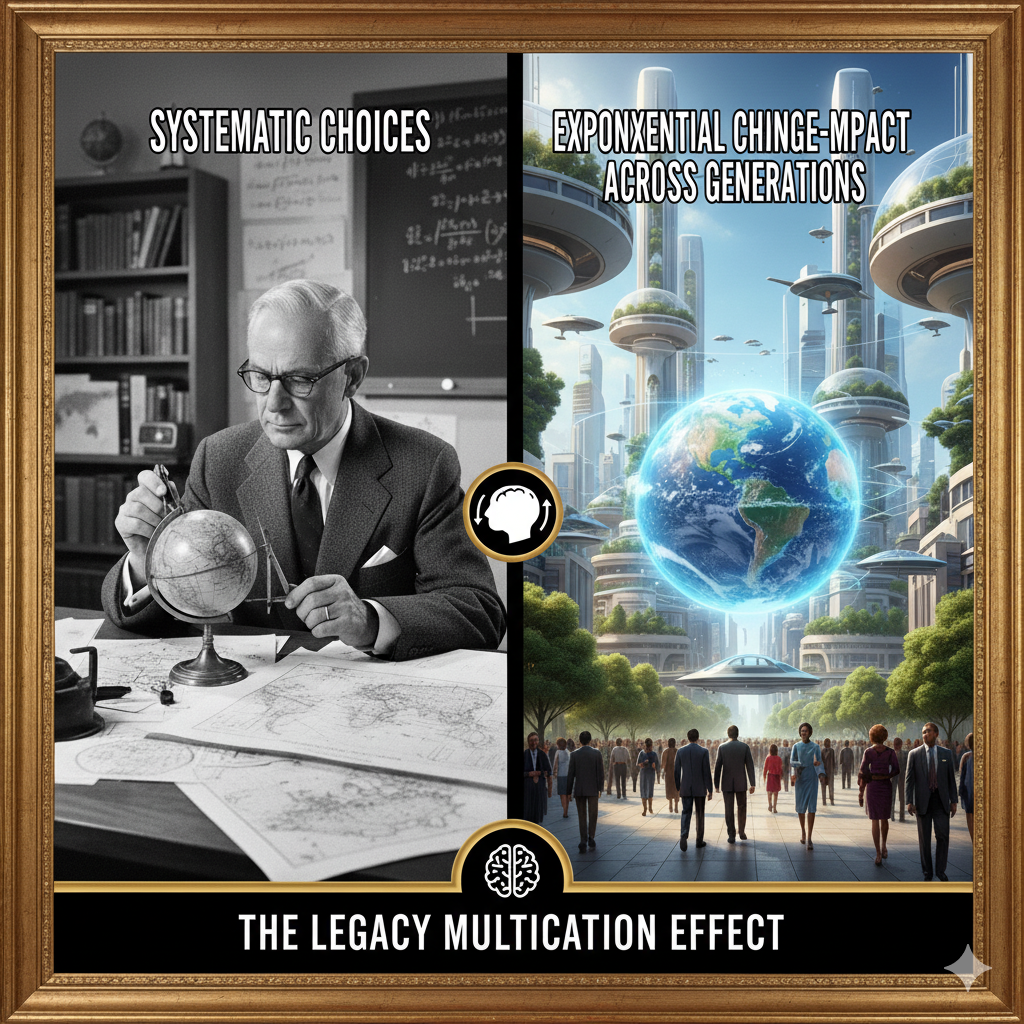
Fuller’s most remarkable achievement wasn’t any single invention—it was his systematic approach to creating what he called “legacy multiplication.” Instead of simply accomplishing beneficial goals during his lifetime, Fuller designed his methods to become self-perpetuating technologies that would enable others to create compound beneficial impact across generations.
“I am not trying to make the world work for me,” Fuller explained near the end of his life. “I am trying to make myself work in ways that will help the world work for everyone, and then to share those ways so the beneficial effect continues expanding beyond anything I could accomplish individually.”
Fuller’s legacy multiplication methodology provides systematic frameworks for anyone seeking to create beneficial impact that expands exponentially rather than linearly. His documented approaches reveal how conscious choices about knowledge sharing, network building, and systematic documentation can transform individual contributions into movements that continue generating benefits indefinitely.
The Compound Impact Design: Creating Self-Sustaining Beneficial Systems
Fuller’s legacy multiplication approach began with fundamental recognition that beneficial impact could be designed to compound over time rather than diminishing after individual effort ended. His systematic analysis of historical change patterns revealed specific methods for creating self-sustaining beneficial systems.
Traditional approaches to beneficial work often exhausted themselves within single generations. Individuals created valuable contributions during their lifetimes, but these contributions typically diminished without continuous maintenance or promotion. Fuller’s systematic investigation identified why some beneficial innovations continued expanding while others disappeared.
The compound impact design principles included:
Self-Perpetuating Knowledge Systems
- Method documentation: Recording systematic approaches rather than just final results so others could understand and improve processes
- Principle extraction: Identifying generalizable frameworks that could apply to diverse challenges and contexts
- Teaching methodology: Developing educational approaches that enabled others to learn and adapt beneficial methods rather than just receiving information
- Knowledge preservation: Creating multiple redundant systems for maintaining and transmitting beneficial insights across changing conditions
Network Effect Creation
- Community building: Fostering relationships among people who applied beneficial methods in different contexts
- Cross-pollination facilitation: Creating opportunities for practitioners to share insights and improvements with each other
- Mentorship development: Training people to teach beneficial methods to others, creating geometric rather than arithmetic growth
- Institutional integration: Embedding beneficial approaches within organizations that would continue applying and developing them
Adaptation and Evolution Mechanisms
- Flexibility design: Creating methods robust enough to remain valuable under changing conditions
- Improvement integration: Building systematic approaches that became more effective as more people contributed refinements
- Application expansion: Enabling beneficial methods to address new challenges and opportunities as they emerged
- Innovation acceleration: Designing approaches that stimulated rather than constrained continued beneficial innovation
Resource Multiplication Systems
- Efficiency amplification: Creating approaches that became more effective per unit of resource investment as they expanded
- Value creation: Designing beneficial systems that generated rather than consumed resources needed for continued operation
- Economic sustainability: Ensuring beneficial approaches remained economically viable for continued development
- Scalability optimization: Creating systems that could expand across larger populations and geographic areas
Fuller’s comprehensive approach to legacy multiplication ensured that his systematic thinking methods would continue generating beneficial impact far beyond his individual lifetime and direct influence.
The compound impact principle: Beneficial work can be systematically designed to create exponential rather than linear impact through self-perpetuating knowledge systems and network effects.
Modern application: How could you design your beneficial work to continue expanding after your individual involvement ends? What systematic approaches could enable others to build on rather than just benefit from your contributions?
The Knowledge Transfer Strategy: Systematic Method Sharing for Multiplicative Learning
Fuller’s legacy multiplication methodology included sophisticated approaches to knowledge transfer that enabled others to understand, adapt, and improve his systematic thinking methods. His strategy focused on sharing methodologies rather than just conclusions, enabling multiplicative rather than additive learning effects.
Rather than keeping his methods proprietary or simply sharing final results, Fuller systematically documented his thinking processes so others could apply comprehensive approaches to their own challenges. This knowledge transfer strategy created exponential learning effects as each person who mastered his methods could teach them to others.
The knowledge transfer strategy included:
Process Documentation and Method Recording
- Thinking process transparency: Recording how he approached challenges rather than just what solutions he developed
- Decision rationale explanation: Documenting why specific choices were made during solution development
- Failure analysis sharing: Recording what didn’t work and why, providing learning opportunities for others
- Systematic methodology extraction: Identifying repeatable approaches that others could adapt to different challenges
Multi-Modal Learning System Development
- Written documentation: Creating books, articles, and technical papers that preserved systematic approaches
- Visual communication: Using diagrams, models, and demonstrations to make complex concepts accessible
- Experiential learning: Designing workshops and exercises where people could practice systematic methods
- Mentorship and apprenticeship: Creating direct learning relationships that enabled deep method transmission
Adaptive Teaching Methodology
- Audience customization: Presenting systematic approaches in ways appropriate for different professional and cultural contexts
- Progressive complexity: Organizing learning sequences that built capability gradually rather than overwhelming beginners
- Practical application: Connecting systematic methods to specific challenges people actually faced
- Immediate utility: Ensuring people could begin applying beneficial methods before completing comprehensive training
Learning Community Creation
- Peer support networks: Connecting people who were learning and applying Fuller’s methods
- Knowledge sharing protocols: Creating systematic approaches for practitioners to share insights and improvements
- Collaboration facilitation: Enabling people to work together on challenges requiring comprehensive approaches
- Continuous improvement: Building feedback systems that enhanced teaching methods based on learner experience
Fuller’s educational influence demonstrates the multiplication effects of systematic knowledge transfer. Universities worldwide continue teaching principles he developed. Professionals across multiple fields apply his comprehensive thinking approaches. Environmental movements use his planetary perspective frameworks.
The knowledge transfer principle: Systematic method sharing creates multiplicative learning effects because each person who masters beneficial approaches can teach them to others.
Modern application: How could you document and share the systematic methods you’ve developed? What teaching approaches would enable others to master and adapt your beneficial approaches? How could knowledge transfer multiply your beneficial impact?
The Network Amplification Method: Building Ecosystems for Compound Beneficial Growth
Fuller’s legacy multiplication approach included systematic network building that created ecosystems capable of generating compound beneficial growth. His methodology for network amplification provides frameworks for creating communities that multiply individual contributions exponentially.
Instead of working in isolation or building hierarchical organizations, Fuller created distributed networks where participants enhanced each other’s capabilities while advancing shared beneficial objectives. These networks continued expanding and generating beneficial impact long after Fuller’s direct involvement ended.
The network amplification methodology included:
Strategic Relationship Development
- Mutual benefit optimization: Creating relationships where all participants gained more through collaboration than they could achieve individually
- Complementary capability coordination: Connecting people whose different strengths created synergistic combinations
- Resource and knowledge sharing: Enabling network members to access collective capabilities that exceeded individual limitations
- Aligned objective advancement: Building networks around shared beneficial goals rather than just professional or social connections
Communication and Coordination Systems
- Information flow optimization: Creating efficient methods for sharing knowledge and insights across network members
- Decision-making protocols: Developing systematic approaches for coordinating complex activities involving multiple participants
- Conflict resolution frameworks: Establishing methods for addressing disagreements without breaking beneficial relationships
- Leadership distribution: Sharing coordination responsibilities based on capabilities and circumstances rather than fixed hierarchies
Value Creation and Distribution
- Collective capability building: Creating opportunities for network members to develop enhanced skills and knowledge through collaboration
- Innovation acceleration: Enabling network participants to create breakthrough solutions through combined expertise
- Resource multiplication: Organizing networks so collective capabilities exceeded the sum of individual contributions
- Benefit sharing: Ensuring network participation provided advantages to all members rather than extracting value from some to benefit others
Expansion and Evolution Mechanisms
- Network growth strategies: Systematic approaches for adding new members who enhanced rather than diluted network capabilities
- Quality maintenance: Ensuring network expansion maintained rather than compromised the beneficial relationships and effectiveness
- Adaptation protocols: Methods for evolving network structures and objectives as conditions and opportunities changed
- Legacy planning: Creating systems that would preserve and continue network benefits beyond founding members
Fuller’s network building created communities of practice that continue developing and applying his systematic methods. The World Game Association, Buckminster Fuller Institute, and numerous academic programs maintain and expand his comprehensive thinking approaches.
Contemporary examples include how open-source software communities create exponential innovation through network effects, how research collaborations accelerate scientific discovery, and how social movements achieve policy changes through distributed coordination.
The network amplification principle: Strategic network building creates ecosystems capable of generating compound beneficial growth that exceeds what individual contributions could achieve.
Modern application: What networks could amplify your beneficial contributions? How could you create ecosystems where participants enhance each other’s capabilities? What systematic approaches could enable network effects that multiply beneficial impact?
The Institutional Integration Strategy: Embedding Beneficial Methods in Self-Perpetuating Systems
Fuller’s legacy multiplication methodology included systematic approaches for embedding beneficial methods within institutions that would continue applying and developing them across generations. His institutional integration strategy provides frameworks for creating lasting beneficial change within organizations.
Rather than depending on individual champions or temporary projects, Fuller designed approaches for making beneficial methods integral to how institutions operated. This integration strategy ensured that systematic thinking approaches would continue generating beneficial impact regardless of personnel changes or shifting priorities.
The institutional integration strategy included:
Educational System Integration
- Curriculum development: Creating educational programs that taught systematic thinking as fundamental skill rather than specialized knowledge
- Teacher training: Preparing educators to understand and apply comprehensive approaches in their own teaching
- Assessment integration: Developing evaluation methods that measured comprehensive thinking capability rather than just information retention
- Institutional culture change: Helping educational institutions adopt systematic approaches to their own operations and planning
Professional Practice Integration
- Methodology adoption: Helping professional organizations integrate comprehensive thinking into their standard practices
- Certification programs: Creating credentialing systems that validated systematic thinking capabilities
- Continuing education: Developing ongoing training that helped professionals refine and expand their comprehensive approaches
- Industry transformation: Influencing entire professional fields to adopt more systematic and beneficial practices
Organizational Culture Development
- Values alignment: Connecting systematic thinking approaches to organizational missions and objectives
- Process integration: Embedding comprehensive analysis methods into routine decision-making and planning
- Leadership development: Training managers and executives to apply systematic thinking to organizational challenges
- Performance measurement: Creating metrics that evaluated comprehensive effectiveness rather than just single-factor optimization
Policy and Regulatory Influence
- Government integration: Helping public agencies adopt systematic approaches to policy development and implementation
- Regulatory framework development: Creating guidelines that encouraged comprehensive thinking in regulated industries
- Public awareness: Building understanding of systematic approaches among citizens and voters
- International coordination: Promoting comprehensive thinking in global organizations and international cooperation
Fuller’s influence on architectural education demonstrates successful institutional integration. His comprehensive design principles became standard teaching in architecture programs worldwide. Environmental design considerations he pioneered are now regulatory requirements. His systematic thinking approaches influenced planning processes in multiple fields.
The institutional integration principle: Embedding beneficial methods within institutional systems creates self-perpetuating beneficial change that continues across generations of participants.
Modern application: What institutions could benefit from integrating systematic approaches you’ve developed? How could you make beneficial methods integral to organizational operations rather than dependent on individual champions? What integration strategies could ensure beneficial approaches survive leadership changes?
The Innovation Catalyst Strategy: Creating Platforms for Continued Beneficial Development
Fuller’s legacy multiplication approach included systematic methods for creating innovation platforms that would continue generating beneficial developments long after his individual contributions ended. His innovation catalyst strategy provides frameworks for enabling others to build on beneficial foundations rather than starting from scratch.
Instead of trying to solve all beneficial challenges individually, Fuller created systematic foundations that enabled others to develop innovations he could never have created alone. This platform approach multiplied beneficial innovation exponentially by providing others with advanced starting points for their own creative work.
The innovation catalyst strategy included:
Foundation Technology Development
- Core principle identification: Establishing fundamental insights that could support multiple types of beneficial innovation
- Platform capability creation: Developing technological and methodological foundations that others could build upon
- Tool and resource provision: Creating instruments and resources that enhanced others’ innovative capabilities
- Standard and protocol establishment: Developing common frameworks that enabled coordination and integration of diverse innovations
Creative Capacity Enhancement
- Imagination stimulation: Providing examples and demonstrations that expanded people’s sense of what was possible
- Skill development: Teaching capabilities that enhanced others’ ability to create beneficial innovations
- Confidence building: Proving that systematic approaches could enable breakthrough achievements
- Barrier removal: Eliminating obstacles that prevented others from pursuing beneficial innovations
Collaboration Infrastructure
- Communication systems: Creating methods for innovators to share insights and coordinate development efforts
- Resource sharing: Enabling innovative groups to access collective capabilities that exceeded individual limitations
- Knowledge integration: Facilitating combination of different types of expertise to create comprehensive solutions
- Success amplification: Helping beneficial innovations achieve widespread adoption and implementation
Sustainable Innovation Ecosystems
- Economic viability: Creating conditions where beneficial innovation became financially sustainable
- Cultural support: Building communities that valued and encouraged beneficial innovation
- Legal and regulatory frameworks: Establishing policies that supported rather than constrained beneficial development
- Educational integration: Ensuring that innovation capabilities would be transmitted to future generations
Fuller’s geodesic dome innovations exemplify successful innovation catalyst strategy. His geometric and structural principles provided foundations that thousands of architects and engineers built upon. His comprehensive design methodology influenced sustainable architecture movements worldwide. His systematic approaches continue inspiring innovations in multiple fields.
Modern examples include how programming languages enable software innovation, how research foundations accelerate scientific discovery, and how open-source platforms enable collaborative technological development.
The innovation catalyst principle: Creating platforms and foundations for innovation enables exponential beneficial development by providing others with advanced starting points for their creative work.
Modern application: What foundations could you create that would enable others to build beneficial innovations? How could your systematic approaches become platforms that accelerate innovation in your field? What innovation catalysts could multiply beneficial development beyond your individual capabilities?
The Measurement and Feedback Strategy: Creating Systems for Continuous Beneficial Improvement
Fuller’s legacy multiplication methodology included systematic approaches to measurement and feedback that enabled continuous improvement of beneficial methods and their implementation. His strategy for creating learning systems provides frameworks for ensuring beneficial approaches continue evolving and improving over time.
Rather than assuming beneficial methods would remain optimal indefinitely, Fuller designed feedback systems that would identify improvement opportunities and integrate them systematically. This measurement strategy enabled beneficial approaches to adapt and enhance themselves based on experience and changing conditions.
The measurement and feedback strategy included:
Comprehensive Impact Assessment
- Multi-dimensional measurement: Tracking beneficial impact across technical, economic, social, and environmental dimensions
- Long-term outcome tracking: Measuring results over extended timeframes rather than just immediate effects
- Unintended consequence detection: Monitoring for secondary and tertiary effects that weren’t anticipated
- Stakeholder satisfaction assessment: Understanding how different groups experienced the effects of beneficial methods
Learning Integration Systems
- Experience analysis: Systematically examining what worked well and what could be improved in beneficial method implementation
- Pattern recognition: Identifying systematic factors that contributed to success or created challenges
- Method refinement: Using measurement data to improve beneficial approaches rather than just evaluating their performance
- Knowledge sharing: Distributing learning insights so all practitioners could benefit from collective experience
Adaptation and Evolution Mechanisms
- Flexibility integration: Building capacity for beneficial methods to adapt to changing conditions and new opportunities
- Innovation incorporation: Integrating new developments and insights that could enhance beneficial effectiveness
- Scaling optimization: Adapting beneficial methods to work effectively at different scales and in different contexts
- Cultural sensitivity: Modifying beneficial approaches to work well within different social and cultural contexts
Continuous Improvement Protocols
- Regular assessment cycles: Establishing systematic schedules for evaluating and improving beneficial methods
- Feedback collection: Creating systematic approaches for gathering input from practitioners and beneficiaries
- Change implementation: Developing processes for implementing improvements without disrupting beneficial ongoing activities
- Quality maintenance: Ensuring continuous improvement enhanced rather than compromised beneficial effectiveness
Fuller’s systematic documentation and refinement of his methods demonstrates effective measurement and feedback strategy. His approaches continued improving based on implementation experience. His teaching methods evolved based on learner feedback. His innovations incorporated new insights from diverse practitioners.
The measurement and feedback principle: Systematic assessment and learning integration enable beneficial methods to continue improving and adapting rather than becoming obsolete over time.
Modern application: What measurement systems could enable continuous improvement of beneficial approaches you’ve developed? How could feedback integration help beneficial methods adapt to changing conditions? What learning systems could ensure beneficial approaches continue evolving and enhancing themselves?
The Cultural Transmission Strategy: Creating Beneficial Change That Transcends Generational Boundaries
Fuller’s legacy multiplication approach included systematic methods for cultural transmission that would embed beneficial approaches within social systems across generational boundaries. His cultural transmission strategy provides frameworks for creating beneficial change that becomes integral to how people think and act.
Rather than expecting beneficial approaches to spread through formal teaching alone, Fuller designed methods for integrating systematic thinking into cultural patterns that would be transmitted naturally through social learning and community practices.
The cultural transmission strategy included:
Value System Integration
- Core principle embedding: Connecting systematic thinking approaches to fundamental values that people already held
- Cultural narrative development: Creating stories and examples that made beneficial approaches part of shared cultural understanding
- Tradition integration: Showing how systematic thinking enhanced rather than replaced valuable cultural practices
- Identity reinforcement: Enabling people to see beneficial approaches as expressions of their existing positive identities
Social Learning Acceleration
- Modeling and demonstration: Living systematic approaches in ways that made them visible and attractive to others
- Peer influence utilization: Creating conditions where beneficial approaches spread through natural social networks
- Community practice development: Establishing group activities that reinforced beneficial approaches through collective experience
- Generational bridge building: Connecting people across age groups to ensure beneficial approaches transferred between generations
Communication and Language Evolution
- Vocabulary development: Creating language that made systematic thinking concepts easy to understand and communicate
- Metaphor and analogy: Using familiar comparisons to make complex beneficial approaches accessible
- Story and narrative: Developing compelling accounts that helped people understand why beneficial approaches mattered
- Media and representation: Using diverse communication channels to make beneficial approaches visible in cultural conversation
Institutional and Environmental Design
- Physical environment modification: Creating spaces and contexts that supported beneficial approaches
- Social structure adaptation: Modifying organizational and community systems to encourage beneficial behaviors
- Economic incentive alignment: Creating conditions where beneficial approaches became economically advantageous
- Policy and regulation development: Establishing formal systems that supported beneficial cultural patterns
Fuller’s influence on environmental consciousness demonstrates successful cultural transmission. His “Spaceship Earth” concept became part of common language and thinking. His systematic approach to resource efficiency influenced consumer behavior. His comprehensive thinking approaches became standard in multiple professional fields.
Contemporary examples include how mindfulness practices spread from Buddhist traditions into mainstream culture, how sustainability thinking influenced business practices, and how systems thinking became standard in organizational development.
The cultural transmission principle: Beneficial approaches can become self-perpetuating cultural patterns when systematically integrated into social learning and community practices across generational boundaries.
Modern application: How could beneficial approaches you’ve developed become integrated into cultural patterns? What social learning methods could accelerate transmission of beneficial practices? How could beneficial thinking become embedded in community traditions and social systems?
Modern Legacy Multiplication Applications: Creating Exponential Beneficial Impact
Fuller’s legacy multiplication methodology provides frameworks that apply to contemporary challenges across technology, business, education, and social innovation. His systematic approaches to creating compound beneficial impact remain relevant because they address fundamental principles of how beneficial change can be designed to expand exponentially.
Technology and Platform Development
Open-source multiplication: Design technological innovations to enable others to build beneficial extensions and improvements rather than just using finished products. How could your innovations become platforms for further beneficial development?
Network effect optimization: Create technologies that become more valuable as more people use them, generating adoption momentum that multiplies beneficial impact exponentially rather than linearly.
Knowledge ecosystem building: Develop technologies that enable systematic knowledge sharing and collaborative problem-solving rather than just individual productivity enhancement.
Business and Organizational Innovation
Method sharing strategy: Document and share business methodologies that enable other organizations to achieve similar beneficial results rather than protecting competitive advantages through secrecy.
Ecosystem value creation: Build business approaches that create value for entire industries or communities rather than extracting value from competitors or suppliers.
Capability multiplication: Develop organizational methods that enhance partner and client capabilities rather than creating dependency relationships.
Educational and Knowledge Development
Teaching multiplication: Create educational approaches that enable learners to become teachers, creating geometric rather than arithmetic expansion of beneficial knowledge.
Methodology transfer: Focus on teaching systematic thinking approaches rather than just domain-specific information, enabling people to apply beneficial methods across multiple contexts.
Learning community development: Build educational systems that continue generating beneficial learning through peer interaction and collaborative investigation.
Social and Environmental Innovation
Movement infrastructure: Create systematic foundations that enable others to build beneficial social innovations rather than trying to solve all social challenges individually.
Policy framework development: Establish regulatory and institutional frameworks that encourage beneficial innovation across multiple organizations and sectors.
Cultural pattern creation: Develop beneficial practices that become self-perpetuating social norms rather than requiring continuous promotion and enforcement.
The Exponential Impact Framework: Designing for Multiplication Rather Than Addition
Fuller’s legacy multiplication methodology demonstrates how systematic design for compound beneficial impact can create exponential rather than linear change. His framework for exponential impact provides systematic approaches for transforming individual contributions into self-sustaining beneficial movements.
Exponential impact design includes:
Self-Replication Mechanisms
- Individual beneficial actions enable others to create similar beneficial actions rather than just benefiting from original efforts
- Methods and knowledge transfer faster than they depreciate, creating growth rather than entropy
- Success creates resources and capabilities that enable larger beneficial activities rather than depleting available capacity
- Network effects multiply rather than dilute individual contributions
Compound Development Systems
- Each implementation of beneficial methods improves the methods themselves rather than just applying them
- Learning from diverse applications enhances rather than compromises beneficial effectiveness
- Integration across different contexts creates synergies that exceed individual application benefits
- Innovation builds on previous innovations to create accelerating beneficial development
Sustainability and Resilience Integration
- Beneficial systems become more stable and effective as they expand rather than more fragile
- Economic models generate rather than consume resources needed for continued beneficial operation
- Cultural integration makes beneficial approaches increasingly natural and automatic rather than requiring constant effort
- Distributed implementation creates resilience against local failures or opposition
Legacy Planning and Transition
- Knowledge preservation systems ensure beneficial approaches survive beyond individual champions
- Institutional integration makes beneficial approaches independent of specific organizational leaders
- Cultural transmission embeds beneficial approaches in social patterns that transcend generational boundaries
- Adaptation mechanisms enable beneficial approaches to remain effective under changing conditions
Fuller’s systematic approach to legacy multiplication created beneficial impact that continues expanding decades after his death. His methods demonstrate how conscious design for multiplication rather than addition can transform individual contributions into movements that generate exponential beneficial change.
Your Legacy Multiplication Challenge: Designing for Exponential Beneficial Impact
Fuller’s legacy multiplication methodology provides a framework for transforming your beneficial contributions into self-sustaining systems that continue expanding long after your individual involvement. His systematic approach to compound impact can guide how you design your work for multiplication rather than addition.
Week 1: Impact Analysis and Multiplication Design
- Assess your beneficial contributions: Identify valuable methods, insights, or innovations you’ve developed that could benefit others
- Map current impact patterns: Understand whether your beneficial work creates linear or exponential effects
- Identify multiplication opportunities: Look for ways your contributions could enable others to create similar beneficial results
- Design for compound growth: Plan how your beneficial work could become self-perpetuating and self-improving
Week 2: Knowledge Transfer and Method Documentation
- Document your systematic approaches: Record the thinking processes and methodologies behind your beneficial contributions rather than just final results
- Create learning systems: Develop approaches that enable others to master and adapt your beneficial methods
- Test teaching effectiveness: Experiment with sharing your methods and observe whether others can successfully apply them
- Build knowledge communities: Connect people who are learning and applying your beneficial approaches
Week 3: Network Building and Platform Creation
- Identify potential multipliers: Find people who could amplify your beneficial impact by applying your methods in their contexts
- Create collaboration opportunities: Design projects that enable others to contribute to beneficial development while learning your methods
- Build support systems: Establish networks that provide ongoing assistance and encouragement for people implementing beneficial approaches
- Develop platform capabilities: Create foundations that enable others to build beneficial innovations beyond what you could develop alone
Week 4: Integration and Sustainability Planning
- Plan institutional integration: Consider how beneficial approaches could become embedded within organizational systems that would perpetuate them
- Design adaptation mechanisms: Build flexibility into beneficial methods so they can evolve and improve based on implementation experience
- Create cultural transmission: Develop approaches that could become natural social patterns rather than requiring continuous promotion
- Establish measurement systems: Implement feedback mechanisms that enable continuous improvement and quality maintenance
The legacy multiplication principle: Systematic design for compound beneficial impact can transform individual contributions into exponential change movements that continue expanding across generations.
What beneficial contributions could you design for multiplication rather than just individual application? How could your systematic approaches become foundations that enable others to create beneficial innovations beyond your individual capabilities? What legacy multiplication could transform your beneficial work into exponential positive change?
Buckminster Fuller’s Legacy Multiplication Effect demonstrates that systematic design for compound beneficial impact can create exponential change that continues expanding across generations. His methodology remains among the most sophisticated frameworks for transforming individual contributions into self-sustaining beneficial movements ever developed.