Welcome to understanding how one Ohio art-rock band became America’s most explicit teachers of conscious choice-making, using every platform they could access to wake people up from unconscious cultural consumption.
Published on consciouschoicemastery.com | Approx. 10-12 min read
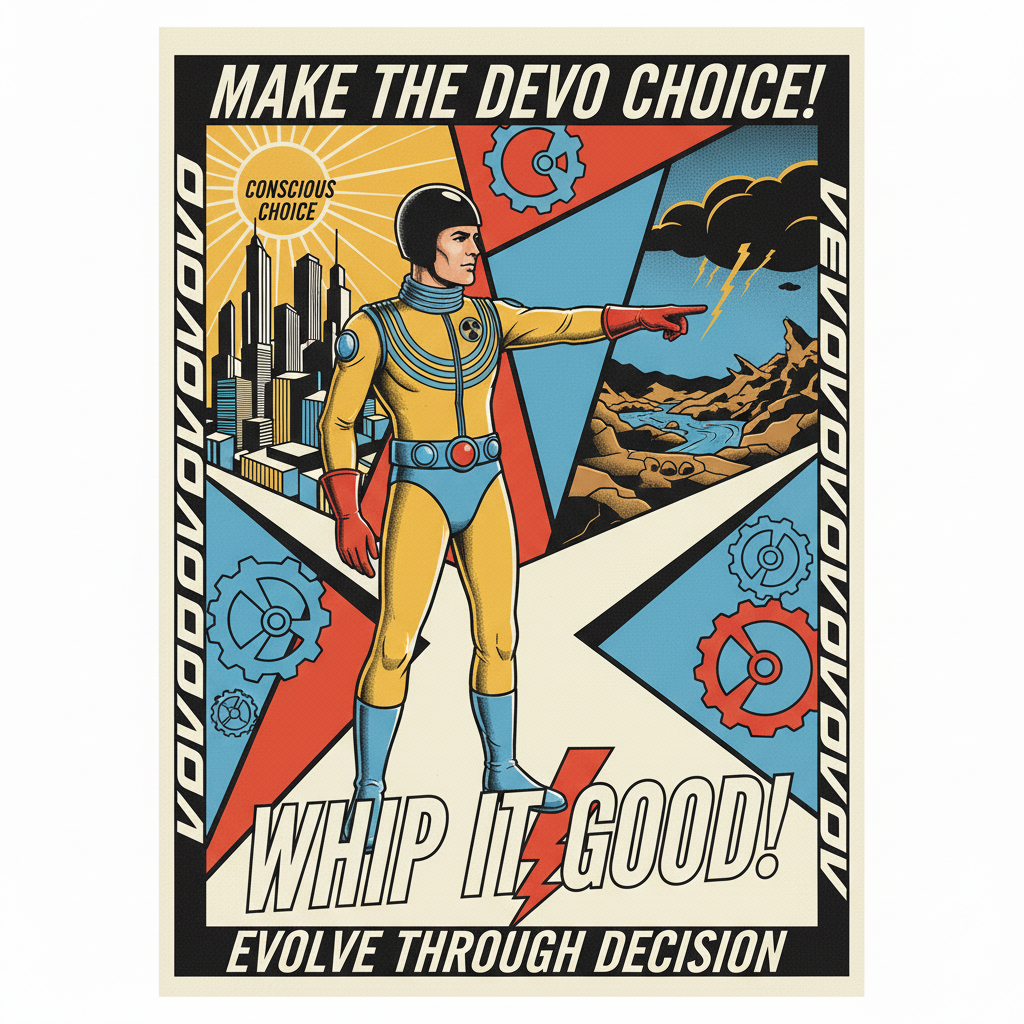
In interviews, videos, and performances throughout their career, Devo made their educational mission crystal clear: they wanted to teach Americans how to make conscious choices instead of blindly following cultural programming. This wasn’t subtle artistic commentary—it was direct instruction in what we now recognize as the five essential principles of conscious choice-making.
“We were true punk, meaning we questioned illegitimate authority and we stayed in our own lane and did our thing, remaining true to our vision,” Gerald Casale explained. But their punk rebellion took a unique form: systematic education in conscious awareness through popular culture.
Their entire artistic project functioned as a consciousness curriculum designed to activate people’s dormant capacity for critical thinking, individual choice-making, and resistance to groupthink. They understood something profound: in a culture designed to promote unconscious consumption, teaching conscious choice becomes the most radical act possible.
The Five Essential Principles of Devo’s Consciousness Curriculum
While Devo didn’t use this exact framework, their approach perfectly demonstrates what we now understand as the core principles of conscious choice-making:
ADAPTIVE FLEXIBILITY – Finding creative ways to deliver consciousness-raising messages through commercial systems
CONTINUOUS CHOICE – Consistently choosing authenticity and critical thinking over social conformity
AVAILABLE SUPPORT – Drawing wisdom from diverse sources and encouraging others to do the same
INHERENT CAPABILITY – Believing that everyone possesses natural critical thinking abilities
CONSCIOUS SELF PARTNERSHIP – Encouraging collaboration with one’s aware, thinking self rather than programmed responses
The Awakening: From Kent State Trauma to Consciousness Teaching
The band’s mission began with a traumatic awakening. Gerald Casale and Mark Mothersbaugh met at Kent State University, where they witnessed the 1970 killing of four unarmed student protesters by the National Guard.
This experience forced them into continuous choice about how to process and respond to state violence against peaceful dissent. Rather than becoming cynical or withdrawing, they chose to transform their trauma into available support for others who needed to wake up to uncomfortable realities about American society.
“We were seeing a world that was the antitheses of the idealized, promised future ginned up in the ’50s and ’60s,” Casale explained. “What we saw was regression.”
Their conscious self partnership led them to recognize that most Americans were making choices based on advertising, propaganda, and social pressure rather than their own direct observation and critical analysis. They decided to become teachers of conscious choice-making.
The Devolution Diagnosis: When Choice-Making Breaks Down
Devo’s central concept wasn’t just cultural criticism—it was educational psychology. They diagnosed exactly what happens when conscious choice-making deteriorates in a society:
The Symptoms of Unconscious Choice-Making:
- Critical thinking atrophy – People stop exercising their inherent capability for analysis
- Groupthink dominance – Continuous choice gets replaced by social conformity
- Authority worship – People ignore available support from their own experience
- Programming acceptance – Conscious self partnership gets replaced by external control
- Adaptive rigidity – Adaptive flexibility is abandoned for mindless rule-following
Devo’s Public Prescription:
“Nobody wanted to hear us talking about the duality of human nature and the dangers of groupthink and the atrophication of people being able to think logically and think critically,” Casale observed. But they kept teaching anyway.
Teaching Through Performance: The Energy Dome Curriculum
Every aspect of Devo’s presentation was designed as conscious choice activation:
The Energy Domes (Red Plastic Hats)
These weren’t just costume pieces—they were visual metaphors for consciousness protection. In interviews, the band explained that the domes represented the need to shield your thinking mind from external programming and manipulation.
The lesson: Conscious self partnership requires protecting your awareness from constant cultural bombardment designed to trigger unconscious responses.
The Uniform Aesthetic
By dressing identically, Devo challenged rock music’s emphasis on individual star personalities. This demonstrated adaptive flexibility—they found a way to critique individualism while still functioning as individual artists.
The lesson: You can maintain your authentic self while recognizing that continuous choice sometimes means choosing collective values over personal ego.
The Robotic Movement
Their choreographed, mechanical dancing wasn’t just artistic choice—it was educational demonstration. They were showing audiences what unconscious behavior looked like from the outside.
The lesson: When you stop making conscious choices, you become mechanical and predictable. Awareness of this can help you choose differently.
Direct Teaching: What Devo Said Publicly About Choice-Making
In countless interviews and public appearances, Devo explicitly taught conscious choice principles:
On Questioning Authority:
“We questioned illegitimate authority,” Casale stated repeatedly. This wasn’t just rebellion—it was instruction in continuous choice. They taught audiences to ask: “Who benefits from my compliance with this authority? Am I choosing to comply, or just automatically obeying?”
On Media Consumption:
“We were seeing people become more and more passive consumers,” Mothersbaugh explained in interviews. They explicitly warned audiences to make conscious choices about what media they consumed and how they interpreted it.
On Individual vs. Group Thinking:
“The dangers of groupthink and the atrophication of people being able to think logically and think critically” became a repeated theme in their public statements. They directly taught conscious self partnership as an antidote to herd mentality.
On Cultural Programming:
They explicitly told audiences that American culture was designed to prevent conscious choice-making. “We saw regression,” Casale explained—not just social regression, but the regression of individual choice-making capability.
The Educational Strategy: Working Within Systems to Change Systems
Devo demonstrated adaptive flexibility by using commercial platforms to deliver consciousness-raising education:
MTV as Classroom
When MTV launched, Devo immediately recognized it as an unprecedented available support system for reaching unconscious consumers. Their videos weren’t just entertainment—they were consciousness curriculum delivered through pop culture.
Talk Shows as Teaching Opportunities
Every appearance on American Bandstand, Late Night with David Letterman, or local morning shows became a consciousness-raising session. They used their platform time to explicitly encourage conscious choice-making.
Record Labels as Distribution Networks
Rather than rejecting commercial systems, they demonstrated adaptive flexibility by using Warner Bros. Records as a distribution network for consciousness education. They found ways to fund their teaching mission through album sales.
The Explicit Curriculum: Teaching Conscious Choice Through Song
“Freedom of Choice” – The Master Class
This song was literally titled after the concept they were teaching. The lyrics explicitly warned about the dangers of unconscious choice-making:
“Freedom of choice / Is what you got / Freedom from choice / Is what you want”
The lesson: Most people prefer having choices made for them rather than exercising their inherent capability for conscious decision-making. Recognizing this tendency is the first step toward conscious self partnership.
“Beautiful World” – Teaching Critical Analysis
The video paired upbeat music with disturbing images of violence and social problems. This wasn’t random juxtaposition—it was educational demonstration of how media manipulates emotional responses to prevent critical thinking.
The lesson: Practice conscious choice about how you respond to media. Don’t let emotional manipulation bypass your critical thinking.
“Satisfaction” – Modeling Conscious Interpretation
Their cover of the Rolling Stones classic demonstrated adaptive flexibility by taking a well-known song and offering a completely different interpretation through mechanical, robotic delivery.
The lesson: You can make conscious choices about how to interpret cultural content rather than just accepting the intended meaning.
Public Education: Teaching Conscious Choice in Interviews
Devo used every interview as a consciousness classroom:
The Dick Clark Teaching Moment
When Dick Clark interviewed them on American Bandstand, Devo explicitly used the platform to teach conscious choice principles. Clark’s visible discomfort demonstrated the collision between unconscious entertainment consumption and conscious cultural analysis.
The lesson they taught: Even entertainment can be approached consciously or unconsciously. Choose awareness over automatic consumption.
David Letterman Consciousness Sessions
Their multiple Letterman appearances became masterclasses in conscious choice demonstration. They showed audiences what it looked like to make continuous choices to stay authentic rather than playing expected roles.
Morning Show Awareness Training
Even on throwaway morning shows, Devo consistently taught conscious choice principles, explaining their mission to wake people up from cultural programming.
The Teaching Results: Evidence of Consciousness Activation
Critical Recognition
Music critics and cultural commentators immediately understood Devo’s educational mission, proving that conscious choice teaching could work for audiences ready to engage.
Academic Adoption
Universities began using Devo’s work in media studies and cultural criticism courses, demonstrating that their consciousness curriculum had educational value beyond entertainment.
Artist Influence
Subsequent musicians explicitly credited Devo with teaching them to make conscious choices about their art rather than following industry expectations.
Cult Following Development
Devo attracted audiences who specifically sought out their consciousness education rather than just entertainment, proving there was demand for conscious choice teaching.
The Modern Legacy: Devo’s Consciousness Curriculum Today
“I always tried to be optimistic that devolution was something that was going to be corrected and that our message would be not necessary at this point, but unfortunately it’s more real than ever,” Mothersbaugh observes.
Digital Age Relevance
Devo’s warnings about unconscious choice-making are more relevant than ever in an era of:
- Algorithmic programming designed to bypass conscious choice
- Social media manipulation that triggers unconscious responses
- Information overload that overwhelms critical thinking capacity
- Political polarization that discourages continuous choice
Educational Applications
Modern educators use Devo’s approach to teach:
- Media literacy through conscious content analysis
- Critical thinking through questioning cultural assumptions
- Individual autonomy through conscious self partnership development
- System analysis through understanding how institutions shape choices
Practical Applications: Implementing Devo’s Consciousness Curriculum
Daily Conscious Choice Practice
Morning Consciousness Check
Start each day by asking: “What choices will I make consciously today versus automatically?” This activates conscious self partnership from the beginning.
Media Consumption Awareness
Before consuming any media, pause and ask: “Am I choosing to engage with this consciously, or just consuming it unconsciously?” This practices continuous choice.
Authority Question Protocol
When receiving instructions or expectations from any authority, ask: “Who benefits from my compliance? Am I choosing to comply or just automatically obeying?” This accesses available support from your own critical thinking.
Group Pressure Recognition
When feeling pressure to conform to group opinions, ask: “Am I making my own conscious choice here, or just following the group?” This activates inherent capability for independent thinking.
Response Flexibility Training
When facing any challenge, ask: “What’s the most adaptive response to this situation, rather than just my automatic reaction?” This develops adaptive flexibility.
Cultural Engagement Practice
Entertainment Analysis
Apply Devo’s approach to current entertainment: What messages am I receiving? Are these messages designed to promote conscious or unconscious responses?
Advertising Resistance
Practice conscious choice when encountering advertising: What choices is this ad trying to influence? How can I make conscious decisions about what I actually need?
Social Media Awareness
Use conscious self partnership on social platforms: Am I using this consciously for connection and learning, or unconsciously for distraction and validation?
News Consumption Strategy
Apply continuous choice to news consumption: Am I seeking information to make better choices, or just consuming content that confirms my existing beliefs?
The Teaching Continues: Your Role in Consciousness Education
Becoming a Consciousness Teacher
Devo demonstrated that anyone can teach conscious choice principles through their authentic expression and consistent choices. You don’t need to be a musician or artist—you just need to choose consciousness over programming.
Supporting Others’ Awareness
Practice available support by sharing consciousness-raising resources, asking questions that promote critical thinking, and modeling conscious choice-making in your own life.
Institutional Influence
Use adaptive flexibility to promote conscious choice principles within whatever systems you participate in—workplace, family, community, political engagement.
Cultural Resistance
Continue Devo’s mission by making continuous choices to question illegitimate authority, resist groupthink, and maintain conscious self partnership even when surrounded by unconscious consumption.
The Ultimate Teaching: Choice as Revolutionary Act
Devo’s most important lesson was that conscious choice-making itself is the ultimate form of cultural resistance. In a society designed to promote unconscious consumption and automatic compliance, every conscious choice becomes a revolutionary act.
Their educational mission wasn’t to tell people what to choose—it was to teach people how to choose consciously. They understood that awakened individuals making conscious choices would naturally create a more conscious culture.
“Rock has always needed bands like Devo, a corrective to the corporate machine,” critics observed. But Devo offered more than correction—they offered education in how to think for yourself.
Your Consciousness Curriculum Continues
Every day presents new opportunities to implement Devo’s consciousness curriculum:
- Question the authorities that shape your choices
- Analyze the media you consume for conscious or unconscious messages
- Practice adaptive flexibility in responding to challenges
- Access available support from your own critical thinking and diverse wisdom sources
- Trust your inherent capability for conscious decision-making
- Develop conscious self partnership with your aware, thinking self
The choice between consciousness and programming is always available, no matter how unconscious the surrounding culture becomes.
Your conscious self has been waiting for this partnership. Devo showed the way—now the choice to follow their consciousness curriculum is entirely yours.
Are we not men? We are Devo! And the capacity for conscious choice is the most human capability we possess.
“The only thing you can hope is that it will create an awareness and get rid of complacency” – Mark Mothersbaugh
The awareness starts with choosing consciousness over programming, one decision at a time.
Sources
- “The story behind Devo’s ‘Whip It’ and their misunderstood legacy,” Associated Press, August 18, 2025
- “Crack That Whip: New Documentary Explores the Evolution of Devo,” Club Devo, 2024
- Multiple Devo interviews and public appearances, 1978-1985
- Devo performance analysis and cultural criticism, various sources
@ 2025 Lee Greene