The ultimate irony: A band dedicated to exposing society’s devolution created their biggest hit by perfectly embodying the mindless consumption they were trying to critique
Published on consciouschoicemastery.com | Approx. 10-12 min read
In 1980, as MTV prepared to launch and fundamentally change how music reached audiences, an Ohio art-rock band called Devo made a calculated decision to create the most absurd, deliberately awful music video possible. They wanted to satirize Ronald Reagan’s cowboy conservatism, mock American machismo, and expose the hollow optimism that they believed was masking society’s intellectual and cultural regression.
The result? “Whip It” became one of the most beloved and misunderstood videos in music history.
This is the story of how a band’s attempt to create conscious, critical art accidentally became a perfect example of the unconscious cultural consumption they were desperately trying to wake people up from. It’s a masterclass in how satire can be so effective that it becomes indistinguishable from the thing it’s satirizing—and how sometimes the most revolutionary art succeeds by completely failing to communicate its revolutionary message.
Born from Tragedy: The Kent State Genesis
To understand Devo’s mission, you have to start with tragedy. The nucleus of the band was formed from tragedy: Casale and Mark Mothersbaugh met at Kent State University, where they lived through the 1970 killing of four unarmed anti-war student protesters by the National Guard.
Gerald Casale and Mark Mothersbaugh weren’t just college friends who decided to start a band. They were young intellectuals who had witnessed American authority literally gun down their peers for the crime of protesting an unpopular war. This experience fundamentally shaped their worldview and their artistic mission.
“We were seeing a world that was the antitheses of the idealized, promised future ginned up in the ’50s and ’60s,” Casale says in the movie. “What we saw was regression.”
From this revelation came their central concept: devolution. While mainstream culture celebrated progress, technology, and American optimism, Devo saw humanity moving backward—becoming more conformist, more mindless, more susceptible to manipulation and control.
The Theory of De-Evolution: Humanity in Reverse
They named themselves after the idea that modern society was entering a process of “devolution.” This wasn’t just a catchy band concept—it was a serious philosophical and political framework that informed everything they created.
Devo’s theory held that despite technological advancement, human beings were becoming less capable of critical thinking, more prone to herd behavior, and increasingly vulnerable to authoritarian manipulation. They saw this everywhere: in mass media, consumer culture, political rhetoric, and social conformity.
Their early work was dense with intellectual references, avant-garde performance art, and multimedia presentations that challenged audiences to think critically about the world around them. “Nobody wanted to hear us talking about the duality of human nature and the dangers of groupthink and the atrophication of people being able to think logically and think critically,” Casale says.
The “Whip It” Trap: Sophisticated Satire in Disguise
By 1980, Devo faced a crisis. Warner Bros. Records was also unhappy with Duty Now for the Future and issued an ultimatum to Devo that they needed to produce a successful follow-up album, or they would be dropped from the label. They needed a hit, but they refused to abandon their artistic mission.
Gerald Casale’s solution was brilliantly subversive. He would write a song that sounded like mindless American optimism while actually being a devastatingly precise parody of it.
“I had been reading Thomas Pynchon’s Gravity’s Rainbow, and he had these limericks and poems in there that really made me laugh, where he was making fun of all the American, capitalist, can-do clichés—Horatio Alger—’there’s nobody else like you,’ ‘you’re number one,’ ‘you can do it.’ And I was just trying my hand at it.”
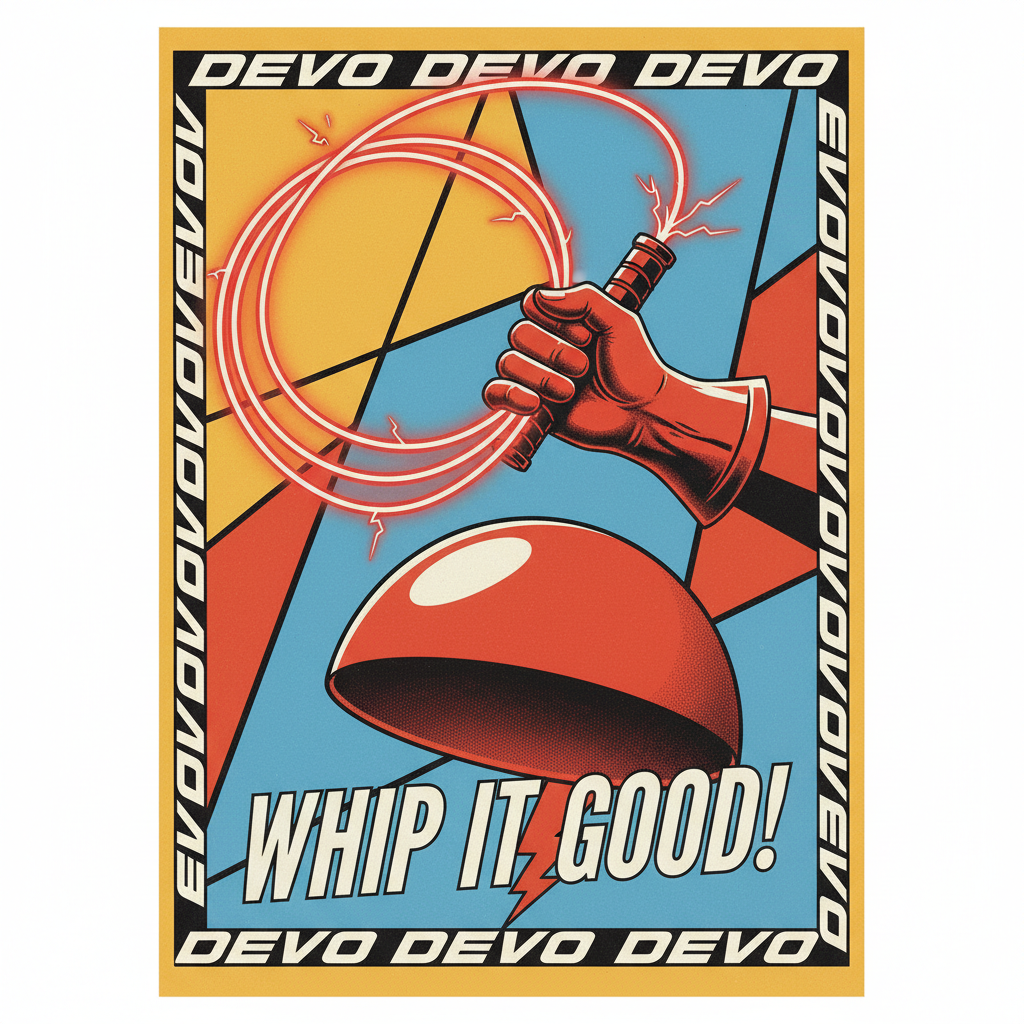
The resulting song was “Whip It”—a track that sounded like a motivational anthem but was actually intended to satirize American optimism. He took inspiration from communist propaganda posters and Gravity’s Rainbow by Thomas Pynchon, a 1973 novel that contains satirical limericks about capitalist can-do clichés.
The Video: Deliberate Absurdity as Political Statement
When it came time to create a music video, Devo saw an opportunity to push their satirical message even further. The video was partially a reaction to President Ronald Reagan’s previous career as a Hollywood actor; Devo wanted to make a video that satirized both the cowboy mythos and “right-wing racist values”.
The video — featuring cowboys drinking beer, dangerous gunplay and assault — was actually mocking President Ronald Reagan and his macho brand of conservatism.
The band deliberately created something that looked like the worst kind of American machismo fantasy: cowboys, whips, saloons, and aggressive masculine posturing. Every element was carefully chosen to embody the Reagan-era conservative mythology they despised.
But when it came time to make the song’s now-legendary music video, Devo ran with the S&M theme to absurd extremes.
The Backfire: When Satire Becomes Celebration
Here’s where Devo’s plan went beautifully, catastrophically wrong.
The American television channel MTV, which was launched in 1981, gave the video so much exposure that it temporarily revived the song’s popularity, but not for the reasons Devo intended.
Audiences didn’t see a brilliant satire of American optimism and conservative machismo. They saw a fun, energetic song with a memorable video featuring cool outfits and whip-cracking action. The very mindlessness that Devo was critiquing prevented viewers from recognizing the critique.
“And then, of course, we were doing lots of interviews back then, and we’d have to get up at seven so we could go be on a morning talk show while people are driving to work. And we’d be sitting in the other room waiting to go in and talk to the disc jockey, and he’d be on the air, going, ‘You know, I whipped it just the other day, haw haw haw haw,’ and we’re like, ‘What an asshole.’ We felt very misunderstood.”
The song became exactly what it was satirizing: a mindless anthem that people consumed without thinking about its meaning or implications.
The Misunderstanding Multiplies
The success of “Whip It” created a fascinating paradox. “We were trivialized and pigeonholed,” co-founder Gerald Casale tells The Associated Press. The very success of their satirical masterpiece trapped them in the role of novelty act.
Members of Devo — which also included Mark’s brother, Bob, Gerald’s brother, Bob, and Alan Myers — performed on TV and chatted with talk show hosts like David Letterman but their satire never seemed to break through.
Audiences loved the red plastic energy domes, the robotic dancing, the quirky costumes, and the catchy songs. But they missed the deeper message entirely. Devo had become victims of their own success—their satirical portrayal of mindless consumption had been mindlessly consumed.
The Deeper Irony: Perfect Devolution in Action
What makes the “Whip It” phenomenon so perfectly ironic is that it demonstrated Devo’s central thesis better than any manifesto could have. The band had created a piece of art specifically designed to make people think critically about American culture, and instead, American culture consumed it thoughtlessly as entertainment.
This wasn’t a failure of Devo’s artistic vision—it was proof that their vision was correct. Society had indeed devolved to the point where even pointed criticism of that devolution would be absorbed and neutralized by the very mechanisms they were critiquing.
The video worked exactly as intended: it exposed the mindless consumption of American popular culture. The only problem was that the exposure came in the form of the culture mindlessly consuming their exposure of mindless consumption.
The Revolutionary Success of Complete Failure
From one perspective, “Whip It” was Devo’s greatest artistic achievement. They had created a perfect piece of satirical art that functioned simultaneously as:
- A genuine critique of American optimism and conservative masculinity
- A catchy pop song that satisfied commercial demands
- A demonstration of their devolution theory in action
- A mirror that reflected society’s inability to recognize itself
The fact that the mirror was misunderstood only made it more accurate.
The Lasting Legacy: Satire in the Age of Irony
“I always tried to be optimistic that devolution was something that was going to be corrected and that our message would be not necessary at this point, but unfortunately it’s more real than ever,” Mothersbaugh tells the AP.
Looking back from 2024, Devo’s experience with “Whip It” feels remarkably prescient. We now live in an era where satirical content is routinely shared and celebrated by the very people being satirized, where irony and sincerity have become nearly indistinguishable, and where critical media is often consumed as entertainment rather than enlightenment.
The “Whip It” phenomenon anticipated the current cultural moment where satirical TV shows become primary news sources, where memes function as political discourse, and where the line between criticism and celebration has been completely erased.
The Devo Doctrine: Art as Accelerated Devolution
Perhaps Devo’s greatest insight was recognizing that in a devolved culture, the most effective form of resistance might be acceleration rather than opposition. Instead of fighting against cultural stupidity, they embodied it so perfectly that it became impossible to ignore.
“Whip It” worked because it didn’t try to educate or elevate—it simply reflected society back to itself with such precision that the reflection became indistinguishable from reality. Whether audiences understood this or not was beside the point. The art succeeded by being exactly what it was criticizing.
The Current Relevance: Devo’s Prophecy Fulfilled
Rock has always needed bands like Devo, a corrective to the corporate machine. You can see an echo of Devo when M.I.A. raised her middle finger during the Super Bowl halftime show in 2012. The members of Devo cite such bands as Rage Against the Machine and System of a Down as keeping the flame alive.
Today, in an era of social media algorithms, political polarization, and information overload, Devo’s devolution theory feels less like artistic provocation and more like documentary observation. The mechanisms they identified in 1970—groupthink, conformity, the inability to think critically—have been amplified and accelerated by digital technology.
You may think of Devo as New Wave or early electronica or synth-pop. but they see themselves differently: “We were true punk, meaning we questioned illegitimate authority and we stayed in our own lane and did our thing, remaining true to our vision,” says Casale. “That’s punk.”
The Ultimate Lesson: Revolutionary Art in Devolved Times
The “Whip It” story offers a crucial lesson for anyone trying to create meaningful art in a culture resistant to meaning: sometimes the most revolutionary act is to become so good at satirizing the system that the system adopts your satire as its anthem.
Devo understood that in a devolved culture, traditional forms of resistance—earnest protest songs, serious political art, direct confrontation—would be easily dismissed or co-opted. But perfect satirical mimicry couldn’t be dismissed because it looked exactly like what the culture already wanted.
The genius of “Whip It” wasn’t that it changed minds—it was that it demonstrated how those minds were incapable of being changed. It held up a mirror to American culture and let that culture decide what it saw. That most people saw a fun video rather than a devastating critique wasn’t a bug—it was the feature.
The Enduring Question: Success or Failure?
Was “Whip It” Devo’s greatest success or their greatest failure? The answer might be both.
As a piece of commercial entertainment, it was an unqualified success that saved their record deal and made them cultural icons. As a piece of critical art, it failed to enlighten its audience or spark the cultural awakening Devo hoped for.
But as a demonstration of their central thesis—that American culture had devolved beyond the ability to recognize its own devolution—it was perfect. The very fact that their critique was embraced without being understood proved their point more effectively than any understood critique could have.
The Meta-Message: When the Medium Becomes the Message
In the end, “Whip It” succeeded because it didn’t fight against the mechanisms of cultural devolution—it used them. Instead of trying to educate people out of mindless consumption, it gave them something worth consuming mindlessly.
The video’s popularity didn’t prove that Devo was wrong about devolution—it proved they were right. A culture capable of critical thinking would have recognized the satire. A culture that had devolved past that capability would consume the satire as entertainment.
The fact that “Whip It” became beloved rather than challenging didn’t undermine Devo’s message—it became their message.
In a devolved culture, the most subversive act might be creating perfect representations of that devolution and letting the culture’s response speak for itself. Devo didn’t need to convince anyone that American culture had lost the ability to think critically—they just needed to create something that demonstrated what that looked like.
“Whip It” remains a masterpiece precisely because it succeeded by failing, criticized by celebrating, and revolutionized by conforming. In the end, the best art doesn’t always change the world—sometimes it just shows the world exactly what it is, and lets that revelation do the work.
The ultimate irony: In trying to wake people up, Devo created the perfect lullaby. And in that perfect failure, they achieved their most perfect success.
Sources
- “Whip It (Devo song),” Wikipedia
- “Everything we thought we knew about Devo’s ‘Whip It’ was wrong,” Salon.com, September 16, 2017
- “The story behind Devo’s ‘Whip It’ and their misunderstood legacy,” Associated Press, August 18, 2025
- “Crack That Whip: New Documentary Explores the Evolution of Devo,” Club Devo, 2024
@ 2025 Lee Greene