The most beautiful contradiction in rock history: How the ultimate anti-establishment punk band secretly worshipped the kings and queens of Eurovision pop
Published on consciouschoicemastery.com | Approx. 10-12 min read
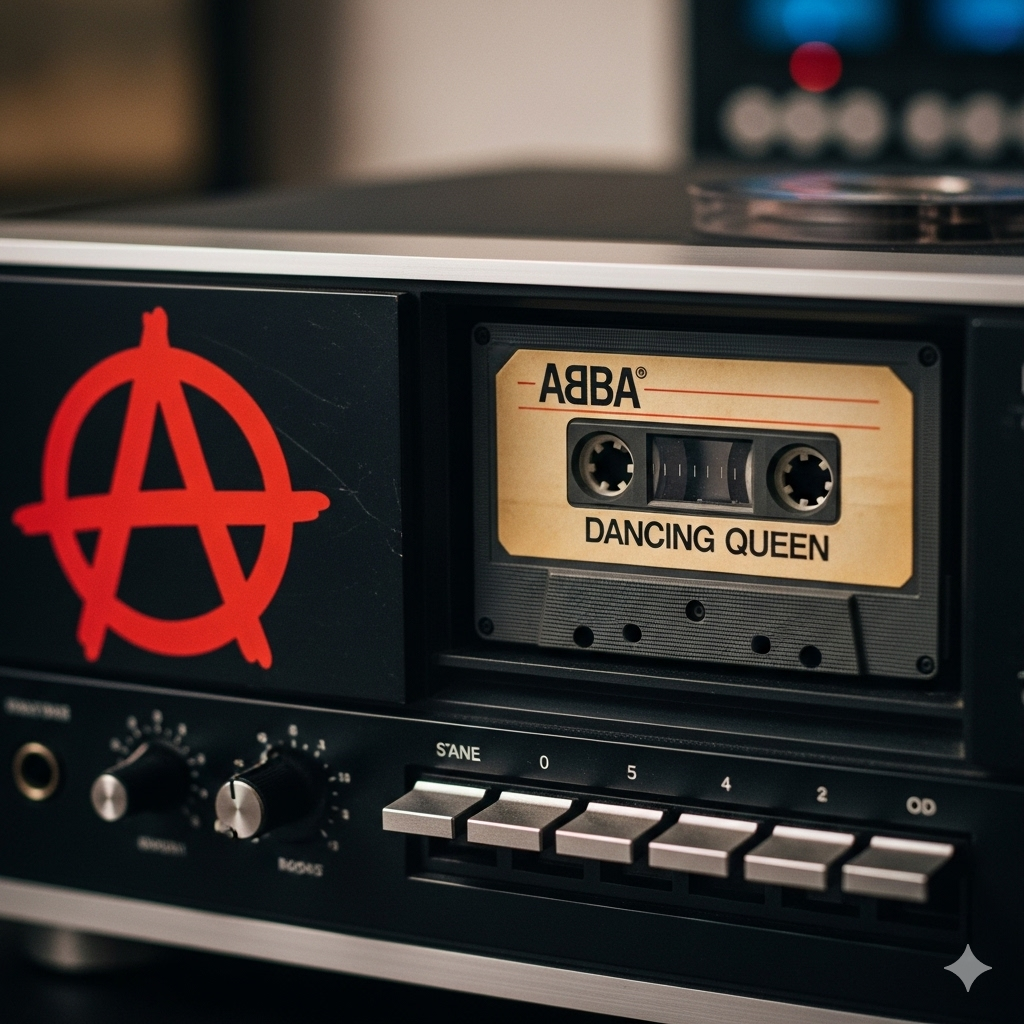
In the summer of 1977, as the Sex Pistols tore through Scandinavia on their first international tour, spreading their gospel of anarchy and anti-establishment fury, something extraordinary was happening backstage. According to Norwegian music journalist Teddie Dahlin, who covered the tour, the band’s roadie Steve “Rodent” Connolly had set up a cassette player with a single tape that played continuously throughout the entire tour.
That tape was ABBA.
“On the cassette player, they had one cassette and it was ABBA,” Dahlin recalled. “They played it 24/7, all the time. It was Rodent’s job to turn it over when it got to the end. It’s a miracle it lasted the whole tour! They were huge ABBA fans.”
This revelation, that the Sex Pistols, the snarling prophets of punk rebellion, were secretly obsessed with the pristine pop perfection of ABBA, represents one of the most delicious contradictions in music history. But it’s not just a quirky footnote. It’s a story that reveals something profound about creativity, influence, and the unexpected connections that drive artistic innovation.
The Impossible Cultural Collision
To understand how extraordinary this connection is, you need to appreciate just how opposite these two acts appeared to be in 1977:
ABBA: Sweden’s Eurovision darlings, creators of immaculate pop confections, dressed in glittering costumes, singing about dancing queens and knowing me, knowing you. They represented everything that was safe, commercial, and wholesome about the music industry.
Sex Pistols: Britain’s punk pariahs, destroyers of musical convention, dressed in ripped clothing held together with safety pins, snarling about anarchy and God saving the Queen from a fascist regime. They represented everything that was dangerous, anti-commercial, and threatening about youth culture.
Yet behind closed doors, in tour buses and backstage areas where image didn’t matter, the Pistols were spinning ABBA records on repeat.
The “Pretty Vacant” Revelation: From “SOS” to Punk Anthem
The most concrete evidence of this unlikely musical romance came when Sex Pistols bassist Glen Matlock made a stunning admission: the iconic riff from “Pretty Vacant”, one of punk’s most recognizable anthems, was directly inspired by ABBA’s 1975 hit “SOS.”
“I had the set of chord changes and the lyric but I was short of a riff,” Matlock recalled. “I knew it needed a melodic thing, and I heard something on a record by a band called ABBA and it inspired the riff I needed, and I said, ‘Guys, I’ve got it.'”
Matlock was specific about the moment of inspiration. He was in Moonies, an upstairs bar in Charing Cross Road, drinking his way through that week’s dole money when ABBA’s ‘SOS’ came on the jukebox. “I heard the riff on it, one simple repeated octave pattern. All I did was take that pattern and alter it slightly, putting in the fifth, to be technical.”
The result was pure punk alchemy: taking ABBA’s melancholic Swedish pop ballad and transforming it into a sneering declaration of empty-headed rebellion. It’s impossible to imagine two songs that sound more different, yet one literally gave birth to the other.
The Christmas Card Connection
The story gets even more charming. After Matlock mentioned the ABBA influence in an interview, “the bass player from ABBA somehow got my address and started sending me Christmas cards for about 10 years.”
Imagine that: Rutger Gunnarsson, ABBA’s session bassist, faithfully sending holiday greetings to the Sex Pistol who had transformed his band’s heartbreak ballad into a punk rallying cry. It’s like a cultural pen pal relationship between two opposite musical universes.
Sid’s Embarrassing Airport Encounter
The band’s ABBA obsession reached its most humiliating peak during that 1977 Scandinavian tour when Sid Vicious, the Pistols’ new bassist and the embodiment of punk’s destructive spirit, encountered his Swedish heroes in person.
According to John Lydon (Johnny Rotten), “We’d been drinking all day in Scandinavia because flights were cancelled, but Sid couldn’t handle alcohol. As soon as he’d seen ABBA, all in matching white fur coats, looking like polar bears, he went running over.”
What happened next was peak Sex Pistols chaos: Vicious, overwhelmed by excitement and alcohol, promptly vomited on his musical heroes. It was the most punk rock way possible to meet your pop idols, through projectile embarrassment.
The Secret Guilty Pleasure
In an era when it wasn’t socially acceptable for the bad boys of punk to admit they were fans, ABBA reportedly became the Pistols’ guilty pleasure. This makes perfect sense when you consider the cultural context of 1977 Britain.
Punk was defined by what it rejected: the perceived bloated excess of progressive rock, the slick commercialism of disco, the manufactured pop of the mainstream music industry. Admitting you loved ABBA, the ultimate Eurovision pop confection, would have been creative suicide for a punk band trying to establish street credibility.
Yet privately, the Pistols understood what serious musicians have always known: as Matlock put it, “I think as pop songwriters they’re fantastic.” ABBA’s songs were undeniably well-crafted, with sophisticated melodic structures, memorable hooks, and emotional depth beneath their polished surface.
The Deeper Musical Connection
Looking beyond the surface contradiction, the ABBA-Sex Pistols connection reveals some fascinating musical parallels:
Simplicity and Power
Both bands understood the power of simplicity. ABBA’s greatest songs work because of their direct emotional impact and memorable melodies. The Sex Pistols’ greatest songs work because of their raw power and unforgettable hooks. Neither band was interested in showing off technical virtuosity.
Melodic Sensibility
Matlock was known for loving great pop songs, and ABBA wrote some great pop songs. His ABBA influence wasn’t an aberration, it was part of his broader appreciation for strong melodic writing that made the Sex Pistols’ songs more memorable than most punk anthems.
Emotional Directness
ABBA’s songs, beneath their disco sheen, were often about heartbreak, longing, and emotional vulnerability. The Sex Pistols’ songs, beneath their aggressive surface, were about alienation, frustration, and social powerlessness. Both bands channeled genuine emotion into their music, just through radically different sonic approaches.
Studio Craftsmanship
ABBA were masters of the recording studio, layering vocals and instruments to create their signature wall of sound. The Sex Pistols, working with producer Chris Thomas, also paid careful attention to sonic detail. “Pretty Vacant,” despite its raw energy, is a carefully constructed recording.
The Broader Cultural Context
The Sex Pistols’ secret ABBA obsession reflects a broader truth about creativity: influence flows in unexpected directions, and the most interesting art often emerges from seemingly incompatible sources.
In 1977, British culture was experiencing massive upheaval. Economic stagnation, social unrest, and political uncertainty created the conditions that made punk necessary. Yet even in the midst of this cultural rebellion, creative people were still drawn to beauty, melody, and craftsmanship, qualities that ABBA possessed in abundance.
As Matlock explained about the context of writing “Pretty Vacant”: “You gotta put the songs in the context of what was going on for a bloke like me in mid-70s London, with the three-day week and the IRA bombings and power cuts, against the fact I was a young man who met some interesting people who was trying to form a rock’n’roll band.”
Even in the midst of chaos and rebellion, there was room for appreciating Swedish pop perfection.
The Critical Response
When Matlock first revealed the ABBA influence, it caused exactly the kind of controversy you’d expect. “I always got quite a bit of stick for liking ABBA,” Matlock told The Mouth, “but I think as pop songwriters they’re fantastic.”
But Matlock defended his musical tastes with characteristic punk honesty: “I think there’s only two types of music: there’s good music and bad music, it doesn’t matter what kind of label people want to put on it.”
This attitude, judging music on its quality rather than its cultural positioning, was actually very punk rock, even if the specific musical choices seemed to contradict punk orthodoxy.
The Lasting Impact
The ABBA-Sex Pistols connection has only become more fascinating over time, as both bands’ legacies have evolved:
ABBA’s Rehabilitation: Once dismissed as lightweight Eurovision pop, ABBA is now recognized as one of the most influential pop acts in history. Their songs have been covered by everyone from U2 to Metallica, and their musical “Mamma Mia!” became a global phenomenon.
Punk’s Pop Influences: The Sex Pistols’ willingness to draw from pop sources presaged punk’s evolution into new wave and post-punk, where bands like Blondie, The Clash, and Talking Heads openly embraced pop influences.
Genre Fluidity: In today’s musical landscape, where genre boundaries are increasingly meaningless, the idea of a punk band loving a pop band seems much less shocking than it did in 1977.
The Lessons for Modern Musicians
The ABBA-Sex Pistols story offers several crucial lessons for contemporary artists:
Don’t Let Genre Loyalty Limit Your Influences
The best artists draw from everywhere. If Glen Matlock had been too cool to appreciate ABBA, “Pretty Vacant” might never have existed in its memorable form.
Quality Transcends Style
Good songwriting is good songwriting, whether it’s dressed up in glitter or ripped denim. Both ABBA and the Sex Pistols understood how to write songs that connected with people emotionally.
Authenticity Includes Admitting Your Influences
Matlock’s honesty about his ABBA influence, even when it was unfashionable, was more punk rock than pretending to only like “acceptable” influences.
Creativity Emerges from Unexpected Combinations
The most interesting art often comes from combining seemingly incompatible elements. The marriage of ABBA’s melodic sensibility with punk’s raw energy created something neither could have achieved alone.
The Enduring Mystery
What makes this story so enduring is how it complicates our understanding of both bands. The Sex Pistols weren’t just mindless destroyers, they were serious students of pop craftsmanship. ABBA weren’t just lightweight entertainers, they were serious enough musicians to inspire some of punk’s greatest songs.
As Norwegian journalist Teddie Dahlin observed, “A Norwegian journalist had even remarked that the Pistols listened to nothing, but Abba.” This wasn’t just a casual musical preference, it was a deep appreciation that shaped their creative process.
The Ultimate Cultural Lesson
The ABBA-Sex Pistols connection reveals something profound about human creativity: we are all more complex than our public personas suggest. Even the most rebellious artists need beauty in their lives. Even the most aggressive music benefits from melodic sophistication. Even the most anti-establishment bands can learn from the establishment’s best practitioners.
In 1977, admitting that you were a punk rocker who loved ABBA would have seemed like a contradiction in terms. Today, it seems like evidence of sophisticated musical taste and creative honesty. The Sex Pistols’ secret love affair with Swedish pop perfection wasn’t a betrayal of punk principles, it was an expression of punk’s most radical idea: that you can find inspiration anywhere, and that authenticity means being honest about all your influences, not just the cool ones.
Sometimes the most revolutionary act is admitting that you love something beautiful, even when your image depends on loving only ugly things.
The cassette tape that played “24/7” on the Sex Pistols’ tour bus wasn’t just background music, it was a masterclass in songwriting, played on repeat by musicians smart enough to learn from the best, regardless of genre, image, or cultural expectations.
In the end, both ABBA and the Sex Pistols were trying to create music that would move people. They just used different tools to get there. But backstage, in the honest moments between performances, even the angriest punks needed a little Swedish sunshine to keep them going.
That might be the most punk rock thing of all.
Sources
- “When ABBA met the Sex Pistols,” &MEETINGS, June 17, 2025
- “A Lengthy Layover and a Pricey Dry-Cleaning Bill: Behind Sex Pistols’ First Interaction With ABBA,” American Songwriter, August 15, 2025
- “The Sex Pistols song inspired by ABBA’s pop smash ‘SOS’,” Far Out Magazine, August 7, 2020
- “READ: I Was A Teenage Sex Pistol,” The Quietus (Glen Matlock autobiography extract)
- “Pretty Vacant,” Wikipedia, June 8, 2025
- “Sex Pistols Break Down ‘Never Mind the Bollocks’ Track by Track,” Rolling Stone, May 25, 2022
- “Interview with Glen Matlock,” The Midlands Rocks
- “The beginner’s guide to Glen Matlock’s six best songs,” Far Out Magazine, August 27, 2022
@ Lee Greene